

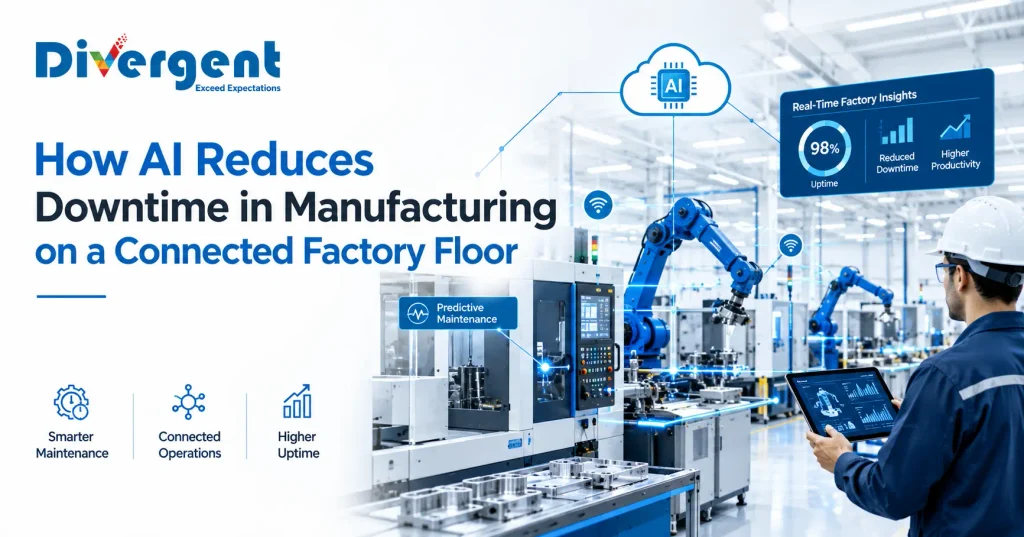
Quick Answer: AI downtime reduction works by predicting equipment failures before they happen, monitoring machine health in real time through IoT sensors, spotting defects with computer vision, and automating maintenance scheduling. Instead of reacting to breakdowns, manufacturers shift to a predictive model — catching problems days or weeks before a costly, unplanned stoppage.
What Is AI Downtime Reduction in Manufacturing?
AI downtime reduction is the use of machine learning, sensor data, and automation to predict, prevent, and shorten equipment failures on the factory floor. Instead of following a fixed maintenance calendar, AI systems continuously analyze data from vibration sensors, temperature gauges, and production logs to flag abnormal patterns before a breakdown occurs.
This approach is often called predictive maintenance, and it sits inside the broader movement known as Industry 4.0 — the integration of IoT, data analytics, and automation into manufacturing operations. The goal of AI downtime reduction isn’t just fewer breakdowns; it’s a shift from a reactive maintenance culture to a data-driven one where decisions are backed by evidence, not guesswork.
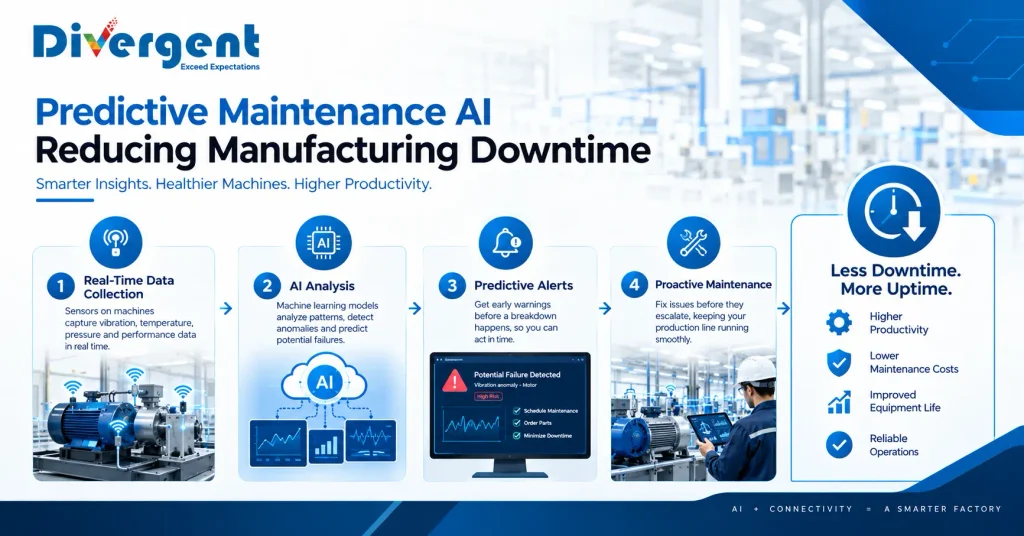
AI downtime reduction data flow from IIoT sensors to analytics dashboardKey Concepts You’ll See Throughout This Guide
• IIoT (Industrial Internet of Things): The network of connected sensors and devices feeding data to AI models.
• MTBF (Mean Time Between Failures): Average operating time between equipment breakdowns.
• MTTR (Mean Time to Repair): Average time needed to fix a failure once it happens.
• OEE (Overall Equipment Effectiveness): A composite score measuring availability, performance, and quality.
• CMMS (Computerized Maintenance Management System): Software that schedules and tracks maintenance work.
Why Manufacturing Downtime Costs More Than You Think
Most plant managers know downtime is expensive, but the full cost is usually higher than the number that shows up on a maintenance report. Direct repair costs are just the visible part of the iceberg — which is exactly why AI downtime reduction has moved from a nice-to-have to a budget priority.
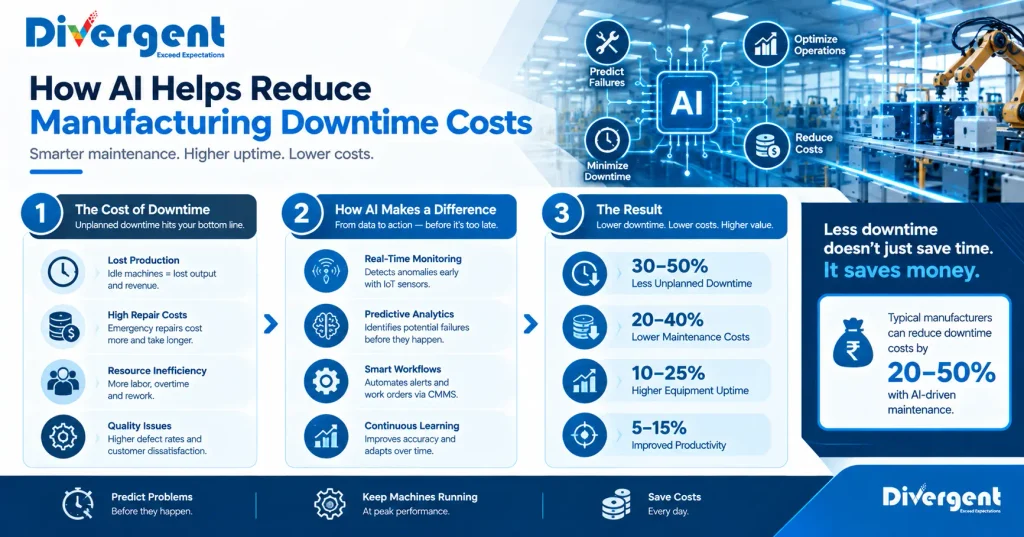
Cost breakdown chart showing hidden losses AI downtime reduction targets
The hidden costs of unplanned downtime include:
- Lost production output and missed delivery deadlines
- Idle labor still being paid during the stoppage
- Overtime pay to catch up once the line restarts
- Rush shipping fees for replacement parts
- Quality issues from restart cycles and reworked batches
- Damaged customer trust from delayed orders
- Increased safety risk during emergency repairs
Industry research from groups like Deloitte and the World Economic Forum has repeatedly pointed to unplanned downtime as one of the largest hidden line items in manufacturing operating budgets — frequently cited in the range of tens of billions of dollars annually across the sector globally. Even a modest cut in downtime frequency translates directly into measurable margin improvement, which is why predictive maintenance AI has become a board-level conversation rather than just an IT initiative.
How AI Downtime Reduction Works: 7 Core Technologies
AI downtime reduction happens through several connected technologies working together — not a single magic algorithm. Here’s how each piece contributes.
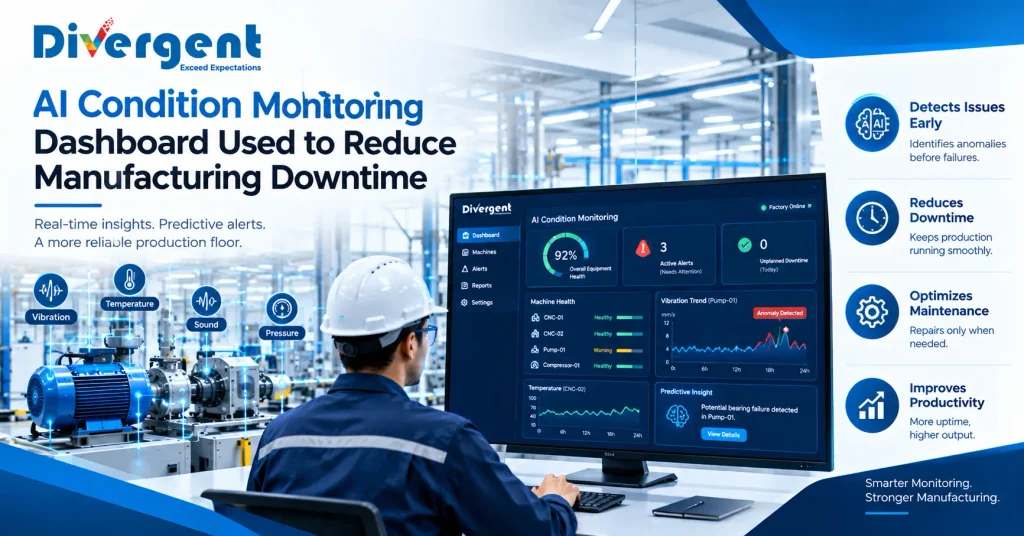
Technician reviewing an AI downtime reduction condition-monitoring alert
1. Predictive Maintenance AI
Predictive maintenance AI models are trained on historical sensor and failure data to recognize the subtle patterns that precede a breakdown — a slight rise in motor temperature, a shift in vibration frequency, or a change in current draw. Once trained, the model scores equipment health continuously and alerts maintenance teams days or weeks before a failure, not after. This is the engine behind most predictive maintenance software deployments.
2. Real-Time Condition Monitoring (IoT + AI)
IIoT sensors attached to motors, pumps, bearings, and compressors stream live data to an AI platform. Instead of a technician manually inspecting each machine on a schedule, the system watches every connected asset around the clock and flags anomalies the moment they appear.
3. Computer Vision for Defect and Anomaly Detection
Cameras paired with computer vision models catch physical defects, misalignments, or wear patterns that lead to failure — often faster and more consistently than a human inspector working a long shift. This is especially valuable on high-speed lines where visual inspection at human speed isn’t practical.
4. Digital Twins and Simulation
A digital twin is a virtual replica of a machine or production line, continuously updated with live data. Engineers can simulate “what if” scenarios — like running a machine at higher speed — to see the projected wear impact before making the change on the physical equipment.
5. AI-Powered Root Cause Analysis
When a failure does happen, AI can sift through thousands of data points across sensors, maintenance logs, and production parameters to identify the actual root cause faster than manual investigation, helping teams fix the real problem instead of a symptom.
6. Automated Maintenance Scheduling
AI integrates with CMMS platforms to automatically generate work orders, order parts, and schedule technicians based on predicted failure windows — closing the gap between “we found a problem” and “it’s fixed.”
7. Continuous Model Retraining
The seventh piece is the one most teams skip: feeding validated outcomes back into the model. Every confirmed or disputed alert becomes labeled training data, and this feedback loop is what separates a stalled pilot from durable AI downtime reduction.
Step-by-Step: Implementing AI Downtime Reduction in Your Plant
Rolling out AI downtime reduction works best as a phased process rather than a single big-bang deployment.
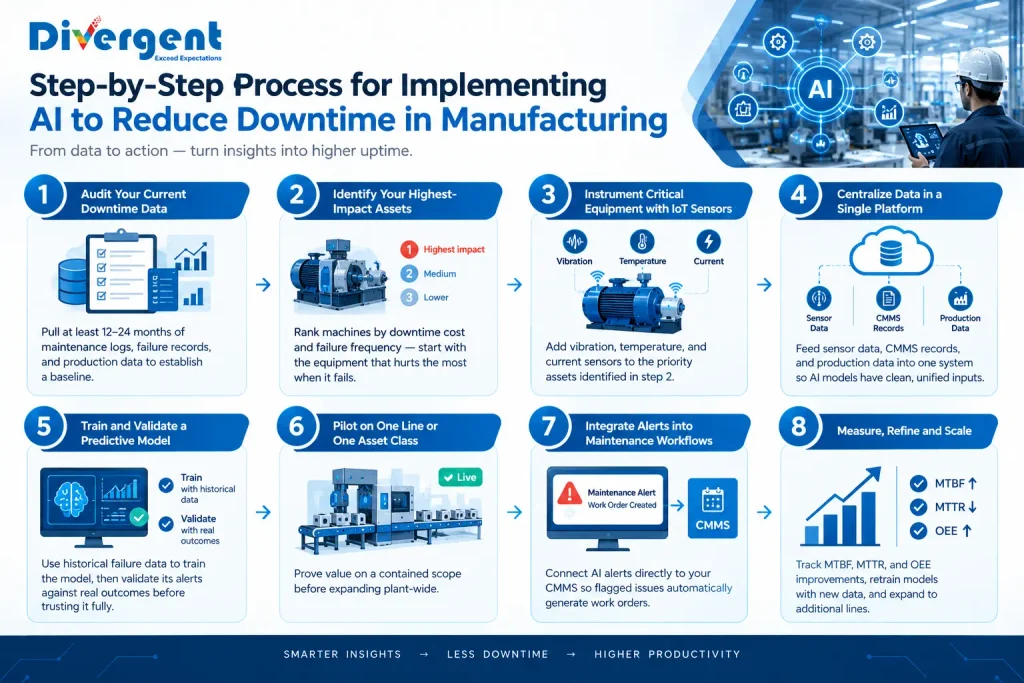
AI downtime reduction implementation flow from data audit to plant-wide rollout
- Audit your current downtime data. Pull at least 12–24 months of maintenance logs, failure records, and production data to establish a baseline.
- Identify your highest-impact assets. Rank machines by downtime cost and failure frequency — start with the equipment that hurts the most when it fails.
- Instrument critical equipment with IoT sensors. Add vibration, temperature, and current sensors to the priority assets identified in step 2.
- Centralize data in a single platform. Feed sensor data, CMMS records, and production data into one system so AI models have clean, unified inputs.
- Train and validate a predictive model. Use historical failure data to train the model, then validate its alerts against real outcomes before trusting it fully.
- Pilot on one line or one asset class. Prove value on a contained scope before expanding plant-wide.
- Integrate alerts into maintenance workflows. Connect AI alerts directly to your CMMS so flagged issues automatically generate work orders.
- Measure, refine, and scale. Track MTBF, MTTR, and OEE improvements, retrain models with new data, and expand to additional lines.
Data Sources Your AI Model Will Need
Vibration and acoustic sensors, temperature and thermal imaging, current and power draw, historical maintenance logs, production throughput data, and environmental conditions (humidity, dust, ambient temperature) all feed a stronger predictive model.
Implementation Timeline: How Fast Can You See Results?
A focused AI downtime reduction pilot on one production line typically takes 8–14 weeks from sensor installation to a validated predictive model, with plant-wide rollout following over the next two to three quarters depending on the number of asset classes involved.
Benefits of AI Downtime Reduction
- Fewer unplanned stoppages — problems are caught before they escalate into full failures
- Lower maintenance costs — repairs happen on your terms, not in an emergency
- Extended equipment lifespan — parts are replaced based on actual condition, not a rigid calendar
- Improved OEE and throughput — more productive hours per shift
- Better resource planning — maintenance teams and parts inventory align with predicted needs
- Stronger safety outcomes — fewer emergency repairs performed under time pressure
- Data-backed capital planning — clearer visibility into which machines need replacement vs. repair
These are the same outcomes we track across our own manufacturing case studies.Common Challenges When Adopting AI Downtime Reduction
- Data quality gaps. Many plants have inconsistent or incomplete historical maintenance records, which weakens model accuracy at the start.
- Legacy equipment. Older machines may lack the sensors or connectivity needed for real-time monitoring without retrofitting.
- Integration complexity. Connecting AI platforms to existing SCADA, PLC, and CMMS systems takes careful planning — often best handled with an experienced custom software development team.
- Change management. Maintenance teams accustomed to scheduled checklists need training and trust-building before relying on AI alerts.
- Upfront investment. Sensors, platform licensing, and integration work require budget commitment before ROI materializes.
Common Mistakes to Avoid
- Trying to instrument every machine in the plant at once instead of starting with high-impact assets
- Deploying a predictive model without validating its alerts against real-world outcomes first
- Ignoring the maintenance team’s input on which failure modes matter most
- Treating AI downtime reduction as a “set and forget” tool instead of retraining models as conditions change
- Skipping the CMMS integration step, leaving alerts stuck in a dashboard nobody checks in time
Best Practices for Long-Term Success
Long-term success usually depends less on the algorithm and more on process discipline — many manufacturers get there faster by working with an Industry 4.0 consulting partner alongside their internal team.
- Start with a narrow, well-defined pilot and prove ROI before scaling
- Keep maintenance technicians involved in reviewing and validating AI alerts
- Standardize how failure data is logged so future models keep improving
- Review model performance quarterly and retrain as equipment or processes change
- Align AI downtime reduction KPIs (MTBF, MTTR, OEE) with leadership reporting so the initiative stays funded
Expert Tips From the Field
Teams that get the most value from predictive maintenance AI treat it as an ongoing partnership between data science and the maintenance floor, not a one-time software install. A few patterns that work consistently in custom AI and IoT engineering projects:
Don’t over-index on a single sensor type; combining vibration, thermal, and current data catches failure modes that any one signal alone would miss
Pair every AI alert with a clear, documented action — an alert with no defined next step just becomes noise
Start model training with your worst-performing equipment class; it’s where the signal is strongest and ROI shows up fastest
Build a feedback loop where technicians confirm or dispute an alert’s accuracy — this labeled data dramatically improves model precision over time
Real-World Examples
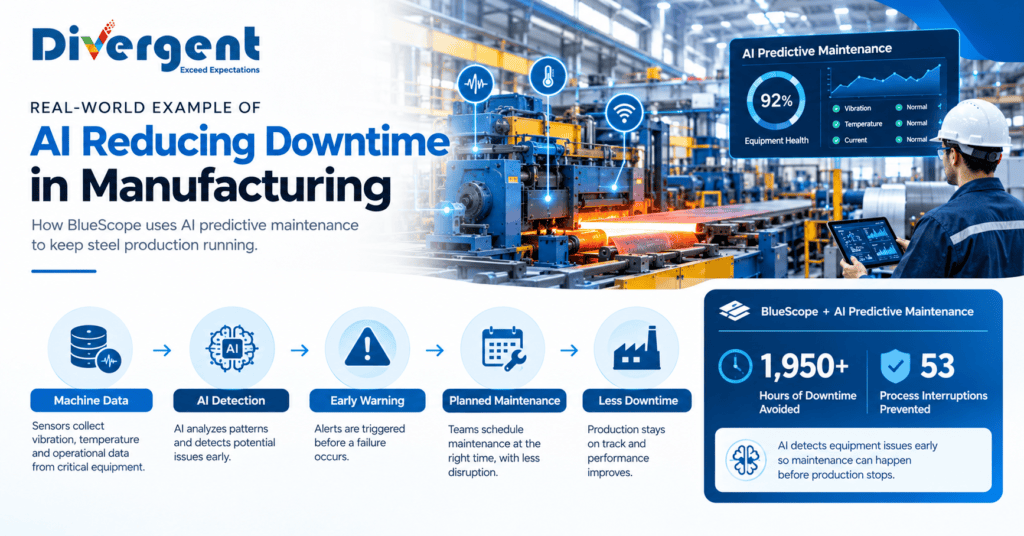
Comparison of preventive maintenance and AI downtime reduction approaches
Automotive Manufacturing Example
A mid-size automotive components plant instrumented its stamping presses with vibration and current sensors. Within the first two quarters, predictive alerts let the maintenance team schedule bearing replacements during planned downtime windows instead of mid-shift, cutting unplanned press stoppages significantly.
Food and Beverage Production Example
A packaging line prone to conveyor motor failures added AI-based condition monitoring. The system flagged early bearing wear weeks before failure, letting the plant order replacement parts in advance and avoid rush shipping and emergency labor costs.
Discrete Electronics Manufacturing Example
A contract electronics manufacturer used computer vision on a high-speed pick-and-place line to catch component placement drift before it caused a full line stop for recalibration, reducing quality-related micro-stoppages.
These examples reflect common, representative outcomes seen across AI downtime reduction deployments rather than a single named case study.
Traditional Maintenance vs. AI-Driven Maintenance
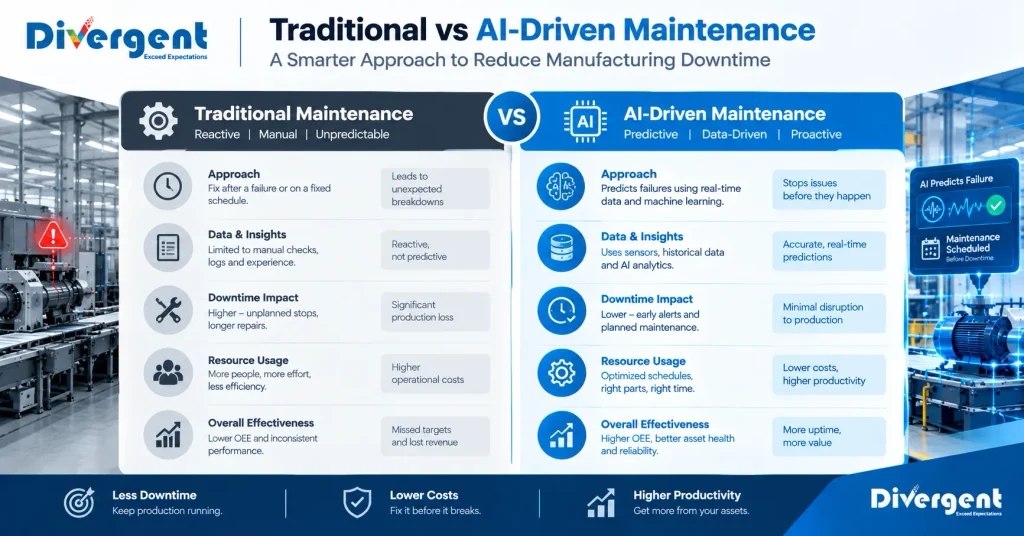
Side-by-side maintenance approach comparison
| Factor | Traditional (Preventive) Maintenance | AI-Driven (Predictive) Maintenance |
| Trigger for maintenance | Fixed calendar schedule | Actual equipment condition |
| Failure detection timing | After symptoms appear or at scheduled check | Days/weeks before failure |
| Parts replacement | Often replaced early, regardless of condition | Replaced based on real wear data |
| Labor planning | Reactive, often overtime-driven | Planned in advance |
| Data used | Limited, manual logs | Continuous sensor + historical data |
| Typical outcome | Reduced but still frequent breakdowns | Significantly fewer unplanned stoppages |
| Scalability | Labor-intensive to scale across many assets | Scales with connected sensors and data pipelines |
Downtime Reduction Readiness Checklist
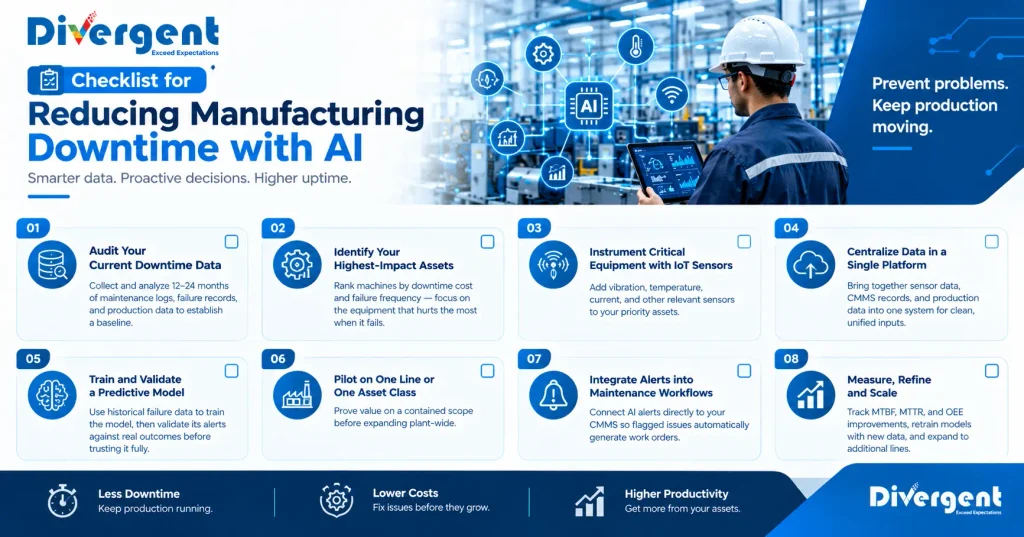
AI downtime reduction readiness checklist before starting a pilot
- 12+ months of historical maintenance and failure data available
- High-impact, high-downtime-cost equipment identified and ranked
- IoT sensor budget approved for priority assets
- CMMS or maintenance software in place (or planned) for integration
- Maintenance team briefed and involved in the pilot design
- Clear KPIs defined (MTBF, MTTR, OEE) before launch
- Pilot scope limited to one line or asset class
- Plan in place to retrain and refine the model post-pilot
Choosing the Right AI Implementation Partner
Not every manufacturer has in-house data science and IoT engineering talent, and that’s usually the biggest bottleneck to getting started with AI downtime reduction. When evaluating a partner, look for a team that can demonstrate:
- Experience integrating AI models with real plant-floor systems (SCADA, PLC, CMMS) — not just building models in isolation
- A phased implementation approach that proves value on a pilot before asking for a plant-wide commitment
- Custom software development capability, since most manufacturing environments need tailored dashboards and integrations rather than an off-the-shelf fit
- Transparent reporting on model accuracy and ongoing retraining, not a “set it and forget it” handoff
At Divergent Software Labs, our engineering teams build custom AI development and IoT solutions for manufacturing that integrate with existing plant infrastructure rather than bolting a generic dashboard on top of it. We follow the same phased, pilot-first approach outlined above on every engagement.
Frequently Asked Questions
How does AI downtime reduction work in manufacturing?
AI downtime reduction works by analyzing sensor and historical data to predict equipment failures before they happen, allowing maintenance teams to fix problems during planned downtime instead of reacting to a breakdown.
What is predictive maintenance AI?
Predictive maintenance AI is a machine learning system that continuously monitors equipment condition data — like vibration, temperature, and current — to forecast when a failure is likely, rather than relying on a fixed maintenance calendar.
How much does AI-based predictive maintenance cost to implement?
Costs vary widely based on the number of assets, sensor types needed, and integration complexity, but most manufacturers start with a scoped pilot on a handful of high-impact machines before committing to plant-wide rollout.
What sensors are needed for AI downtime reduction?
Common sensors include vibration sensors, thermal/temperature sensors, current and power draw meters, and acoustic sensors, depending on the type of equipment being monitored.
Can AI predictive maintenance work with older, legacy equipment?
Yes, though legacy machines often need retrofitted sensors and connectivity hardware since they weren’t originally built with IoT monitoring in mind.
What’s the difference between preventive and predictive maintenance?
Preventive maintenance follows a fixed schedule regardless of equipment condition, while predictive maintenance uses real-time data to trigger maintenance only when actual wear indicators justify it.
How long does it take to see ROI from AI downtime reduction?
Many pilots show measurable improvement within 8–14 weeks, though full ROI depends on how many high-cost assets are included and how quickly the model is validated and trusted.
Does AI replace maintenance technicians?
No — AI surfaces earlier, more accurate warnings, but technicians still perform the diagnosis, repair, and validation work. AI makes their time more targeted, not obsolete.
What industries benefit most from AI downtime reduction?
Automotive, food and beverage, electronics, heavy equipment, and process manufacturing (chemicals, pharmaceuticals) all see strong results due to high equipment utilization and costly stoppages.
What is a digital twin, and how does it relate to downtime reduction?
A digital twin is a live virtual model of a machine or production line that mirrors real-world data, allowing engineers to simulate scenarios and test changes without risking the physical equipment.
How accurate are AI failure predictions?
Accuracy improves over time as models are trained on more validated data. Well-tuned models in mature deployments can achieve high precision, but early-stage models should always be validated against real outcomes before being fully trusted.
What data do I need before starting an AI downtime reduction project?
At minimum, 12–24 months of maintenance and failure logs, along with production data, gives a model enough history to start identifying meaningful patterns.
Is AI downtime reduction only for large manufacturers?
No — small and mid-size manufacturers can start with a scoped pilot on their highest-cost equipment rather than a full-plant deployment, making the entry point far more accessible than it used to be.
Conclusion
AI downtime reduction ultimately comes down to one shift: turning maintenance from a reactive, calendar-driven task into a proactive, data-driven discipline. Downtime will always be a risk in manufacturing, but it doesn’t have to be an unpredictable one — catching failures before they happen, cutting repair costs, and keeping production running on your terms.
The manufacturers seeing the biggest gains from AI downtime reduction aren’t the ones with the most sensors; they’re the ones who started with a focused pilot, proved the ROI, and scaled deliberately from there.
If you’re ready to explore what this could look like on your production floor, talk to our engineering team about a scoped predictive maintenance pilot built around your actual equipment data.