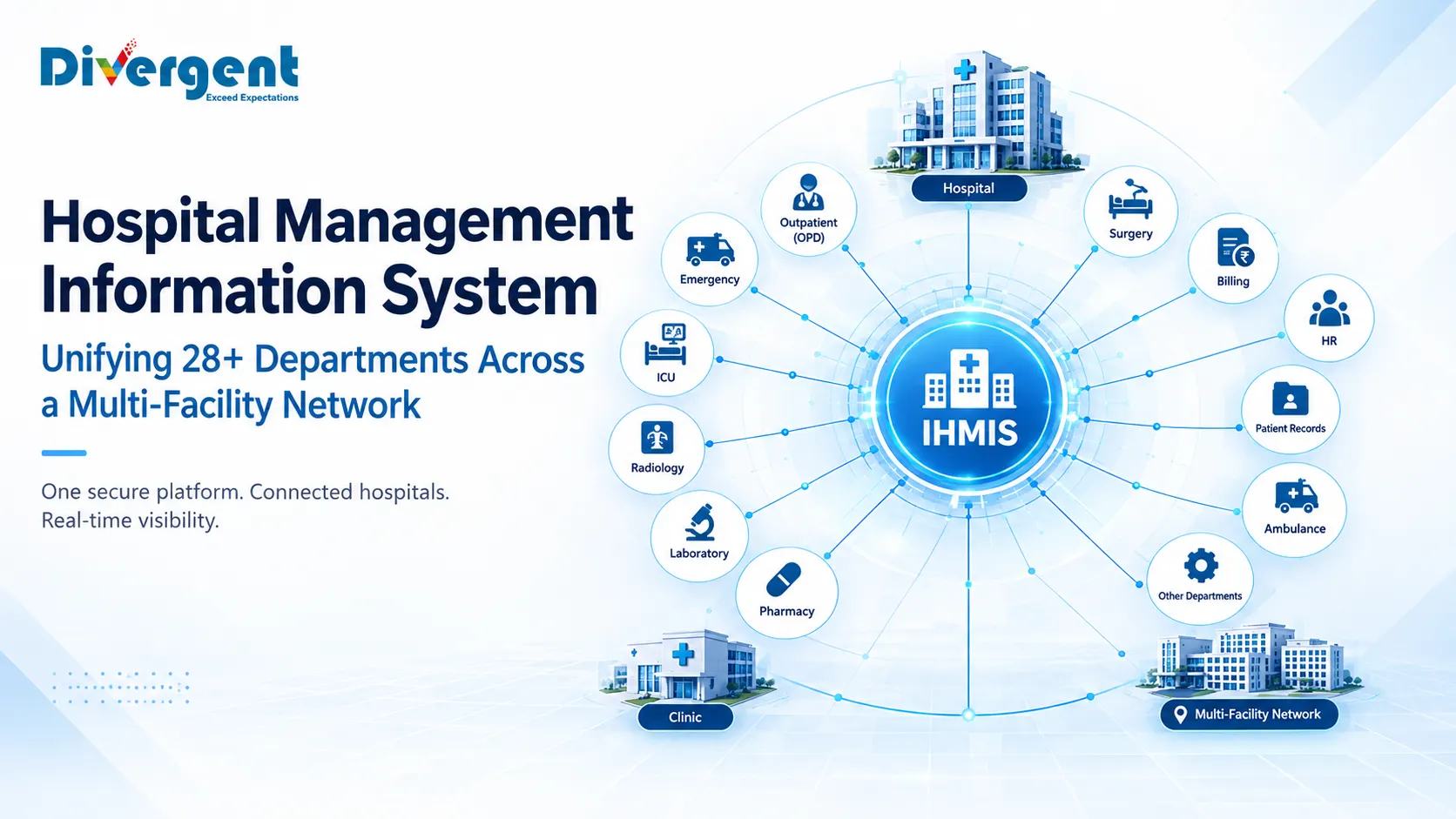
A hospital management information system turns scattered, facility-bound records into one record every site can see. Divergent Software Labs built one for a government hospital network in Uganda, spanning [N] hospitals and clinical facilities — putting more than 28 clinical and administrative units on a single platform, so a patient’s information follows them from the front desk to discharge.
Project snapshot
| Industry | Healthcare — public sector |
| Client type | Government hospital network |
| Solution | Integrated Health Management Information System (IHMIS) |
| Project type | Custom healthcare software development |
| Scope | 28+ clinical and administrative units on one platform |
| Coverage | Registration, OPD, emergency, surgery, maternity, ICU, discharge |
| Security | Role-based access, audit trails, encrypted communication |
| Developer | Divergent Software Labs Pvt. Ltd. |
About the client
The client is a government hospital network in Uganda, running several public hospitals and clinical facilities as one system. Together they cover the full span of care — outpatient clinics, emergency departments, surgical theatres, maternity and intensive care — and patients cross between these sites as their treatment moves through different stages.
In a public network of this size, the record is the operation. A patient registered at one site may be admitted, operated on and sent home across half a dozen departments, and every handoff turns on one thing: does the next clinician have the right information in front of them? For this network, that information lived on paper, inside individual buildings — which is where the project began. Client name and exact size are not publicly disclosed.
The business challenge
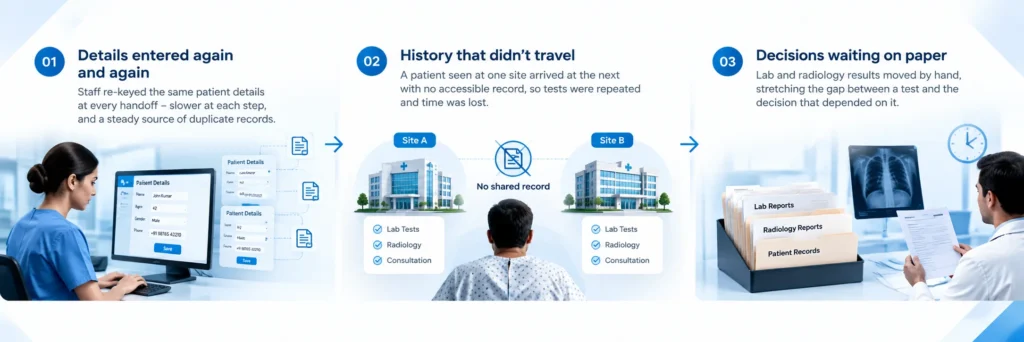
The network relied on fragmented and largely manual processes, which made sharing patient information across departments and facilities difficult. One root cause produced three connected problems.
Project objectives
- Centralise patient records so one record is shared across every facility in the network.
- Connect more than 28 clinical and administrative units on a single platform.
- Support the complete patient journey, from registration through discharge, without breaks between departments.
- Give administrators and clinicians real-time visibility into operations and patient information.
- Protect patient data through role-based access, audit trails and encrypted communication.
- Provide an architecture that scales across facilities while keeping data centrally consistent.
Our approach to the hospital management information system
The available source documents the delivered system rather than the internal methodology, so this section stays at the level the source supports and invents no stages or durations.
The work centred on replacing facility-bound, manual record-keeping with a unified digital ecosystem. That meant mapping the full patient journey — registration, outpatient care, emergency, surgery, maternity, ICU and discharge — and connecting the 28+ units that touch that journey into one platform, rather than digitising each department in isolation. Security was treated as part of the design, not an add-on: role-based access, audit trails and encryption were built into how the platform shares data. The architecture was designed around a centralised data repository with distributed access, so each facility can operate on its own while contributing to one shared record. Detailed discovery, testing, training and deployment activities are not publicly disclosed.
The solution
Divergent designed and implemented IHMIS as a unified digital ecosystem covering the operations of the whole network. Rather than a set of separate department tools, this hospital management information system is one platform that a patient’s record moves through.
Multi-facility patient information management
A single patient record is shared across all facilities, so information registered at one site is available at another. This is the foundation the rest of the system relies on.
Clinical modules
Dedicated modules support OPD, ICU, emergency, operation theatre, wards and specialty departments — the settings a patient passes through during a full course of care.
Maternal, child & reproductive health
The platform includes management for maternal, child and reproductive health, covering care pathways specific to these patients.
Immunization tracking
Immunization is tracked with automated reminders, so due and missed doses are surfaced rather than depending on manual follow-up.
Security and access model
Data sharing is governed by three controls working together: role-based access, so staff see only what their role requires; audit trails, recording who accessed records; and encrypted communication. Together these let the network share information widely without losing control of it.
Architecture: centralised repository, distributed access
IHMIS uses a centralised data repository with distributed access. Each facility works independently, while the record itself stays consistent across the network — which is what lets a patient’s information travel between hospitals without living in any single building. This follows the interoperability principle described in the World Health Organization guidance on health information systems.
Before vs after
| Before | After |
|---|---|
| Records locked inside each facility | One patient record shared across all sites |
| Mostly manual processes | Digitised clinical and administrative workflows |
| No common view of a patient’s history | Real-time view for clinicians and administrators |
| Information tied to a single building | Central repository with distributed access |
| Departments working in isolation | 28+ units connected on one platform |
| Ad-hoc data handling | Access control, audit logging and encryption |
Results & business impact
The source describes outcomes qualitatively. No before/after metrics or efficiency percentages are disclosed, so none are presented as fact.
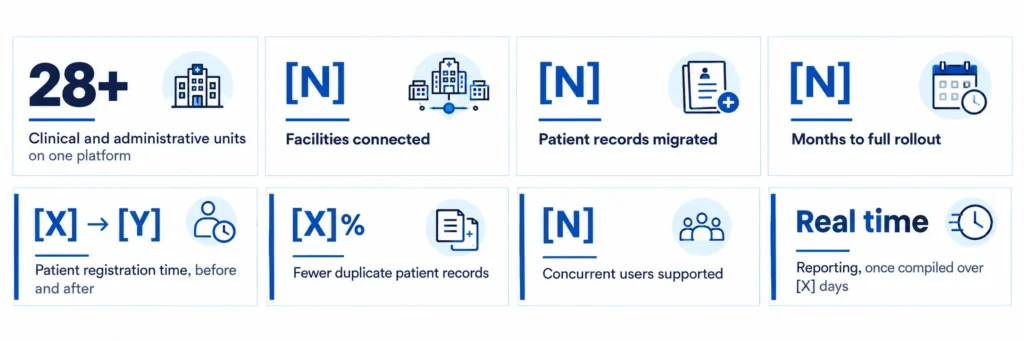
A note on numbers: the cards above are placeholders. Drop in the client’s real figures — registration time, records migrated, users, reporting turnaround — and lead the section with them. Verified numbers are what buyers and AI answer engines quote.
Operational improvements
Digitised workflows and reduced administrative overhead; improved coordination between facilities; timely clinician access to patient information; better continuity of care; and enhanced operational efficiency across the network.
Why this hospital management information system worked
It fixed the record, not just the departments. A single shared record is the thing that makes continuity, visibility and faster decisions possible — digitising each department alone would not have. It carried the whole journey, closing the gaps between departments where information used to stall. Security was built in from the first design session, as it has to be in healthcare. And the central-repository, distributed-access pattern fit how the network actually operates: sites that run independently but can never fall out of sync. It is the same approach we bring to other custom healthcare software projects.
Key takeaways
1. The size of an integration — here, 28+ units — is itself a signal of the complexity handled.
2. In multi-facility healthcare, the biggest win is usually a shared patient record — not digitising one department at a time.
3. Map the full patient journey first; that is where manual handoffs leak information.
4. Access control, audit trails and encryption are foundations of a hospital management information system, not add-ons.
5. A central repository with distributed access keeps facilities independent and consistent at the same time.
Frequently asked questions
What is a hospital management information system?
A hospital management information system (HMIS) is a single platform that centralises patient records, clinical workflows and hospital administration across one or more facilities, replacing separate department-level systems and paper records. In this project it brought more than 28 clinical and administrative units together.
How is an HMIS different from an EMR?
An EMR (electronic medical record) stores a patient’s clinical information. An HMIS is broader — it runs the whole hospital operation, from registration and wards to theatre scheduling and administration, with the clinical record as one part of it. HealthIT.gov covers the distinction in more detail.
How does a hospital unify patient records across multiple facilities?
With a central data repository that every facility reaches and a single patient identity across sites. Each facility works on its own, but the underlying record is shared, so a patient’s history is there wherever they are treated.
What modules did this hospital management information system include?
Multi-facility patient information management; clinical modules for OPD, ICU, emergency, theatre, wards and specialty departments; maternal, child and reproductive health; and immunization tracking with automated reminders.
Is patient data secure in a centralised hospital system?
It rests on three controls working together: role-based access, audit logging of every record opened, and encryption in transit. Standards such as HL7 FHIR support secure exchange between systems.
Can one system work across hospitals in different locations?
Yes. A central repository with distributed access is built for it — facilities in different places share one patient record while each runs independently.