A doctor places an order. A lab runs the test. The result is ready, but the hospital’s system can’t read it.
Somewhere between two healthcare applications, a patient’s information gets stuck. Sometimes it arrives late. Sometimes it arrives incomplete. Sometimes it gets matched to the wrong record.
HL7 integration is how modern healthcare solves this problem. It gives every clinical system a shared language, so orders, results and patient data move safely between applications without manual re-entry.
In this case study, Divergent Software Labs shows how our team built and supported a complete HL7 integration platform on the Corepoint Integration Engine. We cover the architecture, the messages, the validation rules, and how every order and result reached the right place.
Quick Answer: What Did We Build?
We built a central HL7 integration layer on Corepoint that receives, validates, maps, transforms, routes and acknowledges healthcare messages. It exchanges orders (ORM), clinical results (ORU) and acknowledgements (ACK) between independent healthcare applications and external clinical systems.
Project at a Glance
| Item | Detail |
|---|---|
| Industry | Healthcare / Clinical Information Systems |
| Client | [Client name or “Healthcare technology client”] |
| Challenge | Connecting healthcare systems with different data models, identifiers and codes |
| Solution | Hub-based HL7 integration on Corepoint Integration Engine |
| Messages | ORM (orders), ORU (results), ACK (acknowledgements) |
| Segments | PID, PV1, ORC, OBR, DG1, OBX |
| Key strength | Dynamic handling of repeating data and four-level validation |
| Future scope | Localization for multi-country healthcare deployment |
Why This Case Study Matters to You
If your organization runs more than one healthcare application, you already face this challenge. Every new lab, radiology system or partner hospital adds another connection to build and maintain.
This case study shows how a single, well-designed integration hub replaces that complexity, and what it takes to make it reliable in real clinical use.
Key Takeaways
- What we built: An end-to-end HL7 integration layer on Corepoint connecting source healthcare applications with external clinical systems.
- Messages handled: ORM (orders), ORU (clinical results) and ACK (acknowledgements).
- Data covered: Patient (PID), visit (PV1), orders and exams (ORC/OBR), diagnosis and ICD (DG1), and observations (OBX).
- Key strength: Dynamic handling of repeating fields and segments, including automatic OBX creation and sequence numbering.
- Quality: Four-level validation (message, segment, field, component) plus full regression testing.
- Future-ready: A hub architecture that can be localized for new countries without rebuilding the core.
What Is HL7 Integration?
HL7 integration is the process of connecting healthcare software systems so they can exchange clinical and administrative data using the HL7 (Health Level Seven) messaging standard.
Instead of every application learning every other application’s database, each system sends and receives standardized HL7 messages. An integration engine sits in the middle and translates, validates and routes those messages.
The HL7 v2 standard is maintained by HL7 International. It remains one of the most widely used formats for hospital data exchange.
In simple terms, HL7 integration lets an order created in one system appear correctly in another, and lets results travel back without manual re-entry.
The Challenge: Connecting Healthcare Systems That Speak Different Languages
Every healthcare application stores data its own way. One system may identify an examination with one code, while the receiving system expects a completely different one.
Our client needed a reliable way to exchange patient, provider, visit, order, diagnosis, examination and clinical-result information across these systems.
- Different data models: Source and destination systems used different identifiers, codes and structures.
- Variable data volume: Some patients carried several identifiers; some results contained many observations.
- Clinical accuracy: Orders and results had to stay linked to the correct patient and provider.
- Zero tolerance for bad data: Null or invalid values could never pass to connected systems.
- Traceability: When something failed, the team needed to find the exact cause quickly.
Point-to-point connections between every pair of systems would have been fragile and expensive. A central HL7 integration hub was the right answer.
Our HL7 Integration Architecture on Corepoint
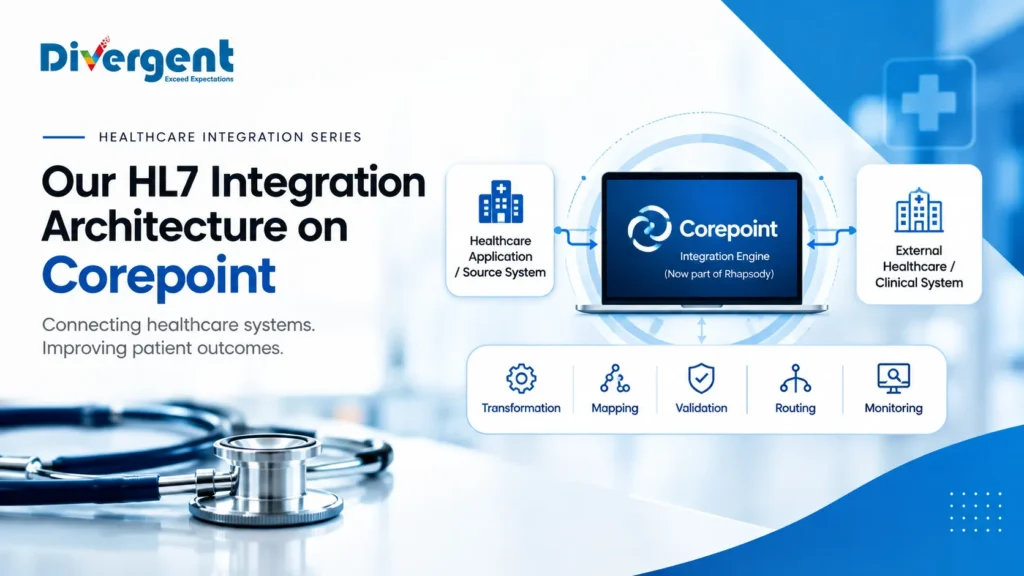
We designed the solution around the Corepoint Integration Engine (now part of Rhapsody) as the central interoperability layer.
Healthcare Application / Source System → HL7 Messaging Layer → Corepoint Integration Engine → Transformation + Mapping + Validation + Routing → External Healthcare / Clinical System
Data also flows in reverse, especially when clinical results return to the originating application.
Within this HL7 integration architecture, Corepoint is responsible for:
- Interface management: Defining how each healthcare application connects and communicates.
- Message transformation: Converting incoming messages into the structure each destination requires.
- Data mapping: Mapping individual fields between source and destination systems.
- Conditional processing: Applying different rules depending on message content.
- Message routing: Sending each message to the right endpoint.
- Validation: Checking messages before they reach downstream applications.
- Monitoring: Tracking message processing so failures are caught early.
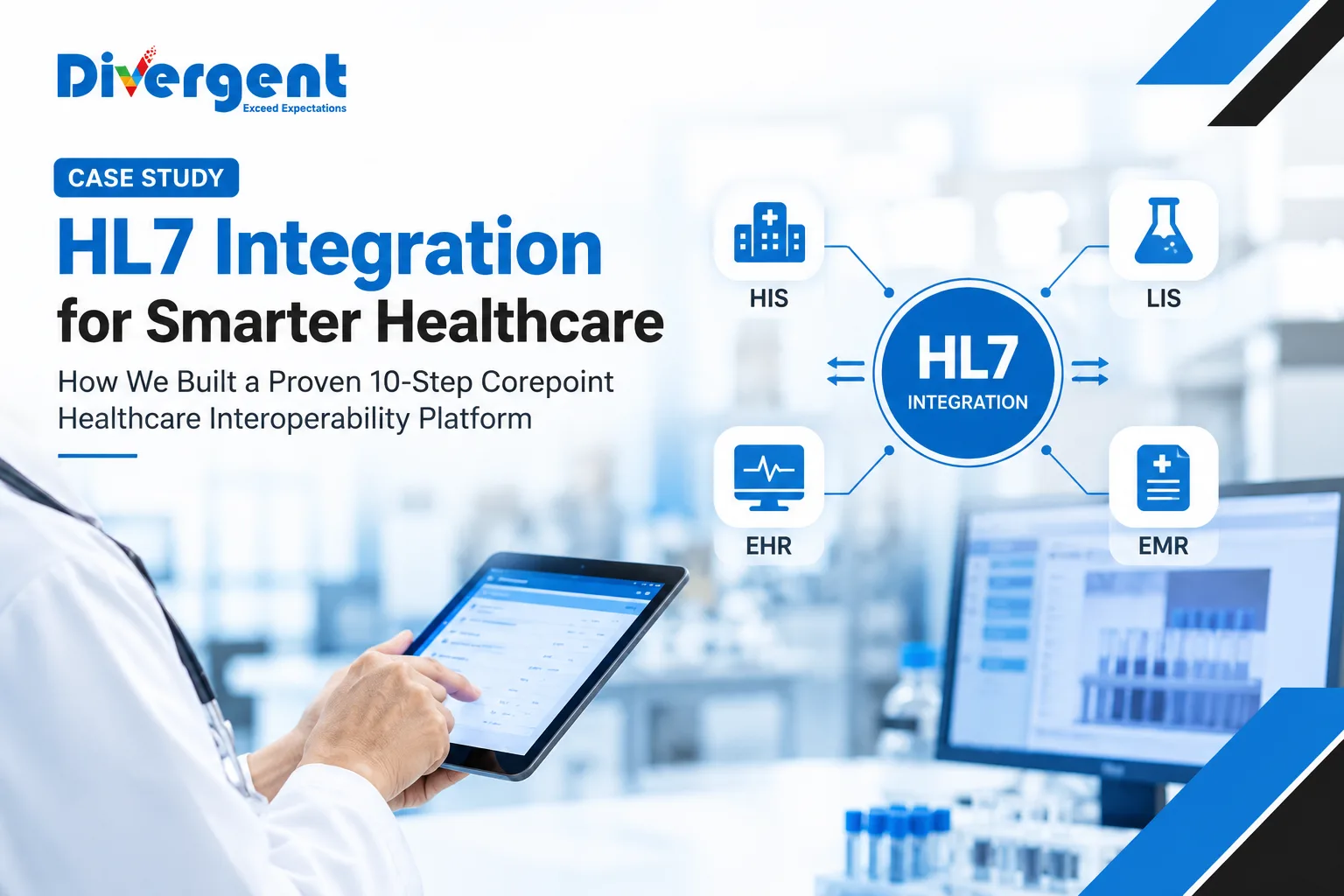
HL7 Integration: A Corepoint healthcare interoperability platform connecting HIS, LIS, EHR, and EMR systems.
We also configured the connectivity layer: integration ports, communication endpoints, provider and interface configuration, connectivity validation and interface associations.
HL7 Message Types in This HL7 Integration Project
Our HL7 integration work focused on three core message types, each with a distinct role in the clinical workflow.
| Message type | Purpose | Key data carried |
|---|---|---|
| ORM (Order) | Sends healthcare orders between systems | Patient, provider, visit, order, diagnosis, examination, order status and identifiers |
| ORU (Result) | Returns clinical observations and results | OBX observations, result values, sequence numbers |
| ACK (Acknowledgement) | Confirms a message was received and processed | Acceptance or error status |
ORM Order Messages
ORM messages let an order created in one healthcare application be sent electronically to another clinical system. They carry the patient, ordering provider, visit context, order status, identifiers, diagnosis and examination descriptions.
ORU Clinical Result Messages
ORU messages carry clinical results back through HL7 OBX segments. Our platform receives results, validates their structure, processes multiple observations and dynamically creates OBX segments.
It also maintains observation sequence numbers, transforms result information, routes results to the correct destination and validates the final outbound result.
ACK Acknowledgement Messages
ACK messages confirm successful delivery and processing. We validate every ACK and use acknowledgement data to identify failed messages or integration problems early.
Segment-Level HL7 Integration: Patient, Visit, Provider, Order and Diagnosis
Strong HL7 integration depends on getting every segment right.
| HL7 segment | Data handled | What we delivered |
|---|---|---|
| PID | Patient identifiers, name, date of birth, gender, contact details | Repeating identifiers supported; null or invalid IDs blocked |
| PV1 | Patient visit and encounter details | Visit context travels with orders |
| ORC / OBR | Order control, status, ordering provider, universal service IDs, exam descriptions, order numbers | Exam mapping between source and destination |
| DG1 | Diagnosis codes, ICD information, descriptions | Outbound diagnosis mapping |
| OBX | Clinical observations and result values | Dynamic segment creation with sequence numbering |
Patient Information (PID)
The platform exchanges patient demographics and identifiers, including multiple identifiers per patient. Invalid or null identifier values are never propagated to connected systems, which protects patient matching downstream.
Provider Information and NPI Mapping
Provider data is mapped and transformed throughout the message, including NPI (National Provider Identifier) data where applicable. Provider information can be traced from source to destination, keeping every order tied to the correct clinician.
Examination Mapping (OBR)
Different systems often describe the same examination differently. Our HL7 integration layer maps examination identifiers, descriptions and universal service identifiers so each destination receives the exam in its expected format.
Diagnosis and ICD Mapping (DG1)
The engine checks that diagnosis data exists in the source message, applies mapping and transformation rules, and delivers the correct diagnosis. This supports ICD-based diagnosis coding.
Dynamic Clinical Data Processing in HL7 Integration
Real clinical data is rarely fixed. One patient may have three identifiers; one lab result may contain twenty observations.
That is why our HL7 integration logic handles dynamic HL7 structures instead of relying only on fixed fields:
- Multiple patient identifiers
- Multiple clinical observations
- Repeating HL7 fields and segments
- Dynamic creation of OBX segments
- Automatic sequence numbering
- Dynamic list updates
- Conditional mapping
This flexibility keeps the platform dependable when data volume changes from patient to patient.
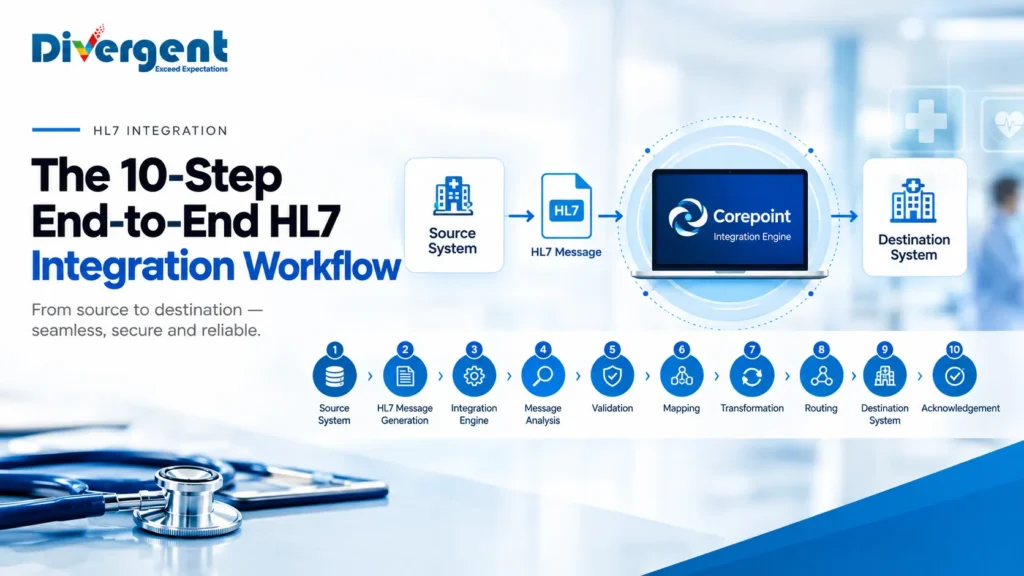
The 10-Step End-to-End HL7 Integration Workflow
Here is how a single transaction, such as a clinical order, moves from source to destination.
- Source System: A healthcare application creates information, such as a clinical order.
- HL7 Message Generation: The information is packaged as an HL7 message.
- Integration Engine: Corepoint receives the message.
- Message Analysis: The engine identifies the message type and relevant segments.
- Validation: Patient, provider, order, diagnosis and other required data is validated.
- Mapping: Source fields are mapped to destination fields.
- Transformation: The message is converted to match destination requirements.
- Routing: The transformed message is sent to the correct destination.
- Destination System: The receiving application processes the information.
- Acknowledgement: An ACK message confirms successful processing.
For clinical results, the flow runs in reverse: External Clinical System → ORU Result → Corepoint → Validation → Result Transformation → OBX Processing → Destination Application.
Four-Level Data Validation Framework
In healthcare, a single wrong value can disrupt care. Every message passes through validation at four levels:
- Message level: The overall HL7 message and message type.
- Segment level: Required and expected segments are present.
- Field level: Individual data elements are correct.
- Component level: Components and subcomponents inside each field are valid.
Validation covers patient identifiers, provider details, visit and order data, examinations, diagnoses, result values, sequence numbers, repeating fields and message control information.
Testing and Regression Framework
No change reaches operational use without testing. Our HL7 integration testing process includes:
- Sending test HL7 messages through the engine
- Validating engine processing and reviewing transformed output
- Comparing expected versus actual output
- Field-level, provider and diagnosis validation
- Repeating-segment and optional/missing-value testing
- Result-message and ACK validation
- Full regression testing after every change
Regression testing matters most when one hub connects many applications. A fix for one interface must never break another.
Production Support: Tracing Every HL7 Integration Issue to Its Root Cause
When an issue is reported, our team traces it step by step:
Reported Issue → Interface → Original HL7 Message → Segment/Field → Transformation Rule → Destination Message → Acknowledgement
This chain lets us classify each problem quickly:
- Source data problems
- Mapping problems
- Transformation problems
- HL7 structural problems
- Configuration problems
- Connectivity problems
- Destination-system problems
Faster classification means faster fixes and less disruption to clinical workflows.
Capabilities Delivered Through This HL7 Integration
The implementation demonstrates 23 working capabilities:
- HL7 healthcare interoperability
- Patient demographic exchange
- Patient identifier management
- Visit information exchange
- Provider information integration
- NPI mapping
- Healthcare order integration
- Examination information integration
- Diagnosis and ICD mapping
- Clinical-result integration
- Dynamic clinical-observation handling
- Message transformation
- Field-level mapping
- Conditional mapping
- Message routing
- Interface configuration
- Integration endpoint management
- Acknowledgement handling
- Integration monitoring
- Message validation
- Production troubleshooting
- Regression testing
- End-to-end source-to-destination traceability
Why a Hub-Based HL7 Integration Beats Point-to-Point
With point-to-point connections, every new system must be wired to every existing system. The number of interfaces grows rapidly, and so does maintenance.
A hub-based HL7 integration model changes this. Each application connects once to the interoperability layer, and the engine handles translation and routing.
- Scalability: New applications plug into the hub instead of into every system.
- Standardization: HL7 provides a common, standards-based language.
- Maintainability: Mapping rules live in one place.
- Lower risk: Validation and monitoring are centralized.
Localizing the HL7 Integration Platform for a New Country
Because the integration layer separates applications from external systems, the architecture suits reuse in another country’s healthcare program. These can be configured or developed locally:
- Healthcare system interfaces and endpoints
- Patient, provider and facility identifier mappings
- Order, examination and diagnosis mappings
- Clinical-result mappings
- Transformation and message-routing rules
Exact localization requirements are confirmed during requirements analysis, since every national health system has its own identifiers and standards.
A Multi-Country HL7 Integration Model
Country Healthcare Systems → Country-Specific Interfaces & Localization → Healthcare Interoperability Layer → HL7 Integration & Transformation Engine → Common Healthcare Platform → External Clinical Systems
The core technology is reused, while country-specific needs are built as configurable components.
Advantages of Reusing a Proven Platform
- Proven knowledge: Our team already understands the full HL7 processing lifecycle.
- Faster implementation: Existing patterns, mappings and troubleshooting know-how carry over.
- Reduced technical risk: Repeating structures, provider mapping, patient identifiers, diagnoses and results are already implemented and tested.
- Easier localization: Country-specific rules fit into configurable interfaces.
- Future growth: The same layer can later extend toward HL7 FHIR APIs as requirements evolve.
For a full-scale hospital system example, see our IHMIS hospital management information system case study.
Technology Stack
| Layer | Technology |
|---|---|
| Integration engine | Corepoint Integration Engine |
| Messaging standard | HL7 v2 (ORM, ORU, ACK) |
| Segments | MSH, PID, PV1, ORC, OBR, DG1, OBX |
| Coding standards | ICD (diagnosis), NPI (provider, where applicable) |
| Practices | Field-level mapping, conditional transformation, four-level validation, regression testing |
FAQs and Call to Action
Build this section with the “FAQ by Rank Math” block, one question per item.
Frequently Asked Questions About HL7 Integration
What is HL7 integration in healthcare?
HL7 integration connects healthcare applications so they can exchange patient, order and result data using the HL7 messaging standard. An integration engine translates and routes messages between systems with different data models.
What is the difference between ORM and ORU messages?
ORM messages send healthcare orders, such as an examination request, from one system to another. ORU messages return the clinical results and observations for those orders, usually inside OBX segments.
What does an HL7 ACK message do?
An ACK message confirms that an HL7 message was received and processed. It helps teams detect failed deliveries and integration errors quickly.
What is the Corepoint Integration Engine used for?
Corepoint is a healthcare integration engine that receives, validates, transforms, maps, routes and monitors HL7 messages. It acts as the central hub of the interoperability layer.
How do you handle repeating data in HL7 integration?
We use dynamic processing that supports repeating fields and segments, multiple patient identifiers, dynamic OBX creation and automatic sequence numbering.
Can an HL7 integration platform be reused in another country?
Yes. Because the integration layer is separated from individual applications, it can be localized with country-specific interfaces, identifiers, mappings and routing rules without rebuilding the core.
How long does an HL7 integration project take?
Timelines depend on the number of interfaces, message types and mapping rules. Reusing a proven platform shortens delivery because core patterns are already built and tested.
Build Your HL7 Integration with Divergent Software Labs
Whether you need to connect a lab, a radiology system or an entire national health network, Divergent Software Labs brings hands-on HL7 integration experience from design to production support.
Explore our healthcare software development services or contact our team to discuss your interoperability project.