What Are the Types of FIBC Bags?
The main types of FIBC bags are Type A, Type B, Type C and Type D, grouped by how they handle static electricity. FIBC bags are also classified by construction, lifting loops, filling and discharge style, safety factor and special use, such as food grade and UN certified bags.
That’s the short answer. The longer one matters more, because picking the wrong bag isn’t a small mistake. Put a flammable powder in a Type A bag and you’ve created a fire risk. Ship sugar in a non-food-grade bag and your customer’s auditor can reject the whole load.
We’ve sorted all the types of FIBC bags into seven clear categories below. Each section opens with a quick answer, then gives you the detail you need to make the right call.
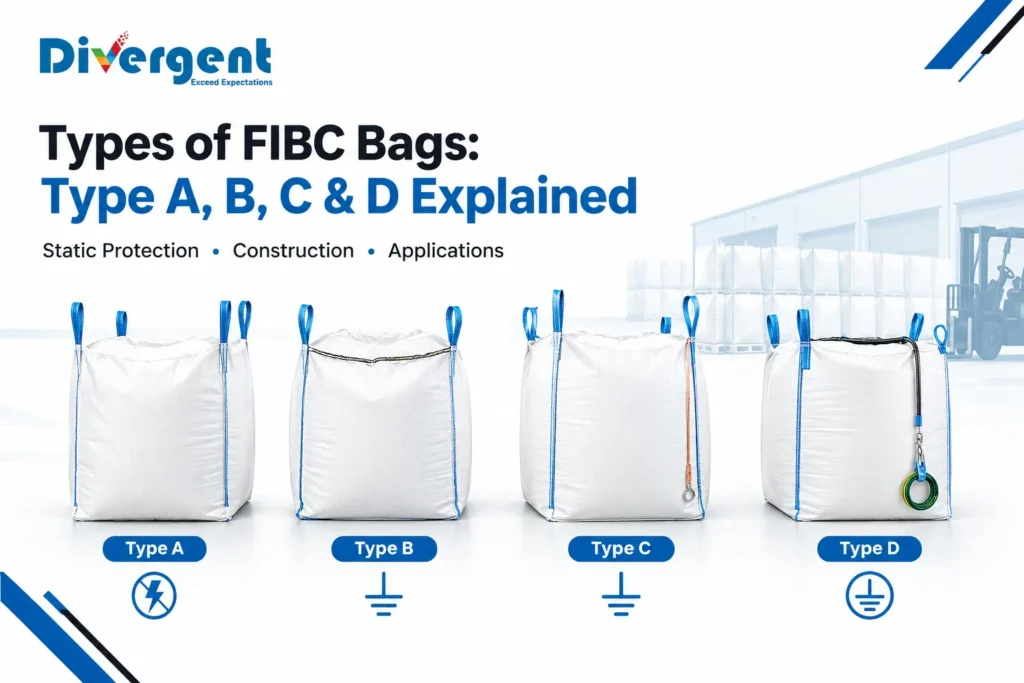
Table of Contents
1.What is an FIBC bag?
2. Type A, B, C and D FIBC bags
3. Types by construction
4. Types by lifting loops
5. Types by filling and discharge
6. Single-trip vs. multi-trip bags
7. Special types of FIBC bags
8. Which bag suits your industry?
9. Common buying mistakes
10. How to choose the right bag
11. For FIBC manufacturers
12. FAQs
What Is an FIBC Bag?
An FIBC bag is a large, flexible container made from woven polypropylene that holds 500 to 2,000 kg of dry, flowable product. FIBC stands for Flexible Intermediate Bulk Container. Most people in the trade simply call it a jumbo bag, bulk bag, big bag or super sack.
Think of it as a sack the size of a pallet. Empty, a standard one-tonne bag weighs only a few kilograms and folds flat. Full, it carries a tonne of cement or grain, and a forklift moves it in seconds.
That mix of strength and low weight is why FIBCs replaced drums and small sacks in so many industries. For a general overview, see Wikipedia’s page on flexible intermediate bulk containers.
Where you’ll find FIBC bags:
- Agriculture: grain, seeds, animal feed and fertilizer
- Construction: cement, sand and aggregates
- Chemicals and mining: powders, pellets, resins and ores
- Food and pharma: sugar, flour, starch and milk powder
- Recycling: plastic scrap and industrial waste
Every bag starts the same way. PP granules are extruded into tapes, woven into fabric, then cut, printed and stitched. The differences between the types of FIBC bags come from the choices made at each of those steps. Our guide to the FIBC manufacturing process walks through every stage.
What Are the 4 Electrostatic Types of FIBC Bags?
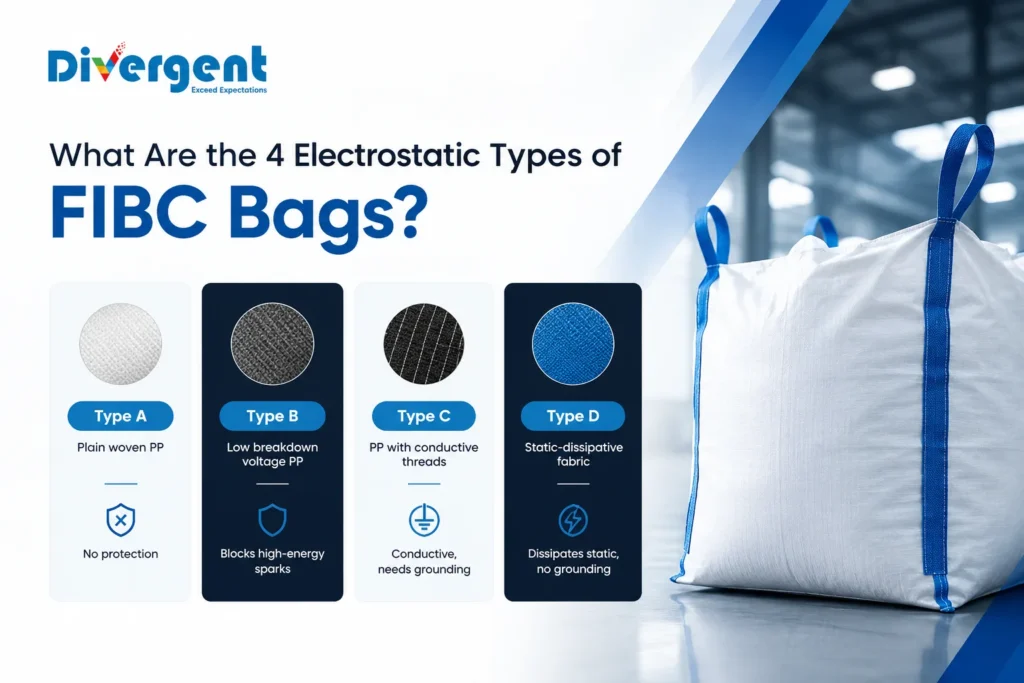
The four electrostatic types of FIBC bags are Type A (no protection), Type B (blocks high-energy sparks), Type C (conductive, must be grounded) and Type D (dissipates static without grounding). This is the most important classification, because it decides whether a bag is safe near flammable dust or vapour.
Here’s why static matters. When powder pours into a bag, friction charges both the product and the fabric. In a dusty area, a single spark from that charge can ignite the air.
The four types are defined in the international standard IEC 61340-4-4. Industry bodies such as FIBCA, the Flexible Intermediate Bulk Container Association, publish guidance on using them safely.
| Type | Fabric | Grounding needed | Flammable powders | Flammable atmosphere | Typical uses |
|---|---|---|---|---|---|
| Type A | Plain woven PP | No | Not safe | Not safe | Sand, gravel, cement |
| Type B | Low breakdown voltage PP | No | Safe (dry powders) | Not safe | Dry flammable powders |
| Type C | PP with conductive threads | Yes, always | Safe | Safe when grounded | Chemicals, pharma |
| Type D | Static-dissipative fabric | No | Safe | Safe | Flammable powders, solvent areas |
What Is a Type A FIBC Bag?
A Type A bag is plain woven polypropylene with no static protection at all. It’s the cheapest option, and it does the job well for sand, gravel, cement and other non-flammable products.
The rule is simple. Never use Type A where flammable dust, gas or solvent vapour could be present, not even “just this once”.
What Is a Type B FIBC Bag?
A Type B bag uses fabric with a low breakdown voltage, under 6 kV. This stops the dangerous high-energy sparks known as propagating brush discharges.
It doesn’t remove static, though. Type B bags are fine for dry flammable powders, but only when there’s no flammable gas or vapour around the bag.
What Is a Type C FIBC Bag?
A Type C bag has conductive threads woven through the fabric in a grid. These threads carry static charge down to earth through a grounding clip while the bag is filled and emptied.
Here’s the catch. If an operator forgets to clip on the ground wire, a Type C bag gives no more protection than Type A. That’s why plants using Type C bags train operators hard and check grounding on every fill.
What Is a Type D FIBC Bag?
A Type D bag is made from static-dissipative fabric that releases charge safely into the air. No grounding is needed.
Among the four electrostatic types of FIBC bags, Type D is the most forgiving. It costs more than Type A or B, but it removes the human-error risk of a forgotten ground clip. Many chemical and pharma buyers now prefer it for that reason alone.
Every anti-static bag has to be tested to prove it works. Our guide to the ISO 21898 FIBC testing standard explains what those tests involve.
What Are the Types of FIBC Bags by Construction?
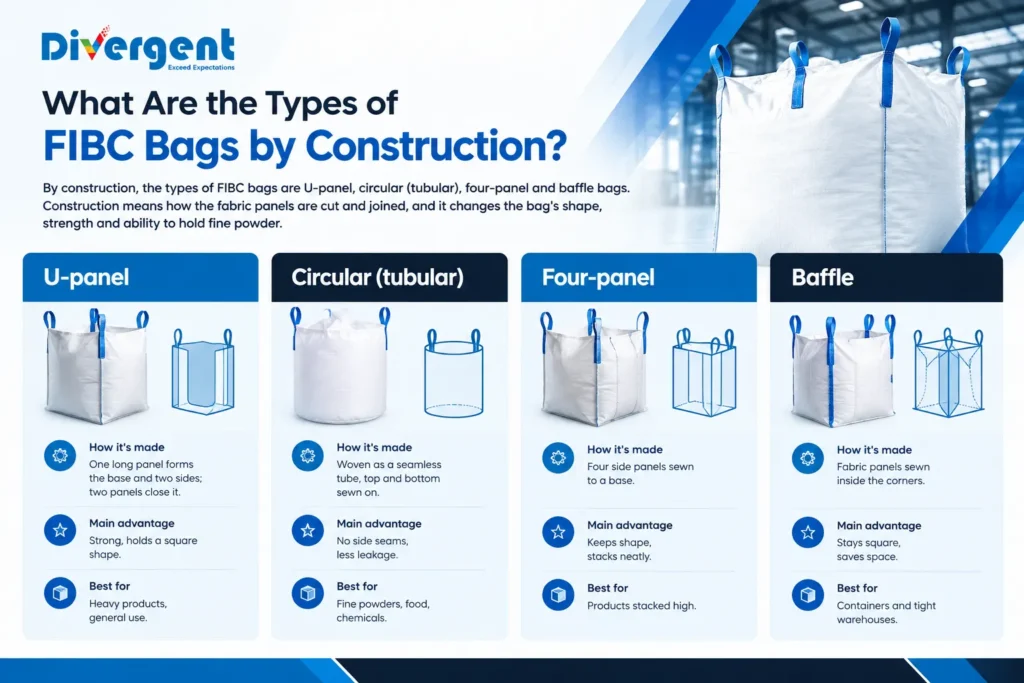
By construction, the types of FIBC bags are U-panel, circular (tubular), four-panel and baffle bags. Construction means how the fabric panels are cut and joined, and it changes the bag’s shape, strength and ability to hold fine powder.
| Construction | How it’s made | Main advantage | Best for |
|---|---|---|---|
| U-panel | One long panel forms the base and two sides; two panels close it | Strong, holds a square shape | Heavy products, general use |
| Circular (tubular) | Woven as a seamless tube, top and bottom sewn on | No side seams, less leakage | Fine powders, food, chemicals |
| Four-panel | Four side panels sewn to a base | Keeps shape, stacks neatly | Products stacked high |
| Baffle | Fabric panels sewn inside the corners | Stays square, saves space | Containers and tight warehouses |
U-Panel Bags
U-panel bags are the workhorse of the industry. One long panel runs up one side, across the base and down the other, so the load rests on a single continuous piece of fabric. They’re strong, simple to make and hold a squarer shape than circular bags.
Circular (Tubular) Bags
Circular bags are woven as a seamless tube on a circular loom. No side seams means fewer places for fine powder to escape. That’s why you’ll see them so often in food ingredients and chemical powders.
Four-Panel Bags
Four-panel bags join four separate side panels to a base. They keep their shape well when full and stack neatly. The extra stitching adds a little to production cost.
Baffle Bags
Baffle bags have fabric panels sewn inside each corner. The baffles stop the bag from bulging into a round shape as it fills.
A square bag packs tighter, so you fit more product into the same truck, container or warehouse, often around 25–30% more (approximate). Want the full comparison? Read baffle bags vs U-panel vs circular FIBC.
Which Types of FIBC Bags Are Based on Lifting Loops?
Based on lifting loops, the types of FIBC bags are single loop, two loop, four loop (cross-corner or side-seam) and tunnel lift bags. Pick the loop style that matches your forklift, crane or hoist.
| Loop type | What it looks like | Best for |
|---|---|---|
| Single loop | One loop formed from the bag’s own body fabric | Fertilizer and grain, fast crane handling |
| Two loop | Two loops formed from the body fabric | Agriculture and minerals |
| Four loop, cross-corner | A loop sewn across each corner | Forklift handling, the most common style |
| Four loop, side-seam | A loop sewn along each side seam | Heavy loads |
| Tunnel lift | Two fabric sleeves along the top | Forklift tines slide straight through |
Single and two loop bags shine in high-volume work like fertilizer and grain, because one person can hook them onto a crane without climbing up. Four loop bags sit more steadily on forklift tines, which is why they’re the default in most warehouses.
What Types of FIBC Bags Are There for Filling and Discharge?
For filling, FIBC bags come with an open top, duffle (skirt) top, fill spout top or conical top. For discharge, they come with a flat bottom, discharge spout, full-open (dump) bottom or conical bottom.
Matching the right top and bottom to your equipment saves time and cuts spillage.
Top options for filling
| Top style | How it works | Best for |
|---|---|---|
| Open top | Fully open, no closure | Large or lumpy items, manual loading |
| Duffle top | A fabric skirt tied closed after filling | Bulky products, wide filling chutes |
| Fill spout top | A narrow tube tied closed after filling | Powders and granules, less dust |
| Conical top | A cone-shaped top with a spout | Filling to maximum capacity |
Bottom options for discharge
| Bottom style | How it works | Best for |
|---|---|---|
| Flat bottom | Closed base, no outlet | Single use; contents cut out or tipped |
| Discharge spout | A tube in the base that you untie to empty | Controlled flow of powders and granules |
| Full-open (dump) bottom | The whole base opens at once | Fast emptying of free-flowing products |
| Conical bottom | Cone-shaped base with a spout | Sticky powders that don’t flow easily |
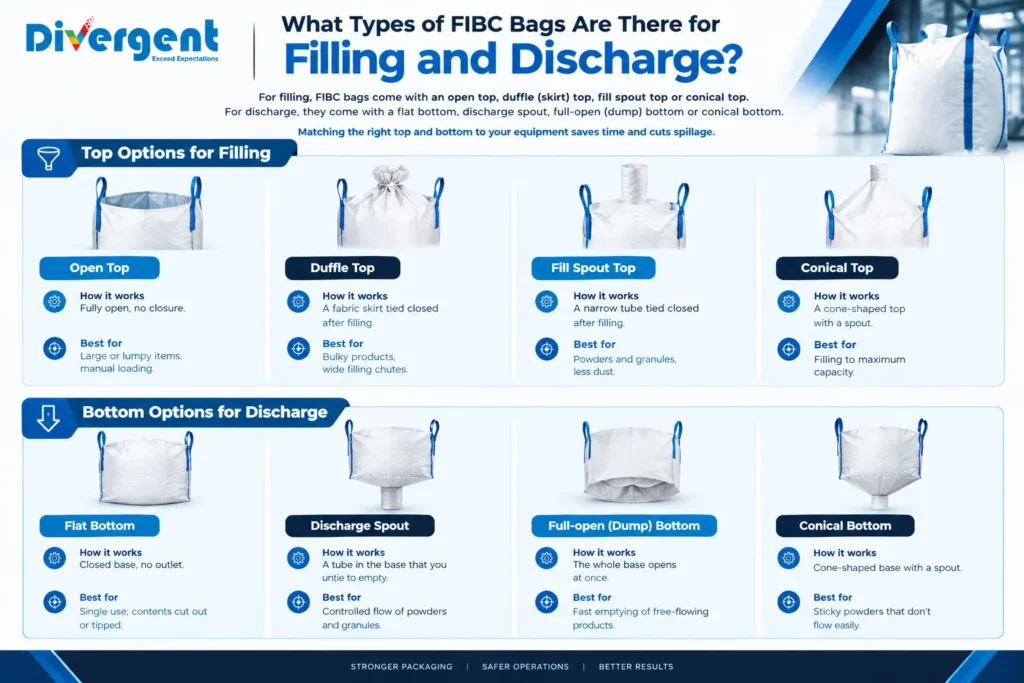
A quick tip: most powder handlers pair a spout top with a spout bottom, which keeps dust down at both ends. Top and bottom choices also change the bag’s size, fabric area and price, so check our FIBC bag specifications and dimensions guide before you order.
What Is the Difference Between Single Trip and Multi Trip FIBC Bags?
A single trip FIBC has a 5:1 safety factor and is meant to be used once. A multi trip FIBC has a 6:1 safety factor and can be reused after inspection. The safety factor shows how many times its rated load a bag can hold in testing before it fails.
| Class | Safety factor | Test load for a 1,000 kg bag | Reuse |
|---|---|---|---|
| Single trip | 5:1 | 5,000 kg | Used once, then recycled |
| Multi trip, standard duty | 6:1 | 6,000 kg | Reused after inspection |
| Multi trip, heavy duty | 6:1 | 6,000 kg, with stronger fabric and stitching | Reused in closed loops with refurbishment |
Safe Working Load (SWL) is the most weight a bag is designed to carry in daily use. So a 1,000 kg single trip bag must survive 5,000 kg in the lab. That margin covers the jolts from lifting, dropping and stacking in real life.
These ratings come from the ISO 21898 standard, which you can look up on the ISO website.
Higher safety factors need heavier fabric, stronger loops and more stitching, and all of that shows up in the price. If you’re costing bags across different types of FIBC bags, our FIBC bag calculation guide shows how to work it out.
What Are the Special Types of FIBC Bags?
The special types of FIBC bags are food grade, UN certified, lined, ventilated and coated bags. Each one solves a specific problem: hygiene, hazardous goods, moisture, or produce that needs to breathe.
Food Grade FIBC Bags
Food grade bags are made in clean-room conditions from virgin polypropylene. Their makers usually hold certifications such as BRCGS Packaging, FSSC 22000 or ISO 22000.
Of all the types of FIBC bags, these face the toughest audits. You’ll see them carrying sugar, flour, starch, rice and pharma ingredients. For the full buyer checklist, read our guide to food grade FIBC bags.
UN Certified FIBC Bags
UN bags are approved to carry hazardous goods under the UN Recommendations on the Transport of Dangerous Goods. They pass extra tests such as drop, topple, righting, tear and stacking.
Each bag carries a UN marking code, in the 13H series for woven plastic bags, that shows exactly what it’s approved for.
Lined FIBC Bags
Lined bags have a polyethylene liner inside the woven shell. The liner keeps out moisture and stops fine powder from leaking through the weave.
Liners can be loose, glued, tabbed or form-fit. See FIBC liners: types and uses for how to pick one.
Ventilated FIBC Bags
Ventilated bags have breathable mesh strips in the side panels. Air moves through, so potatoes, onions, beans and firewood don’t sweat or rot in storage.
Coated vs Uncoated FIBC Bags
Uncoated fabric lets air pass through the weave. Coated fabric has a thin PP layer laminated on top, which blocks moisture and fine dust. Most powder and food applications use coated bags.
Which Types of FIBC Bags Suit Your Industry?
Each industry tends to settle on a standard bag, shown in the table below. Treat it as a starting point; your exact spec still depends on your product, filling line and buyer.
| Industry | Common products | Typical bag |
|---|---|---|
| Construction | Cement, sand, aggregates | Type A, U-panel, four loop, duffle top, flat bottom |
| Agriculture | Grain, seeds, feed | Type A or B, circular, one or two loop, spout top and bottom |
| Fertilizer | Urea, DAP, potash | Type A, coated, one or two loop, with liner |
| Food | Sugar, flour, starch | Food grade, circular or baffle, liner, spout bottom |
| Chemicals | Flammable powders, resins | Type C or D, coated, liner, spout top and bottom |
| Hazardous goods | Regulated chemicals | UN certified, Type C or D |
| Fresh produce | Potatoes, onions | Ventilated, four loop, open top |
| Mining | Ores, minerals | Type A, heavy fabric, 6:1 if reused |
What Mistakes Do Buyers Make With Types of FIBC Bags?
The most common mistake is choosing a bag on price alone. The cheapest option is usually a basic Type A, and it’s the wrong bag more often than people expect.
Here are the other mistakes that come up again and again:
- Using Type C without grounding. An ungrounded Type C bag gives no real static protection. If your team can’t ground every bag, every time, switch to Type D.
- Reusing single trip bags. A 5:1 bag isn’t built for a second trip, even if it looks fine.
- Skipping the liner for fine powders. Fine product works its way through the weave, so you lose material and create dust.
- Ordering the wrong bottom. A flat bottom on a product you need to meter out means cutting bags open on the floor.
- Not asking for test certificates. Any supplier of Type B, C, D, food grade or UN bags should share test reports without hesitation.
How Do You Choose the Right FIBC Bag?
To choose the right FIBC bag, check seven things: flammability, load weight, reuse, particle size, filling and discharge method, handling equipment and certification. Work through them in order, and the right pick from all the types of FIBC bags usually becomes obvious.
- Is the product or the area flammable? Neither: Type A. Flammable dry powder only: Type B. Flammable atmosphere: Type C (grounded) or Type D.
- How heavy is each load? This sets the Safe Working Load, commonly 500 to 2,000 kg.
- Will the bag be reused? Once: single trip 5:1. Several times: multi trip 6:1.
- How fine is the product? Very fine powders need coated fabric, a liner or circular construction.
- How will you fill and empty it? Match the top and bottom to your equipment.
- How will you lift and store it? Choose loops for your forklift or crane, and baffles if space is tight.
- Does it need certification? Food and pharma need food grade bags; hazardous goods need UN certified bags.
How Do FIBC Manufacturers Manage So Many Bag Types?
Most FIBC manufacturers manage bag types with spreadsheets and paper job cards, and that’s where costly mistakes creep in. The better way is an industry-specific ERP that stores every specification and calculates cost automatically.
Look back at everything in this guide. Type, construction, loops, top, bottom, liner, coating and safety factor all change the fabric area, GSM, stitching and test plan. A plant making 50 specifications for 20 customers is juggling hundreds of variables across all the types of FIBC bags it produces.
When all of that lives in Excel, the same problems keep showing up: wrong costing, fabric wastage, late deliveries, and batches nobody can trace when a complaint comes in.
FIBC Pro is an ERP built for FIBC and jumbo bag manufacturers by Divergent Software Labs. With it, you can:
- Save each bag specification once and reuse it for repeat orders
- Calculate costing automatically from fabric, GSM, loops, liners and stitching
- Plan extrusion, weaving, cutting and stitching around real delivery dates
- Track loom efficiency and fabric use to reduce fabric wastage
- Keep batch-wise test records for Type C, Type D, food grade and UN bags
- Handle export orders, dispatch and paperwork in one place
[Image 5 | Alt text: FIBC Pro ERP managing types of FIBC bags]
Still running on spreadsheets? Read Excel vs ERP for FIBC manufacturers, or book a free FIBC Pro demo and see it working with your own bag specs.
FAQs About Types of FIBC Bags
How many types of FIBC bags are there?
There are four main types of FIBC bags by static protection: Type A, B, C and D. Bags are also grouped by construction, loops, top and bottom style, safety factor and special use.
What is the full form of FIBC?
FIBC stands for Flexible Intermediate Bulk Container. It’s a large woven polypropylene bag used to store and move dry bulk products.
What is the difference between Type C and Type D FIBC?
Both are safe for flammable powders and flammable atmospheres. Type C must be grounded during filling and emptying, while Type D dissipates static safely with no grounding at all.
Which types of FIBC bags are safe for flammable powders?
Type B, Type C and Type D bags are safe for flammable dry powders. Where flammable gas or vapour is present, only Type C (when grounded) and Type D are safe.
What does a 5:1 safety factor mean in FIBC bags?
It means the bag can hold five times its Safe Working Load in testing before failing. A 1,000 kg bag rated 5:1 must withstand 5,000 kg, and it’s meant for a single use.
What is a baffle bag used for?
A baffle bag keeps a square shape when full, thanks to fabric panels sewn inside its corners. It’s used where storage or container space is expensive, because more product fits in the same area.
Can FIBC bags be reused?
Only multi trip bags with a 6:1 safety factor are built for reuse, and only after inspection. Single trip 5:1 bags should be used once, then recycled.
What is the difference between a U-panel and a circular FIBC?
A U-panel bag is sewn from flat panels and keeps a squarer shape. A circular bag is woven as a seamless tube, which cuts leakage of fine powders.
Final Thoughts on Types of FIBC Bags
Once you know the seven categories, the types of FIBC bags stop looking confusing. Start with static protection, then match construction, loops, top, bottom and safety factor to your product and handling.
Add food grade, UN or liner features only where your product truly needs them. When in doubt, ask your supplier for test certificates and a sample bag. A good bag maker will be glad to help you get it right.