Why does your production plan fall apart the moment one rush order arrives? Why are your machines sitting idle on Tuesday while three customer deliveries are already overdue? And why does your planning team spend every morning rebuilding a schedule that is outdated before lunch?
The answer is the same in every case — production planning challenges in manufacturing that no spreadsheet was ever built to handle.
Production planning challenges in manufacturing are not just inconvenient. They are expensive, daily, and deeply rooted in the way most factories are run today.
A wrong production plan means delayed deliveries. A delayed delivery means a dissatisfied customer. A dissatisfied customer means a lost repeat order. And a lost repeat order means lost revenue that never shows up in any internal report — because no one tracks what was never ordered.
This chain of consequences starts at the planning table every single morning.
Most manufacturers are managing complex, high-volume operations using spreadsheets, phone calls, and tribal knowledge. The planning team works hard. They are experienced. But they are working with tools that were never designed for the speed, complexity, and volume that modern manufacturing demands.
This blog breaks down the 5 most critical production planning challenges in manufacturing — why each one happens, what it actually costs the factory, and how manufacturing ERP software eliminates every one of them permanently.
Whether you are a plant manager, production head, or business owner, you will recognise every single challenge on this list.
Table of Contents
- What are production planning challenges in manufacturing?
- Challenge 1: Manual production planning
- Challenge 2: Machine capacity planning
- Challenge 3: Production scheduling problems
- Challenge 4: Order prioritization without data
- Challenge 5: Capacity vs delivery commitments
- How ERP software solves production planning challenges in manufacturing
- What to look for in a manufacturing planning module
- Conclusion
- Frequently asked questions
What Are Production Planning Challenges in Manufacturing?
Production planning challenges in manufacturing are the operational problems that arise when a plant tries to decide what to produce, how much to produce, when to produce it, and on which machine — without real-time data, connected systems, or automated scheduling logic.
These challenges are not caused by poor management. They are caused by the fundamental mismatch between the complexity of modern manufacturing and the simplicity of manual planning tools.
According to a McKinsey Global Institute report, manufacturers who invest in connected planning systems reduce production downtime by up to 50% and improve on-time delivery rates significantly.
The 5 production planning challenges in manufacturing below are the most common — and the most costly — problems plants face today.
Read also: 12 Critical Manufacturing Challenges in Modern Manufacturing Industry
Link: https://divergentsoftlab.com/manufacturing-challenges
1. Manual Production Planning
Manual production planning is the foundation of almost every production planning challenge in manufacturing. Everything else — scheduling errors, capacity conflicts, order delays — flows from this single root problem.
Production planning challenges in manufacturing almost always begin with a spreadsheet that nobody fully trusts.
Why Manual Planning Always Falls Short
Every morning, the planning team opens an Excel file. They check pending orders, estimate machine availability, factor in raw material stock, and build a production schedule for the day or week ahead.
By 11 AM, a customer calls with a rush order. The plan changes. By 2 PM, a machine goes down for maintenance. The plan changes again. By end of day, the original plan looks nothing like what was actually produced.
And tomorrow, the same process starts from scratch.
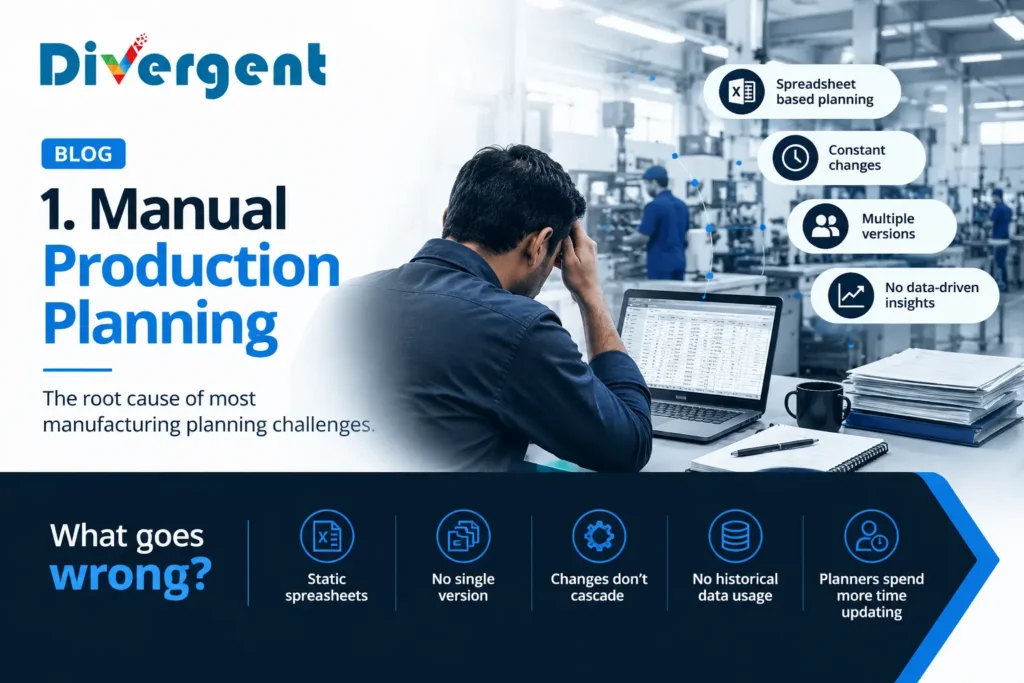
What goes wrong:
- Planning is done on static spreadsheets that cannot update in real time
- No single version of the plan exists — different teams work from different files
- Changes in one area do not cascade through the rest of the plan automatically
- Historical production data is not used to improve future planning accuracy
– Planners spend more time maintaining the plan than actually planning
The real cost of manual planning is not just inefficiency. It is the invisible cost of wrong decisions made on incomplete information — delayed orders, idle machines, and missed customer commitments that compound week after week.
2. Machine Capacity Planning
The second of the critical production planning challenges in manufacturing is machine capacity planning — knowing exactly how much your equipment can produce, at what speed, and with what constraints, at any given moment.
Machine capacity planning is one of the production planning challenges in manufacturing that becomes more painful as production volume grows.
When Capacity Is Guesswork, Commitments Become Promises You Cannot Keep
Most manufacturers have a rough idea of their machine capacity. They know Machine A runs at approximately 200 units per hour. They know there is usually 20 percent downtime for cleaning and changeover. They estimate from experience.
But experience-based capacity planning has a ceiling. When you are running 8 machines across 2 shifts producing 15 product variants, rough estimates are not good enough.
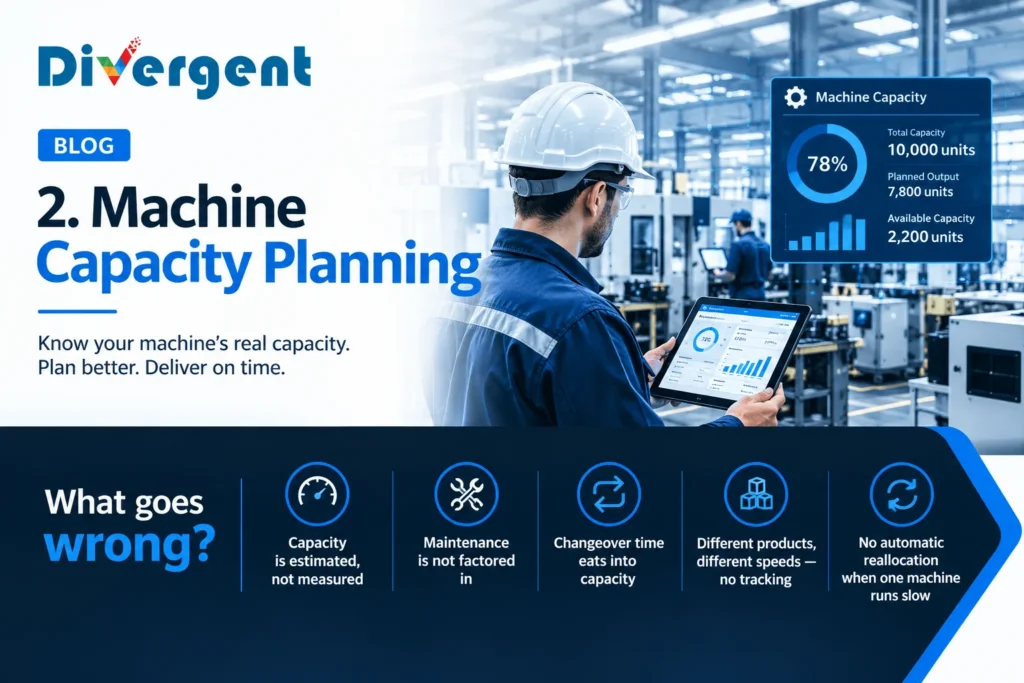
What goes wrong:
- Machine capacity is estimated, not measured — creating systematic overcommitment
- Planned maintenance is not factored into daily production schedules
- Changeover time between products eats into capacity but is rarely accounted for accurately
- Different products run at different speeds on the same machine — no system tracks this granularity
- When one machine runs slow, there is no automatic reallocation of work to available capacity
The result is a factory that promises 10,000 units by Friday and delivers 7,500 — not because of a lack of effort, but because of a lack of accurate capacity data at the planning stage.
3. Production Scheduling Problems
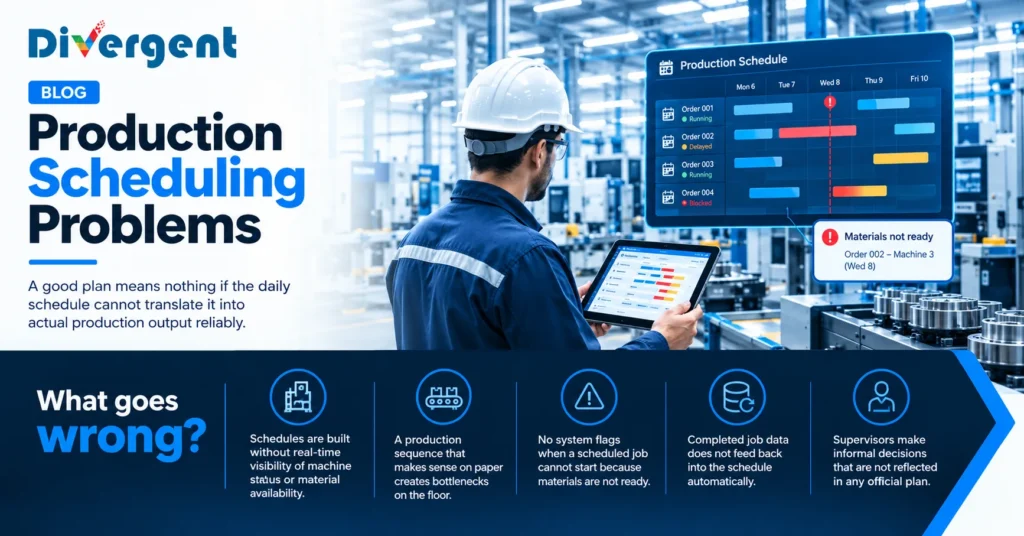
Production scheduling is where production planning challenges in manufacturing become most visible to the customer. A good plan means nothing if the daily schedule cannot translate it into actual production output reliably.
Production scheduling failures are the production planning challenges in manufacturing that customers experience directly — in the form of late deliveries and broken commitments.
The Daily Schedule That Starts Falling Apart by 10 AM
Production scheduling requires matching the right order to the right machine at the right time, accounting for material availability, machine status, operator skill, and a dozen other variables — all simultaneously.
Without a connected system, this is impossible to do accurately. So it gets done approximately. And approximately, in manufacturing, is the gap between profit and loss.
What goes wrong:
- Schedules are built without real-time visibility of machine status or material availability
- A production sequence that makes sense on paper creates bottlenecks on the floor
- No system flags when a scheduled job cannot start because materials are not ready
- Completed job data does not feed back into the schedule automatically
- Supervisors make informal decisions that are not reflected in any official plan
The gap between the scheduled plan and actual floor output widens every hour. By the end of the shift, what was planned and what was produced are two different things — and nobody has a reliable record of either.
4. Order Prioritization Without Data
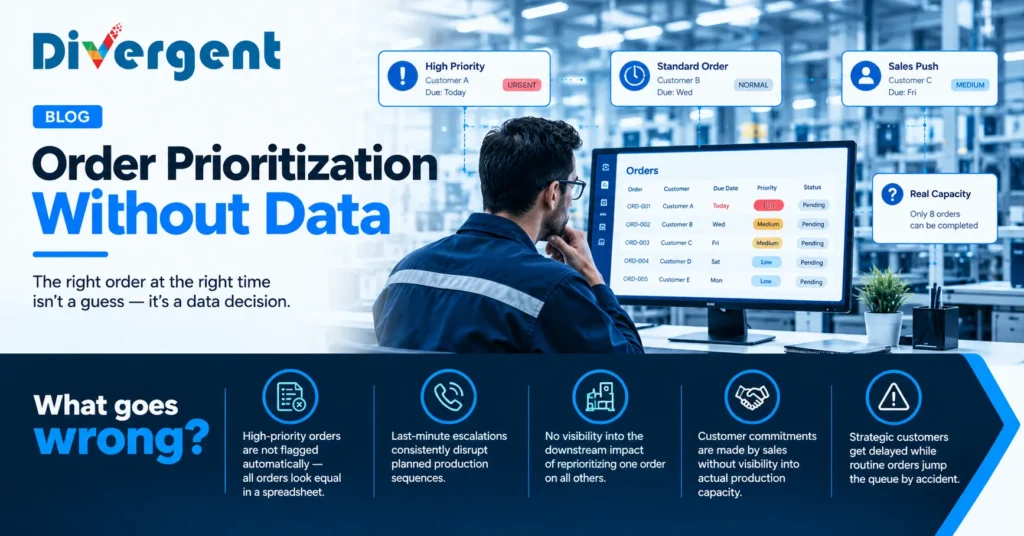
When ten orders need to go out this week, and you can realistically complete eight, which two do you delay? This question is at the heart of one of the most difficult production planning challenges in manufacturing — order prioritization.
Order prioritization without data is one of the production planning challenges in manufacturing that creates the most internal conflict and customer dissatisfaction simultaneously.
When Prioritization Is Based on Who Called Last
In most plants, order prioritization is not a system decision. It is a human one — shaped by which customer called most recently, which salesperson pushed hardest, or which order the plant manager happened to notice when walking the floor.
This is not a people problem. It is a data problem. Without a system that shows every order, every deadline, every machine load, and every customer priority in one place, intelligent prioritization is not possible.
What goes wrong:
- High-priority orders are not flagged automatically — all orders look equal in a spreadsheet
- Last-minute escalations consistently disrupt planned production sequences
- No visibility into the downstream impact of reprioritizing one order on all others
- Customer commitments are made by sales without visibility into actual production capacity
- Strategic customers get delayed while routine orders jump the queue by accident
Every wrong prioritization decision has two costs — the cost of the delayed customer and the cost of the disrupted production sequence that affected every other order in the plan.
5. Capacity vs Delivery Commitments
The fifth and most commercially damaging of the production planning challenges in manufacturing is the gap between what the factory can actually produce and what the sales team has already promised to customers.
Capacity vs delivery commitment gaps are the production planning challenges in manufacturing that turn customer relationships into customer complaints.
Promising What the Factory Cannot Deliver
Sales teams sell. That is their job. But when the sales team commits to a delivery date without real-time visibility into actual machine capacity, raw material availability, and current order load, they are making a promise based on hope rather than data.
When that promise fails — and it does fail, regularly, in plants without connected systems — the customer does not blame the sales team. They blame the manufacturer.
What goes wrong:
- Sales commits delivery dates without checking actual production capacity or order queue
- No system shows the sales team what is already scheduled before they commit to new orders
- Capacity constraints are only discovered after the commitment has already been made to the customer
- Rush production to meet a committed deadline disrupts every other scheduled order
- Consistent overcommitment trains customers to expect delays — destroying trust over time
The business impact of this challenge goes beyond individual orders. It shapes the manufacturer’s reputation in the market — and a reputation for unreliable delivery is one of the hardest things in manufacturing to recover from.
How ERP Software Solves Production Planning Challenges in Manufacturing
Every one of the 5 production planning challenges in manufacturing above has the same root cause — planning decisions being made without real-time, connected data across orders, machines, materials, and capacity.
Manufacturing ERP software solves production planning challenges in manufacturing by replacing every disconnected spreadsheet and manual decision with a single integrated platform where planners can see everything they need in one place.
Here is exactly how each production planning challenge is solved:
- Manual production planning — System-based planning engine that builds and updates schedules automatically based on live order data and machine availability
- Machine capacity planning — Real-time machine capacity tracking with automatic flagging of overloads and underutilization
- Production scheduling problems — Automated scheduling that accounts for material availability, machine status, changeover time, and operator assignments simultaneously
- Order prioritization without data — Rule-based prioritization engine that ranks orders by customer priority, delivery date, and capacity impact automatically
- Capacity vs delivery commitments — Live capacity dashboard visible to the sales team before any delivery date is committed to a customer
- This is exactly why manufacturing ERP adoption has become the primary solution to production planning challenges in manufacturing across industries globally.
What to Look for in a Manufacturing Planning Module
Solving production planning challenges in manufacturing permanently requires an ERP system with a purpose-built planning module — not a generic tool adapted from retail or services.
Core planning module features to look for:
- Automated production scheduling based on live machine capacity and order priority
- Real-time machine status and capacity visibility across all production lines
- Material availability check integrated into the scheduling engine
- Drag-and-drop schedule adjustment with automatic downstream impact calculation
- Customer commitment visibility for the sales team before delivery dates are confirmed
- Multi-shift and multi-plant scheduling capability for growing operations
- Planned vs actual production comparison available at end of every shift
- Integration with inventory, purchase, quality control, and dispatch modules
The one rule that matters most:
A planning module that is not connected to inventory, purchase, and machine data in real time will recreate the same disconnection problems that spreadsheets already cause. Connectivity is not a feature — it is the foundation.
Conclusion
Production planning challenges in manufacturing are not just scheduling problems — they are customer relationship problems, revenue problems, and operational resilience problems that compound with every passing week they go unresolved.
Every delayed delivery, every overcommitted promise, every idle machine, and every disrupted schedule is the direct result of running a complex manufacturing operation on disconnected, manual planning tools.
Every category of production planning challenges in manufacturing — from manual planning to capacity vs. delivery commitment gaps — points to the same root cause: no single connected system that shows planners everything they need to make the right decision at the right time.
The manufacturers who have solved these production planning challenges in manufacturing have done it by moving from reactive planning — responding to problems after they occur — to proactive planning: preventing problems before they reach the floor.
That shift starts with the right system. Identifying which of these 5 production planning challenges in manufacturing is costing your plant the most this week is the right place to begin.
Q: What are production planning challenges in manufacturing?
Production planning challenges in manufacturing are the operational problems that arise when a factory tries to decide what to produce, when, and on which machine — without real-time data, connected systems, or automated scheduling logic. The most common production planning challenges in manufacturing include manual planning on outdated spreadsheets, inaccurate machine capacity estimates, poor production scheduling, reactive order prioritization, and delivery commitments made without checking actual capacity. These production planning challenges in manufacturing are the primary cause of delayed deliveries, idle machines, and broken customer commitments in factories of every size.
Q: Why does production planning fail in most manufacturing plants?
Production planning fails in most manufacturing plants because the tools being used — spreadsheets, phone calls, and manual data entry — cannot process the volume and complexity of information that accurate planning requires. A production plan needs to account for machine capacity, material availability, order priority, changeover time, shift patterns, and real-time floor status simultaneously. No spreadsheet can do this reliably. The result is a plan that looks reasonable on paper but falls apart within hours of the shift starting.
Q: How does ERP software solve production planning challenges in manufacturing?
ERP software solves production planning challenges in manufacturing by creating a single connected platform where all planning inputs — machine capacity, material stock, order priority, and delivery commitments — are visible in real time. Planners can build accurate schedules automatically, see the impact of any change before making it, and give the sales team live capacity data before delivery dates are committed. This transforms planning from a reactive daily exercise into a proactive, data-driven process that prevents problems before they reach the production floor.
Q: What is machine capacity planning in manufacturing?
Machine capacity planning is the process of calculating exactly how much production output each machine can deliver within a given time period, accounting for speed, changeover time, maintenance schedules, and product-specific run rates. Inaccurate machine capacity planning is one of the most common production planning challenges in manufacturing — plants regularly overcommit to customers because their capacity estimates are based on rough experience rather than measured, real-time data. A manufacturing ERP system tracks actual machine performance and uses that data to build realistic, achievable production schedules.
Q: What is order prioritization in manufacturing?
Order prioritization in manufacturing is the process of deciding which production orders should be completed first when the factory cannot complete all orders within the required timeframe. Effective order prioritization requires visibility into every open order, every delivery deadline, every customer priority level, and the real-time impact of changing the production sequence. Without a connected system, most factories prioritize based on whoever called last or escalated loudest — which is one of the most common and most damaging production planning challenges in manufacturing.
Q: How can manufacturers improve production scheduling?
Manufacturers can improve production scheduling by replacing manual spreadsheet-based scheduling with a system-driven approach that accounts for live machine status, material availability, changeover time, and order priority simultaneously. The key improvements are: building schedules from real capacity data rather than estimates, making the schedule visible to all departments in real time, flagging conflicts automatically before they cause delays, and feeding actual floor output back into the system at the end of every shift so the next plan starts from accurate data. These are the exact capabilities that manufacturing ERP software provides to eliminate production planning challenges in manufacturing at the scheduling level.