What Are BOPP Bags?
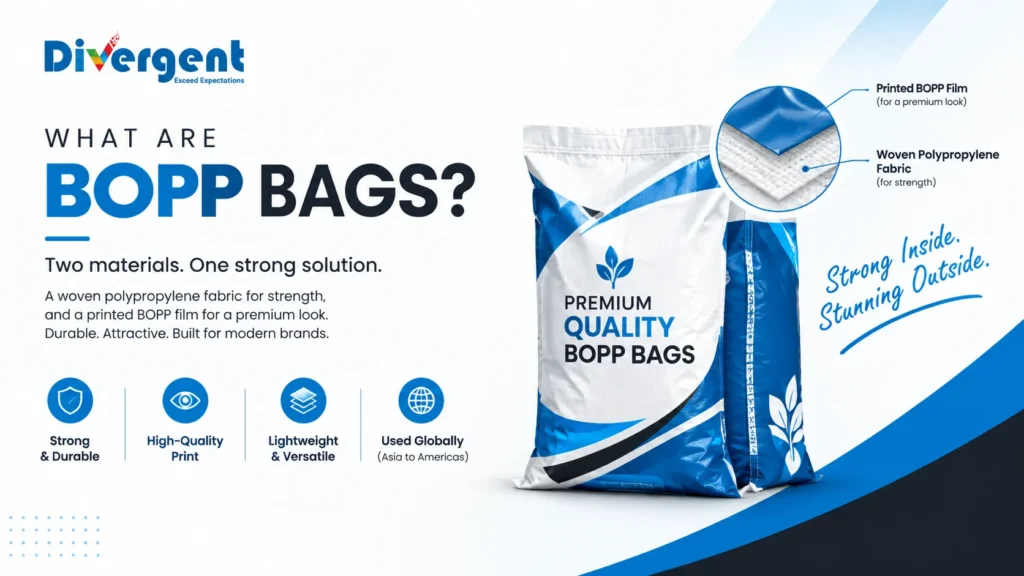
BOPP bags, also called BOPP laminated bags or BOPP woven bags, are really two materials working together. Inside, there’s a woven polypropylene fabric that does the heavy lifting. Outside, there’s a thin printed BOPP film that’s bonded to the fabric through lamination.
Think of it like this: the fabric is the muscle, and the film is the face. You get a sack that can survive a truck ride and a warehouse stack, but it still looks good enough to sit on a retail shelf next to premium brands.
A couple of decades ago, most grain and feed went out in plain white sacks with a basic stamp. As brands started competing on the shelf, they needed packaging that could actually sell. That’s where BOPP bags came in, and today you’ll find them across Asia, the Middle East, Africa, Europe, and the Americas.
How BOPP Bags Are Structured
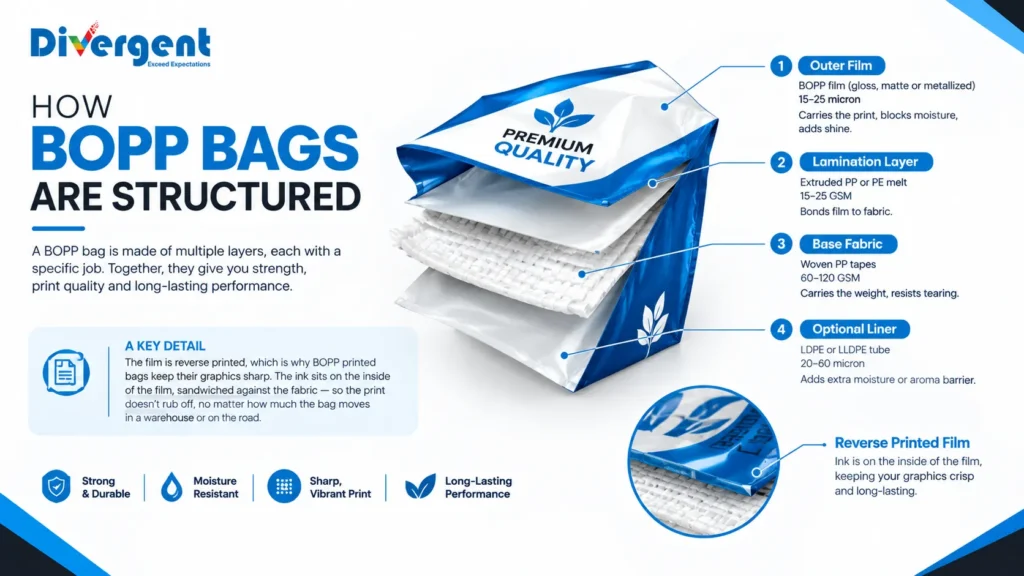
Cut open a typical BOPP bag and you’ll usually find three layers, sometimes four. Each one has a clear job.
| Layer | Material | Typical range | Job it does |
|---|---|---|---|
| Outer film | BOPP film, gloss, matte or metallized | 15–25 micron | Carries the print, blocks moisture, adds shine |
| Lamination layer | Extruded PP or PE melt | 15–25 GSM | Bonds film to fabric |
| Base fabric | Woven PP tapes | 60–120 GSM | Carries the weight, resists tearing |
| Optional liner | LDPE or LLDPE tube | 20–60 micron | Adds an extra moisture or aroma barrier |
Here’s a detail most buyers miss: the film is reverse printed, which is why BOPP printed bags keep their graphics sharp. The ink sits on the inside of the film, sandwiched against the fabric. So no matter how many times the bag gets dragged across a warehouse floor, the print doesn’t rub off.
Types of BOPP Bags
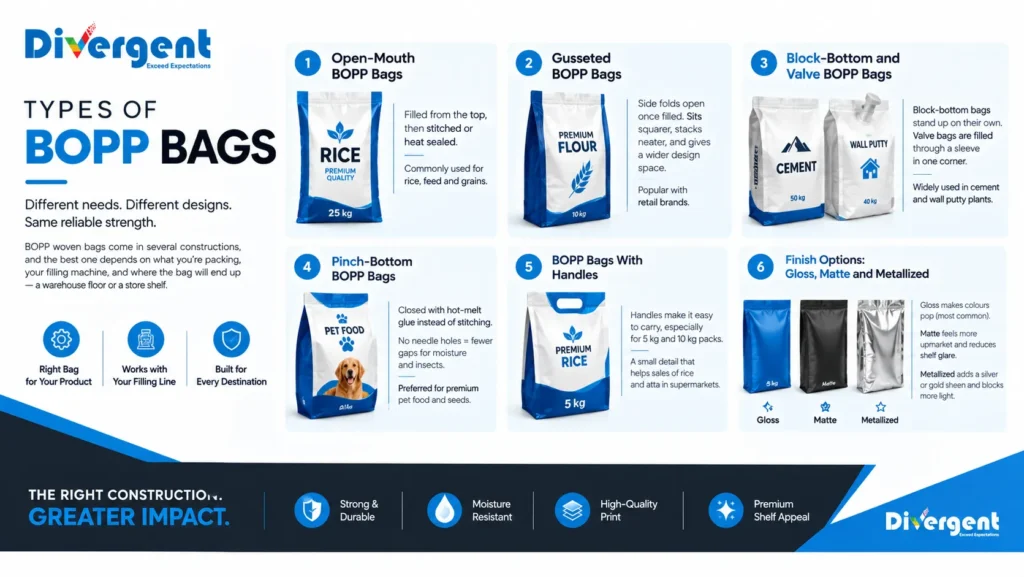
BOPP woven bags come in several constructions, and the “best” one really depends on three things: what you’re packing, what filling machine you run, and where the bag will end up (a warehouse floor or a store shelf).
Open-Mouth BOPP Bags
This is the workhorse. You fill it from the top, then stitch or heat seal it shut. If you’ve bought a 25 kg bag of rice or cattle feed, there’s a good chance it was an open-mouth BOPP bag.
Gusseted BOPP Bags
Gusseted BOPP bags have folds on the sides that open up once the bag is filled. The bag sits squarer, stacks neater on a pallet, and gives you a wider front panel for your design. Retail brands love them for exactly that reason.
Block-Bottom and Valve BOPP Bags
Block-bottom BOPP bags have a flat, box-like base, so they stand up on their own. The valve version is filled through a small sleeve in one corner, which is why cement and wall putty plants use them on high-speed packing lines.
Pinch-Bottom BOPP Bags
Instead of stitching, pinch-bottom bags are closed with hot-melt glue. No stitching means no needle holes, and no needle holes means fewer gaps for moisture and insects. That’s why many premium pet food and seed brands pay a little extra for this style.
BOPP Bags With Handles
For 5 kg and 10 kg packs, a handle makes a real difference. Shoppers can grab the bag with one hand and carry it to the car, which is a small detail that quietly helps sales of rice and atta in supermarkets.
Finish Options: Gloss, Matte and Metallized
Gloss film makes colours pop, and it’s the most common choice. Matte film feels more upmarket and cuts down on shelf glare. Metallized film adds a silver or gold sheen and blocks more light, which helps with products that don’t like sunlight.
How BOPP Bags Are Manufactured
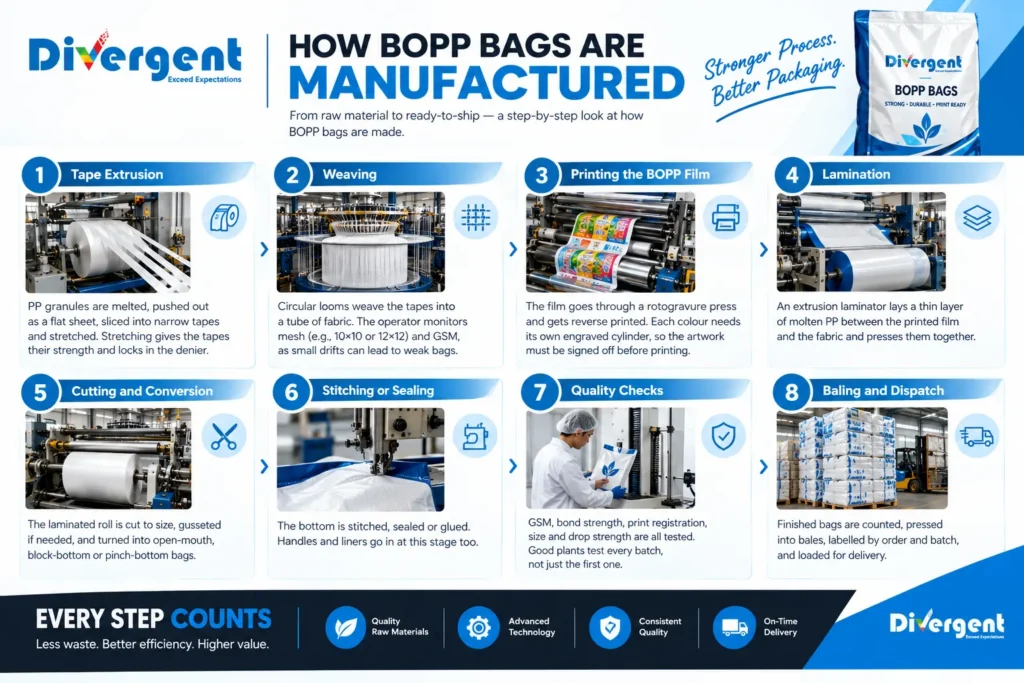
BOPP bag manufacturing runs on two tracks at the same time. One team makes the fabric, another prints the film, and the two finally meet at the laminator. Here’s how a typical order moves through a plant.
- Tape extrusion. PP granules are melted, pushed out as a flat sheet, sliced into narrow tapes, and stretched. The stretching is what gives the tapes their strength, and it’s where denier gets locked in.
- Weaving. Circular looms weave those tapes into a tube of fabric. The operator keeps an eye on mesh (say 10×10 or 12×12) and GSM, because small drifts here show up later as weak bags.
- Printing the BOPP film. The film goes through a rotogravure press and gets reverse printed. Every colour needs its own engraved cylinder, so the artwork has to be signed off before anyone touches the press.
- Lamination. An extrusion laminator lays a thin layer of molten PP between the printed film and the fabric and presses them together.
- Cutting and conversion. The laminated roll is cut to size, gusseted if needed, and turned into open-mouth, block-bottom or pinch-bottom bags.
- Stitching or sealing. The bottom is stitched, sealed, or glued. Handles and liners go in at this stage too.
- Quality checks. GSM, bond strength, print registration, size, and drop strength all get tested. Good plants test every batch, not just the first one.
- Baling and dispatch. Finished bags are counted, pressed into bales, labelled by order and batch, and loaded for delivery.
Every one of these steps throws off some waste, some rejects and some changeover time. In our experience, the plants that make money are the ones that actually measure that loss, step by step, instead of guessing at the end of the month.
Key Benefits of BOPP Bags
Brands choose BOPP laminated bags because one bag quietly solves a handful of problems at once. Here’s what you actually get.
- Real strength. The woven base handles anything from 5 kg to 50 kg, plus the rough treatment of loading docks and trucks.
- Moisture protection. The film keeps rain, humidity, and the odd spill away from rice, feed, and fertilizer.
- Print that sells. Rotogravure gives you photo-quality images, which matters a lot when your bag is sitting next to five competitors.
- Graphics that last. Because of reverse printing, the bag still looks fresh when a customer picks it up.
- Tears don’t spread. A small puncture in woven fabric stays small, instead of ripping open the whole bag.
- Lighter than the alternatives. A BOPP bag weighs far less than jute or multiwall paper of the same size, so you save on freight.
- Fully customisable. Width, length, gusset, finish and closure can all be tuned to your product and your filling line.
- Easier to recycle. Since it’s mostly one polymer, it’s a better recycling candidate than mixed-material packs.
Applications of BOPP Bags by Industry
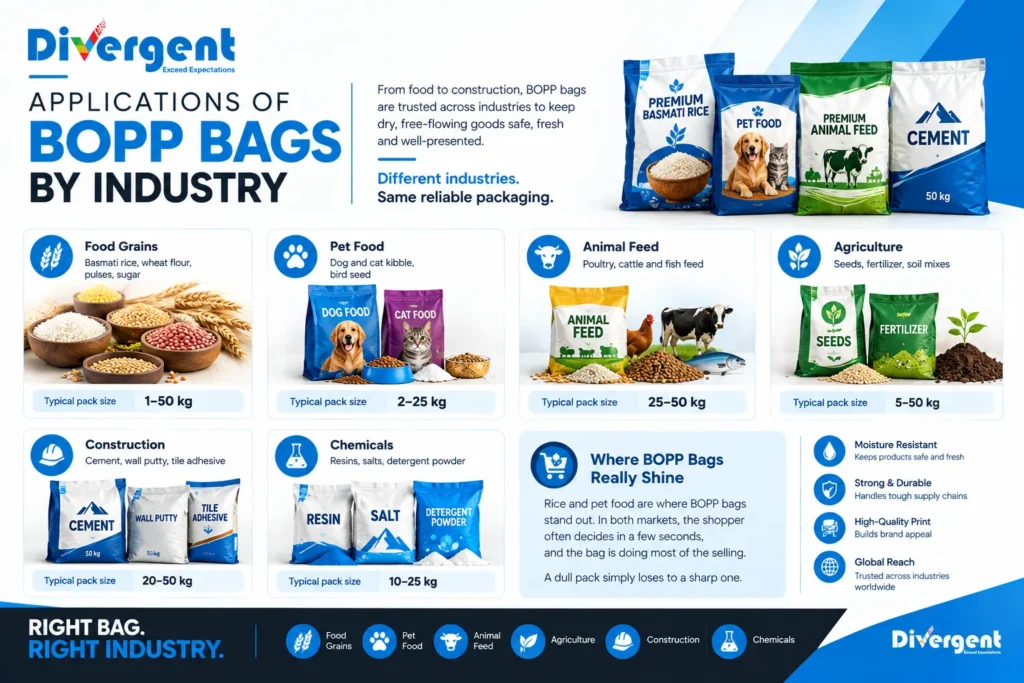
The most common BOPP bag uses span almost every industry that ships dry, free-flowing goods. If it pours and it needs protecting, there’s probably a BOPP bag built for it.
| Industry | Common products | Typical pack size |
|---|---|---|
| Food grains | Basmati rice, wheat flour, pulses, sugar | 1–50 kg |
| Pet food | Dog and cat kibble, bird seed | 2–25 kg |
| Animal feed | Poultry, cattle and fish feed | 25–50 kg |
| Agriculture | Seeds, fertilizer, soil mixes | 5–50 kg |
| Construction | Cement, wall putty, tile adhesive | 20–50 kg |
| Chemicals | Resins, salts, detergent powder | 10–25 kg |
Rice and pet food are where BOPP bags really shine. In both markets, the shopper often decides in a few seconds, and the bag is doing most of the selling. A dull pack simply loses to a sharp one.
BOPP Bags Specifications Explained
When you request a quote for BOPP woven bags, a good supplier will come back with a spec sheet full of numbers. It can look confusing the first time, so here’s what each term actually means.
| Specification | What it means | Common range |
|---|---|---|
| Fabric GSM | Weight of woven fabric per square metre | 60–120 GSM |
| Tape denier | Thickness and weight of each PP tape | 700–1,200 denier |
| Mesh | Tapes per inch in warp × weft | 10×10 to 14×14 |
| Film thickness | Gauge of the BOPP film | 15–25 microns |
| Lamination GSM | Amount of bonding resin | 15–25 GSM |
| Width × length | Flat bag size | 30–70 cm × 45–110 cm |
| Gusset | Side fold depth | 5–15 cm |
| Printing | Number of rotogravure colours | 1–10 colours |
| Closure | Stitched, heat sealed, pinch or valve | Depends on product |
| Load capacity | Safe fill weight | 1–50 kg |
More GSM and more denier give you a stronger bag, but you pay for every extra gram. The smart move is to find the lightest spec that still passes a drop test at your fill weight. Anything beyond that is money left on the table.
BOPP Bags vs PP Woven Bags and Other Packaging
BOPP bags aren’t the only option, of course. They go up against plain woven sacks, jute, paper, and plastic pouches. Here’s an honest side-by-side.
| Feature | BOPP bags | Plain PP woven | Jute bags | Multiwall paper |
|---|---|---|---|---|
| Strength | High | High | Medium | Medium |
| Moisture resistance | High | Low–medium | Low | Low unless coated |
| Print quality | Photographic, 8–10 colours | Basic flexo | Very basic | Good |
| Shelf appeal | Excellent | Low | Rustic | Good |
| Weight | Light | Light | Heavy | Medium |
| Recyclability | Good (mono PP) | Good (mono PP) | Biodegradable | Recyclable if uncoated |
| Relative cost | Medium | Low | Medium–high | Medium |
In the BOPP vs PP woven bags comparison, plain woven sacks are still the cheaper pick for bulk goods that never see a shelf. But the moment your bag has to sell the product as well as carry it, BOPP bags pull ahead.
How to Choose the Right BOPP Bags
When buying BOPP woven bags, the wrong specification leads to split bags, faded print, or paying for strength you never needed. We’ve seen all three. Run through this list before you sign off on an order.
- Start with the product and the weight. A 5 kg rice pack and a 50 kg fertilizer sack are completely different jobs.
- Check your filling machine. Find out whether your line takes open-mouth, valve or pinch-bottom BOPP bags before you order anything.
- Pick a finish. Gloss for bold colour, matte for a premium feel, metallized if light is a problem.
- Think about barriers. Oily pet food, powders that soak up moisture, and long export routes usually need a liner or a pinch-bottom seal.
- Lock the artwork early. Rotogravure cylinders cost real money, so get colours, barcodes and legal text right before engraving starts.
- Ask for test reports. A serious supplier will happily share GSM, tensile strength, bond strength and drop test results.
- Look at the supplier, not just the price. Food-contact compliance, batch traceability and on-time delivery matter more than a small discount.
If you’re packing food, always ask for food-contact compliance documents. In the US, these rules fall under the FDA food contact substances programme. Other countries have their own rules, so check what applies where you sell.
What Affects BOPP Bags Price
Suppliers quote BOPP bags either per piece or per kilogram. Either way, the final number comes down to a few things.
- PP resin prices. Polypropylene granules are the single biggest cost, so when resin prices move, BOPP bags pricing moves with them.
- GSM and size. More material, more cost. Simple as that.
- Number of colours. On BOPP printed bags, each extra colour adds a cylinder and more ink.
- Cylinder charges. A new design means a one-time engraving cost, which hurts most on small orders.
- Order quantity. Bigger runs spread the setup cost and bring the price per bag down.
- Extras. Liners, handles, block bottoms, matte and metallized film all add to the bill.
- Freight and duties. For export orders, shipping and import duty can change the landed cost a lot.
One tip: send every supplier the same spec sheet. When one quote comes in suspiciously low, it’s usually because the GSM is lower or the film is thinner, not because they found some magic efficiency.
Are BOPP Bags Sustainable?
BOPP laminated bags are more sustainable than many people assume. The film, the lamination resin and the fabric are all polypropylene, so the bag is very close to a single-material pack.
That matters. Packs that mix plastic with paper or aluminium foil are very hard to recycle. A mostly-PP bag, on the other hand, can be turned back into things like crates, pallets and non-food fabric.
It isn’t perfect, though. Collection for flexible PP varies a lot from country to country, and inks and adhesives can lower the quality of the recycled material. Manufacturers are working on it with lighter fabric, solvent-free inks and recycled content in non-food bags.
Brands can help too. Right-size the bag, skip liners you don’t really need, and print simple recycling instructions on the pack.
How Manufacturers Run BOPP Bag Production Efficiently
BOPP bag manufacturing means juggling extrusion, weaving, printing, lamination and conversion all at once. And every order is different: its own size, its own GSM, its own design, its own set of cylinders.
When we talk to plant owners, the same headaches come up again and again: the wrong fabric in stock, cylinders mixed up between jobs, wastage nobody can explain, and dispatches running late. Excel sheets work fine at first, but they fall apart once you’re running dozens of orders a week.
That’s the reason we built BOPP Pro at Divergent Software Labs. It’s an ERP made specifically for BOPP bag manufacturers, covering order-to-dispatch planning, roll and fabric inventory, cylinder management, machine-wise production, wastage tracking and order costing.
Make jumbo bags as well?
FIBC Pro does the same job for FIBC and bulk bag plants. And if you’d like to keep reading, there’s more on the Divergent Software Labs blog.
Frequently Asked Questions About BOPP Bags
1. What is the full form of BOPP?
BOPP stands for Biaxially Oriented Polypropylene. It’s a PP film that’s stretched in two directions, which makes it strong and clear.
2. What is the maximum weight BOPP bags can hold?
Most BOPP bags are made for loads up to about 50 kg. For anything heavier, people usually switch to FIBC or jumbo bags.
3. Are BOPP bags food grade?
They can be, as long as the resin, inks and liners are approved for food contact. Don’t take it on trust. Ask your supplier for the certificates.
4. What is the minimum order quantity for BOPP bags?
It depends on the supplier and the design. Since rotogravure cylinders are expensive, most manufacturers ask for at least a few thousand bags per design.
5. How long do BOPP bags last in storage?
Kept indoors and out of direct sun, they hold their strength for a long time. If the bags will sit outside, ask for UV-stabilised fabric.
6. Can BOPP bags be reused?
Yes, and plenty of people do. The woven base is tough enough to reuse as a storage or shopping bag long after the product is gone.
Conclusion
BOPP bags, from simple BOPP laminated bags to premium BOPP printed bags, give you strength, moisture protection and shelf-ready printing in one light, recyclable pack. It’s no surprise they’ve become the go-to choice for rice, flour, pet food, feed and fertilizer.
If you’re buying, get the spec right, choose a supplier you can trust, and don’t rush the artwork approval. If you’re making them, keep a close eye on fabric, film, cylinders and wastage, because that’s where the profit is won or lost.
Running a BOPP bag plant and tired of chasing numbers across spreadsheets?
Book a BOPP Pro demo with Divergent Software Labs and see how it handles planning, wastage, and costing for your orders.