
Costing challenges in manufacturing are not a new problem — they are daily battles that cost manufacturers time, money, and customers every single week.
You quoted 85 rupees per unit. The actual production cost came in at 97 rupees. You found out only after the full batch was delivered and invoiced.
That one miscalculation wiped out the margin on three other profitable orders in the same month.
This is not a rare story. Walk into any manufacturing plant today — automotive parts, food products, packaging materials, textiles, or industrial components — and you will find the same pattern repeating itself.
The problem is not the people doing the work. The problem is the system they are working with.
This blog breaks down the 5 most costly costing challenges in manufacturing — exactly why each one happens, what it costs the business, and how manufacturing ERP software eliminates every one permanently.
Table of Contents
- What are costing challenges in manufacturing?
- Challenge 1: Manual product costing
- Challenge 2: Complex Bill of Materials management
- Challenge 3: Raw material price fluctuations
- Challenge 4: Actual vs estimated cost gap
- Challenge 5: Delayed customer quotations
- How ERP software solves costing challenges in manufacturing
- What to look for in a manufacturing costing module
- Conclusion
- Frequently asked questions
What Are Costing Challenges in Manufacturing?
Costing challenges in manufacturing arise when a plant calculates product costs manually, builds quotations on outdated data, or lacks a connected system that links raw material rates to finished goods pricing in real time.
These challenges are more common — and more expensive — than most manufacturers realise. The 5 costing challenges in manufacturing below represent the most financially damaging problems plants face today.
According to a McKinsey Global Institute report, manufacturers lose up to 20% of their revenue potential due to poor operational visibility and disconnected processes. Costing is almost always where the first error enters the system.
1. Manual Product Costing
Manual product costing is the most widespread of all costing challenges in manufacturing. And it is the most dangerous — because it looks like it is working, right until the moment it is not.
Costing challenges in manufacturing start here — with a spreadsheet that is always one week behind.
Why Manual Costing Fails
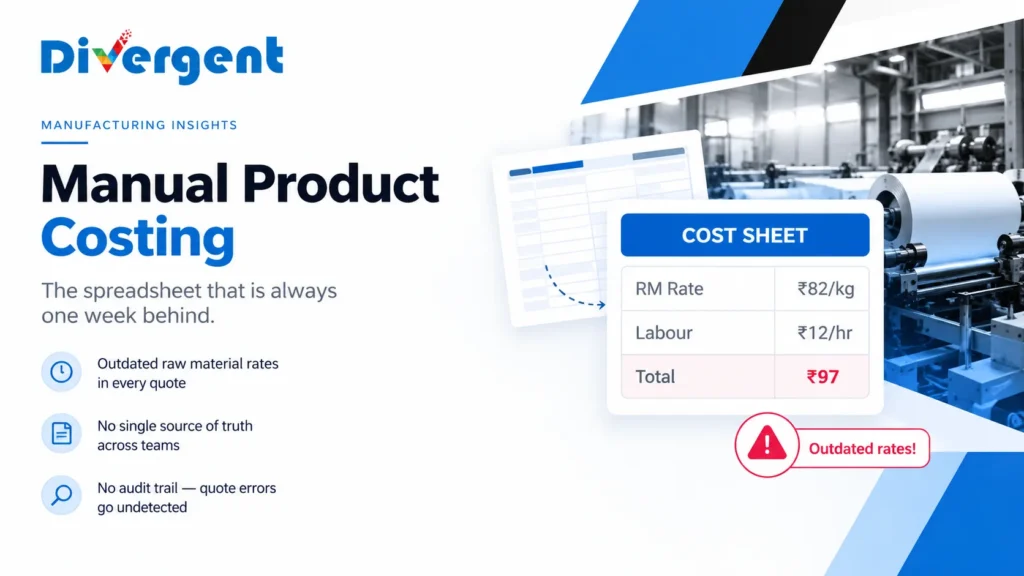
A product cost sheet needs accurate inputs across raw material rates, machine time, labour cost, overhead allocation, and wastage estimates. In a manual system, each of these inputs exists in a different file, maintained by a different person, updated at a different time.
When the sales team needs to quote a price, they pull numbers from wherever they can find them. And those numbers are almost never current.
What goes wrong:
Raw material rates in the quote are days or weeks old
Machine hour rates are calculated once a quarter and never revisited
Labour and overhead costs are estimated, not measured
No single source of truth — every team member has their own version of the cost sheet
No audit trail — if a quote is questioned later, there is no record of how it was built
The result? Quotes that look profitable on paper but start bleeding margin the moment production begins.
Read also: Inventory Management Challenges in Manufacturing
Link: https://divergentsoftlab.com/inventory-management-challenges-manufacturing
2. Complex Bill of Materials Management
For manufacturers dealing with multiple product variants, custom specifications, or multi-level assemblies, BOM management creates serious costing challenges in manufacturing that grow worse as the product range expands.
Complex BOM structures are a root cause of costing challenges in manufacturing — one outdated entry makes the entire quote wrong.
When One Change Creates Ten Errors
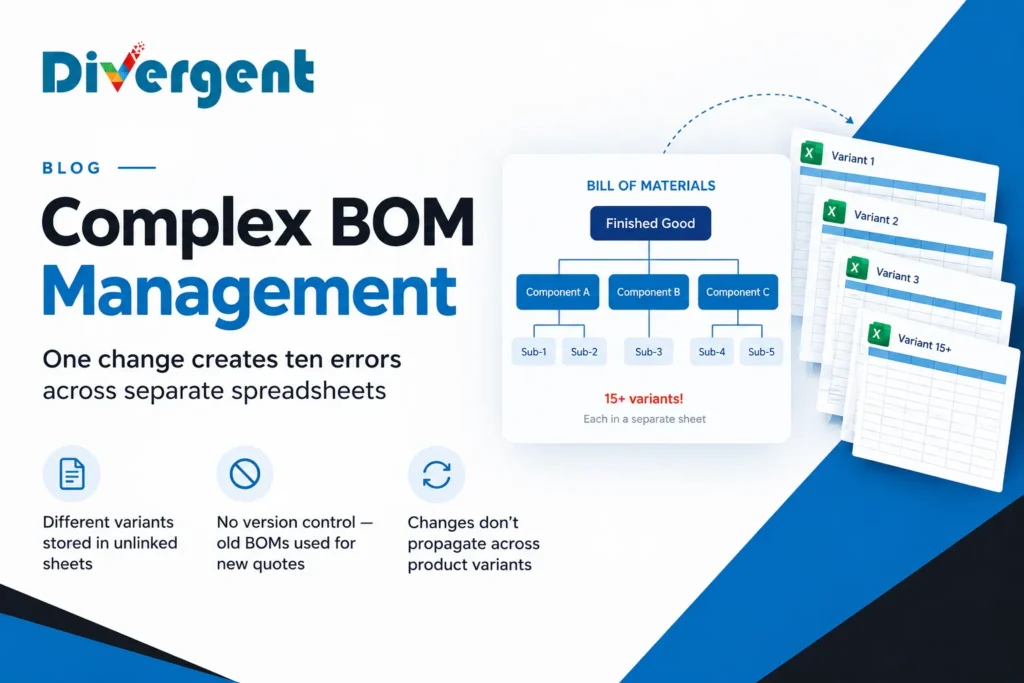
A change in one raw material requires manual updates across dozens of separate product BOMs
Different product variants are stored as separate, unlinked spreadsheets with no version control
Old BOMs get used for new quotes because no one knows which version is current
No system to verify whether actual material usage matches the BOM during production
New product introductions take days because every BOM must be built from scratch
One outdated BOM entry — a wrong quantity, a missing component, an old rate — is enough to make an entire quote unprofitable without anyone realising it until after delivery.
3. Raw Material Price Fluctuations
Raw material prices fluctuate weekly — sometimes daily — based on global supply chains, currency rates, and seasonal demand. This price volatility drives some of the worst costing challenges in manufacturing for plants without a live connected system.
When markets move and your cost sheet does not, price fluctuations become the most financially exposed costing challenges in manufacturing.
The Market Moves. Your Quote Does Not.
What goes wrong:
A quote is built on Monday’s material rates — by Thursday those rates have risen by 4 percent
Long-term contracts are quoted at fixed prices with no mechanism to absorb rate changes
Purchase and costing teams work in silos — rate changes never reach the cost sheet automatically
Margin erosion is discovered at month-end, not at the point of quotation
No alerts when an accepted quote becomes unprofitable due to a rate change
The manufacturers most exposed to this risk are those where pricing data and production data live in completely separate places with no automated connection between them.
4. Actual vs Estimated Cost Gap
The gap between what a product was estimated to cost and what it actually cost to produce is the most financially damaging of all costing challenges in manufacturing — and it is only discovered after the damage is done.
The actual vs estimated cost gap is one of the costing challenges in manufacturing that silently destroys margins order after order.
You Think You Know Your Cost. You Do Not.
What goes wrong:
Estimated costs are built on standard rates that have not been updated in months
Actual machine time, material consumption, and wastage are not tracked in real time during production
Scrap and rework costs are never included in the original quote
The cost vs actual comparison is done manually — days after production ends
By the time the gap is identified, the order is already invoiced at the wrong margin
Manufacturers who consistently underestimate their actual production cost are running a business without knowing whether each individual order is profitable or not.
5. Delayed Customer Quotations
Speed is a competitive advantage in manufacturing. Slow quotation turnaround is one of the most customer-visible costing challenges in manufacturing — and the cause is almost always internal, not external.
Delayed quotations are the most revenue-damaging of all costing challenges in manufacturing because they lose orders before production even starts.
Your Competitor Quoted in 2 Hours. You Took 2 Days.
What goes wrong:
The sales team cannot quote without inputs from the costing team
The costing team cannot build a cost sheet without current rates from purchase
Each handoff takes hours — total turnaround becomes 24 to 48 hours
Complex or custom products take even longer because the BOM must be built each time manually
Customers who needed the quote urgently have already moved to a faster competitor
In a market where the fastest accurate quote usually wins the business, a 2-day turnaround is not just a process problem — it is a direct revenue problem.
How ERP Software Solves Costing Challenges in Manufacturing
Every one of the 5 costing challenges in manufacturing above shares the same root cause — disconnected data, manual processes, and no single system connecting raw material rates to finished goods pricing in real time.
Manufacturing ERP software solves costing challenges in manufacturing by replacing every disconnected spreadsheet and manual process with one integrated platform where all inputs are live, connected, and always current.
ADD IMAGE HERE
Alt text: costing challenges in manufacturing — ERP software solutions comparison
Manual product costing — Automated cost calculation using live BOM and current material rates
Complex BOM management — Centralised BOM with version control, one change updates all products instantly
Raw material price swings — Any rate change updates all cost sheets automatically in real time
Actual vs estimated gap — Real-time production tracking compares actual vs BOM at every stage
Delayed quotations — One-click quote from live BOM and rates, accurate quote in minutes not days
This is exactly why ERP adoption has become the primary response to costing challenges in manufacturing across sectors globally.
What to Look for in a Manufacturing Costing Module
Solving costing challenges in manufacturing permanently requires more than any single tool — it requires a fully integrated ERP system built specifically for production environments.
ADD IMAGE HERE
Alt text: costing challenges in manufacturing — ERP costing module features checklist
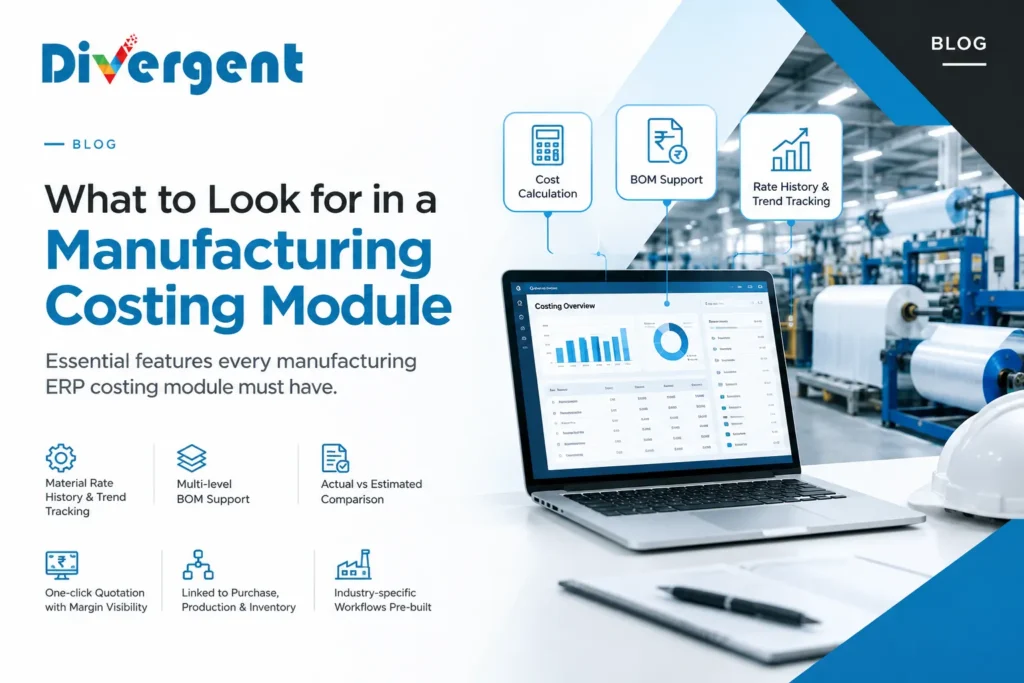
Core costing features to look for:
Live BOM-linked cost calculation — rate changes auto-update all product costs immediately
Multi-level BOM support for complex, assembled, or custom products
Material rate history and price trend tracking
Actual vs estimated cost comparison at order level and batch level
One-click quotation generation with full margin visibility before sending
Costing approval workflow before quotes reach the customer
Full integration with purchase, production, and inventory modules
The one rule that matters most:
A costing module that is not connected to the rest of the manufacturing system will recreate the same disconnection problems that spreadsheets already cause. Integration is not optional — it is the entire point.
Conclusion
Costing challenges in manufacturing are not just operational problems — they are margin problems, revenue problems, and customer relationship problems rolled into one.
Every wrong quote, every delayed response, and every post-production cost surprise is a direct result of running a complex manufacturing business on disconnected, manual costing systems.
Every category of costing challenges in manufacturing — from manual costing to slow quotations — points to the same root cause: disconnected systems and undocumented processes running a business that has outgrown them.
The manufacturers who solve these costing challenges in manufacturing permanently do it the same way — by replacing separate spreadsheets and manual handoffs with a single integrated ERP platform where every cost input is live, every quote is accurate, and every customer gets a response in hours, not days.
Identifying which of these 5 costing challenges in manufacturing is costing your plant the most right now is the right starting point. From there, the solution becomes clear.
Frequently Asked Questions — Costing Challenges in Manufacturing
Q: What are costing challenges in manufacturing?
Costing challenges in manufacturing are the financial and operational problems that arise when a plant calculates product costs manually, uses outdated raw material rates, manages BOMs in disconnected spreadsheets, or takes too long to deliver accurate quotes. The most common costing challenges in manufacturing include manual product costing, complex BOM management, raw material price volatility, the actual vs estimated cost gap, and slow quotation turnaround. These are the costing challenges in manufacturing that ERP software is specifically designed to eliminate.
Q: Why is manual product costing dangerous?
Manual product costing is dangerous because every input — raw material rate, machine cost, labour, overhead — is stored in a different file and updated at a different time. When these inputs are not connected in real time, the cost sheet is always based on old data. Even a 3 to 4 percent error in estimated material cost can wipe out the entire margin on a manufacturing order.
Q: How does ERP software fix costing challenges in manufacturing?
ERP software fixes costing challenges in manufacturing by connecting all cost inputs into one live platform. When a raw material rate changes, it updates across every linked product cost sheet automatically. When a quote is needed, the system generates it instantly from the current BOM and live rates with full margin visibility. Real-time production tracking then compares actual consumption against the estimated cost at every stage, permanently closing the cost gap. This is exactly why ERP adoption has become the primary response to costing challenges in manufacturing globally.
Q: What is the actual vs estimated cost gap in manufacturing?
The actual vs estimated cost gap is the difference between what a product was expected to cost based on the quotation and what it actually cost to produce. In plants without real-time production tracking, this gap is only discovered after the order is complete — often after the invoice has already been sent at the wrong margin. Over time, consistent underestimation of actual cost is one of the leading causes of margin erosion in manufacturing businesses.
Q: What is a Bill of Materials in manufacturing?
A Bill of Materials is a structured list of every raw material, sub-component, and consumable required to produce one unit of a finished product. It is the foundation of every product cost calculation. When a BOM is outdated or managed in disconnected spreadsheets, it becomes one of the most persistent costing challenges in manufacturing — every cost built on that BOM will be inaccurate.