
Patient access software is a set of hospital applications that manages every administrative step of a patient’s journey. These steps include scheduling, pre-registration, insurance eligibility verification, cost estimates and bill payment. In this U.S. project, all of these steps were connected to a single patient record inside the hospital’s Health Information System (HIS). The goal was to reduce duplicate records, catch eligibility issues before claims are filed, and give patients self-service control over their bills.
Denied claims, duplicate records and surprise bills rarely start in the billing office. They start at the front desk. This case study shows how patient access software connects every step of the patient journey to fix these problems at the source.
It is written for hospital leaders, revenue cycle managers and healthcare IT teams who want to understand what effective patient access software looks like in practice.
What Is Patient Access Software?
Patient access software is the technology layer that governs a patient’s administrative journey through a hospital. It typically covers five areas:
- Scheduling: booking appointments and matching patients to the right resources
- Pre-registration and registration: capturing demographic, clinical and financial data
- Insurance eligibility verification: confirming coverage and benefits with payers
- Price estimation: showing patients their expected out-of-pocket cost
- Billing and payment: letting patients view balances and pay online
In many hospitals, these functions grew up as separate tools bought at different times. Modern patient access software replaces that patchwork with one connected system. This connected system is often called the hospital’s “digital front door.”
Project Overview
This project comes from a U.S. healthcare IT provider that delivers electronic health record (EHR) and revenue cycle software to hospitals and health systems. The provider has a strong presence among community and rural hospitals across the United States.
As part of its revenue cycle platform, the provider built a patient access software suite. The suite covers every administrative touchpoint, from the first scheduling call through registration, insurance verification and final bill payment.
Who This Patient Access Software Serves
- Community, rural and regional hospitals in the United States
- Health systems that want to unify scheduling, registration and billing across multiple facilities
- Patient access, registration and revenue cycle teams responsible for reducing denials and administrative cost
The core idea is simple. Instead of treating scheduling, registration, eligibility and billing as separate systems, the patient access software brings them together around one patient record visible across the enterprise.
The Challenge: Why Hospitals Need Better Patient Access Software
Hospitals using disconnected front-end tools tend to face the same six problems. These problems show up as denials, duplicate records and patient complaints, often before a claim is even filed.
1. Fragmented Patient Touchpoints
Scheduling, registration and billing ran on separate systems. Patients experienced the hospital as a series of disconnected steps rather than one smooth journey. Staff repeated questions the patient had already answered.
2. Manual, Error-Prone Data Entry
Registration depended on manual entry of demographic, clinical and financial information. Manual entry is slow and inconsistent. It is also a leading cause of duplicate medical record numbers (MRNs), which create data integrity and patient safety risks.
3. Slow Insurance Eligibility Checks
Without real-time verification, staff had to phone payers or log into multiple payer portals to confirm coverage. This slowed registration. Worse, eligibility errors slipped through to the claims stage, where they became denials.
4. Limited Price Transparency
Patients often had no reliable estimate of what they would owe. Surprise bills hurt satisfaction and slowed collections. Price transparency is also a regulatory priority in the U.S. under the CMS Hospital Price Transparency rule and the No Surprises Act.
5. High Administrative Cost
Manual verification, paper statements and phone-based collections took up large amounts of staff time. All of that raised the hospital’s cost to collect.
6. Low Patient Engagement in Billing
Without self-service options, patients couldn’t easily check balances or pay when it suited them. The result was more inbound phone calls for routine questions.
The root cause: data captured at one step did not flow automatically to the next. Good patient access software solves this in the system design, not through workarounds.
The Solution: How the Patient Access Software Works
The solution is a connected set of applications covering the full front-end revenue cycle. Every module ties back to a single patient record inside the hospital’s HIS.
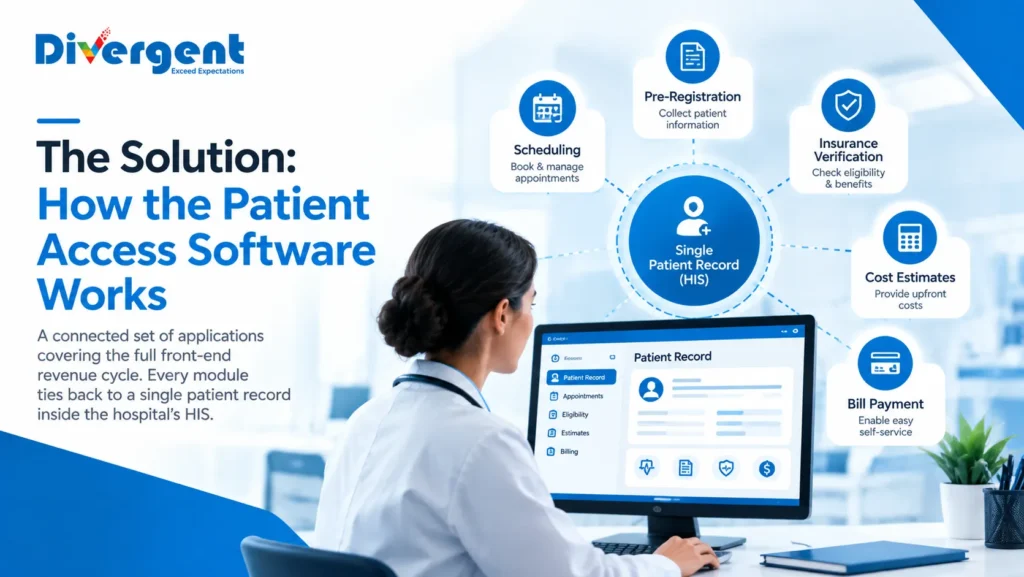
| Module | What It Does |
|---|---|
| Online / Pre-Registration | Pulls a patient’s medical and financial information directly into the HIS, verifies eligibility, checks medical necessity and generates the admission notice |
| Scheduling | Matches patients to the right resources with built-in conflict checks and prerequisite warnings |
| Real-Time Insurance Eligibility | Connects to a national healthcare clearinghouse to verify eligibility and benefits before scheduling, at registration and while working denials |
| Charge Estimator | Gives patients an upfront, facility-specific estimate based on the hospital’s own historical charge data |
| Online Bill Pay & Account Access | Lets patients view balances and pay on their own schedule |
Online Pre-Registration
Pre-registration moves data capture ahead of the visit. Patients or staff enter information once, and it lands directly in the HIS. The module also runs eligibility and medical necessity checks automatically. This cuts the manual entry that causes duplicate records.
Smart Scheduling
The scheduling module checks for resource conflicts. It also warns staff about missing prerequisites, such as a test that must happen before a procedure. Catching these gaps at booking time prevents cancellations and rework later.
Real-Time Insurance Eligibility Verification
This is one of the highest-value parts of any patient access software. Through a connection with a national healthcare clearinghouse, staff can verify coverage and benefits at three points:
- Before scheduling
- At registration
- While working denials
There is no need to call payers or log into separate portals.
Charge Estimator
The Charge Estimator gives patients a facility-specific cost estimate based on the hospital’s own historical data. This improves price transparency and helps patients plan their finances before care.
Online Bill Pay and Account Access
Patients can view balances and make payments at any time. This moves simple transactions away from phone calls and paper statements.
The Architecture That Makes It Work
The key design decision is that every module writes back to one patient record. Information captured at scheduling carries through to registration, eligibility and billing. Nothing is re-entered at each stage. This single-record approach is what separates true patient access software from a bundle of loosely connected tools.
Business Impact of Patient Access Software
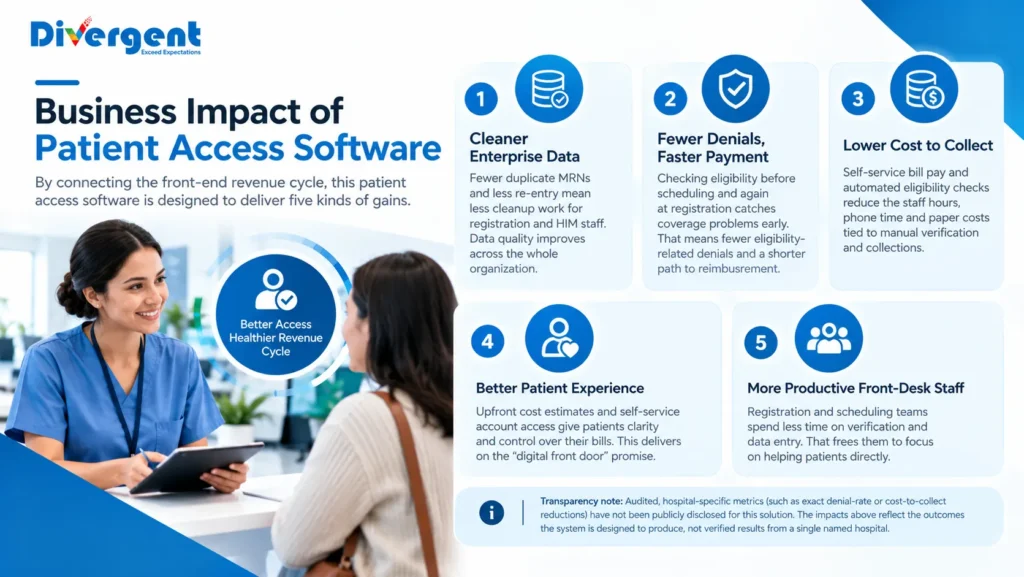
By connecting the front-end revenue cycle, this patient access software is designed to deliver five kinds of gains.
1. Cleaner Enterprise Data
Fewer duplicate MRNs and less re-entry mean less cleanup work for registration and Health Information Management (HIM) staff. Data quality improves across the whole organization.
2. Fewer Denials, Faster Payment
Checking eligibility before scheduling and again at registration catches coverage problems early. That means fewer eligibility-related denials and a shorter path to reimbursement.
3. Lower Cost to Collect
Self-service bill pay and automated eligibility checks reduce the staff hours, phone time and paper costs tied to manual verification and collections.
4. Better Patient Experience
Upfront cost estimates and self-service account access give patients clarity and control over their bills. This delivers on the “digital front door” promise.
5. More Productive Front-Desk Staff
Registration and scheduling teams spend less time on verification and data entry. That frees them to focus on helping patients directly.
Transparency note: Audited, hospital-specific metrics (such as exact denial-rate or cost-to-collect reductions) have not been publicly disclosed for this solution. The impacts above reflect the outcomes the system is designed to produce, not verified results from a single named hospital.
Key Lessons for Hospitals Choosing Patient Access Software
- Start with one patient record. Integration added later rarely fixes duplicate data. The single-record design has to come first.
- Verify eligibility more than once. One check at registration is not enough. Checking before scheduling and during denial work catches far more issues.
- Treat price transparency as a patient experience feature. Cost estimates build trust, not just compliance.
- Make self-service the default. Every routine payment made online is one less phone call.
- Measure the right numbers. Track duplicate MRN rate, eligibility-related denial rate, cost to collect and call volume before and after rollout.
How Divergent Software Labs Builds Healthcare Platforms
At Divergent Software Labs, we design and develop custom healthcare software for hospitals and health networks. We apply the same principles that make patient access software effective: a unified patient record, automated verification and patient-friendly self-service.
Our work includes our Integrated Health Management Information System (IHMIS) case study. In that project, we connected clinical and administrative units across multiple hospital facilities in a single platform.
If your hospital struggles with disconnected registration, scheduling or billing systems, we can help you:
- Review your current front-desk workflows and data gaps
- Design a single-patient-record architecture
- Build or integrate registration, scheduling, eligibility and billing modules
- Develop patient-facing web and mobile portals
Talk to our healthcare software team
Frequently Asked Questions
What is patient access software in a hospital?
Patient access software manages a patient’s administrative journey, including scheduling, pre-registration, insurance eligibility verification, cost estimates and bill payment. It connects these steps to a single patient record, so data doesn’t need to be entered twice.
How does patient access software reduce claim denials?
It verifies insurance eligibility in real time, before scheduling and at registration. This catches coverage problems before a claim is submitted. Eligibility errors are among the most common and most preventable causes of denials.
What is a hospital “digital front door”?
A digital front door is the connected set of online and in-person tools patients use to access a hospital, such as scheduling, registration, cost estimates and payments. Patient access software is the core technology behind it.
What modules does patient access software usually include?
Most patient access software includes online pre-registration, scheduling, real-time insurance eligibility verification, a charge estimator, and online bill pay with account access.
Why do duplicate medical record numbers happen?
Duplicate MRNs usually come from manual data entry across disconnected systems, where the same patient gets registered more than once with slightly different details. A single patient record with automated data capture greatly reduces this risk.
Can patient access software be custom-built?
Yes. Hospitals that need specific workflows, local payer integrations or multi-facility setups often choose custom patient access software built to work with their existing HIS or EHR.