ERP for BOPP film manufacturers is industry-specific enterprise software that manages recipe-based production planning, roll- and reel-based inventory, batch-level traceability, and quality control for biaxially oriented polypropylene (BOPP) film production — built around how a film plant actually runs, instead of adapted from generic accounting-first software.
Quick Answer
- What it does: Connects production planning, raw material costing, batch traceability, and quality control in one system
- Who needs it: BOPP film manufacturers running multi-grade extrusion, coating, and slitting operations
- How it differs from generic ERP: Native support for recipes, roll/reel-based inventory, and batch traceability — not spreadsheets bolted onto software that wasn’t built for the shop floor
- Typical benefits: Lower scrap, faster order turnaround, real-time margin visibility, easier compliance
Why does this matter?
BOPP film manufacturing involves multi-layer extrusion, precise thickness and micron control, coating/metallizing steps, and variable roll-based inventory — none of which a generic accounting-first ERP was ever designed to handle well. Without a purpose-built system, the result is usually the same: quality issues caught too late, and margins that are hard to track until the month-end books close.
This guide walks through what BOPP film ERP software actually needs to do, the features worth paying for, how to choose the right one, and what implementation really looks like — based on what we’ve seen work (and not work) while building ERP systems for plastics and industrial packaging manufacturers.
Table of Contents
- What Is BOPP Film Manufacturing?
- Why BOPP Film Manufacturers Need Specialized ERP
- Key Features to Look for in BOPP Film ERP Software
- Benefits of Implementing ERP for BOPP Film Manufacturers
- How to Choose the Right ERP for Your BOPP Film Business
- Common Implementation Challenges (and How to Avoid Them)
- A Real-World Lens: Lessons from FIBC and Plastic Packaging ERP
- Future Trends: AI and IoT in BOPP Film Manufacturing ERP
- Glossary of Key Terms
- Frequently Asked Questions
- Key Takeaways
- Conclusion
1. What Is BOPP Film Manufacturing?
BOPP (Biaxially Oriented Polypropylene) film is a thin, transparent plastic film produced by stretching extruded polypropylene simultaneously in both the machine direction and the transverse direction. This biaxial stretching gives the film its clarity, strength, and barrier properties, which is why it’s used everywhere from food packaging and labels to tapes, cigarette wrapping, and lamination.
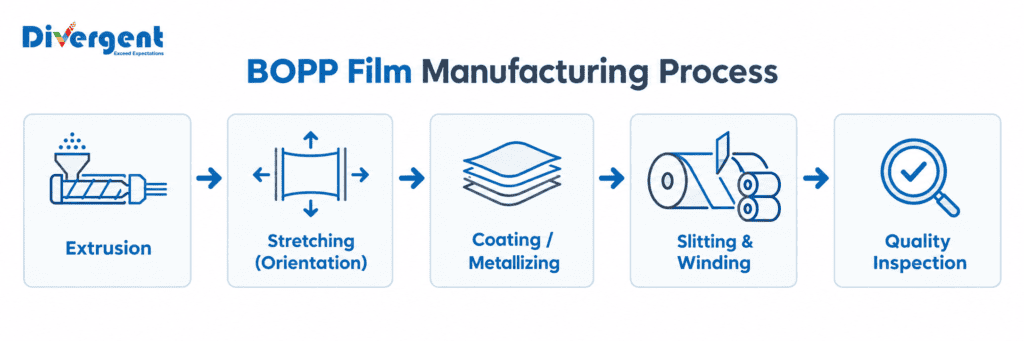
A typical BOPP film production line includes:
- Extrusion — melting and forming the base polypropylene sheet
- Stretching (orientation) — the biaxial stretching stage that defines film properties
- Coating or metallizing (for specialty grades) — adding heat-seal, print, or barrier layers
- Slitting and winding — cutting the master roll into finished rolls of specific widths and lengths
- Quality inspection — checking thickness (micron), haze, tensile strength, and coefficient of friction (COF)
Every one of these stages generates data that, in most factories, still lives in disconnected spreadsheets, paper logs, or machine-specific software. That fragmentation is exactly the gap that a well-built ERP for BOPP film manufacturers is meant to close.
2. Why BOPP Film Manufacturers Need Specialized ERP
Generic ERP systems are usually built around accounting and basic inventory — good enough for a trading company, not for a continuous-process plastics manufacturer. Here’s where the gap shows up in real BOPP film operations.
1. Complex, Multi-Grade Production
A single BOPP film plant might run dozens of film grades — different micron thickness, width, coating type, and treatment level — often on the same line in back-to-back batches. A generic ERP has no concept of “recipe” or “grade specification,” so planners end up tracking this in Excel alongside the ERP, not inside it. This is exactly the gap a purpose-built ERP for BOPP film manufacturers is designed to close.
2. Continuous-Process Scheduling
Unlike discrete manufacturing (assemble part A, then part B), film extrusion is a continuous process where changeovers are expensive — every grade change means downtime, scrap, and setup cost. Scheduling software for BOPP film manufacturers needs to minimize changeovers, not just fill a calendar.
3. Roll-Based Inventory, Not Unit-Based Inventory
Finished goods aren’t “10 units” — they’re rolls with variable length, width, weight, and grade, and they get slit down into smaller rolls per customer order. A BOPP film ERP needs to track inventory in these variable, roll-based units natively.
4. Raw Material Cost Volatility
Polypropylene resin and additive prices fluctuate constantly. Without real-time raw material costing tied to production, it’s very difficult to know your actual margin on a given order until the month-end books close — by which point it’s too late to adjust pricing or sourcing. A real-time-costing ERP for BOPP film manufacturers closes exactly this gap.
5. Quality and Compliance Requirements
Food-grade and pharma-grade BOPP film applications require batch-level traceability, certificates of analysis, and compliance documentation (ISO quality standards, FDA-contact-grade materials, customer-specific QA formats). Generic ERP systems rarely have a quality module that maps to this reality out of the box — this is precisely where dedicated BOPP film ERP software earns its keep.
6. High Scrap and Regrind Sensitivity
Scrap and regrind (reprocessed film waste) materially affect both cost and quality if not tracked and reintroduced into production correctly. A well-built ERP for BOPP film manufacturers treats regrind as a first-class inventory item, not an afterthought — most non-specialized systems simply don’t have a workflow for this.
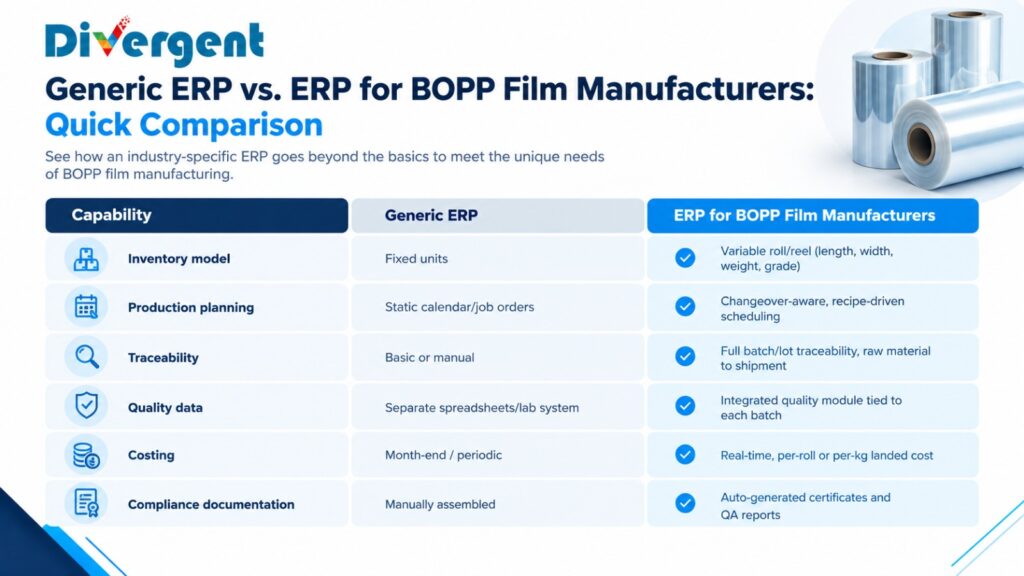
Generic ERP vs. ERP for BOPP Film Manufacturers: Quick Comparison
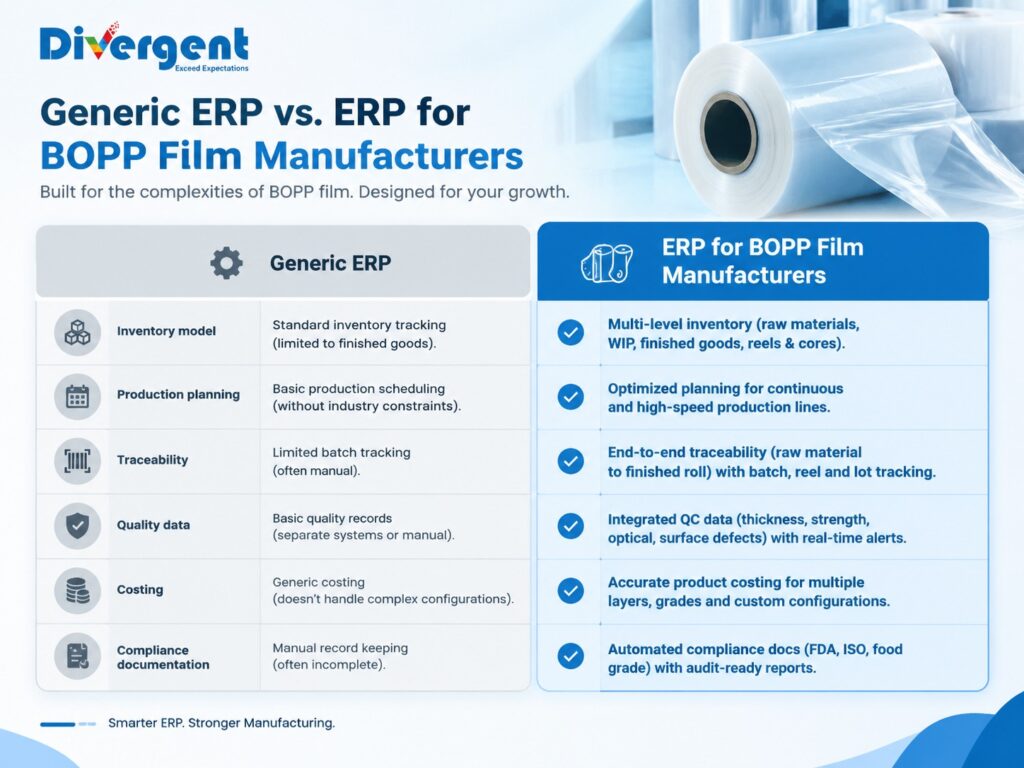
| Capability | Generic ERP | ERP for BOPP Film Manufacturers |
| Inventory model | Fixed units | Variable roll/reel (length, width, weight, grade) |
| Production planning | Static calendar/job orders | Changeover-aware, recipe-driven scheduling |
| Traceability | Basic or manual | Full batch/lot traceability, raw material to shipment |
| Quality data | Separate spreadsheets/lab system | Integrated quality module tied to each batch |
| Costing | Month-end / periodic | Real-time, per-roll or per-kg landed cost |
| Compliance documentation | Manually assembled | Auto-generated certificates and QA reports |
The core issue isn’t features — it’s the data model. A generic ERP simply has no place to store a “recipe” or a “roll,” so BOPP film manufacturers end up rebuilding half the system in spreadsheets anyway.
3. Key Features to Look for in BOPP Film ERP Softwar
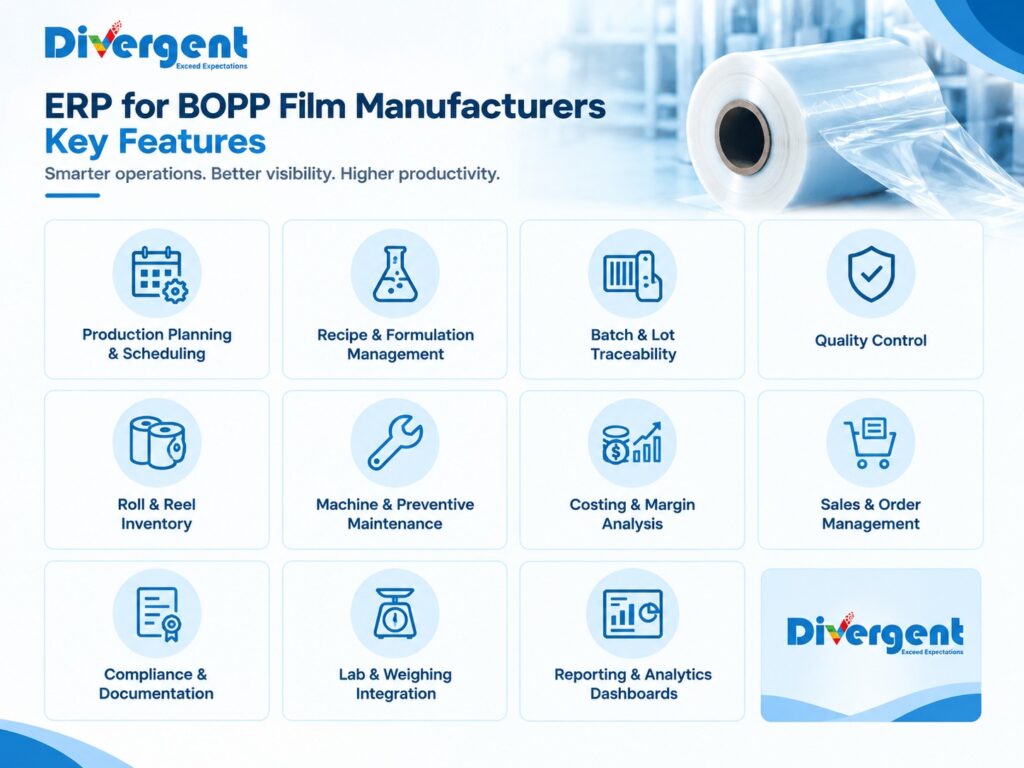
If you’re evaluating vendors, this is the feature checklist that actually matters for a BOPP film manufacturer — not the generic “modules” list most ERP brochures lead with.
1. Production Planning & Scheduling Sequencing that understands changeover cost between grades, and that can plan around extrusion line capacity in real time, not just a static calendar.
2. Recipe & Formulation Management Every film grade should be a stored “recipe” — resin ratios, additive percentages, coating specs, target thickness — so operators pull the exact spec instead of relying on memory or a printed sheet.
3. Batch & Lot Traceability Full forward and backward traceability from raw material lot to finished roll to customer shipment. This is non-negotiable for food-contact and export-grade film, and it’s one of the first things auditors ask for.
4. Quality Control Module Structured recording of thickness, haze, gloss, tensile strength, COF, and other lab test results, tied directly to the batch — with automatic flagging when results fall outside spec.
5. Roll & Reel Inventory Management Native support for variable-dimension inventory (length, width, weight, grade) instead of forcing rolls into a fixed “unit” model built for discrete parts.
6. Machine & Preventive Maintenance Scheduled maintenance for extrusion lines, winders, and slitters — because unplanned downtime on a continuous-process line is far more expensive than on discrete equipment.
7. Costing & Margin Analysis Real-time landed cost per roll or per kg, factoring in resin price, additive cost, energy, and scrap rate — so sales knows the actual margin before quoting, not after.
8. Sales & Order Management Order entry that understands grade, width, micron, and core specifications, with the ability to slit a master order into multiple customer-specific rolls.
9. Compliance & Documentation Automated generation of certificates of analysis, ISO documentation, and customer-specific QA reports tied to the batch record.
10. Integration with Lab & Weighing Equipment Direct data capture from lab instruments and weighing scales, instead of manual re-entry that introduces errors and delays.
11. Reporting & Analytics Dashboards Real-time visibility into OEE (overall equipment effectiveness), scrap rate, on-time delivery, and margin by grade — the metrics that actually drive plant-level decisions.
4. Benefits of Implementing ERP for BOPP Film Manufacturers
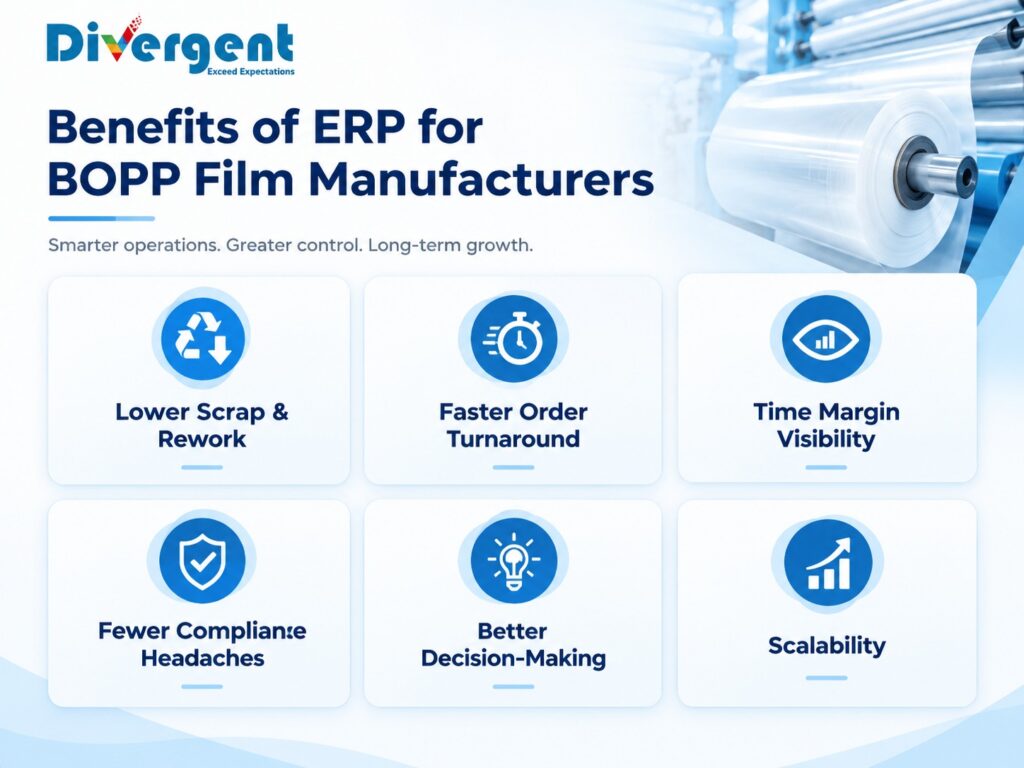
When these features come together in a purpose-built ERP for BOPP film manufacturers, the impact shows up in a few consistent places:
- Lower scrap and rework — because recipes, changeovers, and quality checks are standardized instead of dependent on individual operator memory
- Faster order turnaround — because planning, inventory, and slitting instructions are connected end to end
- Real-time margin visibility — because raw material and production costs update as they happen, not at month-end
- Fewer compliance headaches — because batch traceability and certificates generate automatically instead of being assembled manually before every audit
- Better decision-making — because plant managers see OEE, scrap, and delivery performance on one dashboard instead of piecing it together from five systems
- Scalability — because adding a new grade, line, or plant doesn’t mean rebuilding your tracking process from scratch
These aren’t hypothetical gains — they’re the same categories of improvement we’ve seen play out in adjacent plastics and industrial packaging manufacturing, where the production complexity (multi-stage processing, batch traceability, roll/bundle-based inventory) closely mirrors what BOPP film manufacturers deal with.
5. How to Choose the Right ERP for Your BOPP Film Business
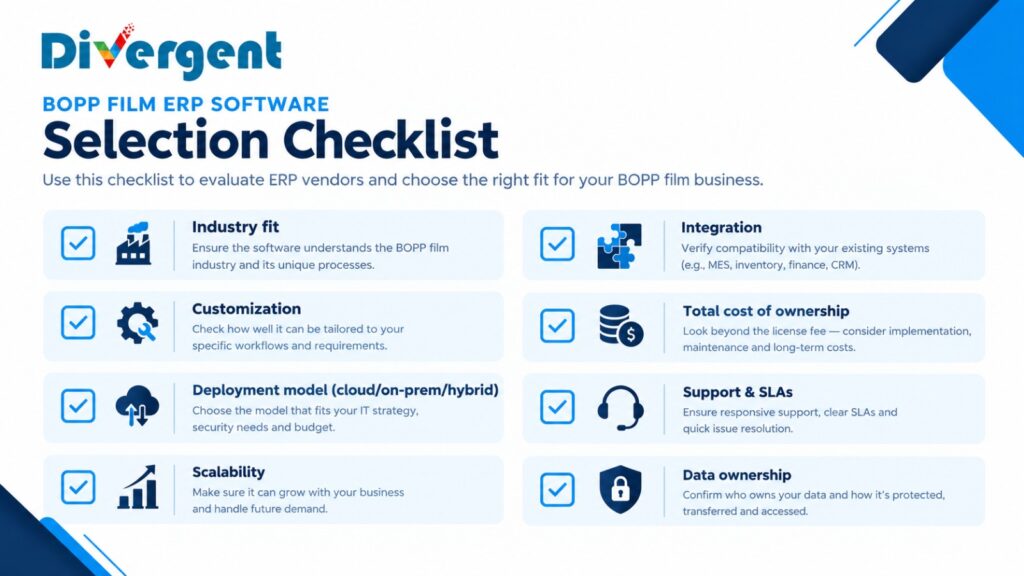
Use this checklist when you’re evaluating vendors or proposals:
| Criteria | What to Ask |
| Industry fit | Does the vendor understand roll-based inventory and recipe management, or are you the one explaining your process to them? |
| Customization | Can the system be configured to your specific grades, specs, and workflows without a full custom rebuild? |
| Deployment model | Cloud, on-premise, or hybrid — which fits your IT setup and plant connectivity? |
| Scalability | Will it handle a second line or plant without a system change? |
| Integration | Can it connect to your lab instruments, weighing scales, and accounting software? |
| Total cost of ownership | Licensing, implementation, training, and ongoing support — not just the sticker price |
| Support & SLAs | What happens when a production-critical issue comes up at 2 a.m.? |
| Data ownership | Do you fully own and can export your production data if you ever switch systems? |
A generic ERP will check some of these boxes on paper. An ERP for BOPP film manufacturers built specifically for plastics and film production will check all of them in practice.
6. Common Implementation Challenges (and How to Avoid Them)
Resistance from the shop floor. Operators who’ve run a line on instinct and a paper log for years won’t switch overnight. Involve them early, and make sure the interface is built for the plant floor, not for a back office.
Data migration from spreadsheets. Years of production history, recipes, and customer specs are often scattered across files. Budget real time for a proper data cleanup and migration plan — don’t treat it as an afterthought.
Underestimating integration work. Lab equipment, weighing scales, and legacy accounting systems all need to talk to the new ERP. Confirm integration scope and cost before signing, not after.
Trying to do everything at once. Rolling out production planning, quality, inventory, and finance simultaneously is a common way to stall a project. A phased rollout — starting with production and inventory, then layering in quality and finance — tends to succeed more often.
Get these five right, and an ERP for BOPP film manufacturers rollout is far more likely to land on time and on budget.
7. A Real-World Lens: Lessons from FIBC and Plastic Packaging ERP
At Divergent Software Labs, we built FIBC Pro — an ERP specifically for FIBC (bulk bag) manufacturers — because the same problem kept showing up: generic ERP systems simply don’t model the reality of industrial plastics and packaging production. Batch-level traceability, recipe-driven manufacturing, roll or bundle-based inventory, and scrap tracking are recurring needs across FIBC, BOPP film, and other plastics processing verticals.
The lesson that carries over directly to an ERP for BOPP film manufacturers: the system has to be built around how your plant actually runs, grade by grade, batch by batch, roll by roll — not retrofitted from a system designed for a completely different kind of business.
8. Future Trends: AI and IoT in BOPP Film Manufacturing ERP
A few developments worth watching as you plan your BOPP film ERP software investment for the next few years:
- IoT-connected extrusion lines feeding real-time thickness, speed, and temperature data directly into the ERP, reducing manual quality logging
- AI-assisted production scheduling that automatically sequences grade changeovers to minimize scrap and downtime
- Predictive maintenance using machine sensor data to flag equipment issues before they cause unplanned stoppages
- AI-driven demand forecasting to better align raw material procurement with actual order patterns, reducing resin inventory carrying costs
- Cloud-based multi-plant dashboards for manufacturers scaling across multiple facilities or export markets
None of these replace the fundamentals in Section 3 — they extend them. A plant that hasn’t nailed batch traceability and recipe management on a solid ERP for BOPP film manufacturers foundation isn’t ready to layer AI scheduling on top of it.
9. Glossary of Key Terms
Knowing these terms will help you evaluate any ERP for BOPP film manufacturers more confidently in vendor conversations.
BOPP (Biaxially Oriented Polypropylene): A plastic film stretched in two directions during manufacturing to improve clarity, strength, and barrier properties.
ERP (Enterprise Resource Planning): Software that connects planning, inventory, production, and finance into one system.
MES (Manufacturing Execution System): Software focused on real-time shop-floor execution, often working alongside or within an ERP.
Recipe/Formulation Management: ERP functionality that stores exact material ratios and process specs for each product grade.
Batch/Lot Traceability: The ability to trace a finished product back to the exact raw material batch and process conditions used to make it.
OEE (Overall Equipment Effectiveness): A metric combining availability, performance, and quality to measure how effectively equipment is used.
COF (Coefficient of Friction): A film property measured during quality testing that affects how film behaves on packaging machinery.
Regrind: Scrap film that is reprocessed and reintroduced into production rather than discarded.
10. Frequently Asked Questions
What is the best ERP for BOPP film manufacturers?
There isn’t a single “best” system for every plant — the right ERP for BOPP film manufacturers is one built around recipe management, roll-based inventory, and batch traceability, and configured to your specific grades, lines, and compliance needs.
How much does ERP for BOPP film manufacturing cost?
Cost varies widely based on plant size, number of lines, deployment model (cloud vs. on-premise), and how much customization is needed — it’s best evaluated against total cost of ownership, not just the license price.
Can a generic ERP work for a BOPP film plant?
It can handle accounting and basic inventory, but a generic system typically struggles with recipe-based production, roll/reel inventory, and batch traceability — which is exactly why manufacturers move to a dedicated ERP for BOPP film manufacturers instead.
How long does ERP implementation take for a film manufacturer?
A phased rollout — production and inventory first, then quality and finance — typically takes a few months to a year depending on plant complexity and how much data migration is involved.
Is cloud-based ERP suitable for plastics manufacturing plants?
Yes, for most manufacturers — cloud ERP offers easier multi-plant visibility and lower upfront infrastructure cost, though plants with unreliable connectivity may prefer a hybrid or on-premise setup for shop-floor systems.
What’s the difference between ERP and MES for a BOPP film plant?
ERP manages planning, inventory, orders, and finance at the business level; MES (Manufacturing Execution System) manages real-time shop-floor execution. Many modern ERP systems for plastics manufacturers now include MES-like functionality for smaller and mid-sized plants.
11. Key Takeaways
- ERP for BOPP film manufacturers needs to be built around recipes, roll/reel inventory, and batch traceability — not adapted from generic accounting software
- The biggest gaps in generic ERP show up in scheduling, inventory, costing, and compliance
- Real-time margin visibility and lower scrap are the two benefits manufacturers notice fastest
- Choosing the right system means checking industry fit, customization, integration, and total cost of ownership — not just price
- A phased rollout (production and inventory first) succeeds more often than an all-at-once implementation
12. Conclusion
Choosing the right ERP for BOPP film manufacturers matters because BOPP film manufacturing is precise, continuous, and unforgiving of the wrong tools — which is exactly why a generic ERP so often falls short on the plant floor The manufacturers who get the most value from their ERP investment are the ones who choose a system built around recipe management, roll-based inventory, batch traceability, and real production scheduling — not a system they have to constantly work around.
If you’re evaluating ERP for BOPP film manufacturers, start with the checklist in Section 5, be honest about which generic systems fall short on your actual shop-floor workflows, and talk to a team that has built ERP specifically for plastics and industrial packaging manufacturing.
Ready to see what a purpose-built ERP could look like for your plant?
Contact our ERP team at Divergent Software Labs to talk through your specific production setup.
BOPP film ERP software, ERP software for plastic film manufacturing, BOPP manufacturing ERP solution, ERP for plastic packaging industry, BOPP film production management software, ERP for extrusion industry