One failed batch can delay a whole container of jumbo bags. In 2027, AI-powered ERP for FIBC manufacturing helps plants catch problems like that early. It turns the data already in your ERP into forecasts, alerts and clear next steps, instead of reports nobody has time to read.
This guide explains what that means in plain words. You will see where AI fits in each production stage, what data you need, which mistakes to avoid, and how to start without a risky, expensive overhaul.
The short answer: AI does not replace your ERP. It sits on top of it and helps in five areas: demand forecasting, raw-material planning, machine maintenance, quality and traceability. It works best with clean data and one focused first project.
Table of Contents
- What Is AI-Powered ERP for FIBC Manufacturing?
- How a FIBC Is Made, and Where the Data Comes From
- Why Planning a FIBC Factory Is Harder Than It Looks
- 7 Ways AI Is Changing FIBC Production
- Traditional ERP vs. AI-Powered ERP for FIBC Manufacturing
- Production Stage vs. AI Use Case
- A Walk Through One Order: An Illustrative Example
- The Data You Need Before You Start
- How to Start in 5 Simple Steps
- 5 Mistakes to Avoid
- Tally, SAP or Another System?
- Trends to Watch in 2027
- Honest Limits and Risks
- How to Measure Success
- Questions to Ask Before You Buy
- Frequently Asked Questions
- Conclusion
What Is AI-Powered ERP for FIBC Manufacturing?
An ERP system connects finance, inventory, purchasing, production and sales in one database. Everyone works from the same numbers.
AI-powered ERP for FIBC manufacturing adds machine-learning models and smart assistants on top of that data. They look for patterns, predict what may happen next and suggest what to do about it.
IBM describes common uses such as predictive maintenance, which typically relies on IoT sensors or digital twins, and demand forecasting linked to inventory so stockouts can be avoided.
AI can arrive in three ways. It can be built into the ERP, added as a separate layer, or connected through integrations. The right route depends on the system you already run.
What is a FIBC?
A flexible intermediate bulk container, or FIBC, is also called a jumbo bag, bulk bag, big bag or tonne bag. It is a flexible fabric container for storing and moving dry, flowable products such as sand and fertiliser.
How a FIBC Is Made, and Where the Data Comes From
Every production step creates data. That data is the raw material for AI. According to manufacturers such as Palmetto Industries, the process runs through extrusion, weaving, cutting, stitching and testing.
Extrusion and tape making
Polypropylene resin and additives go into an extruder, which produces tapes. Useful data here includes resin lot, additive mix, output and wastage.
Weaving and fabric rolls
The tapes are woven into fabric. Loom runtime, stoppages and roll counts tell you how healthy your weaving section is.
Cutting and stitching
Computer-controlled equipment cuts the fabric into panels. Workers then sew the panels into bags and add filler cords to the seams. Job cards, panel counts and stitching-line output are the key records.
Testing and dispatch
Bags move through testing before final approval and dispatch. Test results, rejects and lot numbers link each bag back to its materials.
Many plants record some of this on paper or in spreadsheets. AI-powered ERP for FIBC manufacturing only works well when these steps are captured in one connected system.
Why Planning a FIBC Factory Is Harder Than It Looks
Planning is hard for three reasons. Every order differs (size, loops, liner, print, safe working load). Resin prices keep moving. And one failed batch can hold up a customer’s whole shipment.
Standard ERP planning, such as material requirements planning, follows fixed rules. It does not learn from past delays, machine behaviour or order patterns.
Spreadsheets add another problem. When each department keeps its own file, nobody sees the full picture until something goes wrong.
7 Ways AI Is Changing FIBC Production
Here is where AI-powered ERP for FIBC manufacturing makes the biggest practical difference.
1. Smarter demand forecasting
FIBC demand follows customer industries such as chemicals, fertiliser, food, minerals and construction. Each has its own seasons.
Traditional forecasting leans on past internal sales. AI models can add order patterns, lead times and, where available, outside data. The result is fewer emergency orders and less excess stock.
Panorama Consulting cautions that accuracy depends heavily on the quality of demand signals and the detail of your data.
2. Better raw-material planning
Resin, UV masterbatch and other additives are your biggest cost lines. AI can suggest what to buy and when, using forecast demand, supplier lead times and current stock.
It will not reliably predict a sudden resin price shock. Treat its suggestions as input for your purchasing team, not as automatic orders.
3. Predictive maintenance on key machines
An unplanned loom or extruder stoppage delays orders and wastes material. When machines send vibration, temperature or runtime data, models can flag patterns that often come before a failure.
This lets you schedule predictive maintenance at a quiet time, instead of reacting at the worst moment.
No sensors yet? Start with the maintenance logs your ERP already holds. Past breakdown dates and repair notes are useful data.
4. Quality control and defect flagging
Quality runs through the whole process: extrusion, weaving, laminating, cutting, stitching and finishing. Some manufacturers publish their own numbers. For example, Rishi FIBC states that its bags pass over 200 quality checks. That is a company claim, not an industry benchmark.
AI helps by linking inspection results to batch, machine, operator and material lot. It then shows which combinations produce the most rejects.
5. Batch and lot traceability
Customers in food, pharma and chemicals often ask where a specific bag’s resin and fabric came from. When the ERP records lot numbers at each stage, traceability becomes a quick search instead of a long hunt.
AI assistants can answer plain-language questions, such as “Which bags used this resin lot?” This works only if the data was captured at the time.
6. Production scheduling and order promising
A good schedule weighs machine capacity, material availability and due dates. AI-assisted scheduling can suggest realistic delivery dates and cut changeover time between bag specifications.
Large producers already use in-house systems for this. For example, Kanpur Plastipack’s FY26 investor presentation says its proprietary ERP supports real-time, process-driven decisions.
7. Smarter costing and wastage control
Real order cost depends on resin use, scrap, machine time and rework. AI can compare planned and actual consumption for each order and highlight where material is leaking away.
Over time, this makes quotes more accurate. You can see which bag types earn a healthy margin and which only look busy.
Traditional ERP vs. AI-Powered ERP for FIBC Manufacturing
Many FIBC plants already run a traditional ERP. It records what happened. AI-powered ERP for FIBC manufacturing adds a view of what is likely to happen next.
| Question | Traditional ERP | AI-powered ERP |
|---|---|---|
| Purchasing | Reorder levels set by hand | Suggested quantities and timing from forecast demand |
| Maintenance | Fixed schedule or repair after failure | Alerts based on machine patterns |
| Quality | Reports after rejects appear | Early flags linking rejects to cause |
| Planning | Fixed rules | Schedules that weigh capacity, material and due dates |
| Questions | Needs a report built by IT | Plain-language answers from an assistant |
The jump is not from paper to AI. It is from looking back to looking ahead. That shift is why AI-powered ERP for FIBC manufacturing is a hot topic for plant owners today.
Production Stage vs. AI Use Case
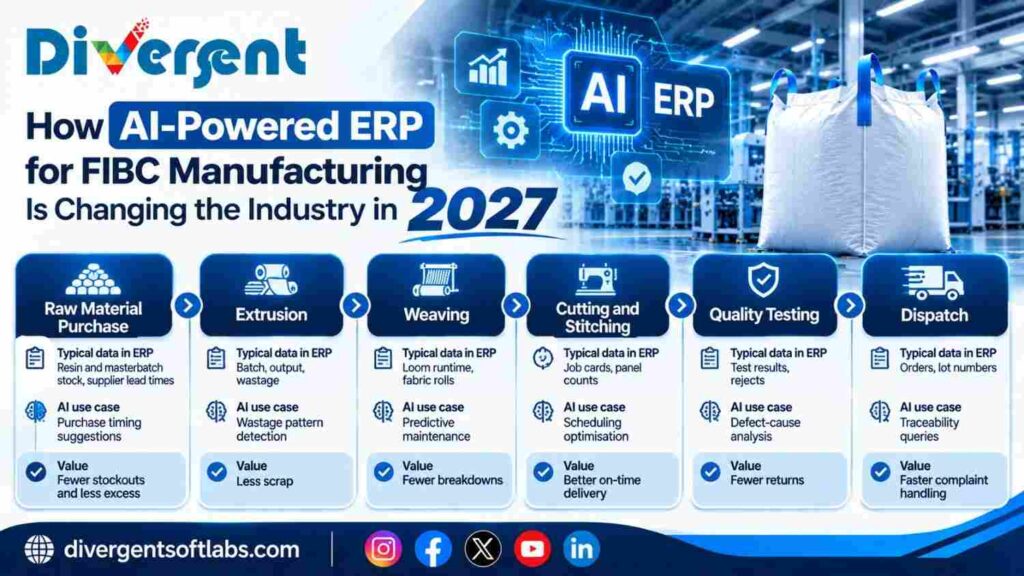
This table shows how AI-powered ERP for FIBC manufacturing maps to each stage.
| Stage | Typical data in ERP | AI use case | Value |
|---|---|---|---|
| Raw material purchase | Resin and masterbatch stock, supplier lead times | Purchase timing suggestions | Fewer stockouts and less excess |
| Extrusion | Batch, output, wastage | Wastage pattern detection | Less scrap |
| Weaving | Loom runtime, fabric rolls | Predictive maintenance | Fewer breakdowns |
| Cutting and stitching | Job cards, panel counts | Scheduling optimisation | Better on-time delivery |
| Quality testing | Test results, rejects | Defect-cause analysis | Fewer returns |
| Dispatch | Orders, lot numbers | Traceability queries | Faster complaint handling |
A Walk Through One Order: An Illustrative Example
The example below is hypothetical. It shows how the pieces could work together. It is not a real client story and the plant is not real.
A buyer asks for 2,000 bags with a liner and a printed logo. Here is what a connected system could do.
- Quote: The ERP checks resin stock, loom capacity and past waste on similar bags, then suggests a realistic price and delivery date.
- Purchase: It notices that resin stock will run short in ten days and prompts the buyer to order early.
- Production: A weaving machine shows an unusual pattern. The system alerts maintenance before it stops.
- Quality: Rejects rise on one stitching line. The system links them to a new thread lot.
- Dispatch: Lot numbers are stored, so the customer’s later question about materials takes minutes to answer.
None of this needs magic. It needs clean records and a team that acts on the alerts.
The Data You Need Before You Start
AI is only as good as the data behind it. Before choosing any tool, check these basics.
- Are orders and bills of materials stored in one system?
- Are resin and fabric lot numbers recorded at each stage?
- Is machine downtime logged with a reason?
- Are rejects recorded by batch, machine and cause?
- Do supervisors enter data on the shop floor or hours later?
If several answers are “no”, fix that first. This step is not glamorous, but it decides whether AI-powered ERP for FIBC manufacturing delivers value or noise.
How to Start in 5 Simple Steps
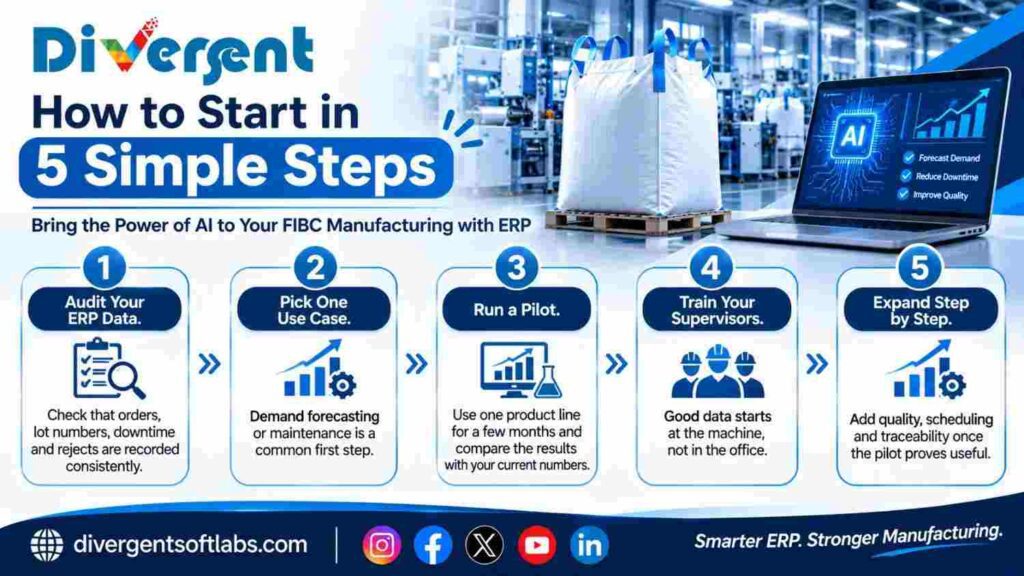
- Audit your ERP data. Check that orders, lot numbers, downtime and rejects are recorded consistently.
- Pick one use case. Demand forecasting or maintenance is a common first step.
- Run a pilot. Use one product line for a few months and compare the results with your current numbers.
- Train your supervisors. Good data starts at the machine, not in the office.
- Expand step by step. Add quality, scheduling and traceability once the pilot proves useful.
Experts at Syspro advise choosing a narrow business case. They also note that machine learning suits forecasting better than generative AI.
5 Mistakes to Avoid
- Starting with bad data. Late or incomplete entries lead to unreliable predictions.
- Trying everything at once. A narrow first project builds trust and shows results faster.
- Ignoring the shop floor. If operators do not trust the system, data quality drops.
- Expecting guaranteed returns. Results vary by plant size, data quality and process maturity.
- Skipping security. Pricing and customer data need proper access controls.
Tally, SAP or Another System?
AI features alone are not a reason to switch systems. The right choice depends on plant size, budget, customisation needs and support.
A smaller FIBC plant may do well with TallyPrime for accounting, inventory and basic manufacturing, extended with customisation and integrations. Tally Solutions mainly serves small and medium businesses.
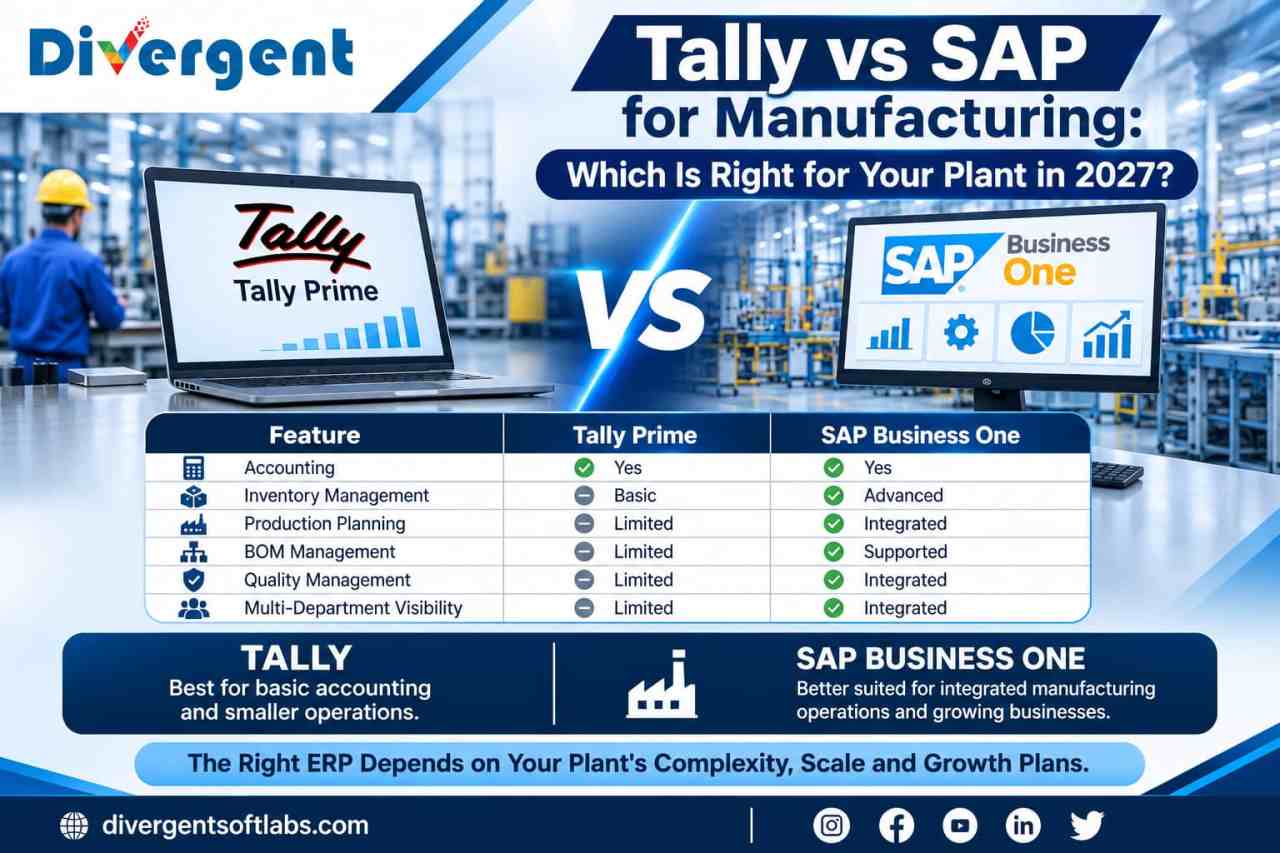
Larger multi-plant exporters may need a deeper platform such as SAP. Our guide on Tally vs SAP for manufacturing compares both in detail. (Replace this link with your real post URL.)
Whatever you choose, ask how AI features are delivered. Built-in, add-on and integration routes differ in cost and effort. Confirm current capabilities with the vendor or your implementation partner.
Trends to Watch in 2027
Nobody can promise exactly how fast adoption will move. Still, a few directions are clear from current industry writing.
- Copilots and AI agents. Vendors are adding assistants that let users question forecasts, explain variances and recommend actions inside planning workflows, as Panorama Consulting notes.
- Machine data meets ERP. Predictive maintenance typically relies on machine sensor data, so connecting looms and extruders to the ERP is a natural next step.
- Narrow, proven projects first. Experts keep advising one or two focused use cases before wider rollout.
- Data quality as a competitive edge. Plants that record clean lot, downtime and reject data can adopt AI faster than those that do not.
If you run a FIBC plant, the safest 2027 plan is simple. Fix your data, run one pilot, and let results guide the next step. AI-powered ERP for FIBC manufacturing rewards patience more than speed.
Honest Limits and Risks
AI-powered ERP for FIBC manufacturing is helpful, but it is not magic. Keep these limits in mind.
- Predictions are not promises. Models estimate. They can be wrong, especially after sudden market changes.
- Small plants may lack data. A few months of clean records may be needed before models are useful.
- People still decide. Treat AI output as advice for experienced planners, buyers and engineers.
- Change takes time. Teams need training and patience before habits change.
How to Measure Success
Pick a few simple measures before the pilot starts. Then compare them after.
- On-time delivery rate
- Unplanned machine downtime
- Raw-material stockouts and excess stock
- Reject and rework rate
- Time taken to trace a batch
- Quote accuracy against actual cost
Write down the starting figure for each one. Without a baseline, you cannot prove what AI improved.
Frequently Asked Questions
What is AI-powered ERP for FIBC manufacturing?
It is an ERP system, or a layer connected to it, that uses machine learning to forecast demand, plan materials, predict machine issues and trace batches across FIBC production.
Do small FIBC manufacturers need AI in their ERP?
Not necessarily. A clean, well-used ERP is the first step. AI adds value once you have reliable data and a clear problem such as stockouts or downtime.
Which FIBC process benefits most from AI?
Demand forecasting and predictive maintenance are common starting points because their results are easy to measure.
Can Tally support AI features?
Tally is mainly known for accounting, inventory and compliance. AI features usually come through integrations or add-on tools. Confirm current capabilities with Tally or your implementation partner.
How long does implementation take?
It depends on data readiness and scope. A single-use-case pilot is typically much faster than a full ERP replacement. Ask your partner for a written timeline.
Is AI-powered ERP safe for sensitive customer data?
It can be, with proper access controls, secure hosting and clear data-ownership terms. Check these before signing any contract.
Conclusion
AI-powered ERP for FIBC manufacturing is making plants more predictive: better forecasts, fewer unplanned stoppages and stronger traceability. But the plants that win in 2027 will not be the ones with the most features. They will be the ones with clean data and a focused first project.
Start small, measure the result, then scale. Want to know if your ERP is AI-ready? Contact Divergent Soft Lab for a practical review.
Follow Divergent Softlab on Google
Enjoying our insights on manufacturing ERP, artificial intelligence and business technology? Add Divergent Softlab as a preferred source on Google to discover more of our latest articles.