Tally vs. SAP for manufacturing is the question every Indian plant owner eventually faces. You started with Tally. It handled your accounts, your GST, and your basic stock. It still does. But somewhere between your 50th purchase order and your third stockout this quarter, you started wondering whether Tally is enough.
This tally vs sap for manufacturing guide covers real India pricing, a 7-sign checklist, and an honest look at which system fits your plant. SAP’s name keeps coming up. Your CA mentioned it. A competitor switched. A consultant quoted you ₹40 lakh for implementation, and you closed the browser tab.
This guide gives you an honest, manufacturing-first comparison, not a software sales pitch. By the end, you will know exactly which system fits your plant, your budget, and your growth stage. What Is Tally Prime? (And What It Does Well)
Tally Prime is India’s most widely used business accounting software. Built by Tally Solutions, Bengaluru, it handles GST filing, TDS, accounts payable and receivable, payroll, basic inventory, and financial reporting, and it does all of this exceptionally well.
For a trading company, a retailer, or a service business, Tally Prime is enough. It is fast, works offline, and requires almost no training, and every CA and accountant in India knows how to use it.
Where Tally Prime genuinely works well:
- Trading and distribution companies
- Retail businesses
- Service firms with simple inventory needs
- Businesses with 1–25 employees where accounts are most of operations
- Companies that need GST-ready accounting without complexity
Tally Prime pricing (2027—India):
- Single user: ₹18,000/year
- Multi-user (unlimited users, one location): ₹54,000/year
- TallyPrime Edit Log: additional cost
Source: tallysolutions.com
What Is SAP Business One? (And What It Does Well)
Before choosing between Tally and SAP for manufacturing, understand what each system was actually built to do.
SAP Business One (SAP B1) is an ERP system built for small and mid-sized businesses. Unlike Tally, it connects every department, procurement, production, quality, dispatch, HR, and finance—into one live database.
For a manufacturing plant, SAP B1 offers capabilities that Tally simply does not have: production orders, multi-level bills of materials (BOM), material requirements planning (MRP), batch and lot tracking, quality inspection workflows, job costing and real-time shop floor visibility.
Where SAP Business One is the right fit:
- Manufacturing plants with 25–500 employees and complex production
- Companies needing multi-location inventory and procurement automation
- Businesses where production costing and variance analysis matter
- Plants with batch traceability requirements (food, pharma, industrial)
- Companies planning aggressive scaling over the next 3–5 years
SAP Business One pricing—India (2027 estimates):
- License: ₹1.5 lakh–₹3 lakh per named user
- Implementation: ₹10 lakh–₹50 lakh depending on scope
- Annual maintenance: approximately 20% of license value
- Total 3-year cost (5 users): ₹35 lakh–₹80 lakh
Actual quotes vary significantly by SAP partner and project scope. Source: sap.com/india
Tally vs SAP for Manufacturing: Head-to-Head Feature Comparison
The tally vs sap for manufacturing decision comes down to one question: has your plantoutgrown what Tally can do?
| Feature | Tally Prime | SAP Business One |
|---|---|---|
| GST & Indian accounting | ✅ Excellent | ✅ Good |
| Inventory management | ⚠️ Basic | ✅ Advanced, multi-location |
| Production planning MRP | ❌ Not available | ✅ Full MRP |
| Bill of materials BOM | ❌ Not available | ✅ Multi-level BOM |
| Batch & lot traceability | ❌ Not available | ✅ Full traceability |
| Quality control & inspection | ❌ Not available | ✅ Built-in QC workflows |
| Automated purchase orders | ❌ Manual only | ✅ Auto PO from MRP |
| Real-time production costing | ⚠️ Basic financial only | ✅ Job costing, variance analysis |
| Dispatch & delivery scheduling | ❌ Manual | ✅ Automated scheduling |
| MIS & management reports | ⚠️ Financial reports only | ✅ 300+ operational reports |
| AI & automation capabilities | ❌ None | ⚠️ Limited, via add-ons |
| Mobile app access | ⚠️ Limited | ✅ Full mobile app |
| Implementation time | 1–2 weeks | 3–12 months |
| Total 3-year cost (5 users) | ₹1.6 lakh | ₹35–80 lakh |
| Best suited for | Accounts-only operations | Large manufacturing plants |
7 Signs Your Manufacturing Plant Has Outgrown Tally
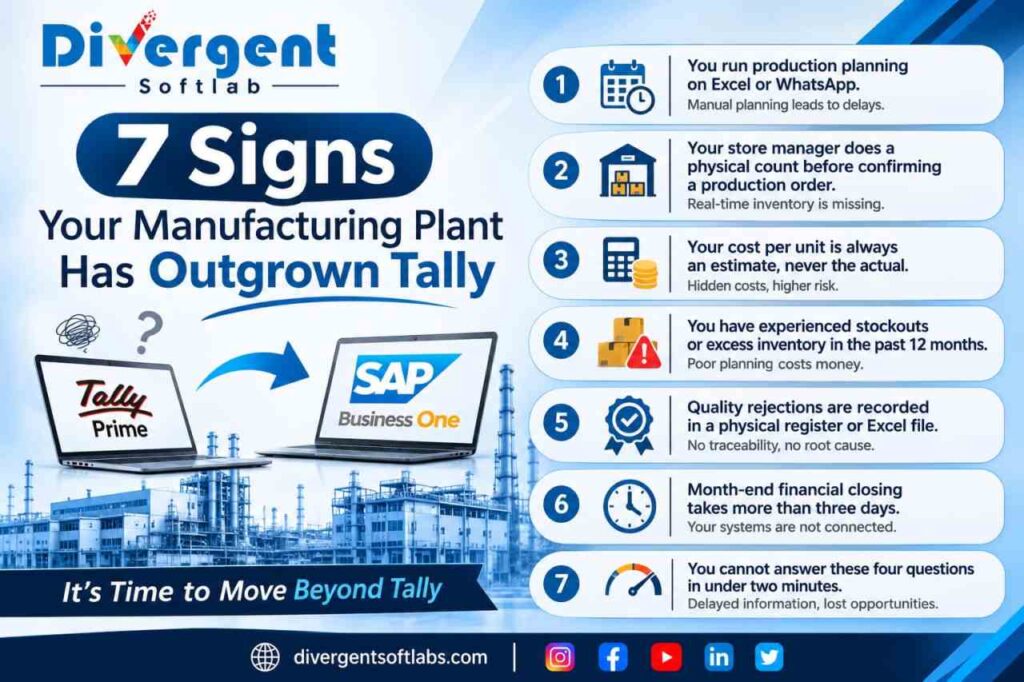
Tally vs SAP for manufacturing is ultimately a question about fit, not about which software is objectively better. Here are seven signs that your plant has reached the point where Tally’s limits are costing you money.
1. You run production planning on Excel or coordinate via WhatsApp.
Tally records stock in and stock out. It has no concept of a production order, a work-in-progress stage, or a shop floor task. If your team runs production on spreadsheets and communicates job status via WhatsApp groups, you have already built a manual system on top of Tally’s gap. That gap has a real cost in miscommunication, delays, and missed orders.
2. Your store manager does a physical count before confirming a production order.
In a manufacturing plant, raw material stock should be visible in real time. If your procurement or production team has to physically check the store before they can confirm whether a job can start, your inventory system is not connected to your operations.
3. Your cost per unit is always an estimate, never the actual.
Tally records what you paid for raw materials and what you invoiced for finished goods. It does not calculate the actual cost of converting one into the other — machine time, labor per unit, rejection waste, and packing material consumed. If your margin calculations are based on estimates rather than live production data, pricing decisions carry hidden risk.
4. You have experienced stockouts or excess inventory in the past 12 months.
Material Requirements Planning (MRP) calculates what raw material you need, when to order it and how much, based on your production schedule and current stock. Tally has no MRP. Plants operating without MRP rely on experience and manual tracking, which works until it doesn’t. A single stockout on a critical material can delay an entire order. Excess stock ties up capital unnecessarily.
5. Quality rejections are recorded in a physical register or Excel file.
If your QC team uses a paper register or spreadsheet to log rejections, batch failures, and customer complaints, there is no traceable link between a defect and its source batch, supplier or production run. When a customer complaint arrives, finding the root cause requires manual investigation. SAP B1 tracks every batch from raw material receipt through production to finished goods dispatch—in one system.
6. Month-end financial closing takes more than three days.
In a connected ERP, purchases, production, dispatch, and sales all flow into accounts automatically. Month-end closing takes hours. In a Tally-based manufacturing operation, the accounts team typically spends several days reconciling production records (usually in Excel) against purchase entries and sales invoices. If your month-end is a multi-day exercise, your systems are not connected.
7. You cannot answer these four questions in under two minutes:
- What is our current raw material stock across all locations?
- Which production orders are behind schedule?
- What was our actual cost per unit for the last batch?
- Which supplier has the highest delivery delay rate this quarter?
If answering any of these requires calling someone, opening a spreadsheet or waiting for a report to be compiled, your plant is operating on delayed information. In a competitive manufacturing environment, that delay has a cost.
The Real Cost of Staying on Tally in a Manufacturing Plant
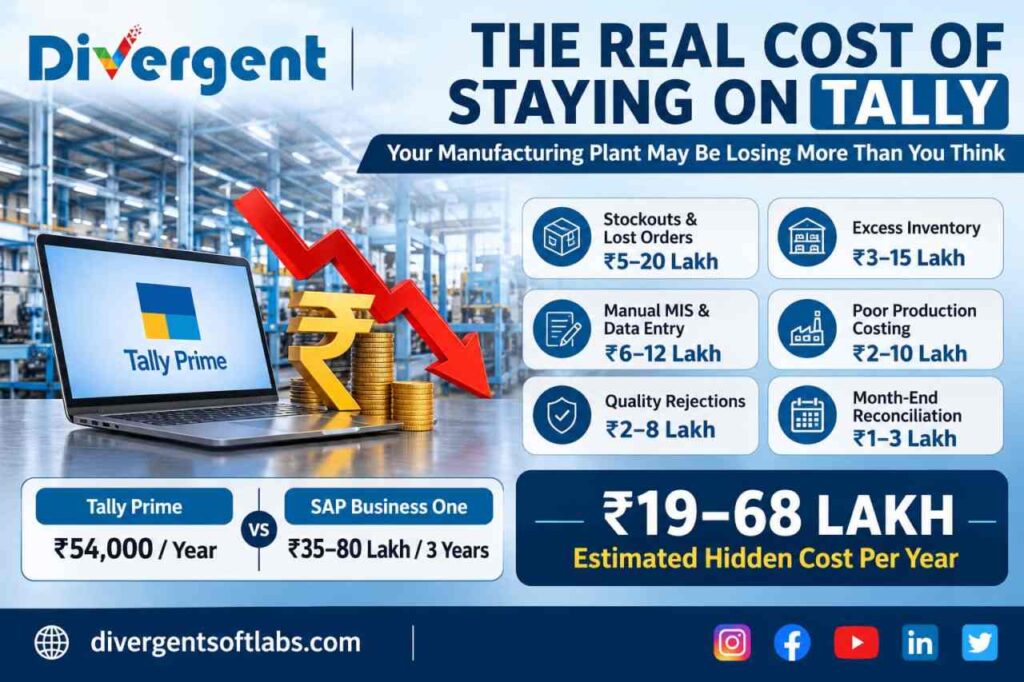
Tally Prime multi-user costs ₹54,000 per year. SAP B1 costs ₹35–80 lakh over three years. On paper, Tally looks like the obvious choice.
But the real cost of Tally in a manufacturing plant is not ₹54,000.
Most plant owners comparing tally vs sap for manufacturing focus only on license cost—and miss the real financial picture.
| Hidden cost area | Estimated annual loss |
|---|---|
| Stockouts, lost orders due to raw material shortages. | ₹5–20 lakh |
| Excess inventory, capital tied up in unused stock | ₹3–15 lakh |
| Manual MIS and data entry, 2–3 staff salaries | ₹6–12 lakh |
| Poor production costing, wrong pricing decisions | ₹2–10 lakh |
| Quality rejections, no batch traceability | ₹2–8 lakh |
| Month-end reconciliation, accounts team overtime | ₹1–3 lakh |
| Total estimated hidden cost | ₹19–68 lakh per year |
For most manufacturing plants turning over ₹5–50 crore, the hidden cost of staying on Tally exceeds the investment in a purpose-built manufacturing ERP within 12–18 months.
Is SAP Business One the Only Option?
This is where most comparison articles stop being honest.
SAP Business One is a genuinely capable ERP. For a manufacturing business turning over ₹100 crore+ with complex multi-site operations, it may well be the right choice. But for the majority of Indian manufacturing SMEs—packaging plants, industrial component makers, food processors, and textile units, SAP B1 creates real practical challenges:
- Cost: A ₹35–80 lakh implementation is inaccessible for most plants under ₹50 crore turnover. The license alone is a significant recurring cost.
- Implementation timeline: 6–12 months for a full SAP B1 implementation means your plant operates on old systems for the better part of a year before seeing any benefit.
- Complexity: SAP B1 is designed for global enterprise operations. Most Indian SME manufacturers use fewer than 20% of their features—but pay for and maintain 100% of the system.
- Local support quality: SAP implementation partners in India vary enormously in quality and manufacturing specialization. Poor implementation is a known risk.
- Customization cost: Adapting SAP B1 to your specific production process requires certified consultants and significant additional cost. Standard SAP does not understand FIBC bag manufacturing, BOPP film processes, or PP woven sack specifications.
For packaging manufacturers and industrial SMEs, a third option exists: a purpose-built manufacturing ERP designed specifically for Indian plants.
Learn more: What Is Agentic AI for Manufacturing ERP?
Tally vs SAP vs Purpose-Built ERP: Three-Way Comparison
When evaluating tally vs sap for manufacturing, a third option — purpose-built ERP — often fits Indian SMEs better than either.
| Tally Prime | SAP Business One | Purpose-Built Manufacturing ERP | |
|---|---|---|---|
| Best for | Accounts-only operations | Large manufacturers | SME manufacturing plants |
| Implementation time | 1–2 weeks | 6–12 months | 4–8 weeks |
| Total 3-year cost | ₹1.6 lakh | ₹35–80 lakh | ₹8–20 lakh |
| Production planning — MRP | ❌ | ✅ | ✅ |
| Bill of materials | ❌ | ✅ | ✅ |
| AI automation | ❌ | ⚠️ Limited, expensive add-ons | ✅ Built-in agents |
| India GST compliance | ✅ | ✅ | ✅ |
| Local implementation support | ✅ Extensive | ⚠️ Variable quality | ✅ Dedicated |
| Industry-specific customisation | ⚠️ Limited | ❌ Expensive | ✅ Pre-built for packaging |
| Scalability | ⚠️ Outgrown at scale | ✅ High | ✅ Designed for Indian SME growth |
How to Migrate from Tally to a Manufacturing ERP: A 4-Step Process
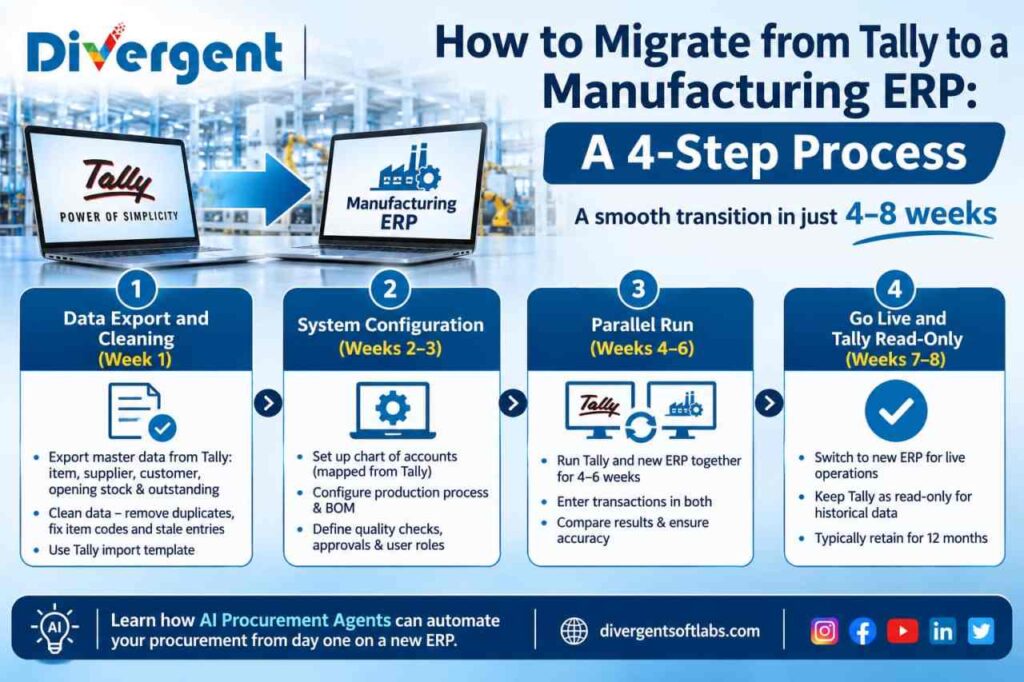
Once you decide on tally vs sap for manufacturing, migration does not have to be disruptive.
Moving from Tally to a full manufacturing ERP does not have to be disruptive. With the right preparation, most manufacturing plants complete a successful migration in 4–8 weeks.
Step 1 — Data Export and Cleaning (Week 1)
Export your master data from Tally: item masters, supplier masters, customer masters, opening stock balances and outstanding payables and receivables. Clean the data before import — duplicate suppliers, inconsistent item codes and stale stock entries create problems in the new system. Most manufacturing ERPs provide a Tally import template.
Step 2 — System Configuration (Weeks 2–3)
Set up your chart of accounts (mapped from Tally), production process, bill of materials for each finished product, quality inspection parameters, approval workflows and user roles. This is where a manufacturing ERP implementation differs from an accounting migration — the production setup requires plant-specific knowledge.
Step 3 — Parallel Run (Weeks 4–6)
Run both Tally and the new ERP simultaneously for 4–6 weeks. Enter all transactions in both systems. Compare outputs at the end of each week. This builds team confidence, catches configuration gaps and ensures financial accuracy before you rely on the new system alone.
Step 4 — Go Live and Tally Read-Only (Weeks 7–8)
Switch your team to the new ERP for all live transactions. Keep Tally active as a read-only reference for historical data. Most plants keep Tally accessible for 12 months after go-live for CA reference and historical reporting.
Learn how AI Procurement Agents can automate your procurement from day one on a new ERP. Tally vs sap for manufacturing is not really
a choice between two software options — it
is a choice between two operating models.
Frequently Asked Questions: Tally vs SAP for Manufacturing
Can Tally be used for manufacturing?
Tally Prime handles accounting, GST and basic stock management reliably. However, it does not include production planning (MRP), bill of materials management, batch traceability, quality control or job costing. For a plant that processes raw materials into finished goods, these gaps mean core manufacturing operations run outside Tally — usually in Excel. A manufacturing ERP covers the full operation in one system.
Is SAP Business One better than Tally for manufacturing?
In terms of manufacturing functionality, yes — SAP B1 has production planning, MRP, BOM, batch tracking and job costing that Tally does not. However, SAP B1 costs ₹35–80 lakh to implement and takes 6–12 months. For Indian SME manufacturers, the question is not whether SAP is functionally superior but whether it represents the best investment relative to cost, complexity and implementation risk. A purpose-built manufacturing ERP often delivers equivalent manufacturing functionality at a fraction of the cost. The tally vs sap for manufacturing comparison shows SAP B1 wins on features but costs ₹35–80 lakh to implement.
What is the cost of SAP Business One in India?
SAP Business One licence cost in India is approximately ₹1.5 lakh to ₹3 lakh per named user, depending on the module package. Implementation costs range from ₹10 lakh to ₹50 lakh based on the number of users, locations and customisation required. Annual maintenance is typically 18–22% of licence value. A 5-user implementation over three years typically costs ₹35–80 lakh in total. The tally vs sap for manufacturing comparison shows SAP B1 wins on features but costs ₹35–80 lakh to implement.
What features should I look for in a manufacturing ERP?
The essential features for a manufacturing ERP are: production planning with MRP, multi-level bill of materials, automated procurement from production schedules, quality control and batch tracking, real-time inventory across locations, actual production costing and variance analysis, dispatch and delivery management, GST-compliant financial accounting, and management dashboards with live production, inventory and financial data in one view.
What are the main limitations of Tally Prime for manufacturing?
Tally Prime’s limitations for manufacturing operations are: no production order management, no MRP or production scheduling, no bill of materials, no batch or lot traceability, no quality control module, no job costing or production variance analysis, no shop floor visibility, and no connection between procurement, production and dispatch in a single system. These are design decisions — Tally is built for accounting, not manufacturing operations management.
How long does migrating from Tally to a manufacturing ERP take?
A well-structured Tally to ERP migration for a manufacturing plant takes 4–8 weeks end to end: approximately one week for data export and cleaning, two weeks for system configuration, four to six weeks of parallel running, and go-live in week seven or eight. The critical factor is data quality — plants with clean Tally masters migrate faster. Plants with years of inconsistent data entry require additional cleaning time before import.
Follow Divergent Softlab on Google
Enjoying our insights on manufacturing ERP, artificial intelligence and business technology? Add Divergent Softlab as a preferred source on Google to discover more of our latest articles.