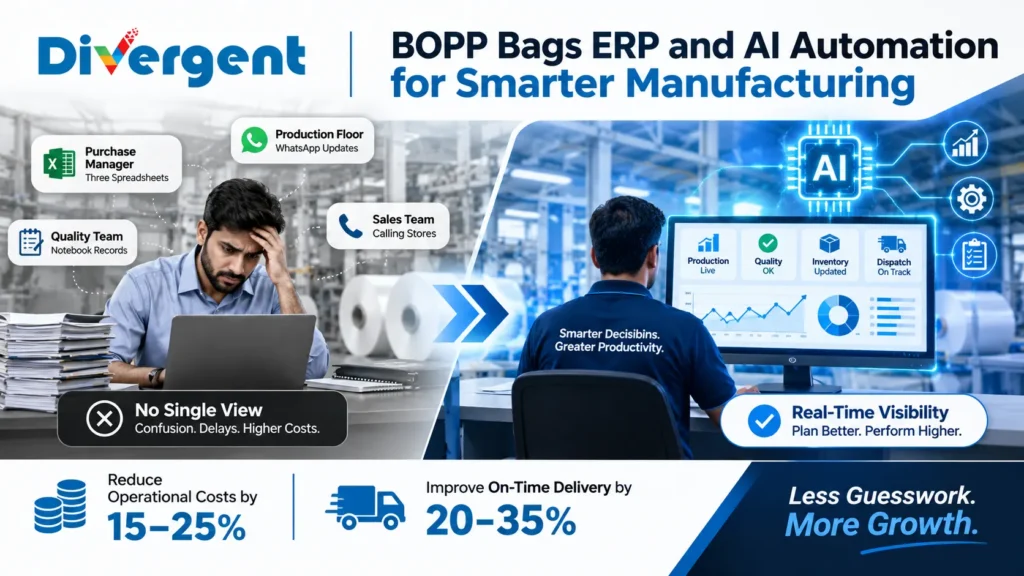
Walk into most BOPP bag plants in India and you will find the same picture. The purchase manager has three spreadsheets open. The production floor sends WhatsApp updates. The quality team writes inspection results in a notebook. The sales team calls the stores to find out if an order is ready.
Everyone is working hard. But nobody has the full picture.
That is what BOPP bags ERP fixes. Not by replacing your team, but by giving everyone the same real-time view of what is happening, what it is costing and what needs to happen next. When you add AI agents on top of that foundation, your plant starts running on information instead of instinct.
According to McKinsey, manufacturers who implement ERP and AI automation reduce operational costs by 15 to 25 percent and improve on-time delivery by 20 to 35 percent in the first year. Those are not theoretical numbers, they come from plants that made the same shift you are considering.
Why Manual Systems Stop Working at Scale
A BOPP bag order is not a simple thing to manage. By the time it moves from confirmation to dispatch, it has touched extrusion, weaving, lamination, printing, cutting, stitching, inspection, and packing. Each stage depends on the one before it. A problem at any point, a machine breakdown, a material shortage, a print rejection, ripples forward.
Up to 50 or 60 orders a month, an experienced team can hold this together manually. Beyond that, things start slipping. A material reorder gets missed because the spreadsheet was not updated. A quality issue is caught three stages too late. A customer calls on the delivery date, and nobody knows exactly where the order is.
BOPP bags ERP removes that ceiling. It handles the coordination that manual systems cannot sustain at volume, so your plant can grow without the chaos growing with it.
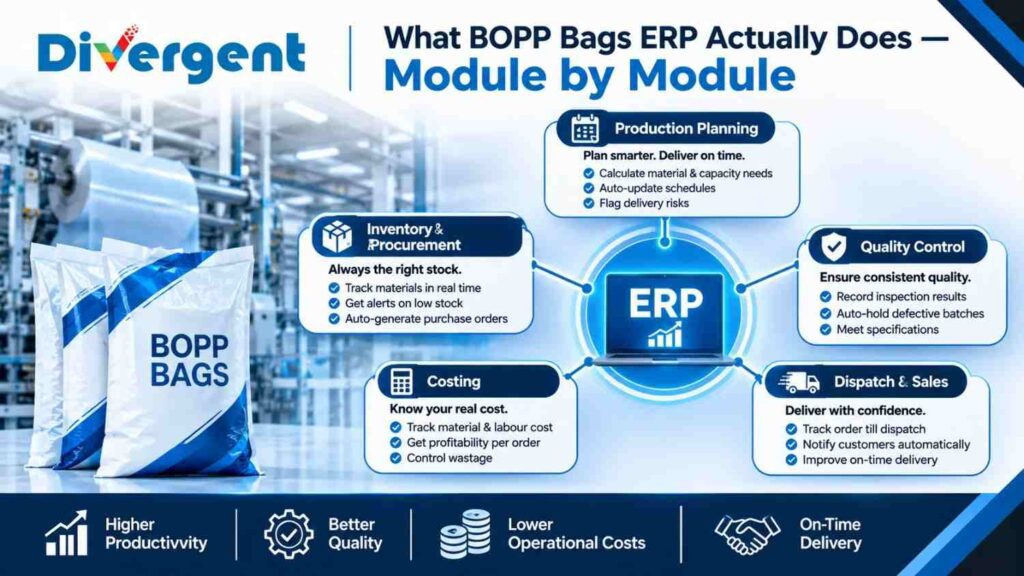
What BOPP Bags ERP Actually Does — Module by Module
A good BOPP bags ERP is not a collection of separate tools bolted together. It is one connected system where a change in one area, a new order, a material receipt, or a quality hold immediately updates everything else. Here is what each module does in practice.
Production Planning
When a customer order is confirmed, the BOPP bags ERP immediately works out what materials are needed at each stage, checks whether stock is available, allocates machine time across the production queue, and calculates a realistic delivery date. Not an estimate, a date based on actual capacity and actual inventory.
When something changes, a machine goes down, a priority order comes in, a quality hold pushes a batch back, the schedule updates automatically and flags any delivery dates that are now at risk. Your production manager sees the problem before it becomes a crisis. See how AI production planning takes this further with autonomous schedule optimization.
Inventory and Procurement
The inventory module in a BOPP bags ERP tracks every material from the moment it enters your stores to the moment it goes into production, PP granules, BOPP film rolls, printing ink by color, stitching thread, liner material, and packaging. Every issue, every receipt, every adjustment recorded in real time.
The system always knows how many days of stock you have against confirmed orders. When a material approaches its reorder point, it flags the shortage, giving your purchase team days to act, not hours. With the AI procurement agent active, it goes further and raises the purchase order automatically. See how AI inventory management eliminates stockouts entirely.
Quality Control
Quality in a BOPP plant means checking fabric GSM at the loom, lamination adhesion after the laminator, color accuracy after printing and finished dimensions before dispatch. Without a BOPP bags ERP, these checks happen on paper and in notebooks and by the time a problem is spotted, the defective material has usually moved two stages forward.
The quality module records inspection results against each stage’s specifications. When a result falls outside the limit, the system places a hold on the affected batch immediately, the same second the result is entered. See how AI quality control makes this process fully autonomous.
Costing
In most BOPP plants, actual order costs are a mystery until month-end. By then, it is too late to do anything about an order that was underpriced or produced inefficiently. The BOPP bags ERP costing module captures actual material consumption, machine time and overhead allocation in real time, per order, per stage. You know the profitability of an order while it is still in production. See how reducing production cost with ERP visibility delivers measurable savings.
Dispatch and Sales
The dispatch module tracks every customer order from quality clearance through packing, loading and dispatch. Your sales team can see exactly where any order is, without calling the floor. When an order moves to dispatch, the AI sales agent sends a confirmation to the customer automatically. See how the AI sales agent keeps your customers proactively informed.
Four AI Agents That Change How a BOPP Plant Operates
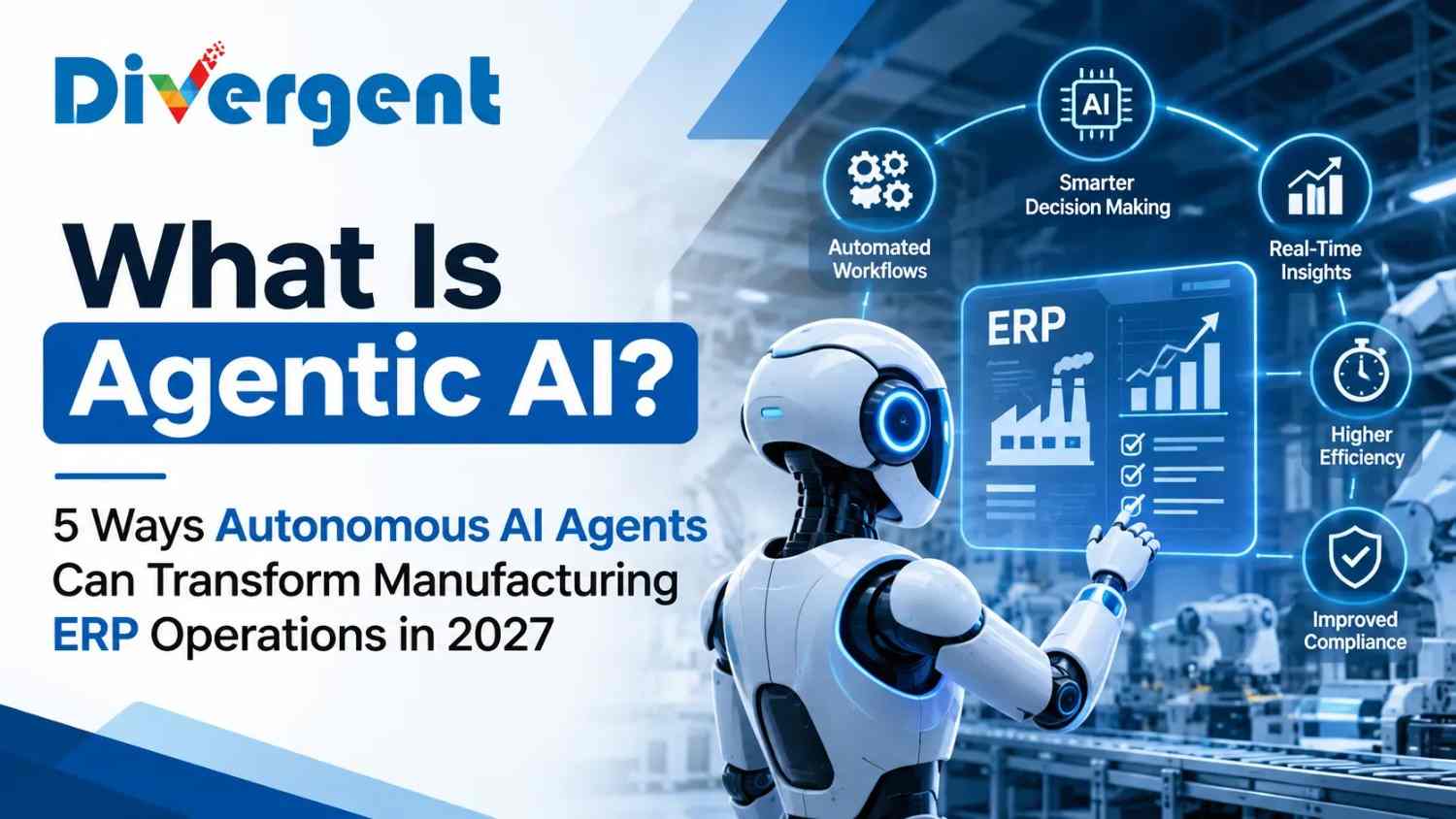
AI agents connect to your BOPP bags ERP and handle specific jobs autonomously, within the limits you define. They are not chatbots or report generators. They are operational agents that do things: raise orders, place holds, compile reports, and send updates. Here is what each one does in a BOPP plant.
AI Procurement Agent
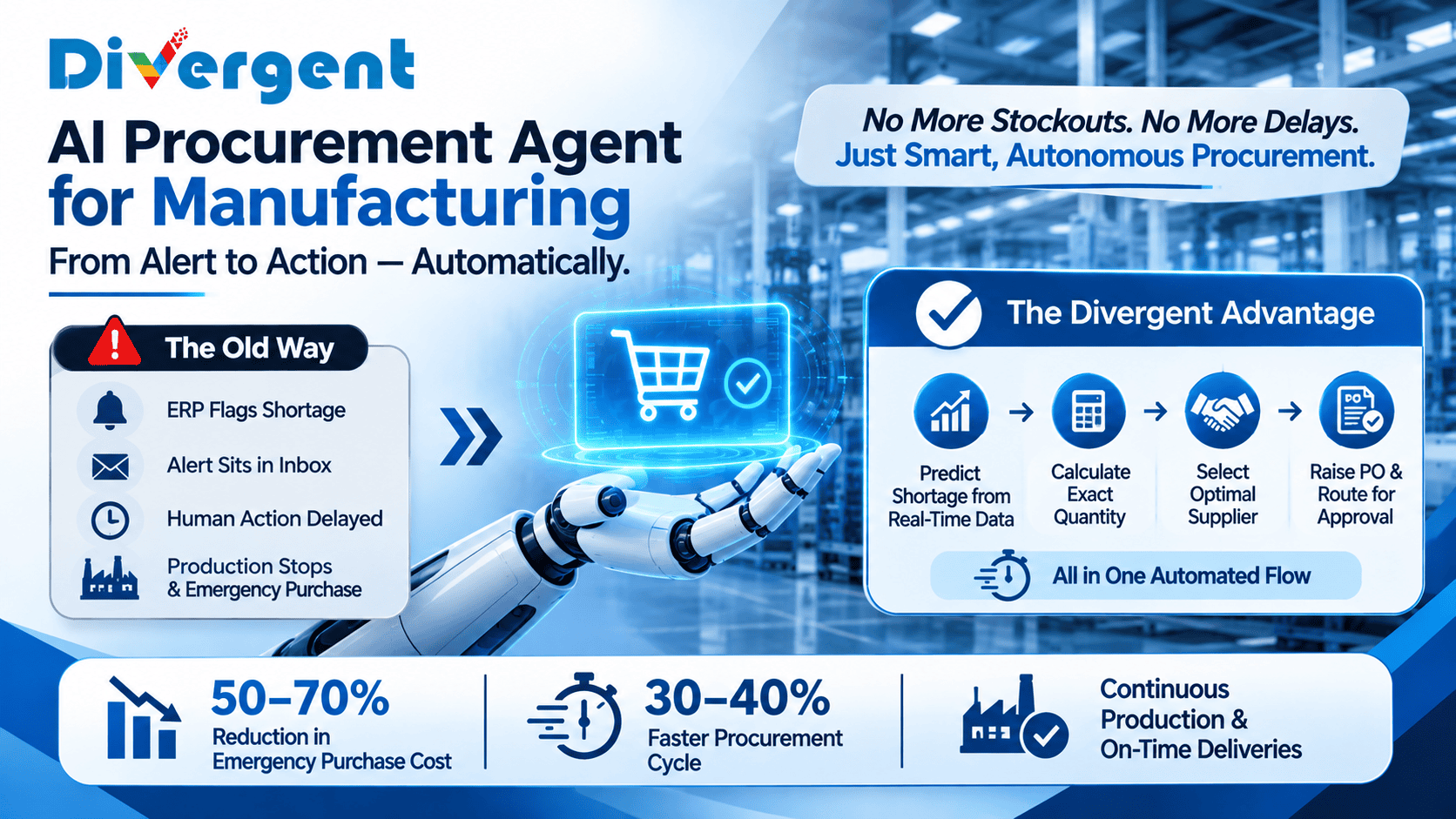
This agent watches your material inventory against confirmed production orders around the clock. When PP granules, BOPP film or printing ink approaches the reorder point, it does not send an alert and waits for someone to act. It calculates the quantity needed, picks the right supplier from your approved list and raises the purchase order in the BOPP bags ERP before the shortage reaches production.
The result is not a small improvement. It is the end of emergency procurement at premium prices. For the full picture, see our guide on the AI procurement agent for manufacturing.
AI Quality Control Agent
This agent monitors inspection results at every production stage as they are recorded. When a fabric GSM reading is off, when lamination adhesion drops below the peel strength threshold for a food-grade bag, when print color delta exceeds the tolerance the agent places a hold on that batch immediately. It notifies the quality manager and production supervisor with the specific deviation, the affected batches and the schedule impact.
No supervisor needs to review a register. No defective batch waits for the morning shift to notice it. Quality problems are contained at the stage where they occur.
AI MIS Reporting Agent
Every Monday morning, your management team gets a full production report — output by line, machine efficiency, inventory position, order completion status, cost variance against target. It is compiled from live BOPP bags ERP data and delivered automatically. Nobody spent two days pulling it together. Nobody had to chase numbers from three departments.
The plant owner makes decisions based on data that is current, not data that was current last Thursday when someone started compiling it.
AI Sales Agent
This agent tracks every open customer order through the production schedule. When a delivery date looks like it will slip — due to a machine breakdown, a quality hold or a material delay — it identifies the gap, prepares a customer update and routes it to the account manager for review before the customer notices. When an order is dispatched, it sends the confirmation automatically.
Your sales team stops spending half their day chasing production updates. They spend it talking to customers about new orders. See the full picture in our guide on the AI sales agent for manufacturing.
BOPP Bags ERP vs Tally + Excel, The Real Difference
Tally is built for accounting. Excel is built for analysis. Neither is built for running a manufacturing plant. The difference between BOPP bags ERP and the Tally-plus-Excel combination is not about features, it is about whether your operations are connected or fragmented.
| What needs to happen | Tally + Excel | BOPP Bags ERP + AI Agents |
|---|---|---|
| New order received, materials calculated | Someone does it manually. | The system calculates immediately. |
| Inventory approaching reorder point | Caught at weekly stock check, if someone checks | Flagged 3 to 4 weeks ahead automatically |
| Quality deviation at the lamination stage | Depends on who is checking and when | Hold placed the moment the result is recorded. |
| Order cost, How much did this actually cost? | Wait for month-end. | Real-time, per order, while in production |
| MIS report for Monday management meeting | Someone spent Friday pulling data. | Compiled and sent automatically |
| The customer asks where their order is. | Sales calls production, production checks, and sales calls customer | The sales team has real-time visibility. |
| How many orders can the team handle? | 50 to 80 per month before things slip | 500+ per month with the same team |
BOPP Bags ERP Production Planning — How It Works in Practice
A BOPP bag order for 10,000 bags with a custom print in 6 colors involves a lot of moving parts. The BOPP bags ERP handles the coordination automatically, from the moment the order is confirmed.
It calculates how much PP granule, BOPP film, ink per color, thread, and packaging is needed. It checks current inventory against those numbers. It allocates time on the extrusion line, the looms, the laminator, the printing press, and the cutting and stitching lines. It books a slot in the inspection queue and a slot on the dispatch schedule. It gives you a delivery date that reflects reality, not optimism.
When things change, and they always do, the system adjusts. A machine breakdown on Tuesday becomes a revised delivery date and a customer notification by Tuesday afternoon. Not Friday, when someone finally got around to updating the spreadsheet.
BOPP Bags ERP Inventory: Why Real-Time Tracking Matters
PP granules have a 2 to 4 week supplier lead time. BOPP film comes in specific widths and microns that cannot be substituted without a customer spec change. Printing ink is managed per colour, and running out of a specific Pantone shade mid-order is a costly problem.
A weekly stock check is not frequent enough to catch these problems before they affect production. The BOPP bags ERP inventory module updates in real time, every material issue, every receipt, every adjustment. When confirmed production orders consume stock on paper, the system knows immediately how many days of material you have left.
The AI procurement agent takes the next step, not just flagging the shortage but raising the purchase order automatically, within the authority limits you have set.
BOPP Bags ERP Quality Control — Catching Problems at the Right Stage
The most expensive quality problem in a BOPP bag plant is the one that reaches the customer. The second most expensive is the one that reaches dispatch. The least expensive, but still costly, is the one caught at the production stage where it occurred.
BOPP bags ERP quality control is designed to catch problems at the earliest possible stage. Inspection results are recorded at each stage against the specification limits for that product. When a result falls outside the limit, the hold is placed immediately, not when the next shift supervisor reviews the register, not when someone notices the batch moving forward with a problem.
The AI quality agent handles this automatically, placing the hold, notifying the right people, flagging the schedule impact, in seconds.
BOPP Bags ERP Costing — Knowing Your Numbers While They Still Matter
PP granule prices move weekly. Ink prices vary by colour and supplier. Machine efficiency affects overhead absorption. If your costing data is a month old, your pricing decisions are based on costs that no longer exist.
| Costing element | Without BOPP Bags ERP | With BOPP Bags ERP |
|---|---|---|
| PP granule consumption | Month-end reconciliation | Real-time per order |
| BOPP film consumption | Estimated from order spec | Actual consumption per batch |
| Ink consumption | Pooled and averaged | Tracked per colour per order |
| Machine time | Standard rate — rarely reviewed | Actual time per stage, per order |
| Wastage | End-of-month stock count variance | Real-time variance flagging per order |
| Order profitability | Known at month-end, after the fact | Known during production, in time to act |
How to Implement BOPP Bags ERP Without Disrupting Production
The concern every plant owner has is the same, will going live on ERP disrupt production during the transition? It is a valid concern. Here is how a phased implementation avoids it.
- Get the master data right before go-live — Your item master, bill of materials, customer list, supplier list and opening stock need to be clean and accurate before the system goes live. This is the most important step and the one that gets skipped most often.
- Go live on inventory and procurement first — This is the lowest-risk module to start with and delivers immediate value real-time stock visibility and automated reorder alerts. Production planning goes live in month 2, quality in month 3.
- Run parallel for 4 to 6 weeks — Keep the old systems running alongside the BOPP bags ERP for the first 4 to 6 weeks. When the new system’s numbers match the old system’s numbers, you switch over with confidence.
- Train by role, not by system — Your stores team does not need to know how to run a production report. Train each person on the screens and processes they use every day. Keep it practical and specific.
- Start AI agents in observation mode — For the first 4 to 6 weeks, the AI agents show you what they would have done without actually doing it. You review every recommendation. When you are satisfied with the judgment, you activate autonomous operation and expand authority gradually.
- Review weekly for three months — Set a one-hour weekly review for the first three months, data accuracy, agent performance, adoption issues. Problems caught early stay small.
What BOPP Plants Actually Achieve — The Numbers
These are the results BOPP bag manufacturers report after implementing ERP and AI automation. They are not from pilot programmes, they are from operational plants that made the full transition.
| What we measured | Before ERP and AI | After BOPP Bags ERP + AI Agents |
|---|---|---|
| Production stoppages from material shortages | 2 to 4 per month | Near zero |
| Quality defects reaching the customer | 1 to 3% of orders | Less than 0.3% |
| MIS report preparation time | 2 to 3 days per week | Zero — automatic |
| Order costing accuracy | Month-end, ±15% | Real-time, ±2% |
| On-time delivery rate | 65 to 75% | 85 to 95% |
| Emergency procurement cost premium | 10 to 15% of purchases | Less than 2% |
| Customer escalations per month | 15 to 25% of orders | Less than 5% |
| Plant capacity actually used | 65 to 75% | 80 to 90% |
Divergent PackPro — BOPP Bags ERP Built for Packaging Plants
Divergent PackPro is a BOPP bags ERP built specifically for BOPP, FIBC, PP woven bag and flexible packaging manufacturers. It is not a generic manufacturing ERP with a packaging module added on. It is built from the ground up for how packaging plants actually operate — with the specific production stages, material specifications, costing structures and quality requirements of the industry already built in.
- GSM and specification-based bill of materials — Materials calculated from actual bag specifications — fabric GSM, BOPP film micron, print colours, lamination type — not generic item quantities.
- Stage-by-stage production tracking — Every stage tracked from extrusion to dispatch with real-time WIP visibility across the whole plant floor.
- AI agents embedded, not bolted on — The procurement, quality, MIS and sales agents are part of the BOPP bags ERP — they read the same data, write to the same records and work within the same approval workflows as your team.
- PP price-aware costing — When PP granule prices move, the costing engine recalculates affected orders automatically. Your pricing decisions are always based on current raw material costs.
- Specification-based quality holds — Hold thresholds set per product, per stage. The AI quality agent enforces them consistently — no variability between shifts, no dependence on individual checkers.
- Automated MIS built in — Daily, weekly and monthly reports compiled and distributed from live ERP data. No manual compilation, no waiting for reports that may or may not reflect current reality.
If you want to see how it works with your plant’s actual products, volumes and processes — here is an overview of Divergent PackPro or you can speak to our team directly. We will show you the system using your own data, not a generic demo.
People Also Ask — BOPP Bags ERP and AI Automation
What is BOPP bags ERP?
BOPP bags ERP is a connected manufacturing system for BOPP bag plants, linking procurement, production planning, inventory, quality control, costing and dispatch in one real-time platform. It replaces the combination of Tally, Excel and manual registers that most BOPP manufacturers currently rely on to run their operations.
How does BOPP bags ERP improve production planning?
When a customer order is confirmed, the BOPP bags ERP calculates material requirements per stage, checks inventory, allocates machine time across the production queue and sets a delivery date based on actual capacity. When the schedule changes, machine breakdown, priority order, quality hold — the system recalculates and flags affected delivery dates immediately.
What is the difference between BOPP bags ERP and Tally?
Tally is built for accounting. BOPP bags ERP is built for manufacturing operations — production planning, inventory tracking, quality management, real-time costing and dispatch coordination, all connected. Tally shows you the financial result. BOPP bags ERP gives you the operational control to improve it.
How do AI agents work in a BOPP bag plant?
AI agents connect to the BOPP bags ERP and handle specific operational jobs autonomously — the procurement agent raises purchase orders when material approaches its reorder point, the quality agent places holds when inspection results deviate from specification, the MIS agent compiles and distributes management reports automatically, and the sales agent tracks orders and prepares proactive customer updates.
What does the AI procurement agent do for BOPP manufacturers?
It monitors PP granule, BOPP film, ink and other material inventory levels continuously against confirmed production orders. When material approaches the reorder point, it calculates the quantity needed, selects the right supplier from the approved vendor list and raises the purchase order in the BOPP bags ERP automatically, before the shortage can affect production.
How does AI quality control work for BOPP bags?
The AI quality control agent monitors inspection results at every production stage as they are recorded. When a result, fabric GSM, lamination adhesion, print colour accuracy, finished bag dimensions — falls outside the specification limit, the agent places a hold on that batch immediately and notifies the quality manager with the specific deviation and schedule impact.
What BOPP bags ERP software is available in India?
Divergent PackPro is a purpose-built BOPP bags ERP for BOPP, FIBC and packaging manufacturers in India, with GSM-based bill of materials, stage-by-stage production tracking, PP price-aware costing and built-in AI agents for procurement, quality, MIS and sales communication.
Related Reading
- What Is Agentic AI: How Autonomous Agents Transform Manufacturing ERP
- AI Procurement Agent for Manufacturing
- AI Quality Control in Manufacturing
- AI Sales Agent for Manufacturing
- How to Reduce Production Cost in Manufacturing
- ERP Software for FIBC Manufacturers
- Tally vs ERP for Manufacturing
Follow Divergent Softlab on Google
Enjoying our insights on manufacturing ERP, artificial intelligence and business technology? Add Divergent Softlab as a preferred source on Google to discover more of our latest articles.