What is AI inventory management in manufacturing?
AI inventory management in manufacturing is the use of artificial intelligence and machine learning to predict what stock is needed, when it is needed and in what quantity — automatically, from production data, order history and supplier patterns — rather than from manual calculations or static reorder rules. AI inventory management in manufacturing replaces the guesswork that causes both stockouts and excess inventory with data-driven decisions that update in real time as conditions change.
Every packaging and FIBC plant faces the same inventory paradox: too much of some materials and not enough of others, simultaneously. The store is full of slow-moving items while the production line stops for a shortage of something that runs out every month. This is not a purchasing failure — it is a visibility and prediction failure. AI inventory management in manufacturing solves it by giving the purchase team accurate forward visibility of what will be needed, when it will run out and what to order now to prevent it.
According to McKinsey, manufacturers that implement AI inventory management reduce inventory carrying costs by 20 to 50 percent while simultaneously reducing stockouts by 65 percent. For packaging plants where raw material inventory represents a significant portion of working capital, these numbers translate directly into cash released and production reliability improved.
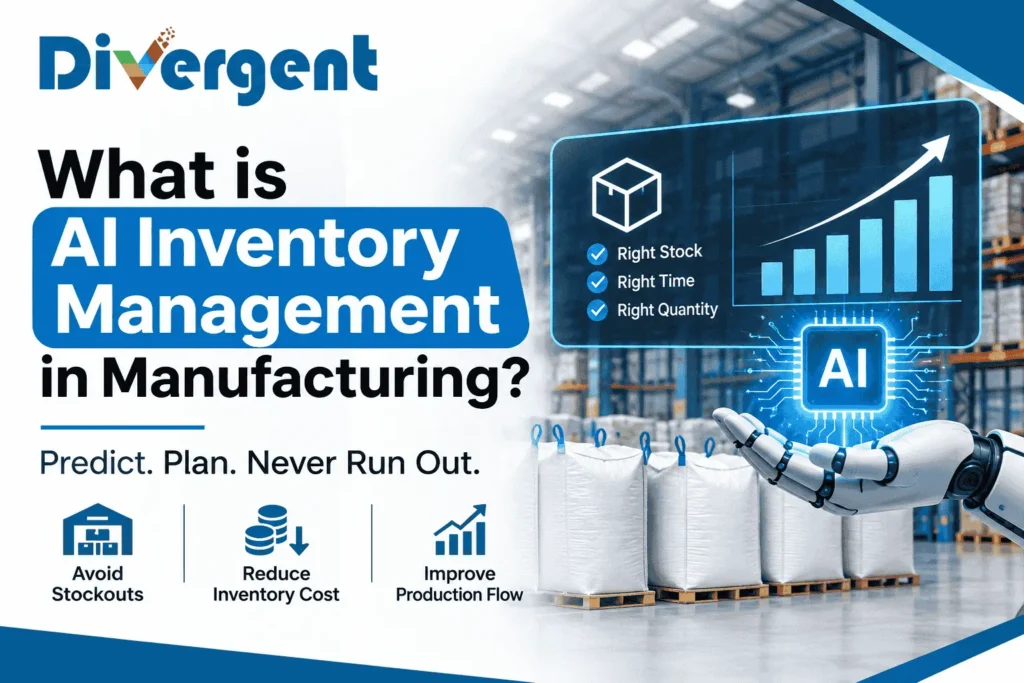
Table of Contents
- What Is AI Inventory Management in Manufacturing?
- How Does AI Inventory Management Work?
- Traditional vs AI Inventory Management
- 7 Ways AI Improves Inventory Management
- How AI Eliminates Stockouts
- How AI Reduces Excess Stock
- What Results Do Packaging Plants Get?
- How to Implement AI Inventory Management
- How Divergent PackPro Uses AI for Inventory
- Frequently Asked Questions
What Is AI Inventory Management in Manufacturing and How Does It Work?
How is AI used in inventory management?
AI is used in inventory management to analyse historical consumption data, production schedules, supplier lead times and demand patterns to predict future stock requirements with significantly higher accuracy than manual methods. Instead of using fixed reorder points set once and rarely reviewed, AI continuously recalculates what is needed based on what is actually happening in production and what orders are confirmed for the coming weeks.
Three types of AI are applied in manufacturing inventory management:
- Demand forecasting AI: Predicts future material consumption from production plans, confirmed sales orders and historical usage patterns. Tells the purchase team what to order and when — before the shortage becomes visible on the production floor.
- Anomaly detection AI: Identifies unusual consumption patterns — a material being consumed faster than the production plan would suggest, a supplier delivering consistently short, a wastage rate that has drifted above standard. Flags these for investigation before they create a problem.
- Optimisation AI: Calculates the optimal stock level for each material — balancing the cost of holding excess stock against the cost of a stockout — and updates those levels automatically as demand patterns and lead times change.
How Does AI Inventory Management Work?
What data does AI use to manage inventory?
AI inventory management uses four categories of data: historical consumption records, confirmed production orders, supplier performance data and current stock levels updated in real time. The AI combines these inputs to calculate a continuously updated view of when each material will run out and what needs to be ordered to prevent it.
- Data collection: The AI draws on transaction data from the ERP — every goods receipt, material issue, production completion and wastage record. The more complete and accurate the transaction data, the more accurate the AI predictions.
- Pattern recognition: The AI identifies consumption patterns — seasonal peaks, product-specific usage rates, the relationship between confirmed order volume and material consumption — that manual analysis would miss.
- Prediction: Based on patterns identified and the current production schedule, the AI predicts when each material will reach its reorder point and generates a purchase recommendation with quantity, timing and supplier suggestion.
- Continuous update: As new transactions are recorded — a production order added, a delivery received short, a customer order cancelled — the AI recalculates its predictions automatically. The purchase team always works from the most current view.
Traditional Inventory Management vs AI Inventory Management in Manufacturing
| Function | Traditional | AI Inventory Management |
|---|---|---|
| Reorder point | Fixed — set manually, rarely reviewed | Dynamic — recalculated continuously from actual consumption |
| Purchase quantity | Estimated — based on experience | Calculated — from confirmed production plan and lead time |
| Stockout prediction | Reactive — discovered when line stops | Predictive — flagged 2-4 weeks before it occurs |
| Excess stock detection | At monthly count — too late | Continuous — slow-moving items flagged automatically |
| Supplier lead time | Promised lead time — often wrong | Actual historical lead time — calculated from delivery records |
| Safety stock level | Fixed estimate — same for all conditions | Dynamic — adjusted for demand variability and supplier reliability |
| Reporting | Weekly manual MIS — always outdated | Live dashboard — current at every moment |
7 Ways AI Inventory Management in Manufacturing Improves Packaging Plant Operations
1. Predicts Stockouts Before They Reach the Production Floor
The most common and most damaging inventory management failure in packaging plants is a stockout that stops a production line. AI inventory management eliminates most stockouts by predicting when each material will run out — not from a fixed reorder point, but from the actual production schedule and actual consumption rate — and generating a purchase recommendation with enough lead time to receive the material before the line stops.
A plant running 12 looms consuming 800kg of PP tape per shift has a predictable consumption rate. AI calculates exactly when current stock will be exhausted given the confirmed production schedule and flags the reorder point 3 to 4 weeks in advance — accounting for the actual lead time of that specific supplier based on historical delivery records.
2. Eliminates Excess and Dead Stock
Excess stock in a packaging plant accumulates in predictable patterns: materials purchased for orders that were cancelled, seasonal materials bought in anticipation of demand that did not arrive, duplicate purchases because two people ordered the same material under different item codes. AI identifies these patterns and flags slow-moving and non-moving items before they become dead stock.
The holding cost of excess inventory is typically 20 to 30 percent of inventory value per year. A plant carrying Rs 50 lakhs of excess stock is paying Rs 10 to Rs 15 lakhs per year to hold material it should not have bought. AI inventory management addresses the root cause: it adjusts purchase quantities to actual demand rather than leaving the plant to discover the excess at the next stock count.
3. Accounts for Real Supplier Lead Times in Purchase Planning
Traditional inventory management uses supplier lead times as stated — even when actual delivery records show the same supplier averaging 11 days with a range of 7 to 18 days. AI uses actual delivery history to calculate the realistic lead time and builds safety stock that covers the variability, not just the average.
A plant that sets reorder points based on a 7-day lead time but actually receives deliveries in 11 days on average will experience stockouts regularly. AI corrects this automatically from the data. See our guide on inventory management challenges for how lead time accuracy affects stock planning.
4. Tracks Real Wastage and Adjusts Consumption Forecasts
When AI inventory management is connected to production data, it tracks actual wastage by process, machine and shift and uses real wastage rates — not BOM standards that may not have been updated in years — to calculate material requirements. A plant whose extrusion BOM assumes 2.5 percent wastage but is actually running at 4.2 percent will consistently underestimate PP granule consumption. AI corrects the forecast automatically as actual consumption data accumulates.
5. Optimises Safety Stock for Each Material Individually
Not all materials carry the same risk. PP granules — consumed every shift in large quantities — need significant safety stock. A specialty ink used for one customer’s bags once a month carries different risk. Traditional inventory management often sets safety stock uniformly. AI sets safety stock individually for each material based on its actual consumption variability, supplier lead time variability and production impact of a stockout.
6. Integrates Demand Forecasting With Inventory Planning
AI inventory management connects what sales expects to sell with what production needs to make with what stores needs to hold. When a large order is confirmed, the AI immediately calculates its material requirements, checks current stock and open purchase orders, identifies any shortfall and generates a purchase recommendation — before the production planning team has opened the schedule. See our guide on AI demand forecasting for how demand forecasting connects to inventory planning.
7. Provides Live Inventory Visibility Across All Locations
AI inventory management works on top of real-time inventory data — every transaction recorded the moment it happens. Quality hold stock is flagged and excluded from available inventory automatically. WIP at each production stage is tracked and reflected in material availability calculations. See our guide on inventory visibility challenges for how live data transforms inventory decision-making.
How AI Inventory Management in Manufacturing Eliminates Stockouts
Can AI prevent stockouts in manufacturing?
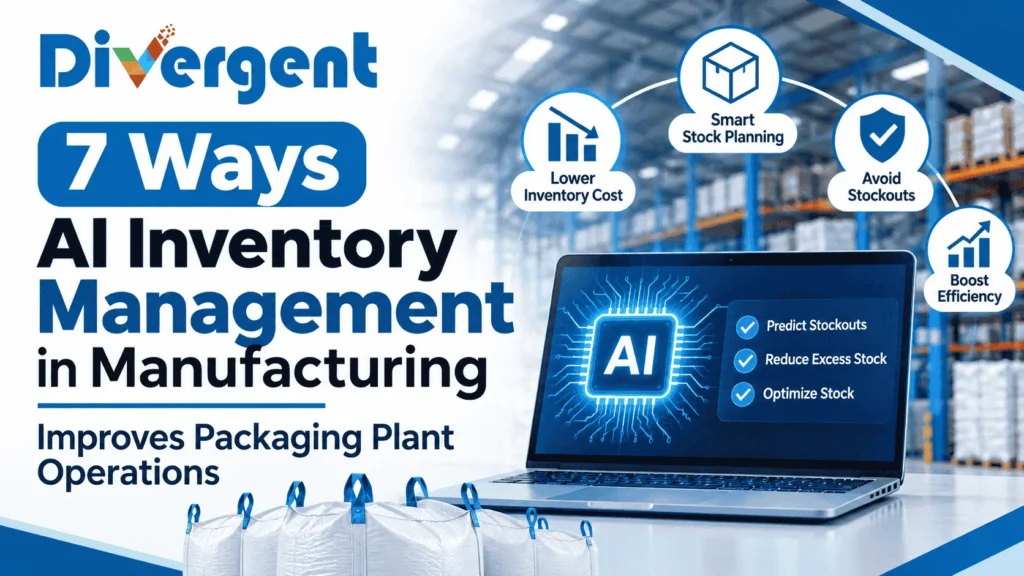
Yes. AI inventory management in manufacturing prevents stockouts by continuously monitoring consumption rates against current stock levels and generating purchase recommendations with enough lead time to receive material before the shortage occurs. Plants implementing AI inventory management in manufacturing typically reduce stockout frequency by 60 to 80 percent within the first six months — the remaining stockouts are almost always caused by supplier failures that exceed historical variability, not planning failures.
How AI Inventory Management in Manufacturing Reduces Excess Stock and Dead Inventory
How does AI reduce excess inventory in manufacturing?
AI reduces excess inventory by calculating purchase quantities from actual confirmed demand rather than from estimates or habit. When demand is lower than expected, the AI reduces the purchase recommendation. When a material’s consumption rate slows, the AI flags it as slow-moving before it becomes dead stock.
| Excess Stock Cause | Traditional Response | AI Response |
|---|---|---|
| Demand lower than forecast | Excess sits until discovered at count | Flagged within days — purchase halted automatically |
| Cancelled customer order | Material already ordered — excess created | Purchase recommendation revised immediately |
| Duplicate item codes | Both ordered — discovered at reconciliation | Detected from consumption pattern match |
| Overly optimistic safety stock | Set once, never reviewed | Recalculated monthly from actual variability data |
| Seasonal material out of season | Sits until next season — ties up cash | Flagged as slow-moving with days-of-cover calculation |
What Results Do Packaging Plants Get From AI Inventory Management in Manufacturing?
What is the ROI of AI inventory management for manufacturing?
The ROI of AI inventory management for packaging manufacturers typically comes from three sources: reduced inventory value as purchasing becomes demand-driven, eliminated emergency procurement as stockouts are predicted in advance, and reduced wastage as actual consumption is measured and fed back into planning. Together these typically deliver inventory value reductions of 20 to 35 percent and stockout reductions of 60 to 80 percent within the first year.
| Result | Typical Improvement | What It Means for a Rs 1Cr Inventory Plant |
|---|---|---|
| Inventory value reduction | 20-35% | Rs 20-35 lakhs freed from working capital |
| Stockout reduction | 60-80% | Near-elimination of emergency procurement |
| Emergency procurement cost | 80-90% reduction | Rs 4-12 lakhs saved per year |
| Wastage reduction | 10-20% | Direct material cost saving |
| Purchase team time saved | 40-60% | Redirected to supplier management and negotiation |
How to Implement AI Inventory Management in Manufacturing: 5 Practical Steps
How do you implement AI inventory management in a packaging plant?
Implementing AI inventory management in manufacturing follows a logical sequence: get the transaction data right first, connect it to a system that can analyse it, start with the highest-impact materials and expand from there. Smart inventory management manufacturing starts with data quality — without clean transaction records, no AI inventory optimization system can deliver accurate results. Inventory management automation becomes reliable only when the underlying data is complete and recorded at the point of transaction.
- Fix transaction data quality first. AI is only as good as the data it learns from. If material issues are recorded at end of shift rather than point of transaction, or if wastage is estimated rather than measured, the AI predictions will be inaccurate. Data quality comes before AI, not after.
- Build 3 to 6 months of clean transaction history. AI inventory management needs enough historical data to identify patterns. For a new ERP implementation, run the system with accurate transaction recording for at least 3 months before activating AI-driven recommendations.
- Start with A-category materials. Apply AI inventory management first to materials that account for 70 to 80 percent of consumption value — typically PP granules, HDPE tape, fabric and packaging materials. These are where accuracy matters most and ROI is highest.
- Validate AI recommendations for the first 4 to 8 weeks. When the AI generates its first purchase recommendations, the purchase team should review and compare them to what they would have ordered manually. The differences will reveal data quality issues to fix or planning assumptions that need updating.
- Expand to all materials and connect to production planning. Once AI inventory management is working for A-category materials, extend it to all materials. Confirmed sales orders drive production plans, production plans drive material requirements, material requirements drive AI purchase recommendations.
Benefits of AI Inventory Management in Manufacturing
What are the key benefits of AI inventory management in manufacturing?
The key benefits of AI inventory management in manufacturing are inventory management automation that eliminates manual calculation, smart inventory management that adjusts to real demand patterns, AI inventory optimization that reduces carrying costs and AI purchase recommendations that give the purchasing team accurate, timely guidance. Together these benefits reduce stockouts by 60-80 percent, free 20-35 percent of working capital from excess inventory and save significant management time previously spent on manual reporting and firefighting.
- Inventory management automation: Every reorder calculation, every safety stock update and every purchase recommendation runs automatically from live transaction data — no manual work required from the purchase team beyond reviewing and actioning the recommendations.
- Smart inventory management: The system learns from your plant’s actual consumption patterns and adjusts recommendations as conditions change — seasonal demand, supplier performance shifts, production plan changes — without anyone updating a setting.
- AI inventory optimization: Safety stock levels, reorder points and order quantities are continuously optimised to minimise the total cost of inventory — balancing holding cost against stockout risk for every material individually.
- AI purchase recommendations ERP: Purchase recommendations generated by the AI surface directly in the ERP purchase order screen — with material, quantity, supplier and order-by date pre-filled from the AI calculation. The purchase team reviews and approves, not calculates.
How Divergent PackPro Uses AI for Inventory Management
Divergent PackPro is a manufacturing ERP built specifically for FIBC, BOPP, PP woven bag and packaging plants. Its AI inventory management in manufacturing module delivers complete inventory management automation — using AI-driven demand forecasting, smart inventory management and AI purchase recommendations ERP teams can act on immediately, without manual calculation or spreadsheet management. PackPro is how packaging plants move from reactive purchasing to AI inventory optimization that prevents stockouts before they occur.
- AI-driven reorder recommendations: PackPro calculates reorder points from actual consumption rates and actual supplier lead times — updated automatically as new transactions are recorded.
- Real-time consumption tracking: Every material issue recorded in PackPro updates the consumption rate calculation. When production runs faster than planned, the AI flags the accelerated consumption and brings forward the reorder recommendation automatically.
- Supplier performance integration: PackPro records actual delivery dates against promised dates for every goods receipt. The AI uses this history to calculate realistic lead times for each supplier and builds safety stock that covers actual variability.
- Slow-moving and dead stock alerts: Materials with no consumption in a defined period are flagged automatically — giving the purchase team early warning before slow-moving stock becomes dead stock.
- Production-linked purchasing: When a new production order is confirmed in PackPro, the AI immediately calculates its material requirements, checks availability and flags any shortfall with a purchase recommendation.
See how Divergent PackPro works or speak to our team for a demonstration of the AI inventory management module.
Frequently Asked Questions — AI Inventory Management in Manufacturing
What is AI inventory management in manufacturing?
AI inventory management in manufacturing is the use of artificial intelligence to predict what stock is needed, when and in what quantity — automatically, from production data, order history and supplier patterns — rather than from manual calculations or static reorder rules.
How does AI improve inventory management?
AI improves inventory management by predicting stockouts before they occur, identifying excess and dead stock automatically, accounting for actual supplier lead times, tracking real wastage rates and optimising safety stock individually for each material based on actual consumption variability.
Can AI prevent stockouts in manufacturing?
Yes. AI prevents stockouts by continuously monitoring projected stock levels against confirmed production schedules and generating purchase recommendations with enough lead time. Plants implementing AI inventory management typically reduce stockout frequency by 60 to 80 percent within six months.
How does AI reduce excess inventory?
AI reduces excess inventory by calculating purchase quantities from actual confirmed demand, flagging slow-moving materials before they become dead stock, detecting duplicate item codes and recalculating safety stock from actual variability data rather than fixed estimates.
What data does AI need for inventory management?
AI inventory management needs historical consumption records, confirmed production orders, supplier delivery performance records and current stock levels updated in real time. The AI is only as accurate as the data it learns from.
What is the ROI of AI inventory management?
AI inventory management typically delivers 20 to 35 percent reduction in inventory value, 60 to 80 percent reduction in stockout frequency and 80 to 90 percent reduction in emergency procurement costs within the first year.
How long does it take to implement AI inventory management?
AI inventory management requires 3 to 6 months of clean transaction history before its predictions become reliable. For an existing ERP with accurate historical data, AI-driven recommendations can be activated and validated within 4 to 8 weeks.
Is AI inventory management suitable for small packaging plants?
Yes. AI inventory management scales to plant size — a plant with 20 looms benefits from the same prediction logic as a plant with 200 looms. Modern manufacturing ERP systems include AI inventory management as a standard module.
What is the difference between AI and traditional inventory management?
Traditional inventory management uses fixed reorder points set manually and reviewed infrequently. AI inventory management uses dynamic reorder points recalculated continuously from actual consumption rates, confirmed production schedules and actual supplier lead times.
How does AI inventory management connect to production planning?
AI inventory management connects to production planning by drawing material requirements directly from confirmed production orders. When a new production order is added, the AI immediately calculates the material needed, checks availability, identifies any shortfall and generates a purchase recommendation.
Related Reading
- AI in Manufacturing: The Essential Guide for Packaging Plants
- AI Demand Forecasting in Manufacturing
- Inventory Management Challenges: 9 Costly Problems
- Inventory Visibility Challenges in Manufacturing
- 12 Critical Manufacturing Challenges and How ERP Solves Them
Follow Divergent Softlab on Google
Enjoying our insights on manufacturing ERP, artificial intelligence and business technology? Add Divergent Softlab as a preferred source on Google to discover more of our latest articles.