Table of Contents
- What Is AI in Manufacturing?
- Why Is AI in Manufacturing Growing So Fast?
- 5 Real AI Use Cases in Packaging and FIBC Manufacturing
- AI in Manufacturing vs Traditional ERP
- How to Start with AI: A Practical Roadmap
- AI in FIBC and Packaging: Specific Applications
- Key Terms Explained
- Frequently Asked Questions
Artificial intelligence in manufacturing is no longer a future technology. Packaging plants, FIBC manufacturers, and woven sack producers worldwide use AI today—to predict machine failures before they happen, automatically catch quality defects, and plan production with more accuracy than any spreadsheet allows.
This guide covers what AI in manufacturing actually means for a packaging or FIBC plant, which use cases deliver real results, what the implementation roadmap looks like, and how AI connects to the ERP system your team already uses.
What Is AI in Manufacturing?
AI in manufacturing uses machine learning, computer vision, and data analysis software to automate decisions and predictions that factory teams currently make manually. Instead of a supervisor estimating tomorrow’s output, an AI system analyses historical production data, machine performance, and order volumes to produce a more accurate forecast. Instead of a quality inspector checking every bag by eye, a computer vision system inspects thousands per hour at consistent accuracy.
The key difference between AI and conventional software is that AI learns from data. A standard ERP system follows the rules you set. An AI system detects patterns in your data and improves its predictions over time, without you rewriting any rules.
For packaging and FIBC manufacturers, AI in manufacturing is most useful in five areas: quality control, demand forecasting, production planning, predictive maintenance, and inventory management. Each one is explained below.
Why Is AI in Manufacturing Growing So Fast?
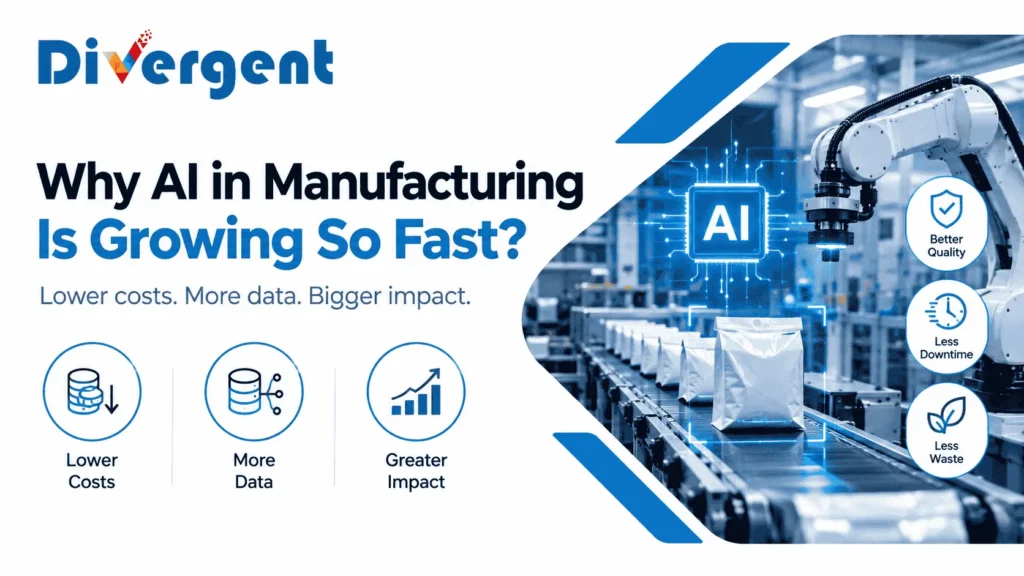
AI in manufacturing is growing because the cost of AI tools has dropped sharply, the amount of data factories generate has increased, and the problems AI solves — quality failures, production delays, material waste — are expensive enough to justify the investment.
According to McKinsey, AI adoption in manufacturing has doubled since 2021. The global AI in manufacturing market was valued at over USD 3 billion in 2023 and is projected to exceed USD 20 billion by 2030, growing at a compound annual rate above 30 percent.
For packaging and FIBC plants specifically, three pressures are driving adoption:
Customer quality requirements are rising. Export customers, food-grade buyers and large FMCG companies now require tighter quality documentation, traceability, and lower defect rates. AI quality inspection delivers consistency that manual inspection cannot.
Labour costs and availability are increasing. AI does not replace skilled workers, but it reduces the need for repetitive inspection and data entry, which are hard to staff and easy to automate.
Margins are tight. In packaging and bulk bag manufacturing, a one percent reduction in material waste or a one percent improvement in machine efficiency directly affects profit. AI finds those percentages in data that most factories already collect but never fully analyse.
5 Real AI Use Cases in Packaging and FIBC Manufacturing
Use Case 1: AI Quality Control
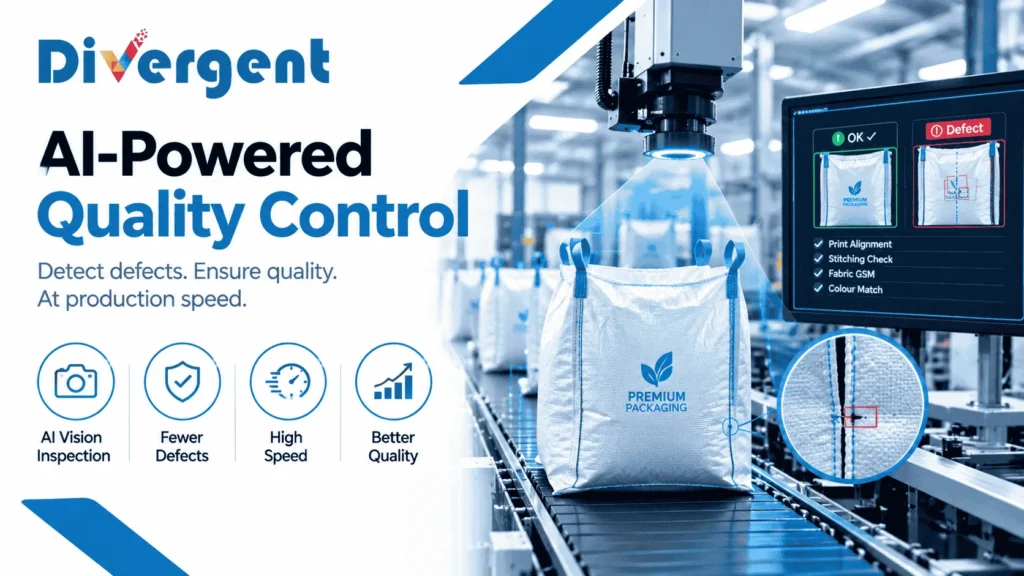
Computer vision cameras inspect bags, fabric, print, and stitching at production speed, comparing each unit against a digital specification. Defects are flagged instantly, without waiting for a human inspector to check a sample.
How it works in a packaging plant: A camera mounted at the output of a printing machine or cutting line captures an image of each bag. The AI model, trained on thousands of images of good and defective bags, identifies colour mismatches, print misalignment, stitching gaps, and GSM variations in real time.
What it replaces: End-of-line manual sampling, which catches defects only after many units have already been produced.
For FIBC and woven bag plants: The most common defects in FIBC production — fabric GSM variation, stitching skips, print registration errors and loop attachment failures — are all detectable by computer vision. A camera-based inspection system at the final line can reduce customer returns by catching rejects before dispatch. See our guide to quality control challenges in manufacturing for more on what causes defects.
Use Case 2: AI Demand Forecasting
AI demand forecasting analyses historical order patterns, seasonal trends, customer buying behaviour and external signals to predict how much of each product a factory will need to produce in the coming weeks and months.
How it works: The AI model is trained on years of order data. It identifies that a particular customer orders more FIBC bags every October before the harvest season, or that BOPP bag orders spike when rice prices rise. The system generates a production forecast that production planning can use directly.
For packaging plants: A BOPP bag manufacturer supplying five large FMCG customers has enough order history to train a simple demand forecasting model. The output is a weekly production recommendation that reduces both overtime and idle time. This directly reduces the production planning challenges that most plants face manually.
Use Case 3: AI Production Planning and Scheduling
AI production planning takes order volumes, machine capacity, material availability and delivery dates and generates an optimised production schedule — one that maximises machine utilisation, minimises changeovers and meets delivery commitments.
For FIBC and woven bag plants: A plant running eight looms for multiple customers with different fabric specifications faces a complex scheduling problem. Changing loom settings has a time cost. An AI scheduling system minimises that cost by grouping similar orders and sequencing changeovers intelligently.
Real result: A packaging plant in Southeast Asia reported a 12 percent improvement in on-time delivery after implementing AI-assisted production scheduling, primarily by reducing unplanned changeovers.
Use Case 4: Predictive Maintenance
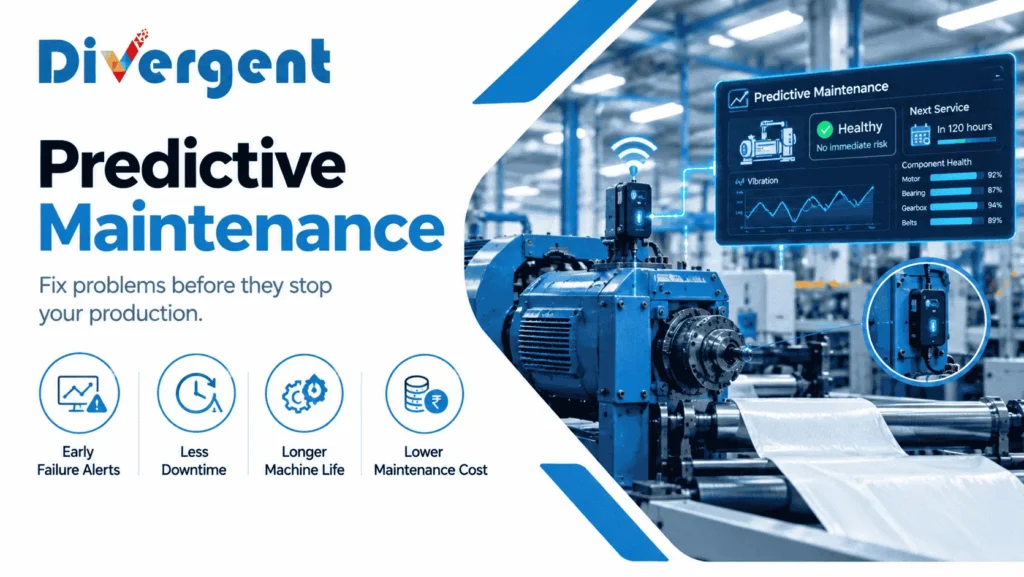
Predictive maintenance uses sensor data from machines to predict when a component is likely to fail, so maintenance is scheduled before a breakdown — not after.
Why it matters for packaging plants: Unplanned downtime on a loom or extruder in a woven bag plant stops an entire production line. A single breakdown during a peak order period can cost more than the sensors that would have predicted it.
Global data: Deloitte reports that predictive maintenance reduces unplanned downtime by 30 to 50 percent and extends machine life by 20 to 40 percent in manufacturing environments.
Use Case 5: AI Inventory Management
AI inventory management predicts when materials will run out, flags slow-moving stock before it becomes dead stock, and recommends reorder quantities based on actual consumption patterns rather than fixed safety stock levels.
For packaging plants: An FIBC plant buying polypropylene granules, UV stabiliser, leno fabric and loops from multiple suppliers has different lead times and usage rates for each. AI inventory management tracks all of them and alerts the purchase team before any material reaches a critical level. See our full guide on inventory management challenges.
AI in Manufacturing vs Traditional ERP: What Is the Difference?
A question plant managers ask frequently is whether they need AI in addition to their ERP, or whether a good ERP already covers what AI promises.
| Feature | Traditional ERP | AI in Manufacturing |
|---|---|---|
| What it does | Records and manages transactions | Analyses patterns and makes predictions |
| Quality control | Records inspection results | Detects defects automatically in real time |
| Production planning | Follows rules you set | Optimises schedules from data |
| Maintenance | Logs breakdowns after they happen | Predicts failures before they happen |
| Inventory | Tracks stock levels | Recommends reorder based on predicted demand |
| Best use | System of record | Analytical layer on top of ERP |
ERP and AI solve different problems and work best together. Your production team records output in the ERP. The AI analyses that data and tells you which machine is trending toward a failure or which order is at risk of being late. Read more about manufacturing challenges that both ERP and AI help solve.
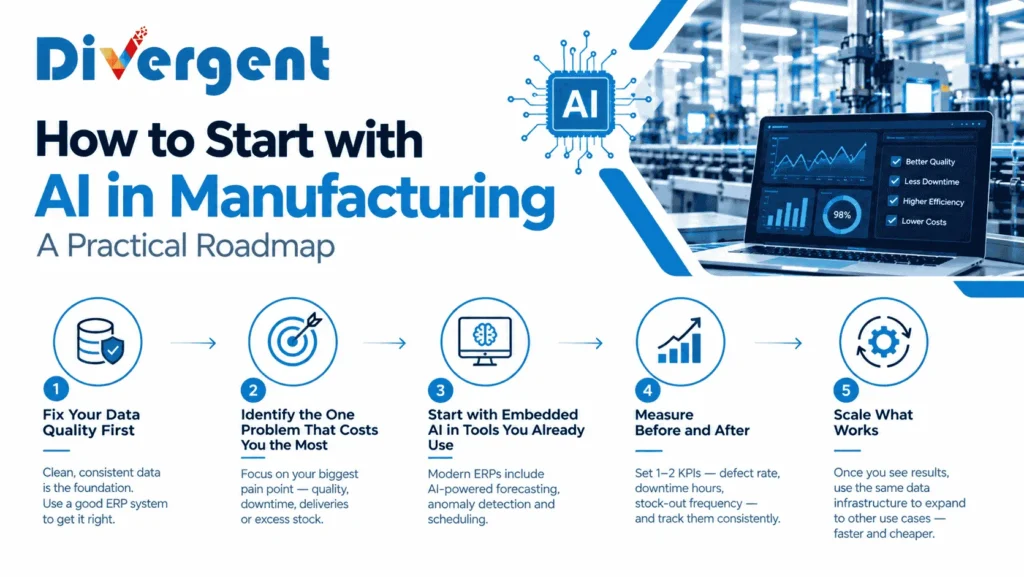
How to Start with AI in Manufacturing: A Practical Roadmap
- Fix your data quality first. AI needs clean, consistent data. If production entries are incomplete, stock counts are inaccurate or quality records are on paper, fix those first with a good ERP system.
- Identify the one problem that costs you the most. Pick the single biggest pain point — quality failures, machine downtime, late deliveries or excess stock — and focus your first AI project there.
- Start with embedded AI in tools you already use. Most modern manufacturing ERPs now include AI-powered forecasting, anomaly detection and scheduling as built-in features.
- Measure before and after. Define one or two KPIs for your AI project before you start — defect rate, downtime hours, stock-out frequency — and measure them consistently.
- Scale what works. Once one use case delivers a measurable result, the same data infrastructure makes the second use case faster and cheaper to implement.
AI in FIBC and Packaging Manufacturing: Specific Applications
FIBC bag plants face a specific set of AI opportunities that differ from general manufacturing:
- Fabric GSM monitoring: AI vision systems mounted on looms detect GSM variation in real time, flagging rolls that fall outside specification before they are cut.
- Loop and stitching inspection: Automated vision inspection of loops and stitching lines catches defects at a rate and consistency that manual sampling cannot match — critical for safety factor compliance.
- Extrusion yield prediction: Machine learning models trained on granule consumption, temperature profiles and tape denier measurements predict extrusion yield per shift.
- Loom efficiency optimisation: AI scheduling tools group similar orders and reduce average changeover time more intelligently than manual scheduling.
- Seasonal demand forecasting: FIBC bags used in agriculture, construction and chemicals follow seasonal demand patterns that AI forecasting detects weeks earlier than manual review.
See our detailed guide on FIBC ERP software for how these AI capabilities connect to your ERP system.
AI in Manufacturing: Key Terms Explained
| Term | What It Means | Used For |
|---|---|---|
| Machine learning | AI that learns patterns from data | Demand forecasting, predictive maintenance |
| Computer vision | AI that analyses images or video | Quality inspection on production line |
| Predictive analytics | Using data to predict future outcomes | Forecasting and maintenance scheduling |
| Digital twin | Virtual model of a machine or line | Simulating changes before implementing them |
| Industrial IoT (IIoT) | Sensors on factory equipment | Data source for predictive maintenance |
| NLP | AI that understands human language | Automated reports and operator queries |
Frequently Asked Questions — AI in Manufacturing
What is AI in manufacturing?
AI in manufacturing is the use of machine learning, computer vision, and predictive analytics to automate decisions and predictions in factory operations. Common applications include quality inspection, demand forecasting, production scheduling, predictive maintenance, and inventory management.
How is AI used in the manufacturing industry?
AI is used in manufacturing for automated quality inspection using computer vision, demand and production forecasting using machine learning, predictive maintenance using sensor data, intelligent scheduling and inventory optimisation.
What are the benefits of AI in manufacturing?
The main benefits of AI in manufacturing are reduced defect rates, lower unplanned downtime, more accurate production and demand forecasts, better inventory levels, and faster identification of process problems.
Is AI replacing workers in manufacturing?
AI in manufacturing automates repetitive inspection and data analysis tasks, but most implementations complement skilled workers rather than replacing them. Quality inspectors move from counting defects by hand to reviewing AI-flagged exceptions.
Can a small packaging plant use AI?
Yes. The most practical starting point for a small packaging or FIBC plant is AI-powered reporting and forecasting built into a modern manufacturing ERP. These features require no additional hardware and work on the data the plant already records.
What is the difference between AI and ERP in manufacturing?
ERP records and manages transactions — orders, stock, production, quality, and dispatch. AI analyses patterns in that data to make predictions and recommendations. They work best together: ERP as the system of record, AI as the analytical layer on top.
What is predictive maintenance in manufacturing?
Predictive maintenance uses sensor data from machines to predict component failures before they cause unplanned downtime. Sensors on looms, extruders, and printing machines feed data to an AI model that identifies patterns preceding a failure.
How does AI improve quality control in manufacturing?
AI improves quality control by using computer vision to inspect every unit at production speed, detecting defects that manual sampling misses and flagging them before they reach the customer.
What data does AI need to work in a factory?
AI in manufacturing needs clean, consistent historical data — production records, quality inspection results, machine sensor readings, order history and material consumption logs. The more complete and consistent this data is, the better the AI predictions.
What is AI demand forecasting in manufacturing?
AI demand forecasting analyses historical order patterns, seasonal trends and customer buying behaviour to predict future production requirements more accurately than manual spreadsheet forecasting.