
A machine stops because one raw material has run out. Meanwhile, the warehouse is full of stock nobody has touched in six months. If that sounds familiar, you’re facing the most common inventory management challenges in manufacturing, and you’re far from alone.
In this guide, you’ll learn the 9 biggest inventory problems factories face, what they really cost, which inventory planning methods work, and a simple step-by-step plan to fix them.
What Are Inventory Management Challenges?
Inventory management challenges are the problems that stop a business from having the right stock, in the right place, at the right time. In manufacturing, they include raw material shortages, excess stock, untracked work-in-progress, late supplier deliveries, inaccurate records and poor visibility across departments.
Manufacturing makes these problems harder than they are in retail. A shop manages one kind of stock: finished products. A factory manages four types of inventory at the same time:
- Raw materials: granules, yarn, film, chemicals, packaging materials
- Work-in-progress (WIP): partly finished goods moving between machines and stages
- Finished goods: products packed and ready to dispatch
- MRO supplies: maintenance, repair and operations items like spare parts and consumables
Each type moves at a different speed and is handled by a different team. That’s why inventory management challenges grow so quickly as a factory grows.
Key takeaways:
- Most inventory management challenges come from inaccurate data and disconnected teams, not from a lack of stock.
- Factories manage four inventory types: raw materials, WIP, finished goods and MRO supplies.
- Poor inventory management ties up cash and stops production at the same time.
- Inventory planning methods like MRP, safety stock and ABC analysis prevent most problems.
- Real-time, shared inventory data is the single biggest fix.
Why Is Inventory Control Important in Manufacturing?
Inventory control is important because inventory is one of the biggest uses of cash in a factory. Too little stock stops production and delays orders. Too much stock ties up money, takes up space and can expire or become obsolete.
The cost of holding stock is easy to underestimate. Storage, insurance, handling, damage and the money locked up in materials are often estimated together at around 20 to 30 percent of inventory value per year.
Ignoring inventory management challenges doesn’t make them cheaper; it makes them bigger. Good inventory control protects three things at once: production uptime, cash flow and delivery promises to customers. That’s the real importance of inventory management. It isn’t about counting boxes. It’s about keeping the whole factory running.
What Are the 9 Biggest Inventory Management Challenges in Manufacturing?
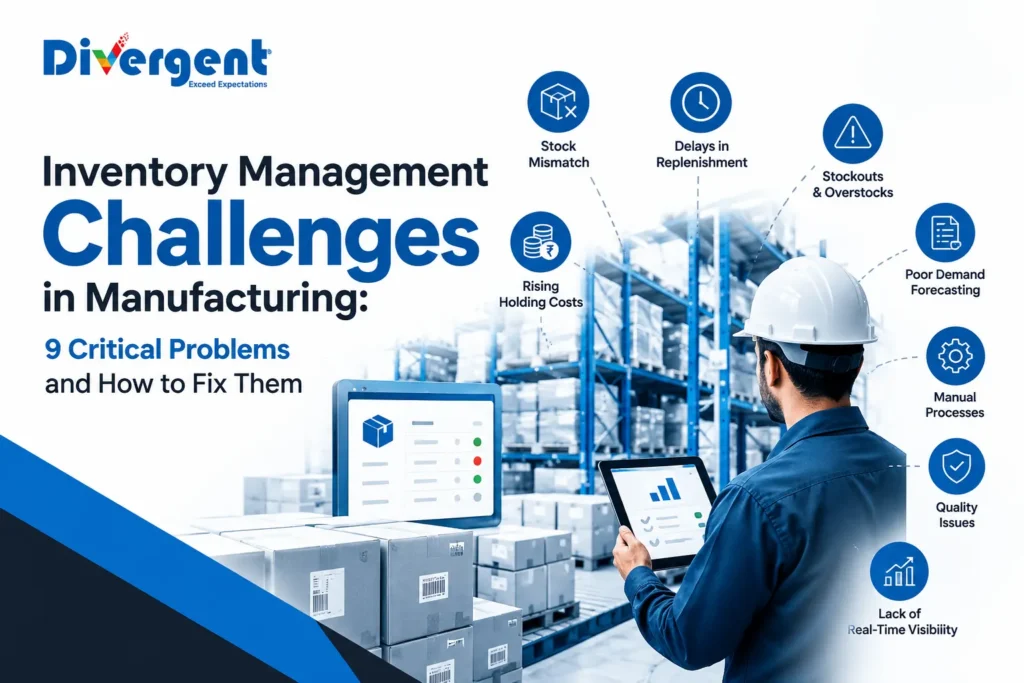
The 9 biggest inventory management challenges in manufacturing are raw material shortages, excess and dead stock, untracked WIP, stock arrival problems, inaccurate records, poor visibility, disconnected departments, unmeasured wastage and unreliable demand forecasts. Each one is explained below with its cause and a practical fix.
1. Why Do Raw Material Shortages Stop Production?
Raw material shortages stop production because one missing input can halt a whole line, even when everything else is ready. They usually happen when reorder points are guessed, consumption isn’t tracked in real time, or purchase only hears about a shortage when the store is already empty.
A common pattern looks like this. The storekeeper notices the shortage on Monday, purchase raises the order on Wednesday, and the supplier delivers the following week. Production loses days to a problem that was visible weeks earlier in the consumption data.
Fix: Set reorder points from actual consumption and lead time, and keep a safety stock for critical materials.
2. What Causes Excess and Dead Stock?
Excess stock builds up when factories over-order “just in case”, buy in bulk for discounts, or keep producing to old forecasts. Dead stock is material that stops moving altogether because a product changed, a customer left or a specification became obsolete.
Excess stock is one of the quietest inventory management challenges. It feels safe, but it drains cash and space. It also hides other inventory issues, because when the shelves are full, nobody notices that planning is broken.
Fix: Review slow-moving items every month, and link purchase quantities to confirmed orders and real consumption.
3. Why Is WIP Inventory So Hard to Track?
Work-in-progress inventory is hard to track because it’s always moving between machines, stages and departments, and it rarely has its own location or label. Partly finished goods sit on the floor between processes, often recorded only on paper job cards.
Untracked WIP causes some of the most expensive inventory management challenges: material that looks “used” in the books but is actually sitting half-processed, duplicate production, and orders that can’t be traced.
Fix: Record WIP at every stage handover, with quantity, stage and job number, on a shared system rather than paper.
4. What Are the Challenges With Stock Arrival?
The main challenges with stock arrival are late deliveries, short or wrong quantities, quality rejections at receipt and unpredictable supplier lead times. When stock arrives late or wrong, the production plan built around that delivery falls apart.
Stock arrival problems are inventory management challenges that start outside your factory, which makes them easy to ignore. Many factories don’t record how suppliers actually perform. They plan with the lead time the supplier promised, not the lead time the supplier really achieves.
Fix: Track promised versus actual lead time for every supplier, inspect goods on arrival, and plan with the real numbers.
5. Why Don’t Stock Records Match Physical Stock?
Stock records stop matching physical stock when issues, returns, scrap and transfers aren’t recorded at the moment they happen. Small gaps add up quickly: a roll issued without an entry, a damaged bag thrown away, a return never booked back into stock.
Inaccurate records are among the most damaging inventory management problems, because every other decision, from purchasing to scheduling, depends on those numbers.
Fix: Record every stock movement where it happens, and run regular cycle counts instead of relying on one big annual count.
6. What Are Inventory Visibility Challenges?
Inventory visibility challenges happen when people can’t see current stock levels across all stores, stages and locations in real time. Purchase sees one number, production sees another, and the store has a third one on paper.
Without shared visibility, teams make decisions with old information. Purchase reorders material that’s already sitting in another store, and sales promises delivery dates that production can’t meet. Our guide to production visibility challenges covers this in more detail.
Fix: Keep one central, real-time inventory record that every department works from.
7. Why Do Purchase, Stores and Production Work in Silos?
Purchase, stores and production often work in silos because each team uses its own spreadsheets, registers and priorities. Production and inventory management are planned separately, so one team doesn’t know what the other is doing.
This is where many inventory management challenges begin. The production plan changes, but purchase isn’t told. A material is substituted, but the store still holds the old one.
Fix: Connect the production plan directly to material requirements, so any change in the plan updates what needs to be bought. Our guide to production planning challenges explains this link step by step.
8. How Do Wastage and Scrap Distort Inventory?
Wastage and scrap distort inventory when they aren’t measured and recorded. Material leaves stock, but if the waste isn’t booked, the books show more material than really exists, and product costs look lower than they are.
In processes like extrusion, weaving, printing and cutting, some wastage is normal. The problem is treating it as a guess, like “around 3 percent”, instead of a measured figure.
Fix: Measure actual wastage by process, machine and shift, and include it in both inventory records and product costing.
9. Why Is Demand Forecasting So Hard for Manufacturers?
Demand forecasting is hard because manufacturers face changing orders, seasonal swings, long supplier lead times and customers who want custom specifications. A forecast that’s even slightly wrong leads to either shortages or excess stock.
Forecasting errors sit behind many other inventory management challenges, from shortages to dead stock. But most factories don’t need a perfect forecast. They need a reasonable forecast that’s updated often, plus inventory planning rules that absorb the errors.
Fix: Combine order history, confirmed orders and safety stock, and review the forecast every month rather than once a year.
![9 inventory management challenges in manufacturing infographic]](https://divergentsoftlab.com/wp-content/uploads/2026/10/9-inventory-management-challenges-manufacturing.webp-1024x683.webp)
What Does Poor Inventory Management Cost a Factory?
Poor inventory management costs a factory in four ways: stopped production, locked-up cash, wasted material and lost customers. Inventory mismanagement usually shows up as several of these at once.
| Problem | What it costs |
|---|---|
| Stockouts | Idle machines and workers, late orders, expensive emergency purchases |
| Excess stock | Cash tied up, storage space, damage and obsolescence |
| Inaccurate records | Wrong purchase decisions and surprise shortages |
| Untracked wastage | Hidden losses and wrong product costs |
| Late deliveries | Penalties and lost repeat business |
The hidden cost is time. Managers spend hours every week chasing stock, checking registers and fixing mistakes, instead of improving the business.
Inventory Management Examples From the Factory Floor
These three inventory management examples show how inventory management challenges play out on a real factory floor, and how each one can be fixed.
Example 1: The missing ink. A packaging plant runs out of one printing ink colour. Everything else for the order is ready, but the line waits three days for the ink. Fix: set reorder points for every critical consumable, not just the main raw materials.
Example 2: The full warehouse. A plant keeps buying a raw material in bulk to get a discount. Six months later, a customer changes their specification, and the stock becomes dead. Fix: link bulk purchases to confirmed demand, and review slow movers every month.
Example 3: The invisible WIP. An order shows as “not started”, but half of it is sitting finished between two processes, recorded only on a paper card. The plant produces it again. Fix: record WIP at every stage handover.
Inventory Management Challenges and Solutions at a Glance
Here’s a quick summary of the inventory management challenges covered above, with the root cause and the fix for each. Save it as a checklist for your next review.
| Challenge | Root cause | Solution |
|---|---|---|
| Raw material shortages | Guessed reorder points | Reorder points based on real consumption and lead time |
| Excess and dead stock | Over-ordering and old forecasts | Monthly slow-mover review, purchases linked to orders |
| Untracked WIP | Paper job cards | Record WIP at every stage handover |
| Stock arrival problems | Unreliable supplier lead times | Track promised versus actual lead time |
| Inaccurate records | Movements not recorded | Record at the point of movement, plus cycle counts |
| Poor visibility | Separate files in each department | One central, real-time stock record |
| Disconnected departments | Plans not shared | Link the production plan to material requirements |
| Unmeasured wastage | Wastage estimated, not measured | Measure by process, machine and shift |
| Unreliable forecasts | Changing orders and long lead times | Monthly forecast review plus safety stock |
How Are Inventory Management Challenges Different in Manufacturing and Retail?
Inventory management challenges in manufacturing are more complex than in retail because factories transform materials, not just resell products. A retailer buys and sells the same item, while a manufacturer has to track materials as they change form through every stage of production.
| Area | Retail | Manufacturing |
|---|---|---|
| Inventory types | Mostly finished goods | Raw materials, WIP, finished goods and MRO |
| What drives demand | Customer purchases | Production plans and customer orders |
| Biggest risk | Running out of popular products | A missing material stopping a whole line |
| Wastage | Damage and theft | Process wastage at every stage |
| Planning method | Sales forecasts and reorder points | MRP, bill of materials and capacity planning |
That’s why generic retail advice often doesn’t work in a factory. Manufacturers need inventory planning that’s tied directly to production.
What Is Inventory Planning, and Which Methods Work Best?
Inventory planning is the process of deciding how much stock to hold, when to reorder and how much to order, based on demand, lead times and production plans. Good inventory planning prevents most inventory management challenges before they start.
When people search for the types of inventory management, they usually mean these inventory planning methods:
| Method | How it works | Best for |
|---|---|---|
| MRP (Material Requirements Planning) | Calculates material needs from the production plan and bill of materials | Factories that make products from many materials |
| JIT (Just-in-Time) | Materials arrive only when they’re needed | Stable demand and reliable suppliers |
| EOQ (Economic Order Quantity) | A formula that balances ordering cost and holding cost | Regularly purchased items |
| Safety stock and reorder point | A buffer of extra stock plus a trigger level for reordering | Critical materials with uncertain supply |
| ABC analysis | Ranks items by value, so A items get the tightest control | Factories with many different items |
You can read more about material requirements planning, just-in-time manufacturing, economic order quantity and ABC analysis on Wikipedia.
Most factories combine methods. ABC analysis decides which items need the closest control, MRP works out what to buy for each order, and safety stock protects the critical materials. Together, they make managing inventory levels far more predictable.
How Do You Solve Inventory Management Challenges?
You solve inventory management challenges by getting accurate data first, then connecting your teams, then planning with proper methods. Here’s a practical 7-step inventory control process you can start this month:
- Count and correct. Do a physical count of your most important items and fix the records.
- Classify with ABC analysis. Focus your effort on the items that matter most.
- Set reorder points and safety stock for every critical material and consumable.
- Record every movement where it happens: receipts, issues, returns, transfers and scrap.
- Track WIP at every stage handover.
- Measure supplier lead times and wastage instead of estimating them.
- Connect production planning with purchase and stores, so a change in the plan updates material needs.
None of these steps needs expensive tools to start. But as order volume grows, manual registers and spreadsheets struggle to keep up, and that’s when most factories look at software.
What Problems Does Inventory Management Software Solve?
Inventory management software solves the problems that spreadsheets can’t: real-time stock visibility, automatic reorder alerts, WIP tracking, accurate records and a live link between production plans and purchasing. For manufacturers, these features usually come as part of a manufacturing ERP or MES system.
The main problems solved by inventory management software include:
- One shared stock number that every department sees in real time
- Automatic alerts when stock falls below the reorder point
- Material requirements calculated directly from the production plan
- WIP tracking by stage, machine and job
- Batch and lot traceability from raw material to finished goods
- Reports on slow-moving stock, wastage and supplier performance
The challenges of managing inventory without manufacturing execution software or an ERP are mostly about delay and duplication: data is entered late, the same numbers live in several files, and nobody is sure which version is right. You can learn more about how enterprise resource planning systems connect these functions.
One warning: software doesn’t fix a broken process by itself. One of the most common pitfalls in inventory optimization projects is automating messy data and unclear ownership. Clean your data and agree who owns each step first, then choose the tool.
FAQs About Inventory Management Challenges
What is inventory management?
Inventory management is the process of ordering, storing, tracking and using a company’s stock. In manufacturing, it covers raw materials, work-in-progress, finished goods and MRO supplies, and makes sure the right materials are available for production without holding too much.
What is an inventory?
An inventory is the stock of materials and goods a business holds to make or sell products. For a manufacturer, inventory includes raw materials, partly finished goods (WIP), finished products ready to ship, and maintenance supplies.
Why is inventory control important?
Inventory control is important because it keeps production running while protecting cash. Too little stock causes stoppages and late orders, while too much stock ties up money and space and increases the risk of damage or obsolescence.
What is inventory planning?
Inventory planning is deciding how much stock to keep, when to reorder and how much to order, based on demand, supplier lead times and the production plan. Common methods include MRP, safety stock with reorder points, EOQ and ABC analysis.
What are the 4 types of inventory management?
The four types of inventory management most often listed are Just-in-Time (JIT), Material Requirements Planning (MRP), Economic Order Quantity (EOQ) and Days Sales of Inventory (DSI). Some sources instead use the phrase for the four types of inventory: raw materials, WIP, finished goods and MRO supplies.
What are the biggest challenges with inventory management?
The biggest challenges with inventory management are stock shortages, excess and dead stock, inaccurate records and poor visibility. In manufacturing, untracked WIP, late supplier deliveries and unmeasured wastage make these inventory management challenges even harder.
How do managers overcome inventory challenges?
Managers overcome inventory challenges by fixing data accuracy first, setting reorder points and safety stock, tracking every stock movement, and connecting purchase, stores and production. Many also use ERP or inventory software once manual systems can’t keep up.