You manage a factory.
But right now — at this exact moment — you do not know what is happening inside it.
Which machine slowed down an hour ago.
Which order is already behind schedule.
Which problem is quietly getting bigger while nobody is watching.
You will find out eventually.
Through a phone call. A WhatsApp message. A supervisor walking to your desk.
But by then — it is already too late to fix it.
That is what production visibility challenges in manufacturing feel like every single day.
And this blog is going to show you exactly why it keeps happening — and what actually stops it.
Production visibility challenges in manufacturing come down to one simple truth.
You cannot manage what you cannot see.
When something goes wrong on your shop floor, you find out in one of three ways. Someone calls you. Someone walks up to your desk. Or a customer calls asking why their delivery is late.
In every single case — the problem already happened. You are not preventing it. You are reacting to it.
This is what running a factory without real-time visibility actually feels like. Not a technology problem. A daily human frustration — the feeling of always being one step behind your own factory.
This blog covers the 5 production visibility challenges in manufacturing that every plant manager deals with. What causes each one. What it actually costs. And what fixes it for good.
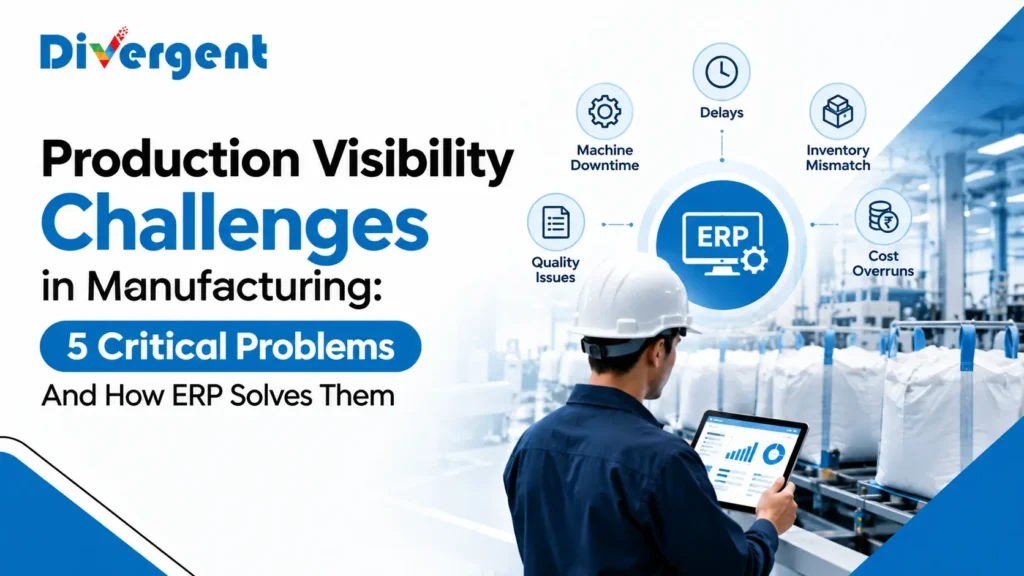
Table of Contents
- What are production visibility challenges in manufacturing?
- Challenge 1: Nobody knows what is happening right now
- Challenge 2: Nobody knows how each machine is really performing
- Challenge 3: Nobody can answer when a customer asks about their order
- Challenge 4: Problems are found too late
- Challenge 5: Efficiency numbers are just guesses
- How ERP solves production visibility challenges in manufacturing
- What to look for
- Conclusion
- Frequently asked questions
What Are Production Visibility Challenges in Manufacturing?
Production visibility challenges in manufacturing happen when the people running the factory do not have a live picture of what is happening on the floor.
Think about what that means in practice.
Your planning team makes decisions using yesterday’s data.
Your management reads reports from last week.
Your sales team promises delivery dates without knowing what the floor actually looks like right now.
Everyone is working hard. Everyone is doing their best.
But everyone is working in the dark.
According to a McKinsey Global Institute report, manufacturers with real-time production visibility reduce downtime by up to 50 percent and improve delivery performance significantly compared to plants running on manual tracking systems.
The 5 production visibility challenges in manufacturing below are the most common and most costly blind spots factories deal with today.
Read also: 12 Critical Manufacturing Challenges in Modern Manufacturing Industry
Link: https://divergentsoftlab.com/manufacturing-challenges
Challenge 1: Nobody Knows What Is Happening Right Now
Think about how you find out what is happening on your shop floor today.
A supervisor sends a WhatsApp. An operator calls. Someone walks to your desk to give you an update. An end of shift report lands on your table at 5 PM.
Every single one of these methods has the same problem.
By the time the information reaches you — the situation has already changed.
This is where production visibility challenges in manufacturing begin. Not with technology. With the simple fact that floor information moves slowly through human channels.
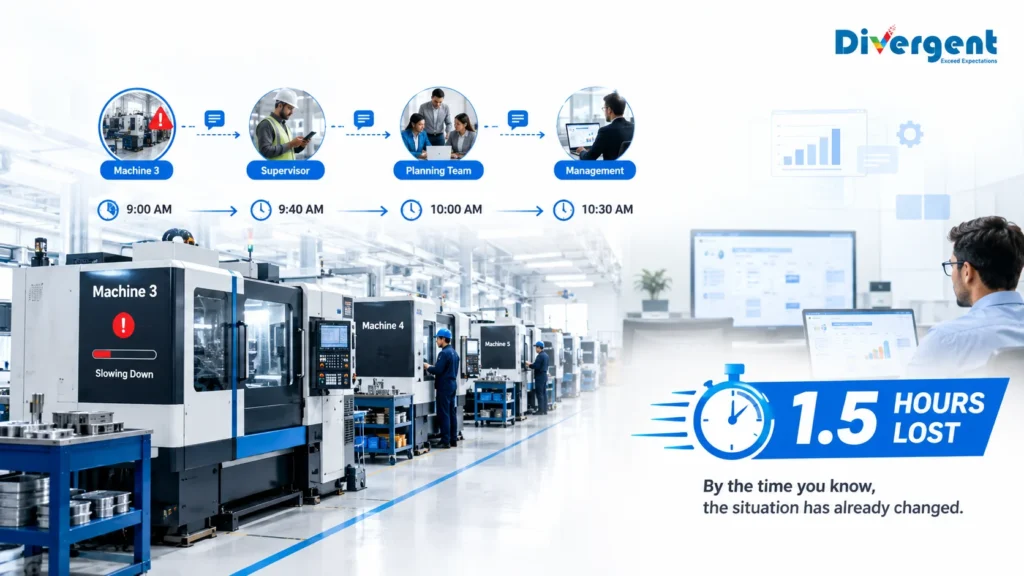
Here is what this actually looks like on a normal day.
Machine 3 slows down at 9 AM.
Supervisor notices at 9:40.
They message the planning team at 10.
Planning team updates the schedule at 10:30.
One and a half hours of lost production. And nobody was in a position to do anything about it in time.
This happens every shift. In factories of every size. The people involved are not careless. The process simply has no way to move information fast enough.
Challenge 2: Nobody Knows How Each Machine Is Really Performing
Here is a question worth sitting with.
How is your Machine 4 actually performing this week?
You probably have a number in your head. Something like — it runs at around 80 percent efficiency. Maybe a little less lately.
Where did that number come from?
Experience. Observation. A rough sense built from months of working with that machine.
Here is the problem with that.
Research from McKinsey shows that when manufacturers install real-time machine tracking, they discover their actual efficiency is 15 to 25 percent lower than their experience-based estimate.
That gap is not anyone’s fault. It is simply what happens when you measure a live machine with a static estimate.
OEE — Overall Equipment Effectiveness — is the standard way to measure how well a machine is actually being used. It looks at three things. Is the machine available when it should be? Is it running at full speed? Is it producing good parts?
Read more: Wikipedia — Overall Equipment Effectiveness
Link: https://en.wikipedia.org/wiki/Overall_equipment_effectiveness
Most factories run at 40 to 60 percent OEE. Most do not know it. Because calculating OEE accurately needs real data from each machine — captured live during the shift, not estimated after it ends.
Production visibility challenges in manufacturing around machine performance are particularly painful because the machine looks like it is running. But running and running well are two very different things.
Challenge 3: Nobody Can Answer When a Customer Asks About Their Order
This one is uncomfortable to admit.
A customer calls. They want to know the status of their order. It is due for dispatch tomorrow. Is it on track?
You turn to the planning team. They call the supervisor. The supervisor walks to the floor to check.
Five minutes later the answer comes back.
The order is 55 percent complete. It will not be ready tomorrow.
The customer is not just disappointed about the delay.
They are disappointed that you did not know. That nobody could tell them in seconds. That your factory — which is supposed to be managing their order — could not see where it was.
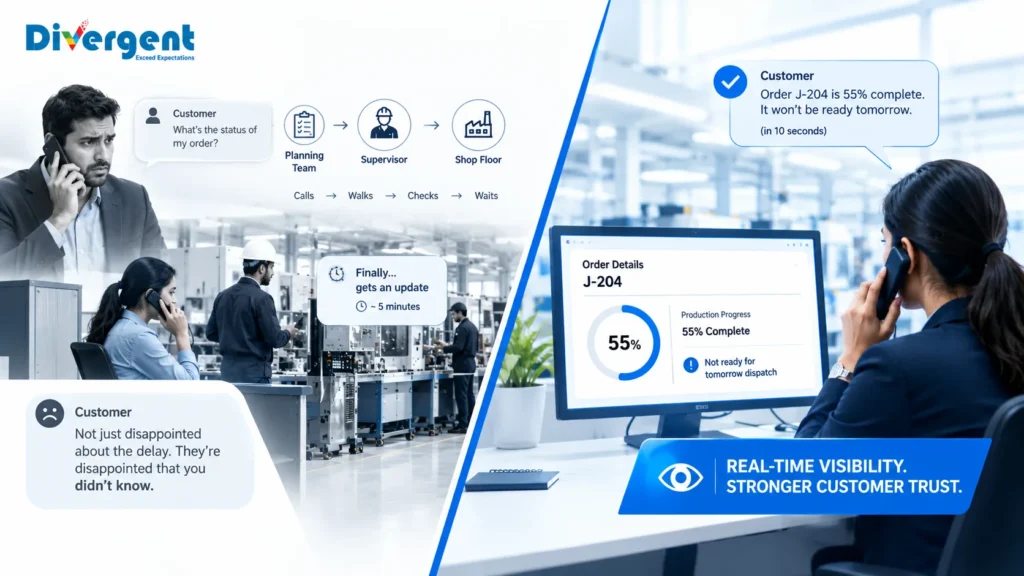
This is one of the production visibility challenges in manufacturing that customers experience directly. Before any delivery is missed. Before any complaint is raised. Just in that five minute pause while someone goes to check.
When you can see every order’s progress in real time — not because someone updated a spreadsheet but because the system captures it automatically as production happens — that phone call becomes completely different.
Customer calls. You look at the screen. Order J-204 is 78 percent complete. On track for tomorrow dispatch. You tell them in ten seconds.
That is the difference visibility makes. Not just operationally. In the relationship.
Read also: 12 Critical Manufacturing Challenges in Modern Manufacturing Industry
Link: https://divergentsoftlab.com/manufacturing-challenges
Challenge 4: Problems Are Found Too Late
A bottleneck happens when work piles up at one point faster than it can move through.
One machine running slightly slow. One operator on a break at the wrong moment. One inspection step taking longer than planned.
On its own — a small problem.
But in a connected production line, a small problem at one station quickly becomes a big problem for every order behind it.
This is what makes late detection one of the most expensive production visibility challenges in manufacturing.
A bottleneck caught in 15 minutes — one job is slightly delayed.
A bottleneck running for 2 hours — five jobs are behind. The day’s schedule has collapsed.
In factories without real-time visibility, bottlenecks are found the old way. Someone walks past and notices material building up at one station. By that point an hour or more has already passed.
With real-time visibility, the system tracks output at each station. The moment any station falls behind its planned rate — an alert goes out. A supervisor checks. The problem gets fixed before the backlog builds.
The problem still happened. But it stayed small.
That is what solving production visibility challenges in manufacturing around bottleneck detection actually means. Not eliminating problems. Catching them early enough that they do not become disasters.
Challenge 5: Your Efficiency Numbers Are Just Guesses
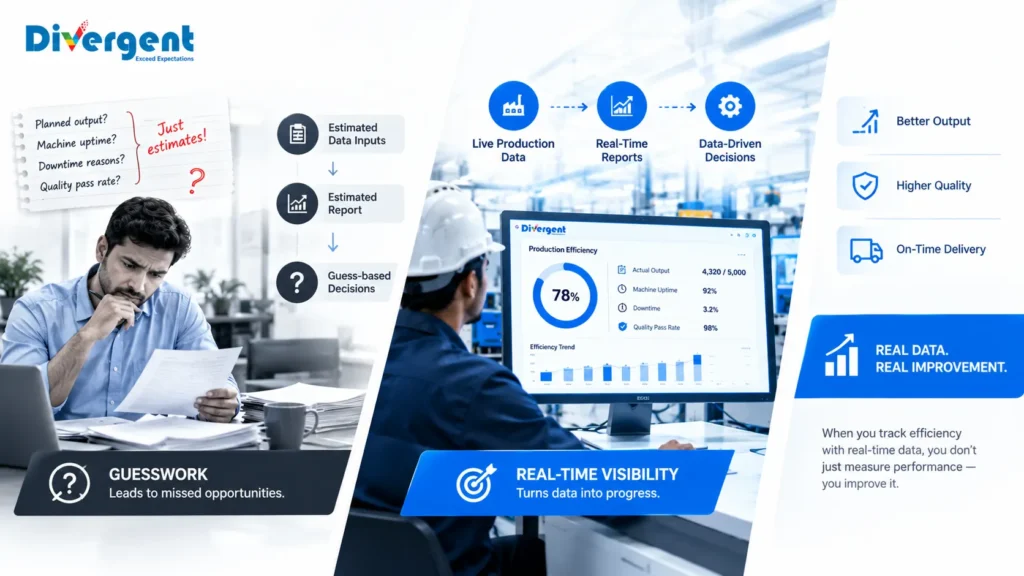
Every week most factories produce a production efficiency report.
And most of those reports are built on estimates.
Actual units produced — counted reasonably well.
Planned output, real machine uptime, downtime reasons, quality pass rates — these need real-time data captured throughout the shift. Not a number pieced together manually at the end of the day.
When the inputs are estimated, the report is estimated.
When the report is estimated, the decisions made from it are guesses.
When decisions are guesses, improvements never target the real problem.
IndustryWeek research shows that manufacturers tracking efficiency with real-time data consistently outperform those using manual or estimated tracking across every key metric — output, quality, and delivery.
Link: https://www.industryweek.com/operations/continuous-improvement
The uncomfortable truth about this production visibility challenge in manufacturing is simple.
You cannot improve a number you are guessing at.
You can only improve a number you actually know.
How ERP Solves Production Visibility Challenges in Manufacturing
Every one of the 5 production visibility challenges in manufacturing above comes from the same place.
The floor moves. The systems tracking it do not keep up.
Manufacturing ERP software closes that gap. It connects the floor to everyone who needs to see it — in real time, automatically, without anyone having to send a message or update a spreadsheet.
Here is what that actually looks like in practice:
- No visibility right now — A live dashboard showing every machine, every order, every station. Updated automatically all shift. No manual input needed.
- Machine performance unknown — Real-time output tracking per machine. Automatic alert when any machine falls below its planned rate.
- Order status unknown — Every order’s completion percentage visible to sales, planning, and management at the same time. Always current. Always accurate.
- Bottlenecks found too late — System flags any station falling behind within minutes. Alert goes to supervisor before backlog builds.
- Efficiency numbers are guesses — OEE calculated automatically from real machine data. Available at end of every shift without anyone manually compiling anything.
This is why solving production visibility challenges in manufacturing is the most important place to start when a factory wants to improve. Because visibility is the foundation everything else is built on. You cannot plan better, schedule better, or deliver better — until you can see clearly.
What to Look for in a Manufacturing Visibility System
When looking for a solution to production visibility challenges in manufacturing, look for these specific things:
- Live shop floor dashboard — real-time view of every machine and order without manual updates
- Machine wise tracking — actual vs planned output per machine with automatic alerts
- Order wise progress — visible to everyone without calling the floor
- Automatic bottleneck detection — alert within minutes of any station falling behind
- OEE calculation — automated from real data, not estimates
- Shift wise reports — actual vs planned available automatically at end of every shift
- Full integration — connected to planning, inventory, quality control, and dispatch
One rule above everything else.
If the system needs someone to manually update it to stay current — it will not stay current. The only visibility that is reliable is visibility captured automatically at the source.
Conclusion
Production visibility challenges in manufacturing are not complicated problems.
They are human problems.
A plant manager who cannot see what is happening on their floor is not failing at their job. They are working with a system that was never built to show them what they need to see.
- When you can finally see everything — in real time, clearly, without waiting for a call or a shift report — the job changes completely.
You stop reacting to problems that already happened.
You start preventing problems before they happen.
- That shift — from reactive to proactive — is what real production visibility actually gives you.
And it starts with being honest about one simple question.
- Right now — do you actually know what is happening on your floor?
Frequently Asked Questions — Production Visibility Challenges in Manufacturing
Q: What are production visibility challenges in manufacturing?
Production visibility challenges in manufacturing are the problems that come from not being able to see what is happening on your factory floor in real time. When managers and planners work from information that is hours old, every decision is based on guesswork instead of facts. The result is delays discovered too late, orders that fall behind without anyone noticing, bottlenecks that run for hours before someone catches them, and efficiency reports built on estimates. Production visibility challenges in manufacturing are among the most common and most financially damaging problems in modern factories — and among the most fixable.
Q: Why do most manufacturers struggle with shop floor visibility?
Most manufacturers struggle with shop floor visibility because the tools they rely on — spreadsheets, WhatsApp messages, verbal updates, end of shift reports — all have built-in delays. Information has to travel from the floor to a person and then to the next person before it reaches whoever needs to act on it. By the time it arrives the situation has already changed. Real-time visibility replaces these slow human channels with a system that captures floor data automatically and makes it available instantly to everyone who needs it.
Q: What is OEE and why does it matter?
OEE stands for Overall Equipment Effectiveness. It is the clearest way to measure how well a machine is actually being used — looking at whether it is available, running at full speed, and producing good parts. Most manufacturers estimate their OEE from experience. Research shows that actual OEE is typically 15 to 25 percent lower than those estimates. Closing that gap is one of the fastest ways to increase output without buying new machines. And closing it starts with measuring it accurately — which requires real-time machine data, not end of shift estimates.
Q: How does ERP software fix production visibility challenges in manufacturing?
ERP software fixes production visibility challenges in manufacturing by creating a live view of the entire factory floor — machine output, order progress, bottleneck alerts, and efficiency data — all captured automatically and updated in real time without manual input. Plant managers see what is happening the moment it happens. Sales teams answer order status questions in seconds. Planning teams spot problems before they become delays. These are the exact production visibility challenges in manufacturing that a connected ERP system eliminates.
Q: What is the most important thing to look for in a visibility system?
The most important thing is that the system captures data automatically rather than requiring manual updates. A visibility system that depends on someone remembering to update it will always have gaps — usually at exactly the moment you need it most. Reliable visibility only comes from data captured automatically at the source, continuously throughout the shift.
Q: How do production visibility challenges connect to late deliveries?
They connect directly. When you cannot see which orders are falling behind in real time you cannot act before they become late. By the time a delayed order surfaces through manual reporting, the delivery date has already passed or there is no time left to recover. Factories with real-time order tracking can identify at-risk deliveries while there is still time to act — reallocate resources, adjust the schedule, or have an honest conversation with the customer before the deadline arrives.