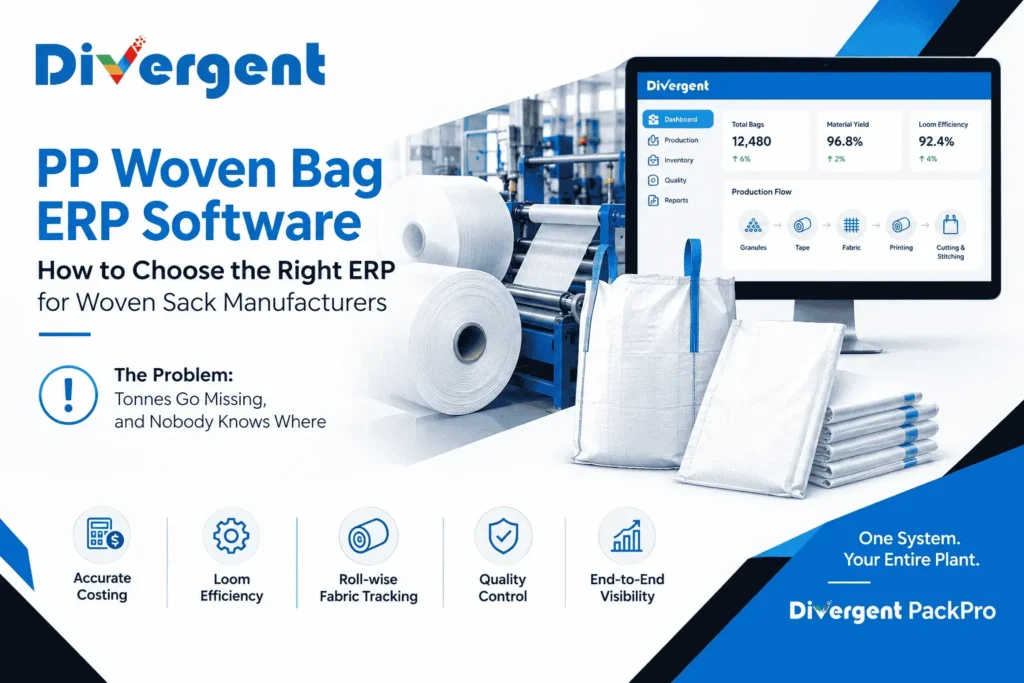
The Problem: Tonnes Go Missing, and Nobody Knows Where
Your extrusion line made 20 tonnes of tape this week. Your looms ran every shift. But when you count the finished bags, the numbers don’t add up. Somewhere between granules and bags, a tonne or more has gone missing.
Was it tape breaks? Fabric waste? Cutting? Rejected bags? Nobody can say for sure, because every stage keeps its own register, and nobody connects them.
And it doesn’t stop there:
- Quotes take a full day, because costing sheets are rebuilt for every enquiry.
- Actual bag cost comes out higher than the price you quoted.
- Looms stop, but nobody records why or for how long.
- Fabric stock is a total, so nobody knows which rolls match which order.
- GSM or strength problems are found at the bag stage, after all the material is already used.
Every one of these gaps looks small. Together, they quietly eat your margin, month after month.
The Answer: PP Woven Bag ERP Software Built for Your Plant
The answer is PP woven bag ERP software: one system that connects every stage of your woven sack plant, from granules to finished bags.
At Divergent Software Labs, we built Divergent PackPro for exactly this. PackPro is an AI-enabled, end-to-end ERP for flexible packaging manufacturers, including PP woven bag plants. It brings costing, tape extrusion, weaving, lamination, printing, cutting and stitching, stock, quality and dispatch into one place, so you can:
- See real yield at every stage, from granules to tape to fabric to bags
- Quote faster and more accurately, with cost calculated from GSM, mesh, size and finish
- Track loom efficiency and the reasons for every stop
- Know every fabric roll, with its GSM, width, length and location
- Catch quality problems early, before more material is added
We don’t start by selling software. We start by understanding your plant: how orders move, where records are kept today, and where the biggest losses happen. Then we set up PackPro around your workflow.
Key takeaways:
- PP woven bag plants lose money in small gaps between stages: tape, fabric, cutting and stitching.
- Generic ERP tracks orders and stock, but not tape yield, loom efficiency or fabric rolls.
- The 9 must-have features include GSM-based costing, extrusion yield, loom efficiency and roll-wise fabric tracking.
- Measuring waste at every stage is the fastest way to protect your margin.
- Divergent PackPro connects all of this in one system, set up around how your plant works.
What Is PP Woven Bag ERP Software?
PP woven bag ERP software is an ERP system made for factories that produce PP woven sacks: cement bags, fertilizer bags, feed bags, sugar and rice bags, woven poly bags and other industrial bags. It links every department, from sales and costing to production, stores, quality and dispatch, so everyone works from the same numbers.
A normal ERP sees a bag as an item with a price and a quantity. A woven sack plant needs much more: the GSM, mesh, width, denier, coating, printing and bag size behind every order. PP woven bag ERP software understands these details, so your costing, planning and stock all match what really happens on the shop floor.
If you’re new to the different types of woven sacks, our guide to woven polypropylene bags explains each one.
Where Do Woven Sack Plants Lose Money?
Most woven sack plants don’t lose money in one big mistake. They lose it in small gaps between stages that nobody measures.
Here’s where the gaps usually are:
- Tape extrusion: granules go in, but tape breaks, startup waste and colour changes reduce the output.
- Weaving: looms stop for beam changes, tape breaks and repairs, so fabric output is lower than planned.
- Lamination and printing: setup waste and edge trim use material that never reaches a bag.
- Cutting and stitching: offcuts, wrong lengths and rejected bags eat into yield.
- Costing: quotes use old GSM and rate assumptions, so actual cost ends up higher than quoted.
Each gap looks small. But across a month of production, they add up to real money. Our guide to manufacturing waste explains how to measure these losses.
Why Don’t Excel and Normal ERP Work Well for Woven Sack Plants?
Excel and normal ERP don’t work well because they weren’t built for multi-stage, weight-based production. They can store orders and total stock, but they can’t easily show yield from granules to tape to fabric to bags, or calculate cost from GSM and mesh.
In a typical plant, this means:
- Costing sheets are rebuilt for every enquiry. See our guide to costing and quotation challenges.
- Planning happens on a whiteboard, and extrusion, looms and conversion aren’t planned together. Read more in production planning challenges.
- Fabric stock is a total, not roll by roll, so nobody knows which rolls match which order. See inventory management challenges.
- Quality checks are on paper, so GSM or strength problems are found too late. See quality control challenges.
That’s why many woven sack manufacturers move to PP woven bag ERP software built for their industry.
What Are the 9 Must-Have Features in PP Woven Bag ERP Software?
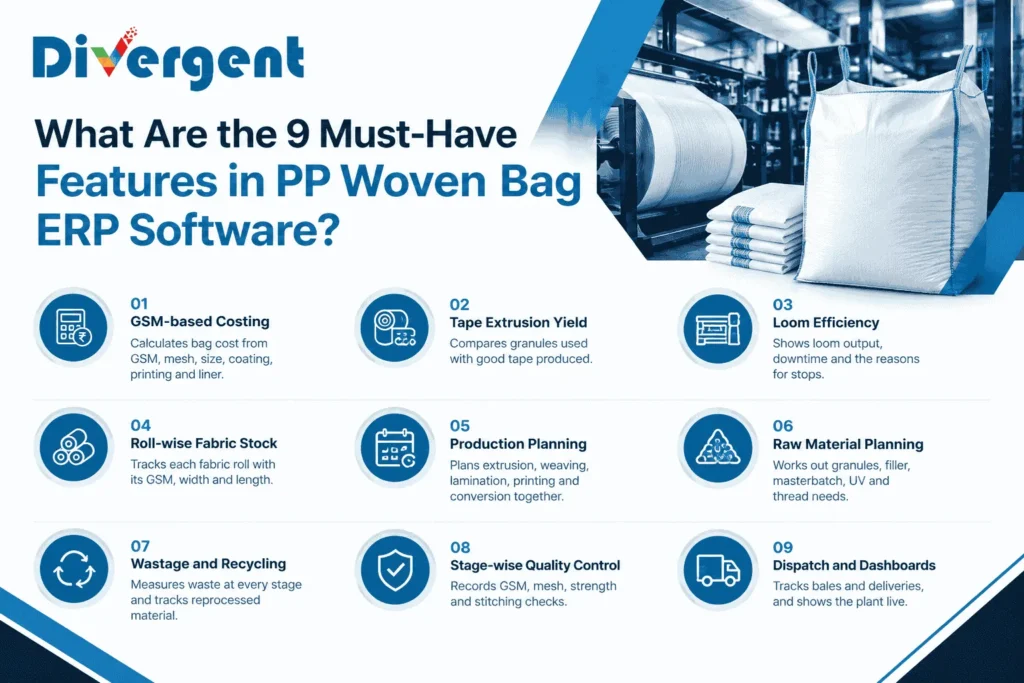
The 9 must-have features in PP woven bag ERP software are GSM-based costing, tape extrusion yield, loom efficiency tracking, roll-wise fabric stock, production planning across stages, raw material planning, wastage and recycling tracking, stage-wise quality control, and dispatch with dashboards.
| Feature | What it does for a woven sack plant |
|---|---|
| GSM-based costing | Calculates bag cost from GSM, mesh, size, coating, printing and liner |
| Tape extrusion yield | Compares granules used with good tape produced |
| Loom efficiency | Shows loom output, downtime and the reasons for stops |
| Roll-wise fabric stock | Tracks each fabric roll with its GSM, width and length |
| Production planning | Plans extrusion, weaving, lamination, printing and conversion together |
| Raw material planning | Works out granules, filler, masterbatch, UV and thread needs |
| Wastage and recycling | Measures waste at every stage and tracks reprocessed material |
| Stage-wise quality control | Records GSM, mesh, strength and stitching checks |
| Dispatch and dashboards | Tracks bales and deliveries, and shows the plant live |
1. GSM-Based Costing
GSM-based costing calculates the cost of each bag from its specification: fabric GSM, mesh, width, bag size, coating, printing, liner and stitching. When granule prices change, the cost updates automatically.
This is often the biggest win. Your sales team can give accurate quotes quickly, without rebuilding a spreadsheet every time.
2. Tape Extrusion Yield
Extrusion yield tracking compares the polypropylene granules and additives used with the good tape produced. It records startup waste, colour-change waste and tape breaks, so you see your real yield by line and shift.
3. Loom Efficiency Tracking
Loom efficiency tracking shows how much fabric each loom produced compared with what it could produce, and why it stopped: beam changes, tape breaks, repairs or no operator. That makes it clear which looms need attention.
4. Roll-Wise Fabric Stock
Roll-wise stock tracks every fabric roll individually, with its GSM, width, length, weight and location. So when an order comes in, you know exactly which rolls match it, instead of guessing from a total.
5. Production Planning Across Stages
Production planning schedules extrusion, weaving, coating, printing, cutting and stitching against delivery dates. A good system groups similar orders to reduce changeovers and shows where every order is, at any time.
6. Raw Material Planning
Raw material planning works out how much granules, filler, masterbatch, UV additive, thread and liner film each order needs, compares it with stock, and flags shortages before they stop a line.
7. Wastage and Recycling Tracking
Woven sack plants usually reprocess some of their own waste into reusable material. PP woven bag ERP software tracks waste at every stage and how much reprocessed material goes back into production, so your yield and costing stay accurate.
8. Stage-Wise Quality Control
Quality control records checks at each stage against the order’s specification: tape denier and strength, fabric GSM and mesh, coating weight, print quality, bag size and stitching strength. Problems are caught early, before more material is added.
9. Dispatch and Dashboards
Dispatch management tracks bales, packing and delivery for each order. Dashboards give owners a live view of orders, machine status, yield, wastage and pending dispatches.
PP Woven Bag ERP Software Options Compared
Woven sack manufacturers usually manage operations in one of three ways: Excel and registers, a normal ERP, or ERP built for their industry, like Divergent PackPro.
| Factor | Excel and registers | Normal ERP | Divergent PackPro |
|---|---|---|---|
| Setup cost | Very low | Medium to high | Medium |
| GSM and mesh-based costing | Manual formulas | Needs customisation | Designed for it |
| Extrusion yield tracking | Rarely tracked | Needs customisation | Designed for it |
| Loom efficiency | Separate register | Rarely available | Designed for it |
| Roll-wise fabric stock | Very difficult | Possible with setup | Designed for it |
| Stage-wise wastage | Rarely tracked | Possible with setup | Designed for it |
| Best for | Very small plants | Large multi-industry groups | Growing woven sack manufacturers |
If you make a few standard bags for a few customers, Excel may still work. Once you handle many sizes, GSMs, customers and printed or laminated bags, PP woven bag ERP software usually pays for itself through better yield, faster quotes and fewer mistakes.
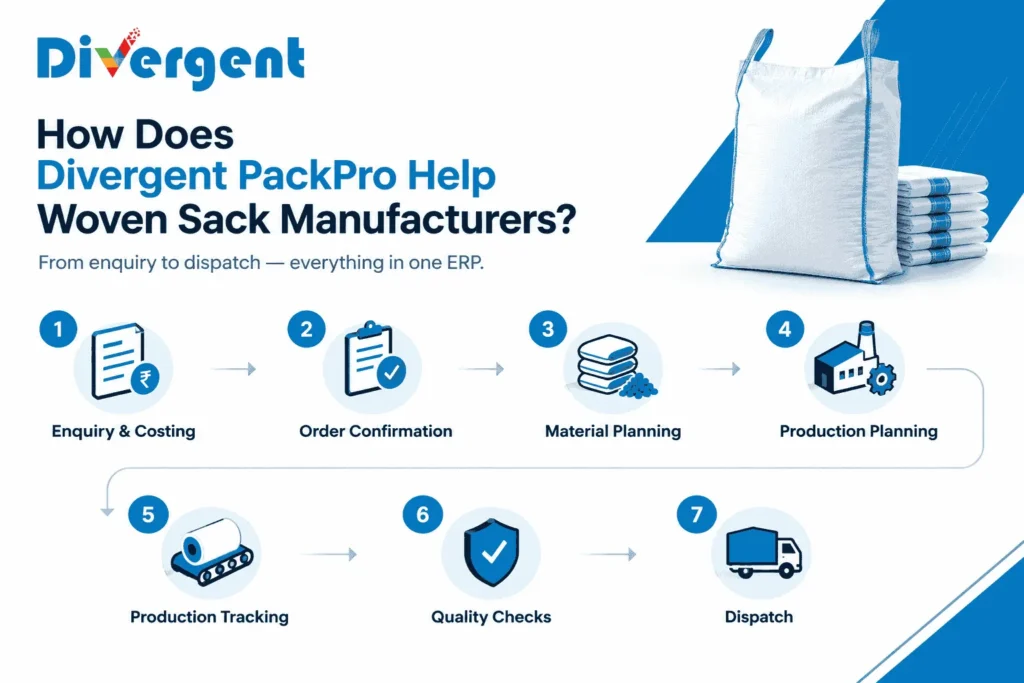
How Does Divergent PackPro Help Woven Sack Manufacturers?
Divergent PackPro is an AI-enabled, end-to-end ERP built by Divergent Software Labs for flexible packaging manufacturers, including PP woven bag plants. It brings costing, planning, production, stock, quality and dispatch together, so every team works from the same numbers.
Here’s how an order typically moves through a woven sack plant using industry-built ERP:
- Enquiry and costing: the bag specification is entered, and cost is calculated from GSM, mesh, size and finish.
- Order confirmation: the order is saved with its approved specification.
- Material planning: granules, additives and accessories are checked against stock.
- Production planning: extrusion, weaving, coating, printing and conversion are scheduled.
- Production tracking: output, downtime and waste are recorded at each stage.
- Quality checks: GSM, strength and stitching results are recorded against the specification.
- Dispatch: bales are packed, documented and delivered, with full history.
What Will You See in a PackPro Demo?
A demo is the best way to judge whether PP woven bag ERP software fits your plant. Bring your real data, and ask to see:
- One of your bag specifications costed from GSM, mesh, size and finish
- A sample order moving from enquiry to production plan
- Extrusion and loom output recorded, with yield and downtime
- Fabric rolls tracked one by one against an order
- A quality check recorded at the fabric or bag stage
Bring your most complicated bag, such as a laminated, printed bag with a liner. It’s the best way to test any system.
Expert Insight
“Most woven sack plants don’t have a production problem. They have a measurement problem. Once you can see yield at every stage, from granules to tape to fabric to bags, the losses become obvious, and most of them are easy to fix.”
Is Your Woven Sack Plant Ready for ERP?
Your plant is ready for PP woven bag ERP software when spreadsheets and registers can’t keep up with your orders, sizes and machines. Check these signs:
- Quotes take a day or more because costing sheets are rebuilt every time
- Actual bag cost often comes out higher than the quoted cost
- Nobody knows the real yield from granules to finished bags
- Loom downtime and its reasons aren’t recorded
- Fabric stock is a total, not tracked roll by roll
- Quality problems are found at the bag stage, not earlier
If three or more of these are true, ERP will likely save you more than it costs.
How Should You Prepare for ERP in a Woven Sack Plant?
The best way to prepare is to organise your bag specifications, clean your core data, and start with your biggest problem.
- List all active bag specifications: GSM, mesh, size, coating, printing and liner.
- Clean your master data: customers, suppliers, materials and machines.
- Decide your roll and batch numbering before going live.
- Pick one project owner inside the plant.
- Start with your biggest pain, such as costing or yield tracking.
- Train each team on the screens they’ll use every day.
What Should You Ask Before Choosing PP Woven Bag ERP Software?
Before choosing PP woven bag ERP software, ask every vendor to show the system with your own bag specifications. Then ask:
- Can it calculate bag cost from GSM, mesh, size, coating, printing and liner?
- Can it show extrusion yield and loom efficiency by machine and shift?
- Does it track fabric stock roll by roll?
- Can it plan extrusion, weaving and conversion together?
- Does it track waste and reprocessed material?
- How long does setup take, and who trains our team?
For a general overview of how these systems work, see enterprise resource planning on Wikipedia. If you also make jumbo bags or laminated bags, see our guides to FIBC ERP software and BOPP bag ERP software.
FAQs About PP Woven Bag ERP Software
What is PP woven bag ERP software?
PP woven bag ERP software is an ERP system built for woven sack manufacturers. It connects costing, extrusion, weaving, conversion, stock, quality and dispatch, using details like GSM, mesh, denier and bag size.
What is a polypropylene bag?
A polypropylene bag, or PP bag, is a bag made from polypropylene plastic. Woven PP bags are made by weaving thin PP tapes into fabric, then cutting and stitching it into sacks for cement, fertilizer, feed, sugar, rice and other products.
What is polypropylene fabric?
Polypropylene fabric is fabric made from polypropylene plastic. In woven sacks, it’s made by weaving stretched PP tapes on looms. It’s strong, light, low-cost and resistant to moisture and many chemicals.
Is polypropylene strong?
Yes. Woven polypropylene is very strong for its weight, which is why it’s used for bags that carry 25 to 50 kg. Its strength depends on the tape denier, fabric GSM and weave.
Can polypropylene be recycled?
Yes. Polypropylene can be recycled, and many woven sack plants reprocess their own production waste into reusable material. Collection of used bags for recycling varies by country.
What is the difference between PP and PE bags?
PP (polypropylene) is stiffer and stronger for its weight, so it’s used for woven sacks. PE (polyethylene) is softer and more flexible, so it’s often used for liners and films. Our woven polypropylene bags guide explains the difference in detail.
How much does PP woven bag ERP software cost?
The cost depends on the number of users, modules, plants and deployment type. Most vendors quote after understanding your operations, so ask for a quote based on your actual setup.