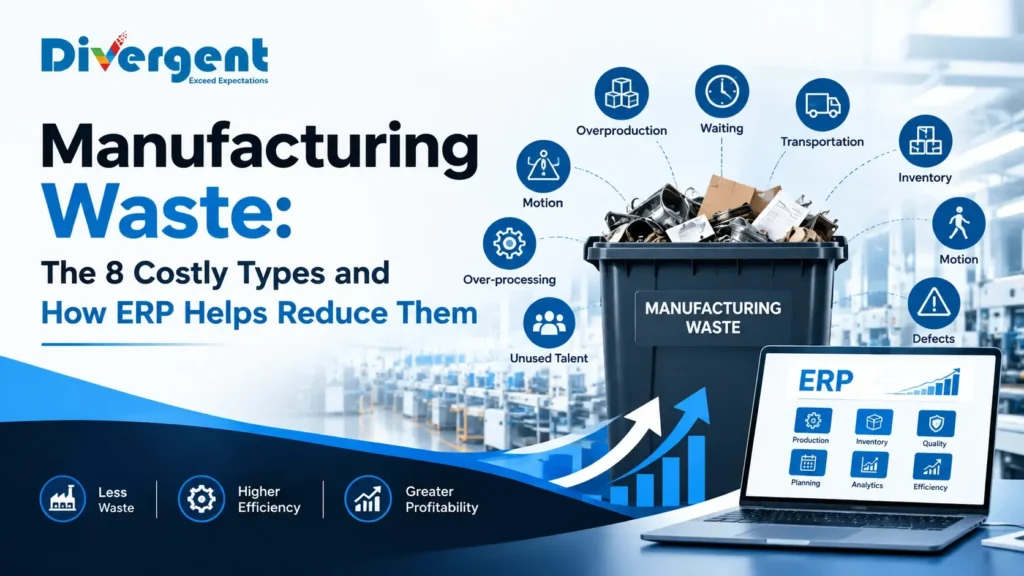
Walk through any factory, and you can see waste: offcuts on the floor, a rejected roll by the machine, a forklift driving back and forth. But the most expensive manufacturing waste is the kind you can’t see. It hides in waiting time, extra stock, rework and numbers nobody measures.
In this guide, you’ll learn what manufacturing waste is, the 8 wastes of lean manufacturing with real factory examples, how to measure waste, and practical ways to cut it, including how an ERP system helps.
What Is Manufacturing Waste?
Manufacturing waste is any activity, material or resource that adds cost to production without adding value for the customer. It includes physical waste like scrap and offcuts, and process waste like waiting, extra movement, overproduction and rework.
In lean manufacturing, waste is called “muda”, a Japanese word made popular by the Toyota Production System. The idea is simple: if the customer wouldn’t pay for it, it’s waste.
Factory waste usually falls into two groups:
- Material waste: scrap, offcuts, rejected products, startup losses and expired stock
- Process waste: waiting, unnecessary movement, overproduction, extra processing and unused skills
Key takeaways:
- Manufacturing waste is anything that adds cost without adding customer value.
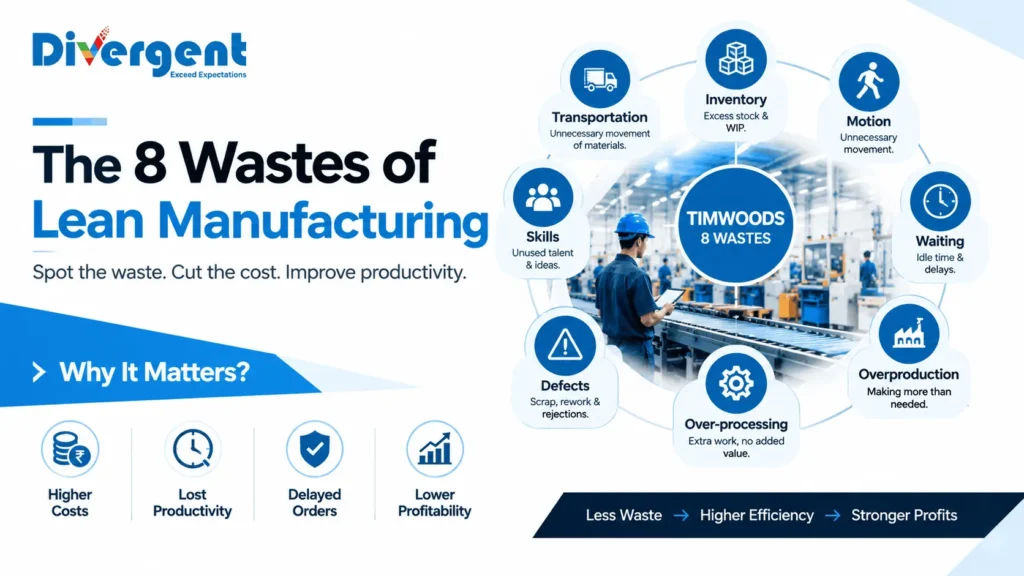
- Lean manufacturing groups waste into 8 types, remembered as TIMWOODS.
- Most manufacturing waste goes unmeasured, so it’s hidden in costs and margins.
- Measuring waste by machine, shift and order is the first step to reducing it.
- An ERP system turns waste from a guess into a tracked, reportable number.
Why Does Manufacturing Waste Matter So Much?
Manufacturing waste matters because every wasted kilogram of material, minute of machine time and hour of labour comes straight out of profit. In industries with thin margins, cutting waste is often the fastest way to improve profitability without raising prices.
Here’s why it’s so damaging. Waste is paid for twice: once when you buy the material or pay for the time, and again when you have to remake, rework or replace what was lost. It also slows everything down. A defect found late can block a whole order.
That’s why “how to reduce manufacturing costs” and “how to improve productivity in manufacturing” are among the most common questions plant managers ask. In most factories, the answer starts with manufacturing waste.
What Are the 8 Wastes of Lean Manufacturing?
The 8 wastes of lean manufacturing are Transportation, Inventory, Motion, Waiting, Overproduction, Over-processing, Defects and Skills, often remembered as TIMWOODS. Each one adds cost without adding value, and most factories have all eight at once.
| Waste | What it looks like in a factory | Quick fix |
|---|---|---|
| Transportation | Moving materials between distant stores and machines | Better layout, fewer handling steps |
| Inventory | Excess raw material, WIP and finished stock | Stock linked to real demand |
| Motion | Workers walking, searching, reaching | Organised workstations, tools close by |
| Waiting | Machines idle for material, approval or setup | Planned material and faster changeovers |
| Overproduction | Making more than ordered, or too early | Produce to confirmed orders |
| Over-processing | Extra work the customer doesn’t need | Clear specifications |
| Defects | Scrap, rejections and rework | Quality checks at every stage |
| Skills | Unused ideas and talent of workers | Involve operators in improvement |
What Is Transportation Waste?
Transportation waste is the unnecessary movement of materials, WIP or products between locations. Every move costs time, labour and fuel, and increases the risk of damage, without changing the product at all.
A common example: rolls of fabric moved from the weaving hall to a distant store, then back to the cutting section the next day. Fewer moves mean less handling damage too.
What Is Inventory Waste?
Inventory waste is holding more raw materials, work-in-progress or finished goods than you need. Extra stock ties up cash, takes up space and can expire, get damaged or become obsolete.
Excess stock also hides other problems, like unreliable suppliers or poor planning. Our guide to inventory management challenges covers this in detail.
What Is Motion Waste?
Motion waste is any unnecessary movement by people: walking, searching, bending, reaching or looking for tools and materials. Unlike transportation waste, it’s about how workers move, not how materials move.
An operator who walks to the store three times a shift for consumables, or searches for the right cutting die, is losing productive time. Organised workstations and tools kept within reach fix most motion waste quickly.
What Is Waiting Waste?
Waiting waste is time when people or machines are idle because they’re waiting for material, instructions, approvals, repairs or the previous process to finish. It’s one of the most common types of manufacturing waste, and one of the least measured.
A loom waiting for a beam, a printing machine waiting for an approved proof, or a stitching line waiting for cut panels are all waiting waste.
What Is Overproduction Waste?
Overproduction waste is making more than the customer ordered, or making it earlier than needed. Many lean experts call it the worst waste, because it creates several others: extra inventory, extra handling and extra storage.
It often happens when machines are kept running “to stay busy”, or when production runs ahead of confirmed orders.
What Is Over-Processing Waste?
Over-processing waste is doing more work than the customer needs: tighter tolerances than required, extra printing colours, extra inspections or unnecessary steps. It uses time and material that nobody is paying for.
The usual cause is unclear specifications. When nobody is sure what the customer needs, teams add “just in case” work.
What Is Defect Waste?
Defect waste is any product that doesn’t meet specification and has to be scrapped, reworked or replaced. It wastes material, machine time and labour, and can damage customer trust if defects reach the customer.
Catching defects early is the key. A printing error found at the cutting stage has already wasted lamination and fabric. Improving quality in production means checking at every stage, not only at the end.
What Is Skills Waste?
Skills waste, sometimes called unused talent, is failing to use the knowledge and ideas of the people doing the work. Operators often know exactly where waste happens, but no one asks them.
This eighth waste was added to the original seven. Factories that involve operators in improvement usually find waste faster than those that rely only on managers.
What Is the Difference Between the 7 Wastes and the 8 Wastes of Lean?
The 7 wastes of lean manufacturing come from the original Toyota Production System: transportation, inventory, motion, waiting, overproduction, over-processing and defects. The 8 wastes add an eighth type, unused skills or talent, which became widely used later as lean spread to the West.
So when you see the 7 types of waste in lean manufacturing, it’s the same list minus skills. Both lists describe the same idea of muda: anything that doesn’t add value.
What Is Material Wastage in Manufacturing?
Material wastage is the raw material lost during production that never becomes good finished product. In process industries like packaging, plastics and textiles, it happens at almost every stage and is often the biggest single source of manufacturing waste.
Here’s where material wastage typically happens in packaging and woven fabric production:
| Process | Typical material wastage |
|---|---|
| Extrusion | Startup scrap, tape breaks, colour changeovers |
| Weaving | Loom stoppages, fabric defects, roll ends |
| Coating and lamination | Edge trim, setup waste, bonding defects |
| Printing | Proof runs, colour setup, misprints |
| Cutting | Offcuts, wrong lengths, edge trim |
| Stitching and conversion | Rejected bags, stitching defects |
Some wastage at each stage is normal. The real problem is not knowing how much. When a plant says “our wastage is around 3 percent”, that’s usually an estimate, not a measurement. The true figure is often higher, and it differs a lot by machine, shift and product.
![material wastage in manufacturing by process]](https://divergentsoftlab.com/wp-content/uploads/2026/10/8-types-of-waste-in-lean-manufacturing-divergent.webp-1-1024x576.webp)
Manufacturing Waste Examples From the Factory Floor
These three manufacturing waste examples are illustrative, based on situations common in packaging and textile plants. Each one shows how measurement changes the outcome.
Example 1: The “3 percent” that wasn’t. A woven bag plant assumes its cutting wastage is about 3 percent. When it starts weighing offcuts by shift, it finds the night shift running close to double that on certain bag sizes, because of a worn cutting setup nobody reported. Fix: measure wastage by shift and machine, not as a plant-wide guess.
Example 2: The printing changeover trap. A plant schedules small BOPP print jobs in the order they arrive. Every job switch means new cylinders, a colour setup, and wasted film. Fix: group jobs by colour and cylinder set, which cuts setup waste and waiting time together.
Example 3: Overproduction to keep machines busy. A plant keeps looms running on a popular fabric between orders, “because it always sells”. Months later, a customer changes its specification, and the stock is dead. Fix: produce to confirmed orders, and plan idle capacity for maintenance instead.
Notice the pattern: in each case, the factory waste was invisible until someone measured it.
What Are the Warning Signs of Too Much Manufacturing Waste?
The clearest warning signs of high manufacturing waste are profits that shrink even when sales grow, regular rush orders, frequent rework, and a store that’s always full yet always short. If several of these sound familiar, waste is probably costing you more than you think.
Check your plant against this list:
- Actual product costs keep coming out higher than quoted costs
- Wastage is reported as a single, rounded percentage for the whole plant
- Machines often wait for material, approvals or the previous stage
- The same defects come back month after month
- Finished stock builds up for products nobody has ordered
- Operators have improvement ideas, but there’s no way to act on them
Any one of these is a sign of hidden manufacturing waste. Three or more usually means there’s a significant saving waiting to be found.
What Causes Manufacturing Waste?
Most manufacturing waste comes from a handful of root causes: no measurement, poor planning, manual records, unplanned machine downtime, unclear specifications, and disconnected departments. The waste you see on the floor is usually a symptom of one of these.
- No measurement: if waste isn’t tracked by machine and shift, nobody knows where it comes from.
- Poor production planning: frequent changeovers and rush orders create startup waste and overproduction.
- Manual records: paper logs filled at the end of a shift hide real losses.
- Unplanned downtime: breakdowns cause waiting waste and restart scrap.
- Unclear specifications: they lead to over-processing and defects.
- Disconnected departments: sales, planning, stores, and production working from different numbers.
Planning problems are a major driver. Our guide to production planning challenges explains how better planning cuts changeovers and rush jobs.
How Do You Measure Manufacturing Waste?
You measure manufacturing waste by tracking material input against good output, and by tracking time lost to waiting and downtime. The most useful manufacturing KPIs for waste are wastage percentage, scrap rate, first pass yield and overall equipment effectiveness (OEE).
| KPI | How to calculate it | What it tells you |
|---|---|---|
| Wastage percentage | (Material input minus good output) ÷ material input × 100 | How much material is lost |
| Scrap rate | Scrapped units ÷ total units produced × 100 | How much output is rejected |
| First pass yield | Good units first time ÷ total units started × 100 | Quality without rework |
| OEE | Availability × performance × quality | Overall machine efficiency |
For example, if a weaving section uses 1,000 kg of tape and produces 960 kg of good fabric, wastage is 40 kg, or 4 percent.
A KPI in manufacturing is only useful if the data behind it is accurate. That’s why manufacturing data collection matters: numbers recorded live at the machine are far more reliable than numbers written up later. You can read more about overall equipment effectiveness on Wikipedia.
How Do You Reduce Manufacturing Waste?
You reduce manufacturing waste by measuring it first, then fixing the biggest sources one by one, and making improvement a continuous habit. These 7 waste reduction strategies work in most factories:
- Measure waste by machine, shift and order. You can’t fix what you can’t see.
- Fix the top three sources first. Usually a few machines or products cause most of the waste.
- Plan production to reduce changeovers. Group similar jobs to cut startup and setup waste.
- Produce to confirmed orders. This stops overproduction and excess inventory.
- Check quality at every stage. Catch defects before more material and time is added.
- Maintain machines on schedule. Planned maintenance reduces breakdowns and restart scrap.
- Involve operators. Ask the people on the floor where waste happens, and act on their ideas.
Eliminating waste isn’t a one-time project. This is the heart of continuous improvement in manufacturing, often called kaizen: small, regular improvements that add up. Reducing manufacturing waste is also one of the most reliable ways to improve quality in production, raise production line efficiency and lift manufacturing efficiency overall.
How Does ERP Help Reduce Manufacturing Waste?
An ERP system helps reduce manufacturing waste by recording material consumption, output and wastage in real time, and linking them to orders, machines, shifts and costs. Instead of guessing wastage at month-end, managers see exactly where it happens, as it happens.
ERP in manufacturing (enterprise resource planning) connects sales, planning, stores, production, quality and accounts in one system. For waste reduction, that brings several benefits:
- Live manufacturing data collection at each machine and stage
- Wastage reports by machine, shift, operator, product and order
- Material planning linked to confirmed orders, which prevents overproduction
- Quality records at every stage, so defects are traced to their source
- Real costing that includes actual wastage, not an estimated percentage
- Production monitoring dashboards that show waiting time and downtime
The difference is visibility. With registers and spreadsheets, waste is a number someone writes down later. With an ERP, it’s measured where it happens, so it can be fixed. That also makes product costing far more accurate, as explained in our guide to costing challenges in manufacturing. For a general overview, see enterprise resource planning on Wikipedia.
FAQs About Manufacturing Waste
What is manufacturing waste?
Manufacturing waste is any activity, material or resource that adds cost to production without adding value for the customer. It includes scrap, offcuts and rejections, as well as waiting, unnecessary movement, overproduction and rework.
What are the 8 wastes of lean manufacturing?
The 8 wastes of lean manufacturing are Transportation, Inventory, Motion, Waiting, Overproduction, Over-processing, Defects and Skills. Together they’re often remembered by the acronym TIMWOODS.
What are the 7 types of waste in lean manufacturing?
The 7 types of waste in lean manufacturing are transportation, inventory, motion, waiting, overproduction, over-processing and defects. They come from the Toyota Production System. The 8-waste list adds unused skills.
What is motion waste?
Motion waste is unnecessary movement by workers, such as walking, searching, reaching or bending to find tools and materials. It can be reduced by organising workstations so everything needed is within easy reach.
What is the biggest type of waste in manufacturing?
Overproduction is often called the biggest waste, because it creates other wastes: extra inventory, handling, storage and the risk of obsolete stock. In process industries, unmeasured material wastage is often the biggest cost.
How do you calculate wastage percentage in manufacturing?
Wastage percentage is calculated as material input minus good output, divided by material input, multiplied by 100. For example, 1,000 kg of input and 960 kg of good output gives 4 percent wastage.
What is ERP in manufacturing?
ERP in manufacturing is software that connects sales, planning, inventory, production, quality and accounts in one system. It gives managers real-time data on orders, materials, output and waste.