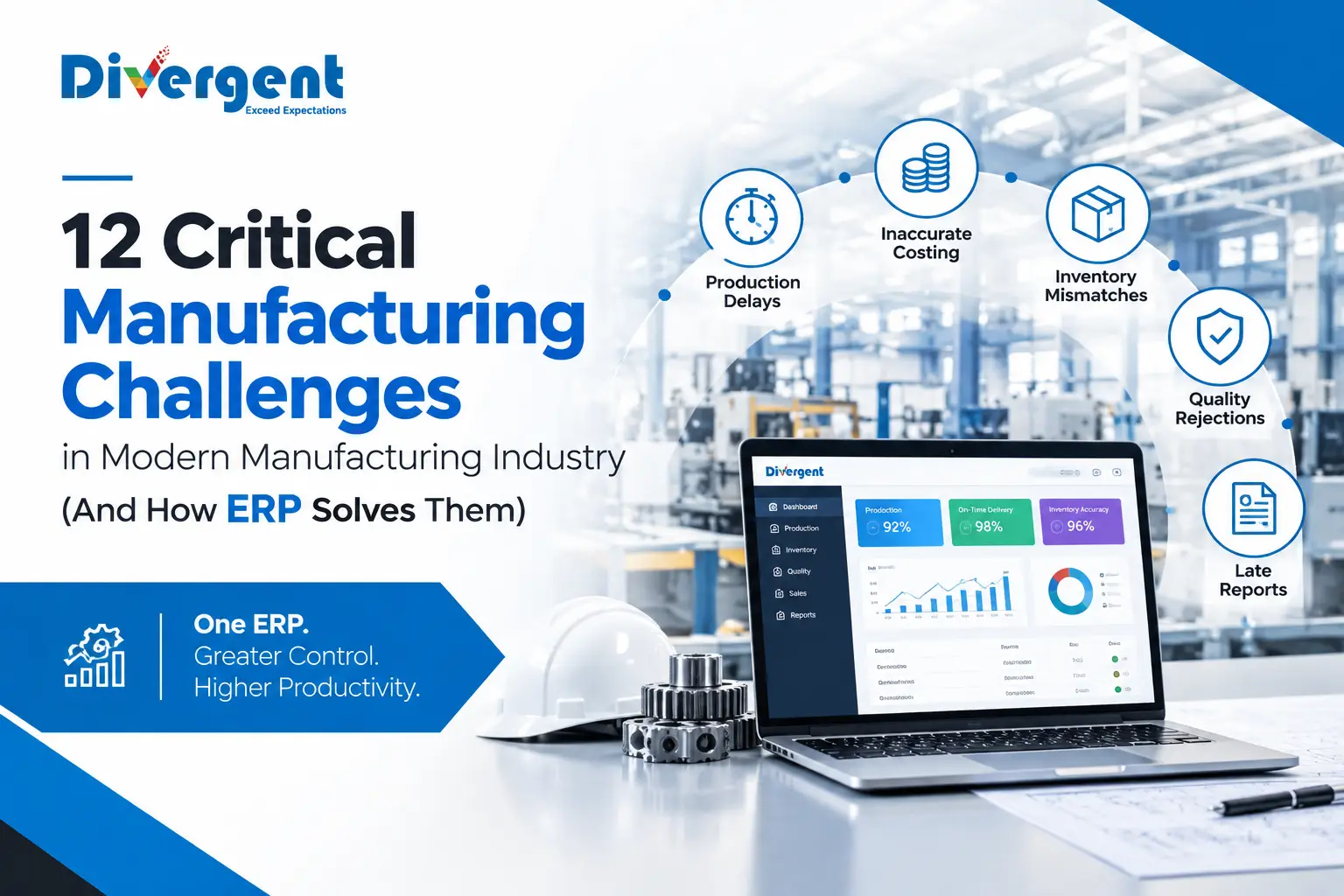
Manufacturing challenges in the modern manufacturing industry are no longer occasional speed bumps. They are daily battles — and every single one has a measurable price tag. Manufacturing challenges in the modern manufacturing industry
Walk into any plant today — automotive parts, food products, packaging materials, textiles, consumer electronics, or industrial components — and you will find the same story. Production delays. Inaccurate cost sheets. Inventory mismatches. Quality rejections. Management reports that are always one week late.
The problem is not the people on the floor. The problem is the process.
Most manufacturers are running complex, high-volume operations on disconnected spreadsheets and manual workflows that were never designed for today’s scale, speed, or customer expectations.
This guide breaks down 12 real manufacturing challenges in modern manufacturing industry that every plant manager, production head, and business owner is dealing with right now — and explains exactly how manufacturing ERP software eliminates each one.
Whether you run a small unit or a large multi-plant operation, this is the most comprehensive breakdown available on what is actually slowing factories down today.
Table of Contents
- What are the manufacturing challenges in modern manufacturing industry?
- Costing & quotation challenges
- Production planning challenges
- Production visibility challenges
- Inventory management challenges
- Waste & material utilization challenges
- Quality control challenges
- Traceability challenges
- Dispatch & logistics challenges
- Reporting & MIS challenges
- Disconnected departments
- Workforce & process challenges
- Scaling manufacturing operations
- How manufacturing ERP solves all 12 challenges
- What to look for in a manufacturing ERP system
- Frequently asked questions
What Are the Manufacturing Challenges in the Modern Manufacturing Industry?
Understanding manufacturing challenges in the modern manufacturing industry requires looking at the full picture — not just one department, one machine, or one process failure. These challenges cut across every function: costing, planning, production, quality, inventory, dispatch, and reporting.
According to a McKinsey Global Institute report, manufacturers lose up to 20% of their revenue potential due to poor operational visibility and disconnected processes. Yet most available software is either too generic or too expensive to deploy at mid-market scale.
The 12 manufacturing challenges below are not theoretical. They come directly from the shop floor — from manufacturers across packaging, textiles, food processing, automotive, agriculture, and industrial production. Each one has a direct, measurable cost.
1. Costing & Quotation Challenges
Getting product costing wrong is one of the most expensive mistakes a manufacturer can make — and it happens every day in plants that rely on manual spreadsheets. Costing errors are among the most financially damaging
manufacturing challenges in the modern manufacturing industry.
Why Manual Costing Fails
When raw material rates change weekly, a spreadsheet last updated two weeks ago produces a wrong cost from the very first number entered. Multiply that error across a complex Bill of Materials with 15–20 components, and the gap between the quoted price and the actual production cost becomes significant.
The specific challenges in costing & quotation:
- Manual product costing with outdated raw material rates
- Complex BOM that cannot be updated across all product variants at once
- Raw material price fluctuations not reflected in real time
- Actual production cost discovered only after the order is complete
- Customer quotations taking 2–3 days instead of 2–3 hours — losing orders to faster competitors
When a customer expects a quote in hours, and the manufacturer delivers it in days, the business is already lost.
2. Production Planning Challenges
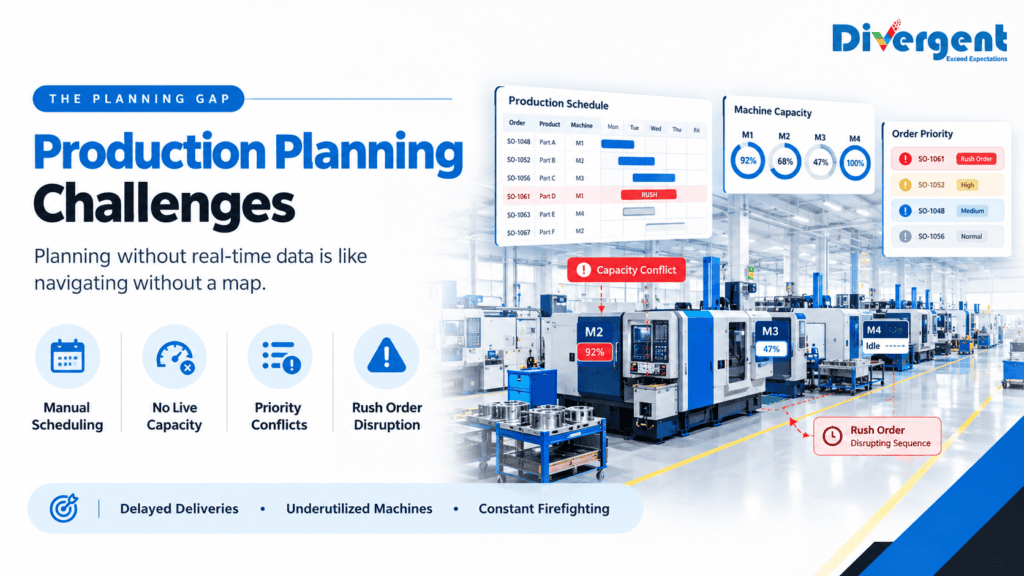
Planning what to produce, when, and on which machine — without real-time data — is like navigating without a map.
Production planning failures represent some of the most common manufacturing challenges in the modern manufacturing
industry faced by plant managers daily.
The Planning Gap That Costs Manufacturers Every Week
Most production planning happens in Excel files that are outdated the moment a new order arrives. There is no live view of machine capacity, no system to flag when two orders compete for the same resource, and no way to automatically reprioritize when a rush order comes in.
The specific challenges in production planning:
- Manual production planning with no system-based scheduling logic
- No real-time visibility into machine capacity and availability
- Order prioritization done by intuition rather than data
- Capacity vs. delivery commitments in constant conflict
- Rush orders disrupting the entire planned production sequence
The result is delayed deliveries, underutilized machines, and a planning team spending most of its time firefighting rather than planning ahead.
3. Production Visibility Challenges
If you cannot see what is happening on your shop floor in real time, you cannot manage it effectively.
The Blind Spot at the Heart of Most Factories
In most plants, production status is tracked through whiteboards, phone calls, or a supervisor walking the floor. By the time a problem is escalated, it has already caused a delay. By the time the delay reaches a management meeting, it has already affected a customer delivery.
The specific challenges in production visibility:
- Limited or zero real-time shop-floor visibility
- No machine-wise tracking of production output
- No order-wise production status available to planning or sales teams
- Bottlenecks identified only after delays have already occurred
- Production efficiency measured weekly, not daily or in real time
In a competitive market, discovering a problem after the damage is done is not management — it is damage control.
4. Inventory Management Challenges
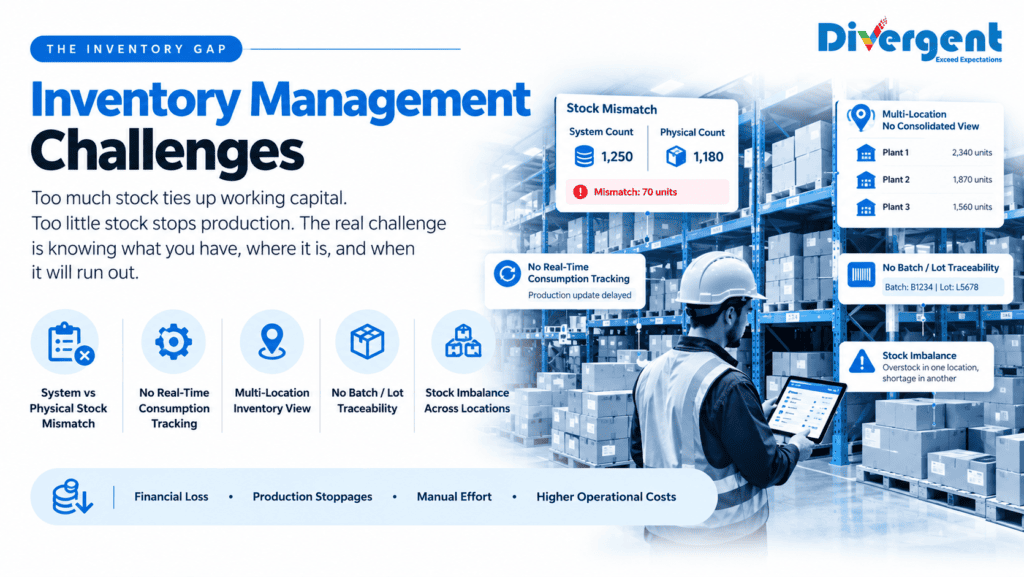
Too much stock ties up working capital. Too little stops production. Somewhere in between lies the daily chaos of not knowing exactly what stock is available, where it is, or when it will run out.
Inventory mismatches rank among the most persistent manufacturing challenges in modern manufacturing industry
affecting both small units and large plants.
Why Inventory Mismatches Happen — and Why They Are Expensive
When stock is tracked manually — through tally sheets, register entries, or end-of-day Excel updates — the physical count and the system count are almost never the same. The gap may be small on any given day, but over a month it represents a significant financial loss.
The specific challenges in inventory management:
- Inventory mismatches between system records and physical stock
- No real-time material consumption tracking during production
- Multi-location inventory with no consolidated view
- No batch and lot traceability for raw materials or finished goods
- Excess stock in one location while another location runs short
For manufacturers handling dozens of raw materials across multiple locations, manual inventory management is a guaranteed source of loss and production stoppages.
5. Waste & Material Utilization Challenges
Every unit of raw material wasted is a direct hit to production margin. Yet most manufacturers have no reliable system to measure how much material is being lost, where, and why.
Uncontrolled material waste is one of the most overlooked manufacturing challenges in the modern manufacturing industry
— invisible until it is measured
When Waste Becomes Invisible, It Becomes Uncontrollable
In a plant running large volumes of raw material daily, even a 2% waste rate adds up to significant financial loss each month. Without tracking waste at machine level, manufacturers cannot reduce it — because they do not know where it is coming from.
The specific challenges in waste & material utilization:
- No real-time tracking of production wastage by machine or order
- Machine-wise waste data not captured or analysed
- Planned vs. actual material consumption never compared
- No data available to drive targeted waste reduction initiatives
- Waste treated as a fixed, unavoidable cost rather than a controllable variable
Manufacturers who reduce waste by even 2–3% gain a measurable, lasting cost advantage over competitors.
6. Quality Control Challenges
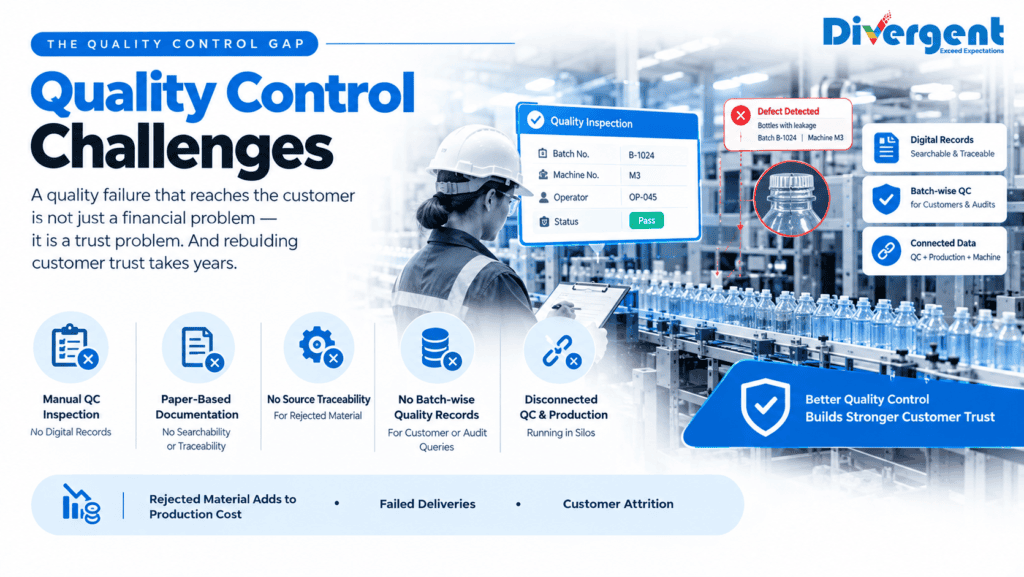
A quality failure that reaches the customer is not just a financial problem — it is a trust problem. And rebuilding trust takes years. Quality control gaps are among the most customer-damaging manufacturing challenges in modern manufacturing industry
any plant can face.
Why Quality Issues Escape the Factory Floor
In most plants, quality control happens at the end of the production line, on paper, with no link to the batch, the machine, or the operator. If a defect pattern emerges across multiple orders, nobody connects the dots because the data lives in separate files — or does not exist at all.
The specific challenges in quality control:
- Manual QC inspection with no digital record-keeping
- QC documentation filed on paper with no searchability or traceability
- Rejected material not traced back to its source machine or input batch
- No batch-wise quality records for customer or audit queries
- QC and production running as separate, disconnected functions
Without integrated quality management, rejected material adds to cost and failed deliveries accelerate customer attrition.
7. Traceability Challenges
If a customer raises a complaint about a product batch delivered three months ago, can the manufacturer trace exactly which raw material lot was used, which machine produced it, and which QC check cleared it?
Traceability gaps are among the manufacturing challenges in the modern manufacturing industry that create both compliance risk and customer relationship risk.
For most manufacturers on manual systems, the honest answer is no.
The Traceability Gap That Exposes Manufacturers to Risk
Traceability is not just a compliance requirement — it is a competitive differentiator. Customers in regulated industries, export markets, and large-scale retail increasingly demand end-to-end supply chain visibility before placing repeat orders.
The specific challenges in traceability:
- No system linking raw material batches to finished goods
- Batch and lot tracking maintained manually or not at all
- No production history linked to individual customer orders
- Quality traceability breaks down across departments
- End-to-end traceability is impossible without a connected platform
In an era where customers and regulators demand accountability at every production stage, traceability is no longer optional.
8. Dispatch & Logistics Challenges
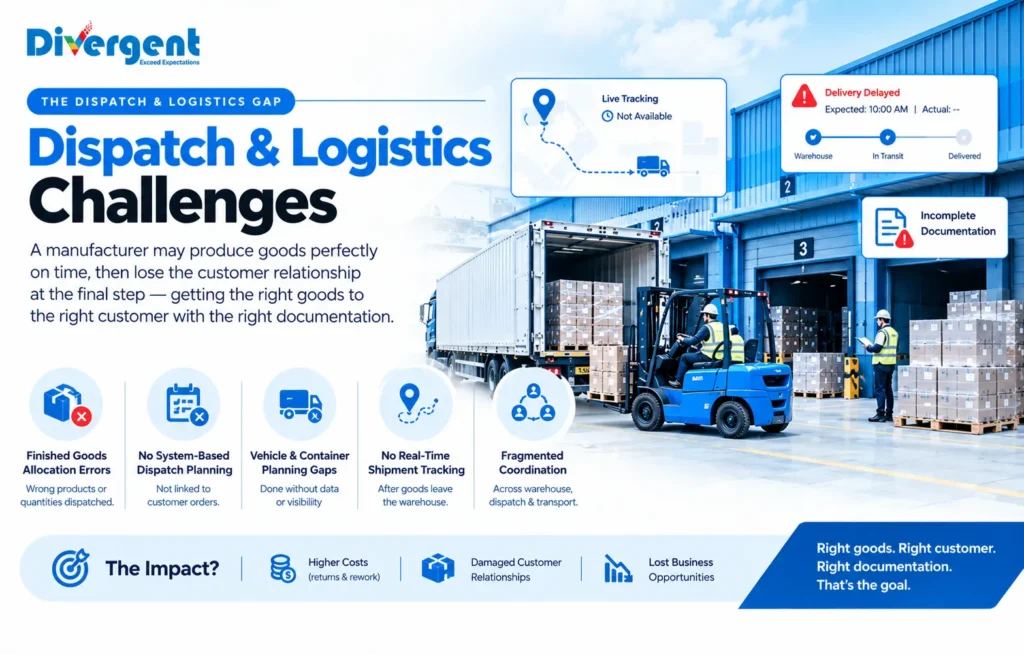
A manufacturer may produce goods perfectly on time, then lose the customer relationship at the very last step — getting the right goods to the right place with the right documentation.
Dispatch failures are among the final-stage manufacturing challenges in the modern manufacturing industry that undo an
otherwise well-run production cycle.
The Last-Mile Problem That Undoes a Good Production Run
Dispatch is often the least-digitized part of any manufacturing operation. Allocation is done manually. Loading plans exist only in a supervisor’s head. Delivery coordination happens over phone calls and messaging apps. When something goes wrong, there is no reliable record of what was committed.
The specific challenges in dispatch & logistics:
- Finished goods allocation errors — wrong products or quantities dispatched
- No system-based dispatch planning linked to customer orders
- Vehicle and container planning done without data or visibility
- No real-time shipment tracking after goods leave the warehouse
- Delivery coordination across warehouse, dispatch, and transport is fragmented
Dispatch errors do not just cost money in returns and rework — they damage customer relationships that took years to build.
9. Reporting & MIS Challenges
If management information is always one week late, decisions are permanently being made about yesterday — not today.
Delayed reporting is one of the most strategic manufacturing challenges in modern manufacturing industry
because it prevents timely, data-driven decisions.
The Hidden Cost of Slow Reporting
Manual reporting is not just slow — it is unreliable. By the time data from production, inventory, and dispatch is consolidated into an MIS report, the situation on the floor has already changed. Decisions made on stale data address last week’s problems, not today’s.
The specific challenges in reporting & MIS:
- Manual MIS preparation consuming 1–2 days of team time each week
- Reports always 5–7 days behind the period they cover
- No real-time comparison of planned vs. actual production performance
- Production and wastage reports unavailable on demand
- No live manufacturing dashboard accessible to management or ownership
Manufacturers who make decisions based on real-time data consistently outperform those relying on delayed, manually compiled reports.
10. Disconnected Departments
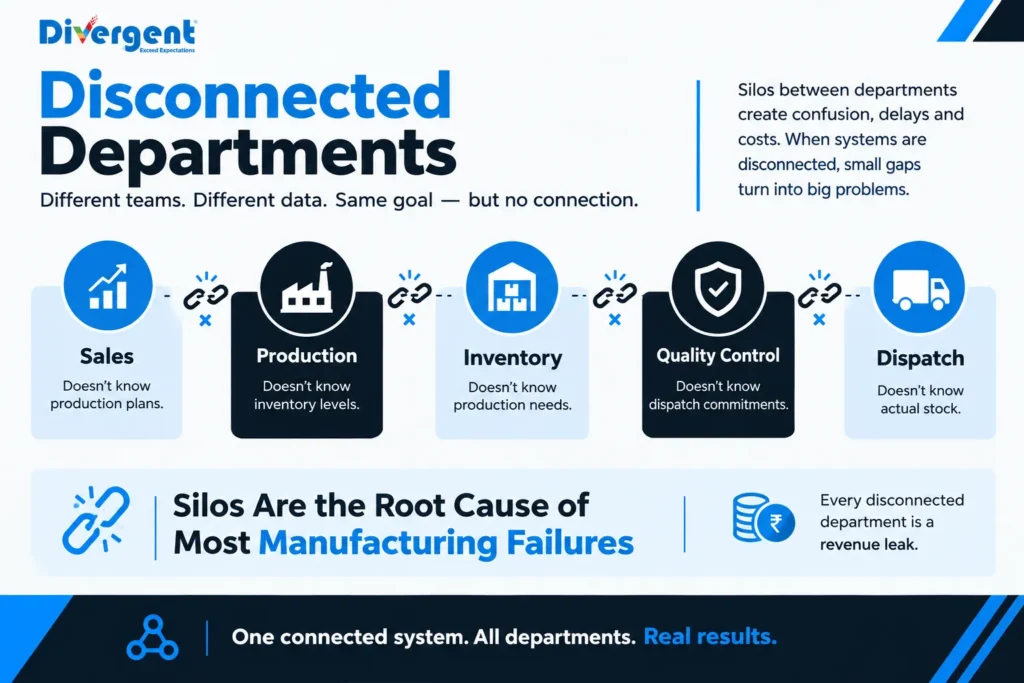
Sales does not know what production is planning. Production does not know what inventory holds. Quality control does not know what dispatch has committed. Management does not see any of it until a customer complaint arrives.
Key-person dependency is one of the most underestimated manufacturing challenges in the modern manufacturing industry,
particularly in growing businesses.
Departmental silos create some of the most systemic manufacturing challenges in the modern manufacturing industry, affecting every function simultaneously.
Silos Are the Root Cause of Most Manufacturing Failures
Disconnected systems do not just slow operations down — they create the conditions for errors. When each department operates from its own data source, conflicts, miscommunications, and duplicated effort are inevitable. Each gap between departments is a gap where cost leaks out unnoticed.
The specific challenges from disconnected departments:
- Sales and costing not integrated — quotes built on assumptions, not live production costs
- Planning and production running in silos with no shared real-time data
- Production and inventory not connected — material shortages discovered only on the production line
- Quality control and production not sharing data — defects reaching dispatch undetected
- Inventory and logistics disconnected — dispatch committing to stock that does not exist
Every silo between departments is a revenue leak. The only sustainable solution is a single connected system across all functions.
11. Workforce & Process Challenges
The most dangerous operational risk in any manufacturing business is key-person dependency — when critical processes exist only in individuals’ knowledge rather than in documented, system-driven workflows.
When a Business Depends on People Rather Than Processes
If the best production planner goes on leave, does planning stop? If the QC supervisor is absent, do inspections get skipped? If the person managing dispatch allocation resigns, how long before the replacement gets up to speed?
These are not edge cases. They are real, recurring vulnerabilities affecting manufacturers of every size.
The specific challenges in workforce & process:
- Manual, undocumented processes that depend entirely on individual knowledge
- Over-reliance on specific employees for critical daily decisions
- Manual approval workflows causing delays across costing, procurement, and dispatch
- No standardised workflows across shifts, production lines, or factory locations
- Process accountability difficult to enforce without a digital system of record
Standardising manufacturing operations through a system does not just reduce risk — it makes the entire business scalable, auditable, and resilient.
12. Scaling Manufacturing Operations
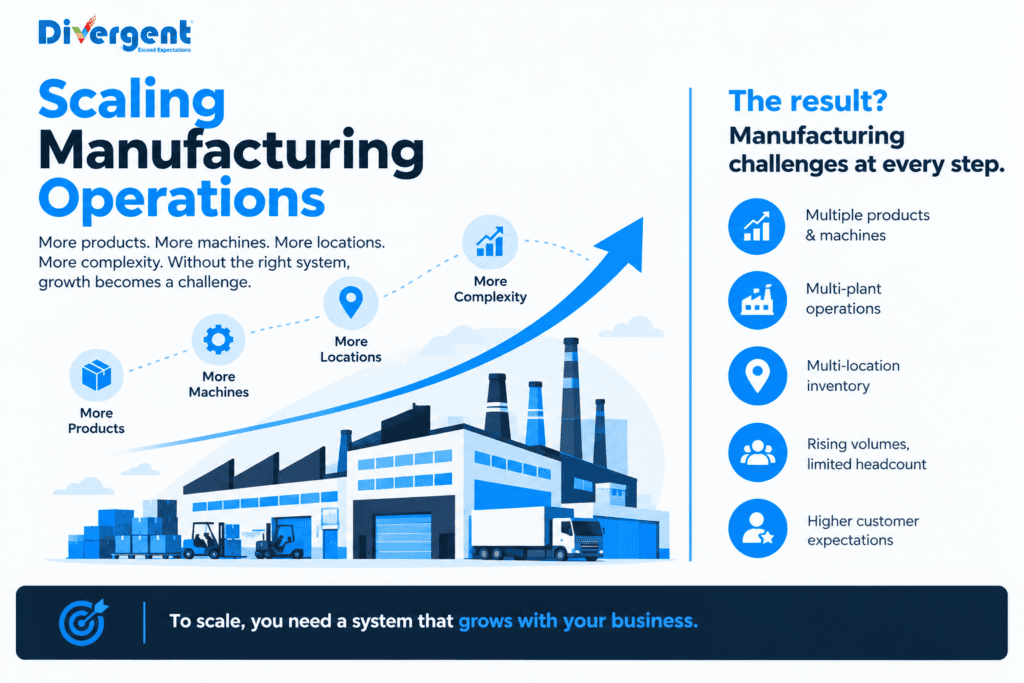
Growth is the objective of every manufacturing business. But without the right operational infrastructure, growth creates its own manufacturing challenges in modern manufacturing industry — more products, more machines, more locations, more complexity, and no system capable of holding it together.
Scaling without a system creates new manufacturing challenges in modern manufacturing industry that compound
with every new product, machine, and location added.
Why Scaling Without a System Fails — Every Time
A business can reach a certain volume using manual processes and spreadsheets. But at some point, complexity outgrows the system. New product lines need new BOMs. New machines need new planning workflows. New locations need new inventory structures — and Excel simply breaks.
The specific challenges in scaling operations:
- Managing multiple product types across multiple machines without a central system
- Multi-plant manufacturing with no consolidated production view
- Multi-location inventory with no real-time stock visibility across sites
- Increasing production volumes without proportionally increasing headcount
- Growing customer requirements outpacing current operational capabilities
A manufacturing business that cannot scale its processes will eventually hit a ceiling — regardless of how strong its product or market position is.
How Manufacturing ERP Software Solves All 12 Challenges
Every challenge listed above shares a common root cause: running a complex, high-volume operation without a connected, real-time system.
Addressing manufacturing challenges in modern manufacturing industry requires replacing every disconnected spreadsheet and manual process with a single integrated platform — a manufacturing ERP. Here is exactly how each challenge is solved:
The table below maps each of the 12 manufacturing challenges in modern manufacturing industry directly
to the ERP capability that eliminates it.
Manufacturing challenges in modern manufacturing industry
What to Look for in a Manufacturing ERP System
Solving manufacturing challenges in modern manufacturing industry permanently requires more than any single tool
— it requires a fully integrated ERP system built specifically for production environments. Every category of manufacturing challenges in modern manufacturing industry — from costing to scaling — points to the same root cause: disconnected systems and undocumented processes running a business that has
outgrown them.
Not all ERP systems are built equally. A generic ERP designed for retail or services will not cover the specific workflows that manufacturing operations require. When evaluating a manufacturing ERP, the following capabilities are essential:
Core manufacturing capabilities:
- Automated costing and quotation linked to a live Bill of Materials
- Production planning and scheduling with machine capacity management
- Real-time shop-floor tracking by order, machine, and shift
- Integrated inventory management with batch and lot traceability
- Digital quality control records linked to production batches
- End-to-end traceability from raw material to finished goods dispatch
- Automated dispatch planning and shipment tracking
- Real-time MIS dashboards and on-demand reporting
Implementation criteria:
- Industry-specific workflows pre-configured for the type of production being run
- Ease of adoption for shop-floor workers and supervisors without extensive training
- Scalability to support multi-plant, multi-location, and multi-product growth
- Integration capability with existing accounting, sales, and procurement tools
A manufacturing ERP that covers all these areas gives the business a single source of operational truth — eliminating the gaps where most errors, delays, and losses currently occur.
Conclusion
Manufacturing challenges in the modern manufacturing industry are real, measurable, and costly. But they are not inevitable.
Every challenge on this list — from manual costing to scaling across multiple plants — has been solved by manufacturers who made one decisive change: replacing disconnected spreadsheets and manual processes with an integrated manufacturing ERP platform.
The question is not whether these challenges need to be addressed. The question is how much longer a manufacturing business can afford to leave them unresolved.
Identifying the one or two challenges causing the most pain today is the right starting point. Evaluating a manufacturing ERP that addresses those specific problems — and the full list alongside them — is the logical next step.
Frequently Asked Questions — Manufacturing Challenges
What are the biggest manufacturing challenges in 2026?
The biggest manufacturing challenges in 2026 include inaccurate product costing, poor shop-floor visibility, disconnected departments, multi-location inventory management, and the inability to scale operations without proportionally increasing headcount and error rates. Global supply chain volatility and rising raw material costs have made manual processes even more risky than in previous years. These are the manufacturing challenges in the modern manufacturing industry that ERP software is specifically
designed to eliminate.
What causes manufacturing problems in most factories?
Most manufacturing problems are caused by one root issue: running complex, high-volume operations without a connected system. When costing, production planning, inventory, quality control, and dispatch each run on separate tools — or on no digital tool at all — errors multiply across every handoff. Data is duplicated, decisions are based on outdated information, and accountability is impossible to enforce. The challenges in manufacturing industry research consistently cite disconnection and manual processes as the primary causes of operational loss.
How does ERP software solve manufacturing challenges?
ERP software for the manufacturing industry solves these challenges by replacing every disconnected spreadsheet and manual process with a single integrated platform. A manufacturing ERP connects costing, production planning, shop-floor tracking, inventory, quality control, dispatch, and MIS reporting in real time. When a raw material rate changes, it updates across every product cost sheet automatically. This is exactly why ERP adoption has become the primary response to manufacturing challenges in the modern manufacturing industry across sectors globally. When production falls behind, the planning team sees it immediately. When a customer raises a quality complaint, the batch can be traced end-to-end within seconds.
What is manufacturing ERP and how does it work?
Manufacturing ERP (Enterprise Resource Planning) is an integrated software system designed to manage the full operations of a manufacturing business from a single platform. It covers the entire production lifecycle — from enquiry, costing, and order management through to raw material planning, production scheduling, quality control, inventory, dispatch, and MIS reporting. At its core, a manufacturing ERP system creates a single source of truth: all departments access the same live data, eliminating the reconciliation, duplication, and delay that manual systems create.
How can manufacturers improve production efficiency?
The most effective ways to improve production efficiency are: replacing manual planning with system-based production scheduling, gaining real-time shop-floor visibility to catch bottlenecks before they cause delays, standardising workflows so processes do not depend on individual employees, and tracking planned vs. actual output daily rather than weekly. Managing manufacturing operations efficiently also requires reducing material waste through real-time tracking, tightening inventory management to prevent production stoppages, and providing management with live dashboards rather than delayed weekly reports.