AI demand forecasting in manufacturing is the most effective way for packaging and FIBC plants to predict customer orders before they arrive. Every packaging plant faces the same planning problem. A large customer places an order for 500,000 FIBC bags. Your production team starts planning. Three weeks in, the customer calls to say they need 200,000 more — next week. You do not have the raw material. Your looms are committed to other orders. The rush costs you overtime, expedited purchases and a strained relationship with a customer who expected you to be ready.
This is not a capacity problem. It is a forecasting problem. And AI demand forecasting in manufacturing is the technology that solves it.
AI demand forecasting uses machine learning to analyse historical order patterns, seasonal cycles, customer behaviour and external signals — and produce a forward-looking prediction of what each customer will order, and when. Instead of reacting to orders after they arrive, a packaging plant with AI demand forecasting is positioned weeks or months ahead of demand, with material purchased, capacity allocated and production scheduled before the customer places the order.
This guide covers what AI demand forecasting in manufacturing is, how it works in packaging and FIBC plants specifically, which demand forecasting methods AI uses, what implementation looks like, and what results manufacturers are actually achieving.
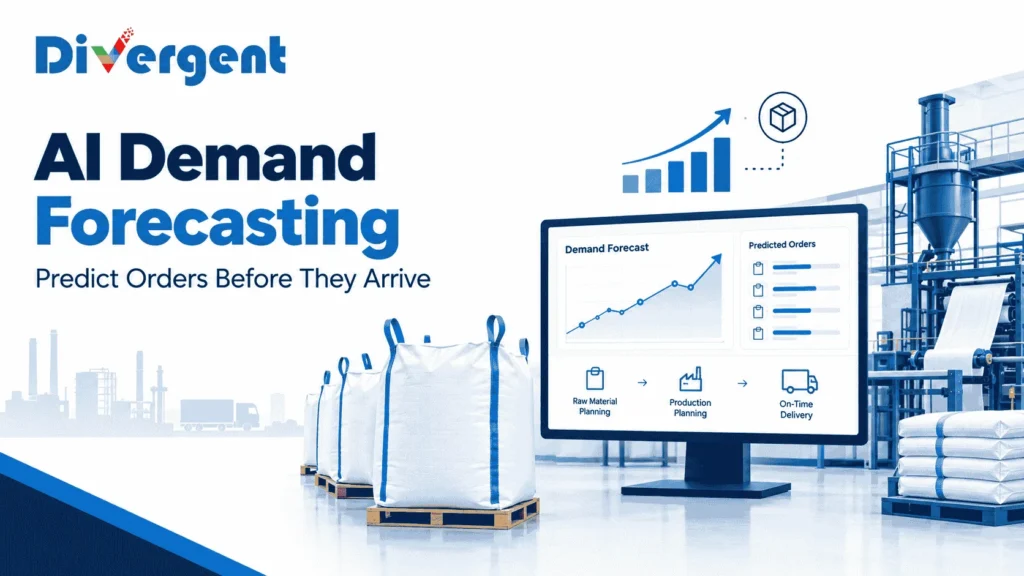
Table of Contents
- What Is AI Demand Forecasting in Manufacturing?
- What Is Demand Planning and How Does It Connect to AI?
- Demand Forecasting Methods: Traditional vs AI
- How AI Demand Forecasting Works: Step by Step
- AI Demand Forecasting for Packaging and FIBC Plants
- What Is Demand Sensing and Why Does It Matter?
- Machine Learning Demand Forecasting and Inventory Optimisation
- Demand Forecasting Software: What to Look For
- How AI Demand Forecasting Connects to Your ERP
- How to Implement AI Demand Forecasting: A Practical Roadmap
- Real Results from AI Demand Forecasting in Manufacturing
- How Divergent PackPro Supports Demand Forecasting
- Frequently Asked Questions
What Is AI Demand Forecasting in Manufacturing?
AI demand forecasting in manufacturing is the use of machine learning algorithms to predict future product demand based on historical order data, seasonal patterns, customer behaviour, and external market signals. Unlike traditional demand forecasting methods that rely on simple averages or manual judgment, AI demand forecasting learns from data — identifying patterns that human planners cannot see and improving accuracy over time.
In a packaging or FIBC manufacturing plant, AI demand forecasting answers three questions that manual planning cannot answer reliably:
- How much of each product will each customer order in the next 4 to 12 weeks?
- When will demand spike — and how early should raw material be purchased?
- Which products are likely to see declining demand — and should not be overstocked?
The accuracy of AI demand forecasting in manufacturing depends on data quality and volume. A plant with three or more years of clean order history — order dates, quantities, product specifications, customer names — has enough data to train a machine learning model that outperforms manual forecasting significantly.
According to McKinsey, AI-based demand forecasting reduces forecast errors by 30 to 50 percent compared to traditional methods, and reduces lost sales from stockouts by 65 percent. For packaging plants running on tight margins, these numbers translate directly into profit.
What Is Demand Planning and How Does It Connect to AI?
Demand planning is the process of estimating future customer demand and using those estimates to plan production, raw material purchasing and inventory levels. It is the bridge between what customers will want and what the factory needs to produce.
Traditional demand planning in packaging plants uses one or more of these inputs: last year’s orders for the same period, a sales team estimate, a customer-provided forecast (which is often wrong), or a simple rolling average of recent months. Each of these approaches has the same weakness — they look backward or rely on human judgment, which means they cannot account for new patterns, market shifts or early demand signals.
AI demand forecasting improves demand planning by replacing or augmenting these manual inputs with a machine learning model that processes the full order history simultaneously, identifies seasonal cycles, customer-specific patterns and product-level trends, and generates a forward-looking forecast that updates automatically as new orders arrive.
The result is a demand plan that is more accurate, more granular — down to customer and product level — and updated continuously rather than once a month. For production planners in packaging plants, this means fewer emergency orders, fewer idle machines and fewer customer complaints about late deliveries.
Demand Forecasting Methods: Traditional vs AI
Understanding the different demand forecasting methods helps manufacturers see exactly where AI adds value over conventional approaches.
| Method | How It Works | Best For | Limitation |
|---|---|---|---|
| Moving average | Averages demand over recent periods | Stable, low-variation products | Misses seasonality and trends |
| Exponential smoothing | Weights recent data more heavily | Short-term forecasting | Struggles with sudden demand shifts |
| Sales team estimate | Planner or sales rep judgment | New products with no history | Inconsistent, often optimistic |
| Customer-provided forecast | Customer shares expected purchase volume | Long-term contracts | Customers frequently change their forecasts |
| Statistical regression | Finds linear relationships in data | Demand linked to one or two variables | Cannot handle complex non-linear patterns |
| Machine learning (AI) | Learns patterns from full data history | Complex, multi-product environments | Needs sufficient historical data to train |
For packaging plants producing dozens or hundreds of product variants across multiple customers, machine learning demand forecasting outperforms every traditional method because it processes all variables simultaneously — customer order history, product mix, seasonal cycles, lead times and raw material availability — and produces a forecast that reflects the actual complexity of the business.
How AI Demand Forecasting Works: Step by Step
Understanding how AI demand forecasting actually works removes the mystery and makes implementation planning easier.
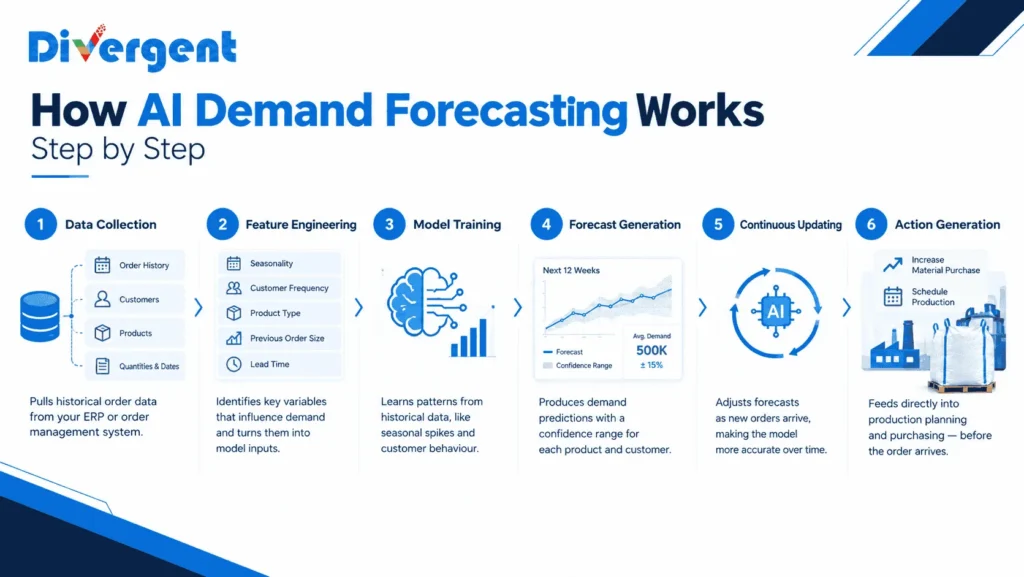
- Data collection. The AI system pulls historical order data — dates, quantities, products, customers — from your ERP or order management system. The more complete and consistent this data, the more accurate the forecast. Most packaging plants with 2 to 3 years of ERP data have sufficient history to start.
- Feature engineering. The system identifies which variables correlate with demand — time of year, customer order frequency, product type, previous order size, lead time from last order to next. These become the inputs to the machine learning model.
- Model training. The machine learning model is trained on historical data. It learns the patterns that precede high-demand periods for each product and customer combination — for example, that Customer A orders FIBC bags for fertiliser every February and October, and that the February order is typically 20 percent larger than the October order.
- Forecast generation. The trained model generates a demand prediction for each product and customer for the coming 4, 8 or 12 weeks. The prediction includes a confidence range — not just a single number, but a range within which actual demand is likely to fall.
- Continuous updating. As new orders arrive, the model updates its predictions. If actual demand in week 1 was higher than forecast, the model adjusts week 2 through 12 accordingly. This continuous learning loop is what makes AI demand forecasting progressively more accurate over time.
- Action generation. The forecast feeds directly into production planning and purchasing. If demand for a particular FIBC bag type is forecast to rise 30 percent in six weeks, the system raises a purchase recommendation for polypropylene granules and schedules loom capacity accordingly — before the order arrives.
AI Demand Forecasting for Packaging and FIBC Plants: Specific Applications
Packaging and FIBC manufacturing plants face specific demand patterns that make AI demand forecasting particularly valuable.
Seasonal Demand Spikes
FIBC bags used in agriculture follow harvest seasons. Cement bags peak with construction activity. Food-grade PP bags track FMCG production cycles. AI demand forecasting in manufacturing identifies these seasonal patterns from order history and predicts the spike weeks or months in advance — giving the plant time to position raw materials and allocate loom capacity before the rush.
Manual planning recognises these cycles too, but typically responds too late — waiting for the first large order before starting the purchasing process. By then, raw material lead times and loom scheduling constraints make it impossible to respond without either overtime or customer disappointment.
Customer-Level Forecasting
A plant supplying ten large FIBC customers has ten different ordering patterns. One customer orders monthly in consistent quantities. Another orders quarterly in large batches. A third has no fixed cycle but always orders within two weeks of a commodity price drop.
AI demand forecasting generates a separate prediction for each customer, based on that customer’s specific history. The result is a customer-level demand plan — not just a total volume forecast — that tells the production planning team which customers need capacity reserved and when.
Product Mix Optimisation
A woven bag plant producing multiple GSM variants, sizes and print specifications cannot plan every product the same way. Some products have stable, predictable demand. Others are highly variable. AI demand forecasting identifies which products are predictable — and therefore safe to produce ahead of orders — and which are variable and should only be produced to confirmed order. This distinction alone can reduce finished goods inventory by 20 to 30 percent without increasing stockout risk.
Raw Material Positioning
The most direct benefit of AI demand forecasting for a packaging plant is raw material positioning. Polypropylene granule lead times are typically 2 to 4 weeks. If the plant knows 8 weeks in advance that a seasonal demand spike is coming, it can purchase and receive raw material before the spike arrives — avoiding emergency procurement at premium prices.
What Is Demand Sensing and Why Does It Matter?
Demand sensing is a short-term forecasting technique that uses real-time signals — daily sales data, point-of-sale information, weather data, social media trends — to update demand predictions on a daily or weekly basis rather than monthly.
Where traditional demand forecasting looks 8 to 12 weeks ahead with moderate accuracy, demand sensing focuses on the next 1 to 4 weeks with high accuracy by incorporating the most recent data available. For packaging plants supplying FMCG customers, demand sensing picks up early signals — a retailer’s promotional activity, a weather event driving construction material demand, a commodity price shift affecting agricultural packaging needs — before those signals appear in formal order data.
The combination of AI demand forecasting for medium-term planning and demand sensing for short-term adjustment gives packaging plants the most complete picture of upcoming demand available from any forecasting approach.
Machine Learning Demand Forecasting and Inventory Optimisation
Machine learning demand forecasting and inventory optimisation work together. An accurate demand forecast is the input to an inventory optimisation system — which uses the forecast to calculate the right safety stock level for each material, the optimal reorder point and the ideal order quantity.
Without an accurate demand forecast, inventory optimisation produces the wrong recommendations — either too much safety stock (tying up working capital) or too little (causing stockouts). With machine learning demand forecasting as the input, inventory optimisation can:
- Set safety stock levels that reflect actual demand variability rather than fixed rules
- Trigger purchase orders at the right time — early enough to avoid stockouts, not so early that stock sits idle
- Identify slow-moving stock before it becomes dead stock
- Reduce total inventory value while maintaining or improving service levels
According to Gartner’s supply chain research, companies using AI-powered inventory optimisation reduce inventory carrying costs by 20 to 30 percent on average while simultaneously improving in-stock rates. For a packaging plant carrying significant raw material and finished goods inventory, this is a material financial improvement.
Demand Forecasting Software: What to Look For
Demand forecasting software ranges from standalone AI forecasting tools to forecasting modules built into manufacturing ERP systems. For packaging and FIBC plants, the most important criteria when evaluating demand forecasting software are:
- ERP integration: The forecasting system must connect to your ERP to pull order history and push purchase recommendations. A standalone demand forecasting tool that does not integrate with your production planning system creates a data silo.
- Customer and product granularity: The system should forecast at customer-product level, not just total volume. A forecast that says you will need 500 tonnes of PP next month is less useful than one that says Customer A will need 200,000 Type A FIBC bags and Customer B will need 150,000 Type C FIBC bags.
- Forecast horizon: For raw material purchasing in packaging, you need at least 8 to 12 weeks of forward visibility. Confirm the software provides this.
- Accuracy measurement: Good demand forecasting tools report their own forecast accuracy — the difference between what was predicted and what actually happened. If a vendor cannot show you their forecast error rate from live deployments, the system’s performance is unknown.
- Handling of new products: Every plant introduces new product variants. The demand forecasting software should handle new products — using similar product history as a proxy — rather than simply failing to forecast them.
- Planner override: AI demand forecasting tools should allow the production planner to override a forecast when they have specific knowledge the system does not — a customer’s confirmed shutdown, a new contract starting. The AI provides the baseline; the human applies judgment on top.
How AI Demand Forecasting Connects to Your ERP
AI demand forecasting in manufacturing delivers its full value only when it connects to the ERP system that drives production, purchasing and inventory. The integration works in both directions:
- From ERP to AI: Order history, product specifications, customer data and current stock levels flow from the ERP into the demand forecasting model as inputs.
- From AI to ERP: Demand predictions, purchase recommendations and production schedule suggestions flow from the AI system back into the ERP, where they trigger purchase orders, production plans and capacity allocations.
Without this two-way integration, the forecast exists as a report that planners read and manually act on — which eliminates most of the efficiency gain. With the integration in place, the forecast automatically drives the supply chain: a predicted demand increase in week 6 triggers a purchase order in week 1, which arrives in time for production in week 4.
See our guide to inventory management challenges in manufacturing for how ERP-connected forecasting eliminates the most common stock problems packaging plants face.
How to Implement AI Demand Forecasting in Manufacturing: A Practical Roadmap
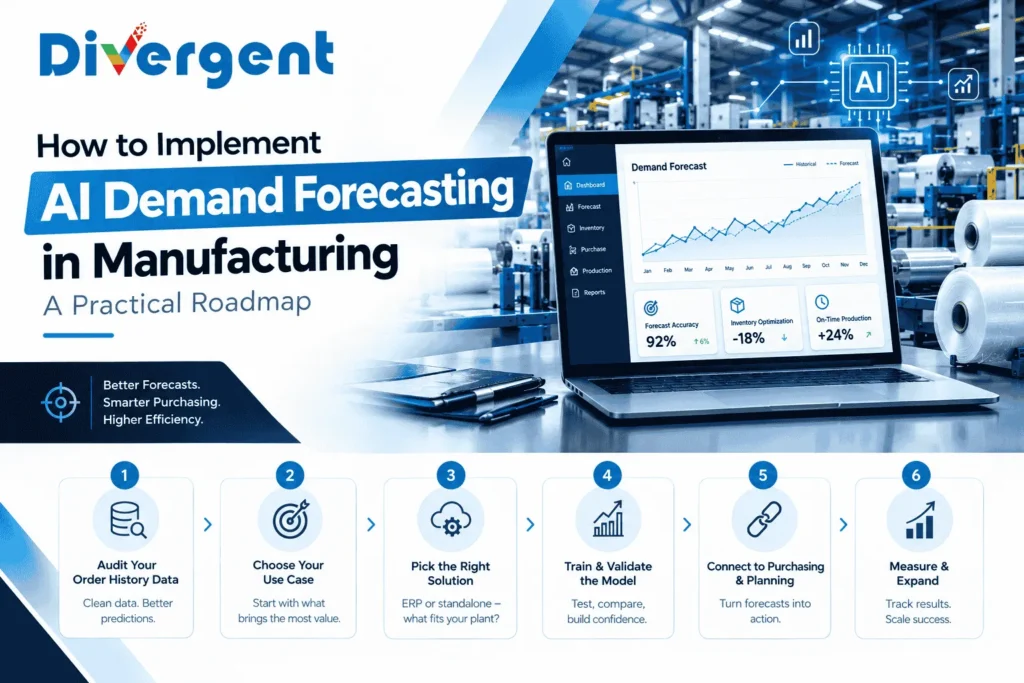
Most packaging plants can implement AI demand forecasting in 3 to 6 months. The roadmap below covers the practical steps.
- Audit your order history data. Pull 2 to 3 years of order data from your ERP. Check completeness — are order dates, quantities, product codes and customer names all present and consistent? Data gaps and inconsistencies are the most common reason AI demand forecasting underperforms. Fix data quality before training the model.
- Identify your highest-priority forecast use case. Choose the one application that will deliver the most value fastest — typically raw material purchasing for your top 3 to 5 raw materials, or demand forecasting for your top 10 customers. Starting narrow gives you a fast, measurable result that builds confidence for wider rollout.
- Choose embedded or standalone forecasting. Decide whether to use a demand forecasting module within your existing ERP or a standalone AI forecasting tool that integrates with it. For most packaging plants, an ERP with built-in forecasting is the lower-risk path — fewer integration points, one system to support.
- Train the model and validate accuracy. Train the demand forecasting model on your historical data. Before using it for real purchasing decisions, run it in parallel with your existing process for 4 to 8 weeks — comparing AI predictions against actual orders. This validation step confirms the model is working and builds planner trust in the system.
- Connect to purchasing and production planning. Once accuracy is validated, connect the demand forecast to your purchase order process and production planning system. Set up alerts for when forecast demand exceeds available raw material — so purchasing can act immediately, automatically.
- Measure and expand. Track forecast accuracy, raw material stockout rate, inventory value and production schedule adherence before and after. Once the first use case is delivering measurable results, expand the model to cover more products, more customers and more raw materials.
Real Results from AI Demand Forecasting in Manufacturing
Published case studies and industry research show consistent results from AI demand forecasting implementations in manufacturing environments:
| Metric | Before AI Forecasting | After AI Forecasting |
|---|---|---|
| Forecast error rate | 25–40% | 10–15% |
| Raw material stockouts | 8–12 per year | 1–2 per year |
| Excess inventory value | High | Reduced 20–30% |
| Emergency purchase premium | Frequent | Rare |
| Production schedule adherence | 70–80% | 88–95% |
| Customer on-time delivery rate | 82–88% | 93–97% |
For a mid-size packaging plant, a 20 percent reduction in inventory value typically represents hundreds of thousands of rupees in freed working capital. A reduction in emergency procurement eliminates the premium costs associated with rush orders. An improvement in on-time delivery rate directly protects and builds customer relationships.
How Divergent PackPro Supports Demand Forecasting
Divergent PackPro is a manufacturing ERP built for FIBC, BOPP, PP woven bag and flexible packaging plants. Its planning module uses order history to generate forward-looking demand signals that production and purchase teams can act on — connecting forecast data directly to purchase order creation, production scheduling and inventory management.
- Order history analysis: PackPro analyses customer order patterns to identify seasonal cycles and recurring demand peaks — visible to production and purchase teams in a single dashboard.
- Raw material requirement projection: Based on open orders and historical demand patterns, PackPro projects raw material needs 4 to 8 weeks forward — giving purchase teams lead time to order before shortages develop.
- Production capacity planning: Forecast demand flows into the production planning workbench, where capacity can be allocated to high-priority products ahead of confirmed orders.
- Inventory optimisation: PackPro tracks actual consumption against forecast, flagging materials where stock is building above the predicted requirement and materials where stock is falling below the safety level for the forecast demand.
See how Divergent PackPro works or speak to our team for a walkthrough of the planning and forecasting module using your own order data.
Related Reading
- AI in Manufacturing: The Essential Guide for Packaging and FIBC Plants
- Inventory Management Challenges in Manufacturing
- Production Planning Challenges in Manufacturing
- 12 Critical Manufacturing Challenges and How ERP Solves Them
- FIBC ERP Software: How to Choose the Best System
Frequently Asked Questions — AI Demand Forecasting in Manufacturing
What is AI demand forecasting in manufacturing?
AI demand forecasting in manufacturing is the use of machine learning to predict future customer demand based on historical order data, seasonal patterns and external signals. It replaces manual spreadsheet forecasting with a model that learns from data, improving accuracy and updating continuously as new orders arrive.
What is demand planning?
Demand planning is the process of estimating future customer demand and using that estimate to plan production, purchasing and inventory. It connects what customers will want to what the factory needs to produce. AI demand forecasting improves demand planning by replacing manual estimates with machine learning predictions that are more accurate and more granular.
What is demand sensing?
Demand sensing is a short-term forecasting technique that uses real-time data signals — daily orders, point-of-sale data, weather, promotional activity — to update demand predictions on a daily or weekly basis. It complements longer-term AI demand forecasting by giving planners a high-accuracy view of the next 1 to 4 weeks.
How do you forecast demand?
You can forecast demand using several methods: moving averages, exponential smoothing, sales team estimates, customer-provided forecasts or machine learning models. AI demand forecasting uses machine learning to analyse historical order patterns and generate predictions that are significantly more accurate than manual methods, especially in complex multi-product, multi-customer environments.
What is supply chain forecasting?
Supply chain forecasting is the process of predicting future demand, supply and inventory levels across a supply chain. AI demand forecasting is one component of supply chain forecasting — focused specifically on predicting what customers will order. It feeds into inventory planning, production scheduling and raw material purchasing across the supply chain.
How to forecast demand for a new product?
Forecasting demand for a new product without order history requires using similar product data as a proxy. If the new product is a variation of an existing one — different GSM, different size — the AI model can use the existing product’s order history as a starting point. Sales team input and customer commitments provide additional signal for the first 3 to 6 months, after which the product’s own order history becomes sufficient for the model.
What are the main demand forecasting methods?
The main demand forecasting methods are: moving average, exponential smoothing, sales team estimate, customer-provided forecast, statistical regression and machine learning. Machine learning demand forecasting outperforms the others in complex manufacturing environments because it processes all variables simultaneously and learns from the full data history rather than applying fixed rules.
How does machine learning improve demand forecasting?
Machine learning improves demand forecasting by identifying patterns in historical data that human planners and traditional statistical methods cannot detect. It handles seasonal cycles, customer-specific ordering patterns, product-level trends and multiple interacting variables simultaneously — and updates its predictions continuously as new data arrives, rather than requiring manual recalibration.
What data does AI demand forecasting need?
AI demand forecasting needs clean, consistent historical order data — order dates, quantities, product codes and customer names — ideally covering 2 to 3 years. Additional data that improves accuracy includes lead times, promotional calendars, seasonal indicators and external market signals such as commodity prices.
Can a small packaging plant use AI demand forecasting?
Yes. Packaging plants with 2 or more years of ERP order history and 10 or more active customers have sufficient data to train an AI demand forecasting model. The best starting point is a forecasting module built into the manufacturing ERP the plant already uses — no separate system to integrate, no additional infrastructure required.