AI sales agent for manufacturing is the solution to one of the most damaging problems a packaging plant faces — a customer calling to ask where their order is, when no one on the sales team knows the answer.
Your sales team confirmed a delivery date four weeks ago. Since then, the order has been through raw material procurement, production planning, extrusion, weaving, cutting, printing and dispatch — each stage with its own delays and schedule changes. The sales team has no visibility of any of it. The customer calls on the promised delivery day. The sales executive calls the production floor. The production floor checks the schedule. The sales executive calls the customer back — with a new date that may also change.
This destroys customer trust. And it happens every week in manufacturing plants across India. An AI sales agent for manufacturing eliminates this gap entirely — tracking every order through production, flagging delays before the customer calls and maintaining proactive communication automatically.
According to Gartner, B2B customers who receive proactive communication during order fulfilment are 2.4 times more likely to reorder without escalation. According to McKinsey, AI-powered sales automation reduces customer escalation rates by up to 60 percent in manufacturing operations. For manufacturing plants where repeat orders are the foundation of the business, an AI sales agent for manufacturing is a revenue protection mechanism.
What Is an AI Sales Agent for Manufacturing?
What does an AI sales agent for manufacturing do?
An AI sales agent for manufacturing is an autonomous AI system that manages customer order communication — tracking every order through production, monitoring delivery timelines against commitments, preparing proactive customer updates and flagging risks before they become missed commitments — without requiring manual follow-up from the sales team for routine order status communication.
Unlike CRM systems that store customer data and require sales executives to manually check and update order status, an AI sales agent for manufacturing actively monitors the production schedule, identifies gaps between committed delivery dates and actual production progress and acts on those gaps — preparing updates, routing approvals and maintaining customer communication — automatically.
In a FIBC or BOPP packaging plant processing 200 to 500 customer orders per month, a sales team of 3 to 5 people cannot realistically track every order through every production stage manually. The AI sales agent for manufacturing does this continuously — for every order, every day, without any manual monitoring work. See our complete guide on what agentic AI in manufacturing ERP is and how autonomous agents work across all manufacturing departments.
Why Manufacturing Plants Need AI Sales Agent
Why do manufacturing plants need an AI sales agent?
Manufacturing plants face a structural information gap — the sales team makes delivery commitments based on the production schedule at the time of order confirmation. But production schedules change every day — material delays, machine breakdowns, priority order insertions, quality holds. By the time the original committed delivery date arrives, the actual production status may be completely different.
Without an AI sales agent for manufacturing, this information gap is bridged manually — the sales executive calls the production floor, the production floor checks the schedule, the sales executive calls the customer. This takes time, happens inconsistently and always puts the sales team in a reactive position.
With an AI sales agent for manufacturing, the information gap is closed in real time — the agent monitors production continuously, identifies when any committed delivery date is at risk and prepares a proactive update before the gap becomes a missed commitment and before the customer notices.
How AI Sales Agent for Manufacturing Works in ERP
How does an AI sales agent for manufacturing work inside an ERP system?
An AI sales agent for manufacturing works by continuously reading sales order data, production schedules and dispatch records from the ERP, calculating the projected delivery date for every open order, comparing that against the committed delivery date and acting when a gap is detected.
Step 1 — Order Tracking
The AI sales agent for manufacturing reads every confirmed sales order — customer name, quantity, committed delivery date and special specifications. From confirmation, the agent begins tracking it through every production stage — raw material, WIP, finishing, quality check and dispatch.
Step 2 — Production Progress Monitoring
The AI sales agent for manufacturing monitors the production schedule against each open order — checking raw material availability, WIP status and any schedule changes. When a production delay, material shortage or capacity constraint affects an order’s timeline, the agent identifies it immediately — not at the next weekly production meeting.
Step 3 — Delivery Date Projection
The AI sales agent for manufacturing calculates a revised projected delivery date for every open order based on current production progress, remaining production steps and dispatch lead time — updating continuously as production data changes in the ERP.
Step 4 — Risk Detection
When projected delivery exceeds the committed date by more than the agent’s threshold, the AI sales agent for manufacturing flags the order as at-risk — identifying root cause and calculating the revised timeline. Orders close to the commitment date with remaining production steps are flagged as watch items before they become at-risk.
Step 5 — Customer Update Preparation
For at-risk orders, the AI sales agent for manufacturing prepares a customer update draft — revised delivery date, brief explanation and available recovery options — routed to the account manager for review and approval before sending. The sales executive reviews and approves, not researches and writes.
Step 6 — Dispatch Confirmation
When an order moves to dispatch, the AI sales agent for manufacturing sends an automatic dispatch confirmation to the customer — order number, quantity dispatched, vehicle number and expected delivery date. Customers receive confirmation the same day as dispatch without the sales team making a single call or sending a manual email.
AI Sales Agent for Manufacturing vs Manual Sales Follow-Up
What is the difference between AI sales agent for manufacturing and manual follow-up?
| Function | Manual Follow-Up | AI Sales Agent for Manufacturing |
|---|---|---|
| Order visibility | Weekly production meeting | Real-time — continuous monitoring |
| Delay detection | Customer calls to ask | Identified before customer notices |
| Customer update | Sales exec calls production, then customer | Automatic draft — sales exec approves |
| Dispatch confirmation | Manual email or call — 1 to 2 days | Automatic — same day as dispatch |
| At-risk management | Reactive — after delay | Proactive — 2 to 3 weeks before |
| Sales team time on status calls | 40 to 60% of working time | Less than 10% of working time |
| Customer escalations | Frequent — surprise delays | Rare — proactive communication |
| Order history visibility | Scattered emails and calls | Complete log in ERP — instant |
Benefits of AI Sales Agent for Manufacturing
What are the key benefits of AI sales agent for manufacturing plants?
- Zero surprise delivery delays — The AI sales agent for manufacturing identifies risks before the customer calls. Customers receive proactive updates — not reactive explanations after escalation. Customer relationships are protected automatically.
- Sales team focused on selling — Instead of spending 40 to 60 percent of working time on status calls and production follow-up, the sales team focuses on new customer development, relationship building and commercial negotiations — work that generates revenue.
- Faster customer response time — When a customer enquires about an order, the sales executive has real-time production visibility at their fingertips. Response time drops from hours to seconds. See how reducing production cost in manufacturing with AI improves overall plant performance and customer satisfaction.
- Reduced customer escalations — Proactive communication before a delay becomes a missed commitment reduces customer escalations by up to 70 percent. Customers who receive early notice of a revised delivery date are far more understanding than customers who discover the delay when the truck does not arrive.
- Better on-time delivery rate — When the sales team has real-time visibility of at-risk orders, they can intervene early — expediting production, arranging partial shipments or managing customer expectations before the delay becomes a missed commitment. Plants implementing AI sales agent for manufacturing report on-time delivery rates improving from 70-80 percent to 85-95 percent.
- Complete order communication history — Every customer update, delivery confirmation and escalation logged automatically against the order and customer record in the ERP. When a dispute arises, the complete communication history is available instantly.
- Scalable without headcount — An AI sales agent for manufacturing tracks 50 orders or 500 orders with the same team, the same accuracy and the same response time. Order volume growth does not require additional sales staff for order management.
How AI Sales Agent for Manufacturing Prevents Missed Commitments
How does AI sales agent for manufacturing prevent missed delivery commitments?
An AI sales agent for manufacturing prevents missed commitments by closing the information gap between production reality and sales team knowledge. Without an AI sales agent for manufacturing, the sales team knows what was committed but not what is actually happening in production. With an AI sales agent for manufacturing, the sales team has the same real-time visibility as the production floor — and the agent acts on that visibility automatically.
| Scenario | Without AI Sales Agent | With AI Sales Agent for Manufacturing |
|---|---|---|
| Production delay detected | Discovered at delivery date | Flagged 2 to 3 weeks ahead |
| Material shortage affects order | Customer calls to ask | Sales team notified immediately |
| Order dispatched | Manual call or email — same day to 2 days | Automatic dispatch confirmation same day |
| Customer enquires about status | Production call needed — hours to respond | Real-time status available in seconds |
| New large order confirmed | Sales exec manually tracks | Agent begins tracking immediately |
| Quality hold delays order | Discovered at dispatch stage | Flagged when hold is placed |
AI Sales Agent for Manufacturing Inside ERP
How does AI sales automation connect to manufacturing ERP systems?
An AI sales agent for manufacturing connects to manufacturing ERP through the ERP API — reading sales order, production schedule and dispatch data, and writing customer communication records exactly as a sales executive would. The agent works inside the ERP the plant already uses — no separate CRM, no parallel system, no duplicate data entry.
For manufacturing plants using purpose-built ERP like Divergent PackPro for FIBC manufacturers, the AI sales agent for manufacturing understands FIBC, BOPP and packaging order structures natively — bag specifications, weight tolerances, print specifications, UN certification requirements and customer-specific requirements tracked per order without custom configuration.
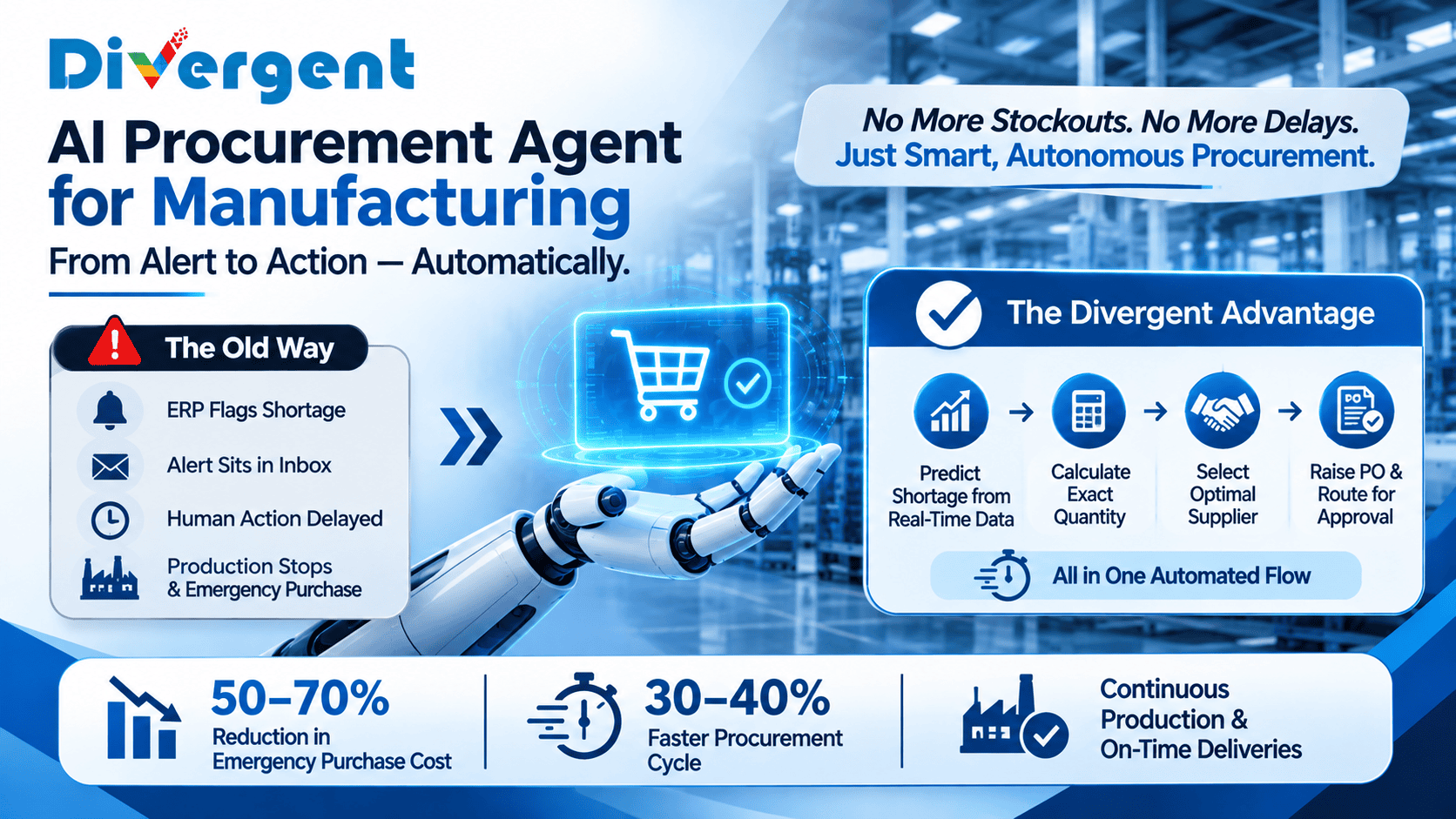
See how AI procurement agent for manufacturing works alongside the sales agent — when procurement delays affect delivery timelines, the sales agent is notified immediately and prepares customer updates automatically.
AI Sales Agent for Manufacturing — Real World Example
How does AI sales agent work in a real FIBC manufacturing plant?
A FIBC manufacturer receives a confirmed order for 5,000 bags with a 21-day delivery commitment. The AI sales agent for manufacturing begins tracking the order immediately — monitoring PP granule procurement, extrusion scheduling, weaving queue position, cutting and stitching allocation, printing slot and dispatch scheduling.
On day 8, the extrusion line scheduled for this order has an unplanned breakdown. The production schedule shifts the order back by 4 days. The committed delivery date is now at risk. The AI sales agent for manufacturing detects this immediately — calculates the revised delivery date, identifies the root cause, prepares a customer update draft and routes it to the account manager for review. The account manager reviews and approves the update. The customer receives a proactive notification on day 8 — 13 days before the original delivery date — with a revised date and an explanation.
The customer does not need to call. The sales executive does not need to investigate. The customer relationship is protected. The process took minutes — not a day of back-and-forth between sales and production.
How to Implement AI Sales Agent for Manufacturing Safely
How do you implement AI sales agent for manufacturing without risk?
- Map current order communication workflows — Understand how orders are tracked, how delays are communicated and how dispatch confirmations are sent today. This baseline defines the agent’s initial configuration and the communication templates it will use.
- Define agent authority parameters — Set what the AI sales agent for manufacturing sends automatically versus what requires sales executive approval. Dispatch confirmations can typically be sent automatically; delay notifications always go for review before sending.
- Run in monitoring-only mode first — 4 to 6 weeks — agent identifies at-risk orders and prepares updates but humans review every draft before sending. This builds confidence in the agent’s judgment before autonomous communication begins.
- Start with dispatch confirmations — Activate autonomous sending first for dispatch confirmations — factual, low-risk communications that customers always appreciate receiving promptly.
- Expand to proactive delay notices — Once dispatch confirmation performance is proven, activate proactive delay notices — still with sales executive approval for every update, but the research and drafting work is eliminated.
- Monitor customer response patterns — Track how customers respond to AI sales agent for manufacturing communications. Response patterns reveal which communication templates need adjustment and which customers prefer human contact for specific situations.
What Manufacturing Plants Achieve With AI Sales Agent for Manufacturing
What results do manufacturing plants get from AI sales agent for manufacturing?
| Metric | Before AI Sales Agent | After AI Sales Agent for Manufacturing |
|---|---|---|
| Customer escalation rate | 15 to 25% of orders | Less than 5% of orders |
| Sales team time on status calls | 40 to 60% of working time | Less than 10% of working time |
| Order visibility | Weekly production meeting | Real-time — continuous |
| Delay notification timing | After customer calls | 2 to 3 weeks before delivery date |
| Dispatch confirmation time | Same day to 2 days | Automatic — same day |
| On-time delivery rate | 70 to 80% | 85 to 95% with early intervention |
| Customer reorder rate | Standard | Up to 2.4x higher with proactive communication |
Divergent Software Labs AI Sales Agent for Manufacturing
Divergent Software Labs builds AI sales agents for manufacturing — autonomous systems that connect to your existing ERP, track every order through production and maintain proactive customer communication without manual follow-up work.
- Real-time order tracking — Every customer order monitored continuously through production — not just at weekly production meetings. The AI sales agent for manufacturing tracks raw material, WIP, quality and dispatch stages.
- Manufacturing-specific understanding — FIBC, BOPP and packaging order structures understood natively — bag specifications, weight tolerances and customer-specific requirements tracked per order without custom configuration.
- Proactive delay management — At-risk orders identified 2 to 3 weeks before the committed delivery date — giving the sales team time to intervene rather than explain.
- Automatic dispatch confirmations — Sent to customer automatically on dispatch day — order details, quantity, vehicle and expected delivery date. No manual email required.
- Graduated autonomy — Dispatch confirmations sent automatically; delay notifications always reviewed by the sales executive before sending. Human judgment retained for all sensitive communications.
- Full ERP integration — Customer communication history logged against order and customer records in the ERP. Complete visibility for the entire sales team at any time.
See how Divergent PackPro AI sales agent works or speak to our team for a demonstration using your own plant’s order data and customer base.
People Also Ask — AI Sales Agent for Manufacturing
What is an AI sales agent for manufacturing?
An AI sales agent for manufacturing is an autonomous AI system that tracks every customer order through production, monitors delivery timelines, prepares proactive customer updates when delays are detected and sends dispatch confirmations automatically — without manual follow-up for routine order status communication.
How does an AI sales agent prevent missed delivery commitments?
An AI sales agent for manufacturing identifies delivery risks 2 to 3 weeks before the committed delivery date — giving the sales team time to intervene, expedite production or manage customer expectations proactively rather than reactively after the customer complains.
Can AI replace a sales team in manufacturing?
No. An AI sales agent for manufacturing handles routine communication — order tracking, status updates, dispatch confirmations. It frees the sales team from administrative follow-up so they can focus on relationship building, negotiation and new customer development — work that requires human judgment and trust.
How does AI sales agent connect to manufacturing ERP?
An AI sales agent for manufacturing connects through the ERP API — reading sales order, production schedule and dispatch data, and writing customer communication records exactly as a sales executive would. It works inside the ERP the plant already uses with no separate CRM or parallel system required.
What is the difference between AI sales agent and CRM software?
CRM software stores customer data and requires sales executives to manually check and update order status. An AI sales agent for manufacturing actively monitors production schedules, identifies delivery risks and acts on those risks automatically — preparing updates, routing approvals and sending dispatch confirmations without manual intervention.
How much time does AI sales agent save the sales team?
Manufacturing plants implementing AI sales agents report sales teams spending less than 10% of working time on order status management — compared to 40 to 60% before. The freed time is redirected to new customer development, relationship building and commercial negotiations.
Is AI sales agent safe to use with customers?
Yes — delay notifications always go through sales executive approval before sending. The AI sales agent for manufacturing handles research and drafting; the sales executive handles judgment and relationship decisions. Dispatch confirmations can be sent automatically as they are factual and always appreciated by customers.
What industries benefit most from AI sales agent?
Manufacturing plants with high order volumes, complex production cycles and repeat customers benefit most — FIBC, BOPP, PP woven bag manufacturers, packaging plants, textile mills and any B2B manufacturer where on-time delivery is a core customer expectation and repeat orders are the foundation of the business.
How long does it take to implement AI sales agent for manufacturing?
Implementation follows a phased approach: order tracking configuration (2 to 4 weeks), monitoring-only mode where humans review every draft (4 to 6 weeks), autonomous dispatch confirmations, then progressive expansion to proactive delay management. Full autonomous operation typically takes 4 to 6 months.
What is autonomous sales agent?
An autonomous sales agent is an AI system that independently manages routine sales communication workflows — order tracking, status updates, dispatch confirmations — within defined parameters, without requiring human action at each step. Human judgment is retained for commercial decisions and relationship-sensitive communications.
Can AI sales agent send emails to customers automatically?
Dispatch confirmations can be sent automatically within defined parameters. Delay notifications and revised delivery date communications are always routed for sales executive review and approval before sending — the AI sales agent for manufacturing drafts the communication, the executive approves and sends.
How does AI sales agent handle customer complaints?
An AI sales agent for manufacturing prevents most complaints by identifying delivery risks before the customer notices and preparing proactive updates. When a complaint does arrive, the agent flags it to the sales executive with full order context — production status, delay reason and suggested resolution — so the executive can respond with complete information immediately.
Related Reading
- What Is Agentic AI: How Autonomous Agents Transform Manufacturing ERP
- AI Procurement Agent for Manufacturing
- How to Reduce Production Cost in Manufacturing
- Tally vs ERP for Manufacturing
- ERP Software for FIBC Manufacturers
Follow Divergent Softlab on Google
Enjoying our insights on manufacturing ERP, artificial intelligence and business technology? Add Divergent Softlab as a preferred source on Google to discover more of our latest articles.