AI procurement agent for manufacturing is the solution to one of the most common and costly problems in packaging plants — the gap between an ERP predicting a material shortage and a human acting on it.
Your ERP flagged a PP granule shortage three weeks ago. The alert sat in the purchase manager’s inbox. The purchase manager was busy with supplier negotiations. The reorder never happened. Last Tuesday, the extrusion line stopped at 11 AM. Customer deliveries were delayed. Emergency procurement happened at 15 percent premium over standard price.
An AI procurement agent for manufacturing eliminates this gap entirely. It does not predict the shortage and wait for a human to act. It predicts the shortage, calculates the exact quantity required, selects the optimal supplier from the approved vendor list, raises the purchase order in the ERP system and routes it for approval — all within the same system cycle, without any human intervention for routine reorders.
According to McKinsey, manufacturers implementing AI-driven procurement automation reduce emergency purchasing costs by 50 to 70 percent and procurement cycle times by 30 to 40 percent within the first year of implementation.
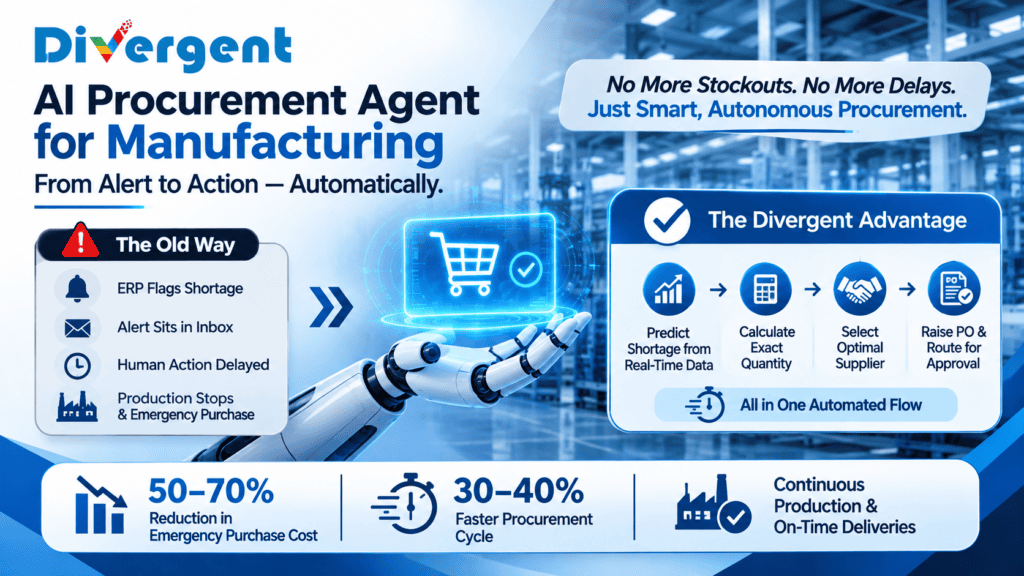
Table of Contents
- What Is an AI Procurement Agent for Manufacturing?
- How AI Procurement Agent Works in Manufacturing ERP
- AI Procurement Agent vs Manual Purchasing
- Benefits of AI Procurement Agent in Manufacturing
- How AI Procurement Agent Eliminates Stockouts
- AI Procurement Agent Inside Manufacturing ERP
- How to Implement AI Procurement Agent Safely
- What Manufacturing Plants Achieve
- Divergent PackPro AI Procurement Agent
- Frequently Asked Questions
What Is an AI Procurement Agent for Manufacturing?
What does an AI procurement agent do in manufacturing?
An AI procurement agent for manufacturing is an autonomous AI system that manages the complete purchasing workflow — from monitoring inventory levels to raising purchase orders — without requiring human intervention at each step. Unlike traditional procurement software that generates recommendations for humans to act on, an AI procurement agent acts on those recommendations itself, within defined authority parameters and approval limits.
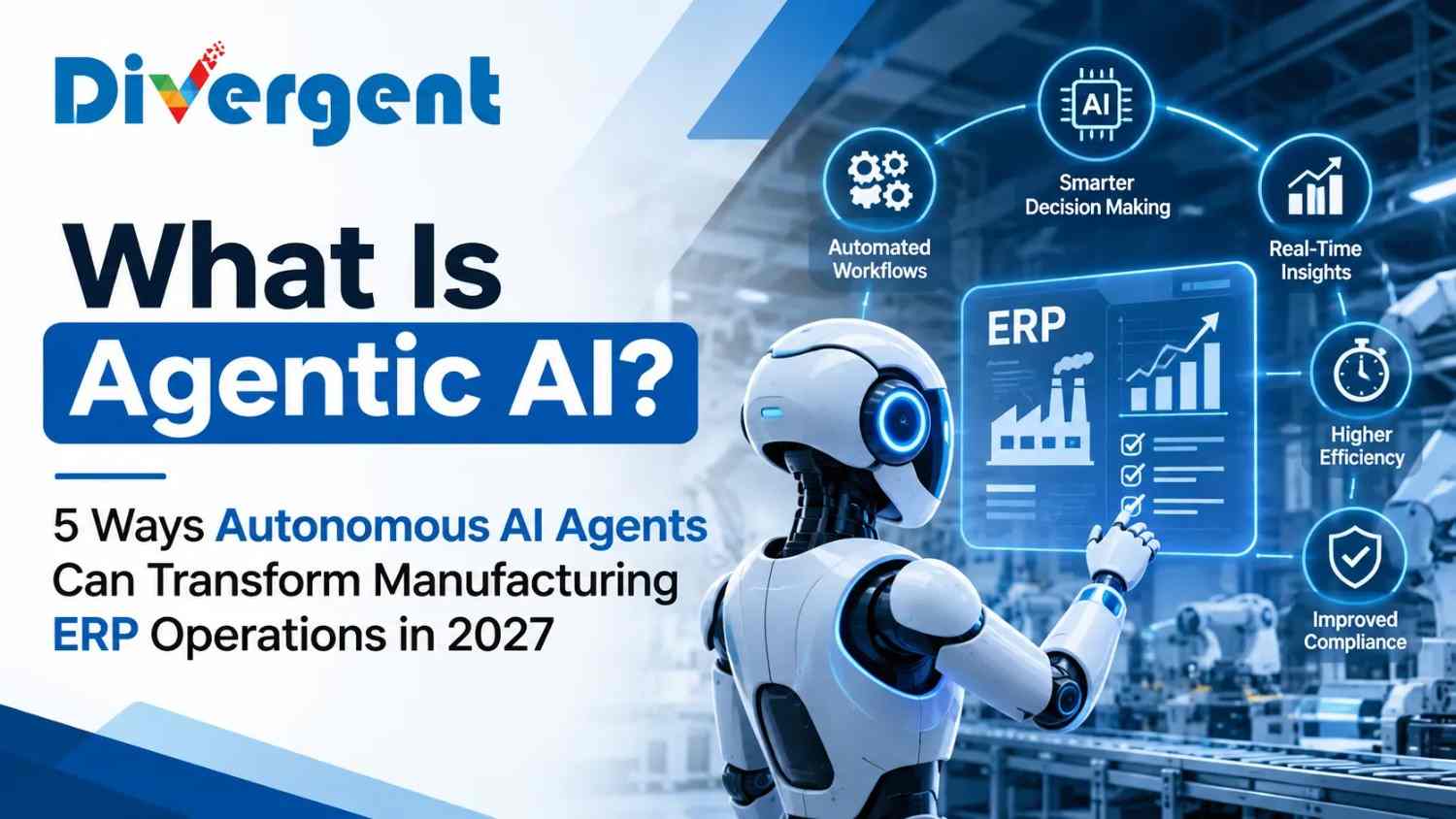
In a manufacturing plant, an AI procurement agent continuously monitors raw material inventory, calculates material requirements from confirmed production orders, identifies when materials approach their reorder points, selects the optimal supplier based on price, lead time and reliability history, raises the purchase order in the ERP system and follows up on delivery against the promised date. For routine reorders within defined authority limits, the entire process happens automatically — the purchase team is notified of what was ordered, not asked to order it. See our complete guide on what is agentic AI in manufacturing ERP for how autonomous agents work across all manufacturing departments.
How AI Procurement Agent Works in Manufacturing ERP
How does an AI procurement agent work inside a manufacturing ERP system?
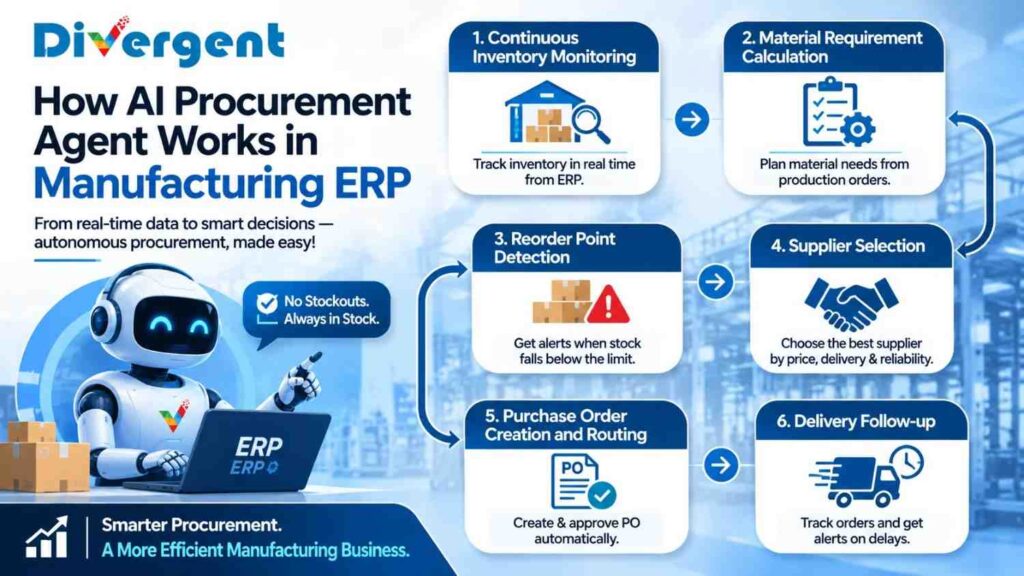
An AI procurement agent for manufacturing works inside a manufacturing ERP by continuously reading inventory data, production schedules and supplier information through the ERP API, calculating when each material will reach its reorder point, planning the optimal purchase action and executing that action within defined authority limits. The agent operates 24 hours a day, 7 days a week — without fatigue or distraction.
Step 1 — Continuous Inventory Monitoring
The AI procurement agent reads inventory balances from the ERP in real time — not from invoice dates as Tally and spreadsheets do, but from every material issue recorded at the moment it happens on the production floor. When a storekeeper issues 50kg of PP granules to the extrusion line, the agent immediately recalculates the projected inventory position for that material.
Step 2 — Material Requirement Calculation
The agent calculates material requirements from confirmed production orders and actual bill of materials — not from historical averages or manual estimates. When a 10,000 bag order is confirmed, the agent immediately calculates the PP granule, masterbatch, thread and packaging requirements for that specific order and identifies how many days of stock are available to cover total confirmed demand.
Step 3 — Reorder Point Detection
When projected inventory for any material falls below its calculated reorder point — based on actual consumption rate and supplier lead time — the agent flags it for procurement action. The reorder point is dynamic, not fixed: it adjusts automatically when production volumes change, when a supplier’s lead time changes or when a large new order is confirmed.
Step 4 — Supplier Selection
The agent selects the optimal supplier from the approved vendor list based on a weighted score of price, lead time, delivery reliability history and current availability. For standard materials with multiple approved suppliers, the agent selects automatically. For high-value orders requiring competitive comparison, the agent prepares the comparison and routes it for human review.
Step 5 — Purchase Order Creation and Routing
Within its defined authority limit, the agent creates the purchase order directly in the ERP and routes it for approval if required. The purchase manager receives a notification of what was ordered, with full context: why it was ordered, which supplier was selected, what the price is and when delivery is expected.
Step 6 — Delivery Follow-up
The agent tracks every open purchase order against its promised delivery date. When a delivery is approaching and the supplier has not confirmed dispatch, the agent sends an automated follow-up. When a delivery is delayed, the agent flags the impact on the production schedule and escalates to the purchase manager.
AI Procurement Agent vs Manual Purchasing
What is the difference between AI procurement agent and manual purchasing?
| Function | Manual Purchasing | AI Procurement Agent |
|---|---|---|
| Inventory monitoring | Weekly stock check — often outdated | Real-time — every transaction |
| Shortage detection | When production stops | 3 to 4 weeks before shortage |
| Material calculation | Manual estimation — error-prone | Exact BOM calculation per order |
| Supplier selection | Habit and relationship | Price + lead time + reliability score |
| PO creation | Manual — 30 to 60 minutes per PO | Automatic — seconds |
| Availability | Business hours only | 24/7 — no holidays |
| Emergency procurement | Frequent — 10 to 15% premium | Rare — planned procurement only |
| Audit trail | Emails and approvals — scattered | Complete log in ERP — instant |
Benefits of AI Procurement Agent in Manufacturing
What are the benefits of using an AI procurement agent in manufacturing?
- Zero routine stockouts: The AI procurement agent identifies shortage risk 3 to 4 weeks before the material would run out — enough lead time for planned procurement at standard prices.
- Reduced procurement cost: Emergency procurement at 10 to 15 percent premium over standard price is eliminated. See our guide on how to reduce production cost in manufacturing for the full cost reduction picture.
- Purchase team freed for strategic work: Time redirected from routine PO creation to supplier development, contract negotiation and strategic sourcing.
- Accurate material planning: Requirements calculated from actual confirmed production orders and real BOM data — not estimates. When production plans change, material requirements update automatically.
- Better supplier performance data: Every delivery recorded automatically. Reliable supplier performance database built over time.
- Complete procurement audit trail: Every procurement decision recorded automatically in ERP. Audit queries answered in seconds.
How AI Procurement Agent for Manufacturing Eliminates Stockouts
How does an AI procurement agent prevent production stoppages from material shortages?
An AI procurement agent for manufacturing eliminates stockouts by closing the gap between shortage prediction and procurement action. In a plant without an AI procurement agent, a shortage predicted by the ERP requires a human to read the prediction, prioritise it, calculate the order quantity, select a supplier, raise a PO and get it approved. Each step takes time. The gap can be days or weeks. In a plant with an AI procurement agent, the prediction and the action happen in the same system cycle. The gap is seconds.
| Scenario | Without AI Agent | With AI Procurement Agent |
|---|---|---|
| PP granule shortage detected | ERP alert — human must act | PO raised automatically |
| Masterbatch running low | Discovered at stock check | Flagged 3 weeks ahead |
| Supplier delayed delivery | Discovered when material does not arrive | Flagged before production impact |
| New large order confirmed | Purchase team manually recalculates | Requirements updated instantly |
| Emergency procurement needed | Premium price — 10 to 15% | Eliminated for predictable materials |
AI Procurement Agent Inside Manufacturing ERP
How does AI procurement automation connect to existing ERP systems?
An AI procurement agent connects to manufacturing ERP through the ERP API layer — reading inventory data, production orders and supplier information and writing purchase order records exactly as a human user would. The agent works inside the ERP the plant already uses — no separate database, no parallel system required. For manufacturing plants using purpose-built ERP systems like Divergent PackPro, the AI procurement agent is embedded in the ERP — not bolted on as a separate module.
How to Implement AI Procurement Agent Safely
How do you implement an AI procurement agent in a manufacturing plant without risk?
- Clean inventory data first: An AI procurement agent is only as reliable as the inventory data it acts on. Verify and correct all inventory records before autonomous operation begins.
- Define authority parameters: Maximum PO value without approval, approved vendor list scope, materials the agent orders autonomously versus those requiring human review.
- Run in observation mode: 4 to 6 weeks — agent generates recommendations, humans review and approve each one. Validates agent judgment before autonomy begins.
- Start with low-value routine materials: Consumables first — thread, packaging material, standard masterbatch. Build confidence before extending to PP granules.
- Expand authority progressively: Rs 25,000 without approval → Rs 2 lakhs after six months of proven performance.
- Monitor and audit continuously: Review audit log weekly for first three months. Identify patterns requiring parameter adjustment.
What Manufacturing Plants Achieve With AI Procurement Agent
What results do manufacturing plants get from AI procurement automation?
| Metric | Before AI Procurement Agent | After AI Procurement Agent |
|---|---|---|
| Emergency procurement rate | 8 to 15% of all POs | Less than 2% of all POs |
| Stockout incidents per month | 2 to 4 preventable stoppages | Zero preventable stoppages |
| Procurement cycle time | 3 to 7 days per PO | Same day for routine reorders |
| Emergency procurement premium | 10 to 15% above standard | Eliminated for monitored materials |
| Purchase team time on routine POs | 60 to 70% of working time | Less than 20% of working time |
| Supplier delivery tracking | Manual follow-up calls | Automated — flagged when delayed |
Divergent PackPro AI Procurement Agent
Divergent PackPro includes a built-in AI procurement agent designed specifically for FIBC, BOPP, PP woven bag and packaging manufacturers — understanding the specific materials, specifications and procurement patterns of packaging plant operations from day one.
- GSM-based material requirements: Calculates PP granule, masterbatch, thread and liner requirements from actual bag specifications and confirmed production orders.
- Bag-type specific procurement: Different bag types require different materials. Agent calculates requirements separately per type and raises POs against correct specifications automatically.
- PP price-aware ordering: When PP granule prices change, agent recalculates economic order quantity and adjusts purchase recommendations accordingly.
- Graduated autonomy: Authority parameters set per material category — consumables ordered autonomously, PP granules routed for approval above defined value.
- Full audit trail: Every procurement decision logged with complete context in the ERP.
See how Divergent PackPro AI procurement agent works or speak to our team for a demonstration using your own plant material list and production volumes.
Frequently Asked Questions — AI Procurement Agent Manufacturing
What is an AI procurement agent for manufacturing?
An AI procurement agent for manufacturing is an autonomous AI system that monitors inventory, calculates material requirements, selects suppliers and raises purchase orders automatically within defined authority limits — without human intervention for routine reorders.
How does AI procurement agent eliminate stockouts?
Identifies shortage risk 3 to 4 weeks ahead, calculates exact quantity needed, selects optimal supplier and raises the PO automatically — before shortage affects production.
What is the difference between AI procurement agent and manual purchasing?
Manual purchasing requires humans to read alerts, calculate quantities, select suppliers and raise POs — taking days. AI procurement agent completes all steps automatically in seconds, 24/7, without human intervention for routine reorders.
Can AI automate purchase orders in manufacturing?
Yes. AI procurement agent creates purchase orders automatically within defined authority limits. Orders above the limit are routed for human approval with full context. Purchase team reviews rather than creates from scratch.
How much can AI procurement agent save a manufacturing plant?
50 to 70 percent reduction in emergency procurement costs. Typically Rs 1 to 2 lakhs annual saving for a mid-size packaging plant — plus the value of production stoppages prevented.
Is AI procurement agent safe for manufacturing operations?
Yes. Defined authority limits, approved vendors only, full audit trail. Starts in observation mode and gains autonomy progressively as performance is proven.
How does AI procurement agent connect to ERP?
Through ERP API — reads inventory and production data, creates PO records exactly as a human would. Embedded in PackPro. Connected via API for other ERP systems.
What is autonomous procurement?
AI independently manages routine purchasing within defined parameters. Humans focus on exceptions, high-value decisions and strategic sourcing — not routine PO creation.
How long does it take to implement AI procurement agent?
4 to 6 months for full autonomy: data validation 2 to 4 weeks, observation mode 4 to 6 weeks, limited autonomy, then progressive expansion of authority.
What materials can AI procurement agent manage?
All ERP-tracked materials — PP granules, masterbatch, thread, liners, packaging. Different authority levels set per material category.
Related Reading
- What Is Agentic AI: How Autonomous Agents Transform Manufacturing ERP
- AI Inventory Management in Manufacturing
- Inventory Management Challenges in Manufacturing
- How to Reduce Production Cost in Manufacturing
- ERP Software for FIBC Manufacturers
Follow Divergent Softlab on Google
Enjoying our insights on manufacturing ERP, artificial intelligence and business technology? Add Divergent Softlab as a preferred source on Google to discover more of our latest articles.