Tally vs ERP for manufacturing – which is right for your packaging plant?
Tally vs ERP for manufacturing is not a choice between two competing systems — it is a question of what your plant needs beyond accounts. Tally records what happened financially after the fact. ERP manages what is happening operationally right now — production, inventory, quality and dispatch — and connects every department to the same live data simultaneously. Most packaging plants need both.
Most packaging plants in India start with Tally. It is affordable, familiar and handles statutory compliance perfectly. The problem begins when the plant grows — more looms, more products, more customers, more complexity. At that point, Tally continues to handle accounts correctly while every operational problem the plant faces — stockouts, production stoppages, quality escapes, late deliveries — remains invisible to the system managing the numbers.
According to McKinsey, manufacturers that implement connected ERP systems reduce operational costs by 15 to 20 percent within two years. For a packaging plant spending Rs 5 crore per month on operations, that is Rs 75 lakhs to Rs 1 crore saved annually — from a system that most plants have been avoiding because they assumed ERP would replace Tally and disrupt accounts. It does not. The right answer for most Indian packaging plants in 2027 is not Tally vs ERP — it is Tally AND ERP, connected.
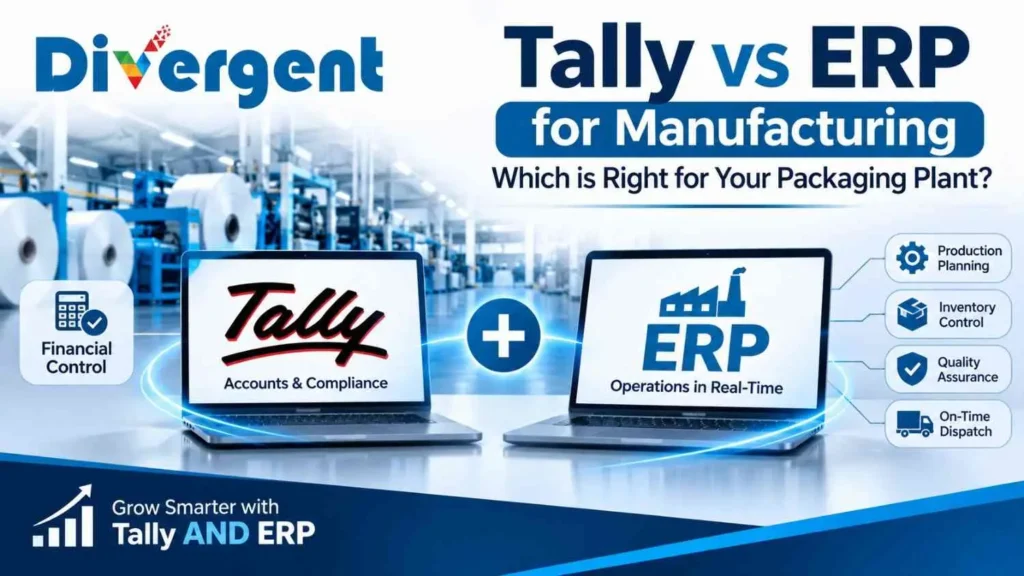
Table of Contents
- What Is Tally Used For in Manufacturing?
- What Tally Cannot Do in Manufacturing
- What Is ERP and How Is It Different From Tally?
- Tally vs ERP — Complete Comparison
- 7 Signs Your Packaging Plant Has Outgrown Tally
- When Should You Switch From Tally to ERP?
- Can You Keep Tally and Add ERP?
- What Does ERP Cost vs. What Tally Is Costing You?
- How AI Makes ERP Even More Powerful Than Tally Alone
- Divergent PackPro — ERP That Works With Tally
- Frequently Asked Questions
What Is Tally Used For in Manufacturing?
What does Tally do for a manufacturing plant?
Tally is an accounting software that records financial transactions — purchase invoices, sales invoices, payment entries, receipt entries, journal vouchers and statutory returns. In a manufacturing plant, Tally handles accounts payable, accounts receivable, GST filing, TDS management, bank reconciliation and financial reporting. According to Tally Solutions, over 7 million businesses across India use Tally — making it the most widely used accounting software in Indian manufacturing.
What Tally is not designed to do is manage manufacturing operations. It has no concept of a production order, a bill of materials, a machine, a shift, a loom efficiency rate, a quality inspection result or a stage-wise WIP balance. These are manufacturing concepts — and manufacturing operations management is not what Tally was built for.
What Tally Cannot Do in Manufacturing
What are the limitations of Tally for manufacturing plants?
The limitations of Tally for manufacturing plants are that it cannot track production in real time, cannot manage bill of materials, cannot calculate material requirements from a production plan, cannot track WIP between production stages, cannot enforce quality holds and cannot give any department live visibility of what is happening on the production floor.
- No production tracking: Tally records a finished goods entry when production is complete — it has no visibility of what is happening during production. The loom supervisor, the quality inspector and the dispatch team all operate completely outside Tally during the production process.
- No BOM management: Tally has no native bill of materials. It cannot calculate how much PP granule, masterbatch or thread is required to produce 10,000 bags of a specific GSM specification. This calculation happens in a spreadsheet — or in someone’s head.
- No material requirements planning: Tally cannot look at a production order and tell the purchase team what materials to order, in what quantity, by what date. This calculation — which an ERP does automatically — requires manual work in Tally that is both time-consuming and error-prone.
- No WIP tracking: Work-in-progress between production stages is invisible in Tally. The tape extruded today, the fabric woven this week, the bags cut and waiting for stitching — none of this exists in Tally until it becomes a finished goods entry.
- No quality management: Tally has no quality module. Quality inspection results, batch holds, rejection records and test certificates all exist on paper or in separate spreadsheets that never connect to the financial record.
- No live inventory: Tally inventory is updated when purchase invoices and sales invoices are entered — often days after the actual movement. The store manager’s physical register is always more current than Tally’s stock report.
According to Gartner, ERP systems are defined by their ability to integrate all business functions — including manufacturing, inventory, quality and finance — in one connected system. Tally integrates accounts. ERP integrates everything.
What Is ERP and How Is It Different From Tally?
What is ERP and why is it different from Tally?
ERP stands for Enterprise Resource Planning — a software system that connects every department of a manufacturing plant in one live database. When a storekeeper issues material in ERP, the production team sees the updated stock balance immediately. When quality rejects a batch, dispatch cannot ship it — the system enforces the hold automatically. When a sales order is confirmed, production planning and purchase can see it immediately without anyone sending a file or making a call.
The difference between Tally vs ERP for manufacturing is the difference between recording what happened and managing what is happening. In the Tally vs ERP for manufacturing debate, Tally is a record-keeping system and ERP is an operational management system. Both are necessary for Indian packaging plants. Neither replaces the other — the right answer is Tally AND ERP working together.
Tally vs ERP for Manufacturing — Complete Comparison
| Function | Tally | ERP |
|---|---|---|
| Accounts and GST | ✅ Excellent | ✅ Good |
| Purchase invoice recording | ✅ Yes | ✅ Yes |
| Sales invoice recording | ✅ Yes | ✅ Yes |
| Production order management | ❌ No | ✅ Yes |
| Bill of materials | ❌ No | ✅ Yes |
| Material requirements planning | ❌ No | ✅ Yes |
| Real-time stock visibility | ❌ No | ✅ Yes |
| WIP tracking by stage | ❌ No | ✅ Yes |
| Quality management | ❌ No | ✅ Yes |
| Loom efficiency tracking | ❌ No | ✅ Yes |
| GSM-based costing | ❌ No | ✅ Yes |
| AI inventory management | ❌ No | ✅ Yes |
| Live management dashboard | ❌ No | ✅ Yes |
| Statutory compliance | ✅ Excellent | ✅ Good |
7 Signs Your Packaging Plant Has Outgrown Tally
How do I know when my plant needs ERP beyond Tally?
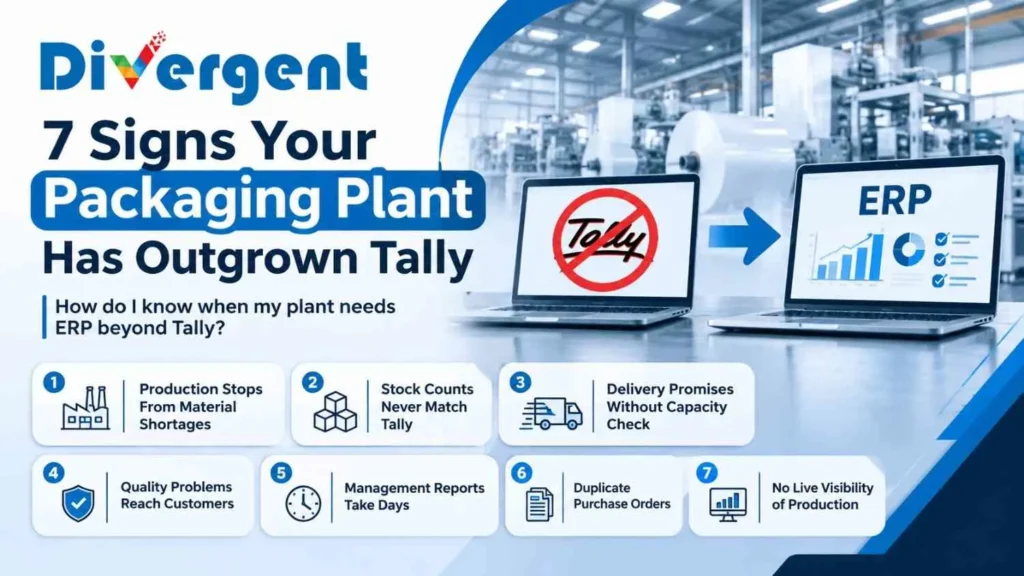
The seven signs that your packaging plant has outgrown Tally are production stoppages from unexpected material shortages, stock counts that never match Tally, delivery promises made without checking production capacity, quality problems that reach customers, management reports that take days to compile, duplicate purchase orders and no live visibility of production during the shift.
1. Production Stops From Material Shortages
Material runs out without warning because Tally inventory is updated from purchase invoices — not from actual consumption at the production stage. The store issues material without recording it immediately. By the time Tally shows a low balance, the production line has already stopped. See our guide on inventory management challenges for how real-time consumption tracking prevents production stoppages.
2. Stock Counts Never Match Tally
Physical stock count at month end never matches Tally’s ledger balance. The difference is explained by adjustment entries that nobody investigates. The root cause is that Tally records stock movements from invoice dates — not from actual movement dates. ERP records every movement at the point it happens.
3. Delivery Promises Without Capacity Check
Sales commits delivery dates by calling the production supervisor — not by checking a system. The supervisor gives an optimistic answer. The commitment is made. Production cannot meet it. The customer is disappointed. This happens because Tally has no production capacity data to check.
4. Quality Problems Reach Customers
A batch fails quality inspection. The result is recorded on paper. Dispatch ships the batch because nobody told them about the hold. The customer returns it. This happens because Tally has no quality module — quality and dispatch operate in complete isolation.
5. Management Reports Take Days
The weekly MIS report takes two days to compile — someone manually pulls data from Tally, the production register, the quality file and the dispatch record and assembles it in Excel. By the time it reaches management, it is already outdated. ERP generates this report in real time from live transaction data.
6. Duplicate Purchase Orders
Purchase raises an order for material already in the store under a different item code. Tally does not flag this because it has no item master that connects the two codes. The duplicate order arrives. Excess stock accumulates. Working capital is locked up unnecessarily.
7. No Live Production Visibility
At any moment during the production shift, nobody can tell you exactly how many bags have been produced, how much material has been consumed and what the current WIP balance is at each stage — without calling the floor or walking across. ERP gives every manager a live dashboard updated by every transaction on the floor. See our guide on production visibility challenges for how live data changes operational decisions.
When Should You Switch From Tally to ERP?
When is the right time to add ERP to Tally in a manufacturing plant?
The right time for Tally vs ERP for manufacturing decision is when three or more of the seven signs above apply regularly — not occasionally. In the Tally vs ERP for manufacturing evaluation, if production stoppages happen more than once a month, if stock counts are always wrong, if delivery commitments are routinely missed — these are symptoms of a plant that has grown beyond what Tally alone can manage.
For most packaging plants, this point arrives when the plant has more than three production lines, more than 50 active SKUs, more than two shifts or more than 30 people involved in operations. Beyond these thresholds, the volume of manual coordination required to run the plant on Tally alone exceeds what any team can reliably maintain. See our guide to ERP implementation in manufacturing for the complete step-by-step process.
Can You Keep Tally and Add ERP?
Do I have to replace Tally when I implement ERP?
No. You do not have to replace Tally when you implement ERP. Most Indian packaging plants keep Tally for statutory accounts — GST, TDS, bank reconciliation and financial statements — and add a manufacturing ERP for production, stores, quality and dispatch. A standard Tally integration passes financial entries from the ERP to Tally automatically — so the accounts team stays in Tally and the operations team works in ERP, with both systems synchronised without any manual data entry in either.
| System | What It Handles | Who Uses It |
|---|---|---|
| Tally | GST, TDS, bank reconciliation, financial statements | Accounts team |
| ERP (PackPro) | Production, stores, quality, dispatch, costing | Operations team |
| Integration | Financial entries pass from ERP to Tally automatically | Both — seamlessly |
This Tally vs ERP for manufacturing answer — use both together — is how the most operationally efficient packaging plants in India run in 2027. In the Tally vs ERP for manufacturing decision, Tally does what it does best and ERP does what Tally cannot. The Tally vs ERP for manufacturing integration keeps both in sync without anyone maintaining two sets of records.
What Does ERP Cost vs What Tally Is Costing You?
Is ERP affordable for a mid-size packaging plant?
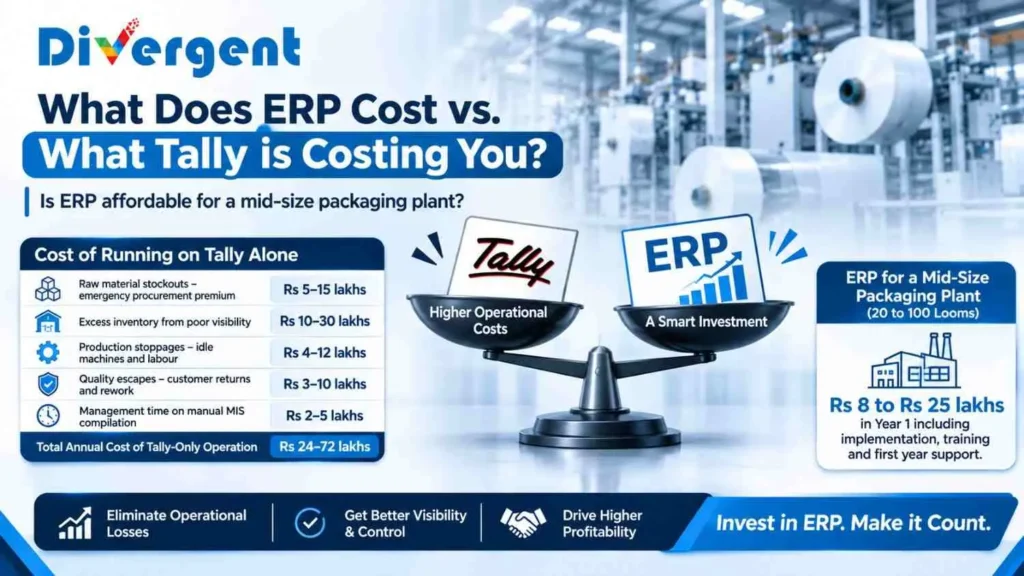
ERP is affordable for a mid-size packaging plant when compared to what running on Tally alone is costing in operational losses. The question is not whether ERP is expensive — it is whether the operational losses from running without ERP exceed the cost of ERP. For most packaging plants, they do — significantly.
| Cost of Running on Tally Alone | Annual Estimate |
|---|---|
| Raw material stockouts — emergency procurement premium | Rs 5-15 lakhs |
| Excess inventory from poor visibility | Rs 10-30 lakhs |
| Production stoppages — idle machines and labour | Rs 4-12 lakhs |
| Quality escapes — customer returns and rework | Rs 3-10 lakhs |
| Management time on manual MIS compilation | Rs 2-5 lakhs |
| Total annual cost of Tally-only operation | Rs 24-72 lakhs |
Purpose-built ERP for a mid-size packaging plant — 20 to 100 looms — typically costs Rs 8 to Rs 25 lakhs in Year 1 including implementation, training and first year support. The operational losses it eliminates typically exceed this cost within 8 to 14 months. The packaging plant has been paying for ERP in operational losses for years — without getting any of the benefit. See our guide on ERP vs Excel in manufacturing for detailed ROI calculations.
How AI Makes ERP Even More Powerful Than Tally Alone
How does AI improve manufacturing ERP beyond what Tally offers?
AI makes manufacturing ERP significantly more powerful than Tally alone by adding predictive capability to real-time visibility. ERP shows what is happening now. AI shows what will happen next — which materials will run short before the production line notices, which machines are showing efficiency patterns that precede breakdowns, which customer orders are at risk of being late based on current production progress.
- AI inventory management: Predicts when each material will run short from confirmed production orders and actual consumption rates — generating purchase recommendations 3 to 4 weeks before the shortage occurs. See our guide on AI inventory management in manufacturing.
- AI demand forecasting: Forecasts material requirements from historical order patterns and confirmed sales orders — reducing both stockouts and excess inventory simultaneously. See our guide on AI demand forecasting in manufacturing.
- AI quality inspection: Computer vision cameras at each production stage inspect every bag at full line speed — catching defects that human inspection misses before they reach the customer. See our guide on AI quality control in manufacturing.
- AI predictive maintenance: Detects machine efficiency patterns that precede breakdowns 2 to 4 weeks before failure — converting unplanned stoppages into planned maintenance windows. See our guide on predictive maintenance in manufacturing.
Divergent PackPro — ERP Built for Packaging Plants That Use Tally
Divergent PackPro is a manufacturing ERP built specifically for FIBC, BOPP, PP woven bag and packaging plants — designed to work alongside Tally, not replace it. PackPro handles everything Tally cannot: production management, GSM-based costing, stage-wise WIP tracking, quality management and AI-driven inventory management. Tally handles what it does best: GST, statutory compliance and financial statements. The Tally integration passes all financial entries from PackPro to Tally automatically.
- Tally integration: Every purchase receipt, sales invoice, production entry and payment in PackPro passes to Tally automatically. Accounts team stays in Tally. Operations team works in PackPro. No duplicate data entry in either system.
- GSM-based costing: PackPro calculates bag cost from fabric GSM, dimensions, loop type, liner and print specification automatically. When PP prices change, all open order costs recalculate instantly.
- Real-time inventory: Every goods receipt, material issue and production entry updates the stock balance instantly — visible to stores, production, purchase and management simultaneously. No more waiting for Tally to be updated from invoices.
- Stage-wise production tracking: WIP tracked at every production stage — extrusion, weaving, printing, cutting, stitching. Production manager sees live progress without leaving the office.
- Quality enforcement: Batches under quality hold cannot be dispatched — the system enforces this automatically without requiring anyone to remember to check.
- AI inventory management: Purchase recommendations generated from confirmed production orders and actual consumption rates — 3 to 4 weeks before a shortage would occur. No production line ever stops for a preventable material shortage.
See how Divergent PackPro works with Tally or speak to our team for a demonstration using your own plant specifications, loom count and production volumes.
Frequently Asked Questions — Tally vs ERP for Manufacturing
What is the difference between Tally and ERP for manufacturing?
Tally is an accounting system that records financial transactions. ERP is an operational management system that connects production, stores, quality and dispatch in real time. Tally records what happened financially. ERP manages what is happening operationally. Most manufacturing plants need both.
Can I keep Tally and add ERP?
Yes. Most Indian packaging plants keep Tally for GST, TDS and financial statements and add manufacturing ERP for production, stores, quality and dispatch. A standard integration passes financial entries from ERP to Tally automatically — no duplicate data entry required in either system.
What are the limitations of Tally for manufacturing?
Tally cannot track production in real time, cannot manage bill of materials, cannot calculate material requirements from a production plan, cannot track WIP between stages, cannot enforce quality holds and cannot give live visibility of production floor operations. It is an accounting system, not a manufacturing operations system.
When should a packaging plant switch from Tally to ERP?
When three or more of these apply regularly: production stops from material shortages, stock counts never match Tally, delivery promises are made without checking capacity, quality problems reach customers, MIS reports take days to compile, duplicate purchase orders are raised. These are symptoms of a plant that has outgrown Tally alone.
How much does ERP cost compared to Tally?
Purpose-built ERP for a mid-size packaging plant costs Rs 8 to Rs 25 lakhs in Year 1 including implementation and training. The operational losses from running on Tally alone — stockouts, excess inventory, quality escapes, production stoppages — typically total Rs 24 to Rs 72 lakhs per year. Most plants recover ERP cost within 8 to 14 months.
Does ERP replace Tally in manufacturing?
No. ERP does not replace Tally — it complements it. Tally continues handling GST, TDS, bank reconciliation and statutory compliance. ERP handles production, stores, quality and dispatch. The integration keeps both synchronised automatically. The accounts team stays in Tally. Operations runs in ERP.
How does Tally integrate with manufacturing ERP?
A Tally integration module in the ERP passes financial entries — purchase receipts, sales invoices, payment records — from the ERP to Tally automatically. Every operational transaction in ERP that has a financial impact creates the corresponding Tally voucher without manual data entry. Both systems stay synchronised in real time.
What does ERP do that Tally cannot do in manufacturing?
ERP does five things Tally cannot: tracks production in real time by stage, manages bill of materials and calculates material requirements automatically, enforces quality holds that prevent non-conforming material from being dispatched, tracks WIP at every production stage and generates management dashboards from live transaction data without manual compilation.
Is ERP affordable for small packaging plants?
Yes. Purpose-built ERP for packaging plants starts at Rs 5 to Rs 8 lakhs for smaller plants — significantly less than the operational losses most small plants incur annually from running without it. The question is not whether ERP is affordable — it is whether the operational losses from running without ERP are affordable.
How does AI improve ERP beyond what Tally offers?
AI adds predictive capability to ERP’s real-time visibility — predicting material shortages 3 to 4 weeks before they occur, identifying machine efficiency patterns that precede breakdowns, forecasting seasonal demand patterns and detecting quality defects at production speed using computer vision. Tally records. ERP manages. AI predicts.
Related Reading
- ERP Implementation in Manufacturing: 7-Step Checklist
- ERP vs Excel in Manufacturing
- Inventory Management Challenges in Manufacturing
- AI Inventory Management in Manufacturing
- 12 Critical Manufacturing Challenges
Follow Divergent Softlab on Google
Enjoying our insights on manufacturing ERP, artificial intelligence and business technology? Add Divergent Softlab as a preferred source on Google to discover more of our latest articles.