
Predictive maintenance in manufacturing is the practice of using data — from sensors, machine logs and production records — to predict when a machine is likely to fail, so maintenance is scheduled before the breakdown happens rather than after.
Every packaging plant knows the cost of an unplanned machine breakdown. A loom stops mid-shift. The maintenance team is called. The fault takes two hours to diagnose and four hours to fix. Six hours of production are lost on that machine. If the breakdown happens during a peak order period, the ripple effect — delayed deliveries, overtime on other machines, expedited raw material — costs far more than the repair itself.
Predictive maintenance in manufacturing eliminates most of this cost. Instead of waiting for the breakdown, sensors on the machine detect the early warning signs — a vibration frequency that is shifting, a temperature that is trending upward, a current draw that is increasing — and alert the maintenance team days or weeks before the failure would have occurred. The part is replaced during a planned maintenance window. The machine never stops unexpectedly.
According to McKinsey, predictive maintenance in manufacturing reduces unplanned downtime by 30 to 50 percent, reduces maintenance costs by 10 to 25 percent and extends machine life by 20 to 40 percent. For packaging and FIBC plants running capital-intensive equipment — extruders, looms, printing machines, slitting lines — these numbers represent significant financial improvement.
This guide covers how predictive maintenance in manufacturing works, how it differs from preventive maintenance, what data it needs, what implementation costs and what results packaging plants are achieving.
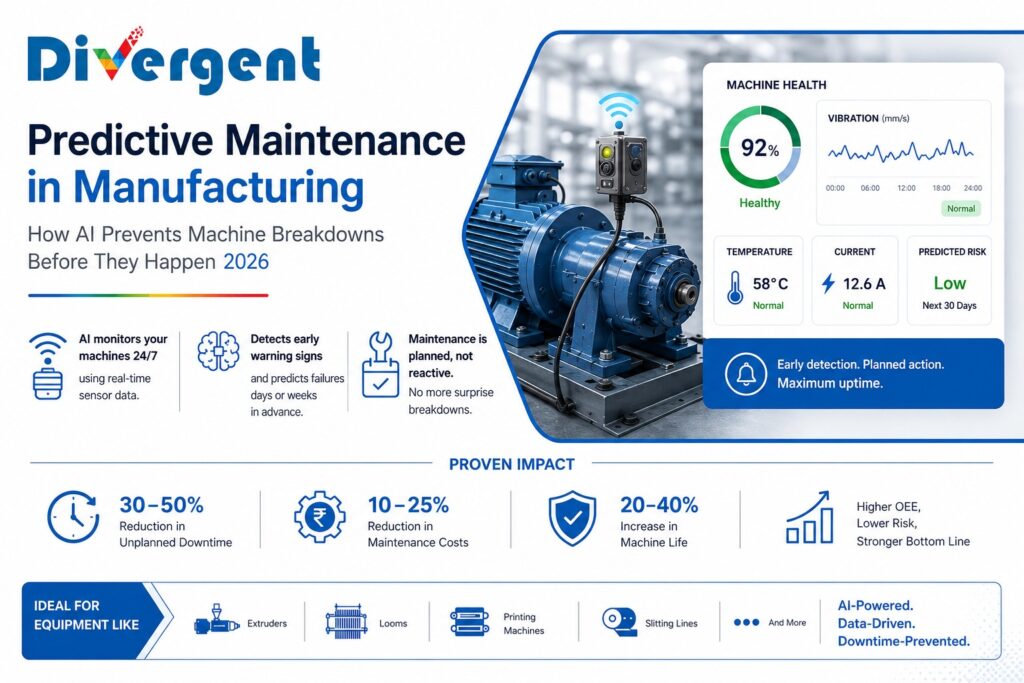
Table of Contents
- What Is Predictive Maintenance in Manufacturing?
- Predictive Maintenance vs Preventive Maintenance
- How Does Predictive Maintenance Work?
- What Sensors Does Predictive Maintenance Use?
- How AI Powers Predictive Maintenance
- Predictive Maintenance for Packaging and FIBC Plants
- Benefits of Predictive Maintenance in Manufacturing
- What Does Predictive Maintenance Cost?
- How to Implement Predictive Maintenance: A Practical Roadmap
- How Predictive Maintenance Connects to ERP
- How Divergent PackPro Supports Predictive Maintenance
- Frequently Asked Questions
What Is Predictive Maintenance in Manufacturing?
Predictive maintenance in manufacturing is a maintenance strategy that uses real-time data from machines — collected by sensors and analysed by AI or statistical models — to predict when a component is likely to fail. Maintenance is then scheduled before the failure occurs, during a planned window that minimises production disruption.
Predictive maintenance sits at the most advanced point of the maintenance maturity scale. At the reactive end, maintenance happens after a breakdown — the machine stops, the team fixes it, production is lost. In the middle, preventive maintenance follows a fixed schedule — the machine is serviced every 500 hours regardless of its actual condition. At the advanced end, predictive maintenance services the machine when the data says it needs attention — neither too early nor too late.
For packaging and FIBC manufacturers, predictive maintenance in manufacturing is most valuable on the machines that are most expensive to stop: extruders, circular looms, flat looms, printing machines and lamination lines. A breakdown on any of these machines affects an entire production line — not just the machine itself.
Predictive Maintenance vs Preventive Maintenance: What Is the Difference?
Predictive maintenance and preventive maintenance are both proactive strategies — neither waits for a breakdown. The difference is what triggers the maintenance action.
| Factor | Reactive Maintenance | Preventive Maintenance | Predictive Maintenance |
|---|---|---|---|
| Trigger | Machine breakdown | Fixed schedule (hours or calendar) | Sensor data showing early failure signal |
| Timing | After failure — too late | On schedule — sometimes too early | Before failure — just in time |
| Downtime | Unplanned, unpredictable | Planned but may be unnecessary | Planned and minimised |
| Parts replaced | Failed parts only | All scheduled parts, regardless of condition | Parts showing wear, at right time |
| Cost | Highest — emergency repair + lost production | Medium — some unnecessary maintenance | Lowest — right maintenance at right time |
| Data needed | None | Maintenance history | Real-time sensor data + AI model |
Most packaging plants currently use a mix of reactive and preventive maintenance. Predictive manance in manufacturing is the upgrade that reduces both the emergency repairs and the unnecessary scheduled work — replacing both with data-driven maintenance that happens exactly when the machine needs it.
How Does Predictive Maintenance Work?
Predictive maintenance in manufacturing works through a four-step process that runs continuously while the machine operates.
- Data collection. Sensors mounted on the machine capture real-time measurements — vibration, temperature, current draw, pressure, acoustic emissions — continuously, at intervals ranging from milliseconds to minutes depending on the parameter being on-premises
- Data transmission. Sensor data is transmitted to a central system — either on-premise or cloud-based — where it is stored and processed. For packaging plants with unreliable internet connectivity, edge computing devices process data locally and transmit summaries rather than raw readings.
- AI analysis. A machine learning model trained on historical data from the same machine — or from similar machines — analyses the incoming sensor readings. It compares current patterns against known failure signatures and calculates the probability that a specific component will fail within a defined time window.
- Alert and action. When the failure probability crosses a threshold, the system generates an alert — to the maintenance team, the production head and, if integrated, the ERP maintenance module. The alert specifies which component is at risk, the estimated time to failure and the recommended action.
The maintenance team schedules the repair during the next planned production stoppage — shift change, lunch break or planned maintenance window. The component is replaced before it fails. The machine continues running without unplanned interruption.
What Sensors Does Predictive Maintenance Use?
The sensors used in predictive maintenance in manufacturing depend on the machine type and the failure modes being monitored. The most common sensor types in packaging plant predictive maintenance are:
- Vibration sensors (accelerometers): The most widely used sensor in predictive maintenance. Vibration patterns change as bearings wear, shafts bend, belts stretch and gears develop faults. Vibration analysis detects these changes weeks before they cause a failure. Used on looms, extruders, motors and gearboxes.
- Temperature sensors: Overheating is an early indicator of bearing failure, electrical fault, friction increase or cooling system problem. Temperature sensors on motors, bearings and electrical panels flag abnormal heat rise before it causes damage.
- Current and power monitors: An increase in electrical current draw on a motor often precedes mechanical failure. Current monitoring detects this increase — which may be too small to notice manually — and flags it as a warning.
- Acoustic sensors: High-frequency sound sensors detect the noise signature of developing faults — a bearing beginning to fail, a gear starting to wear, a belt developing a crack — before the noise is audible to a human operator.
- Pressure sensors: Used on hydraulic and pneumatic systems. Pressure drop or fluctuation indicates seal wear, valve failure or pump degradation — each of which can cause sudden stoppage if not addressed.
- Oil quality sensors: Monitor the condition of lubricating oil in gearboxes and hydraulic systems. Degraded oil accelerates wear — an oil quality sensor detects this degradation before it causes bearing or gear damage.
How AI Powers Predictive Maintenance in Manufacturing
AI is what makes predictive maintenance in manufacturing practically useful at scale. Without AI, sensor data is just data — numbers that require a specialist to interpret. With AI, sensor data becomes actionable — the system tells the maintenance team what is wrong, which component is at risk and when it needs attention.
Three types of AI models are used in predictive maintenance:
- Anomaly detection models: Learn what normal operating conditions look like for each machine and flag deviations. The simplest and fastest to deploy — requires only normal operating data to train, not historical failure data.
- Failure prediction models: Trained on historical data that includes both normal operation and the period preceding known failures. More accurate than anomaly detection because they predict specific failure modes, not just deviations from normal.
- Remaining useful life (RUL) models: Estimate how many hours or cycles a component has remaining before failure. The most sophisticated model type — requires substantial failure history to train and provides the most actionable output for maintenance scheduling.
According to Gartner, AI-powered predictive maintenance in manufacturing delivers 10 times the return on investment of traditional time-based preventive maintenance — primarily through the elimination of unplanned downtime and the reduction of unnecessary parts replacement.
Predictive Maintenance for Packaging and FIBC Plants: Specific Applications
Packaging and FIBC plants have specific machines where predictive maintenance in manufacturing delivers the highest value.
Extruder Predictive Maintenance
The extruder is the highest-value machine in a woven bag plant — a breakdown stops tape production for the entire plant. Predictive maintenance on extruders monitors screw and barrel wear through motor current and melt pressure sensors, detects gearbox deterioration through vibration analysis, and monitors die temperature consistency to predict blockage or flow restriction. An unplanned extruder breakdown in a busy plant costs 8 to 24 hours of production — predictive maintenance converts this to a 2-hour planned replacement during a scheduled stop.
Loom Predictive Maintenance
Circular and flat looms run at high speed with multiple moving parts — shuttles, rapiers, warp beams, take-up rollers. Bearing failure and rapier wear are the most common causes of loom breakdown. Vibration sensors on loom bearings detect the early signature of bearing wear — a change in vibration frequency that appears 2 to 6 weeks before failure — giving the maintenance team time to order and install the replacement bearing during a shift change rather than an emergency stop.
Printing Machine Predictive Maintenance
Printing machine breakdowns cause two costs: the direct downtime cost and the quality cost of discovering ink system or impression cylinder problems after defective bags have already been produced. Temperature monitoring on ink rollers and pressure monitoring on impression systems detect developing faults before they affect print quality — giving quality and maintenance teams an early warning that allows correction before customer-visible defects occur.
Lamination Line Predictive Maintenance
Lamination lines run at high speed with tension-sensitive material. Roller bearing failure, nip pressure variation and temperature inconsistency all cause lamination defects and potential line stoppage. Predictive maintenance on lamination lines uses vibration, temperature and tension sensors to detect developing problems before they affect output quality or cause an unplanned stop.
Benefits of Predictive Maintenance in Manufacturing
| Benefit | Typical Improvement | How It Happens |
|---|---|---|
| Unplanned downtime reduction | 30-50% | Failures predicted and prevented before they occur |
| Maintenance cost reduction | 10-25% | Parts replaced when needed, not on fixed schedule |
| Machine life extension | 20-40% | Early fault correction prevents secondary damage |
| Spare parts inventory reduction | 15-30% | Known maintenance requirements replace stockpiling |
| Energy consumption reduction | 5-10% | Machines running in degraded condition consume more power |
| Quality improvement | Significant | Machines in good condition produce consistent output |
What Does Predictive Maintenance Cost?
Predictive maintenance in manufacturing costs vary significantly based on the number of machines monitored, the sensor types required and whether the solution is a standalone system or integrated with an existing ERP or CMMS.
| Solution Type | Cost Range | Best For |
|---|---|---|
| Entry-level vibration monitoring per machine | USD 500-2,000 per machine | Bearing and motor monitoring on critical machines |
| Multi-sensor system per machine | USD 2,000-8,000 per machine | Comprehensive monitoring of extruders and looms |
| Full plant predictive maintenance platform | USD 30,000-150,000 | 10+ machines with AI analytics and ERP integration |
| Cloud-based predictive maintenance SaaS | USD 500-2,000 per month | Plants wanting minimal upfront capital expenditure |
The ROI calculation for predictive maintenance in manufacturing is straightforward. If a single unplanned extruder breakdown costs USD 5,000 in lost production and emergency repair, a predictive maintenance system that prevents three such breakdowns per year saves USD 15,000 — paying for a significant sensor investment in the first year alone. Most packaging plants with predictive maintenance achieve payback within 12 to 24 months.
How to Implement Predictive Maintenance in Manufacturing: A Practical Roadmap
- Identify your highest-cost breakdown machines. List every machine breakdown in the past 12 months with its duration and production impact. The machines at the top of that list — in terms of downtime hours and lost output — are where predictive maintenance delivers the fastest payback.
- Define the failure modes you want to predict. For each priority machine, identify the most common failure modes — bearing failure on the loom, screw wear on the extruder, roller bearing failure on the printing machine. These become the targets for sensor selection and model training.
- Select the right sensors for each failure mode. Vibration sensors for rotating machinery, temperature sensors for electrical and thermal systems, current monitors for motors. Work with a predictive maintenance vendor who has experience in packaging plant machinery — not just generic industrial equipment.
- Install sensors and collect baseline data. Install sensors on the selected machines and collect 4 to 8 weeks of baseline data during normal operation. This data trains the anomaly detection model to recognise what normal looks like for each machine in your specific environment.
- Deploy the AI model and validate alerts. Deploy the predictive model and monitor its alerts for 4 to 8 weeks before acting on them. This validation period confirms that alerts correspond to real developing faults and calibrates the threshold to reduce false positives.
- Integrate with your maintenance workflow and ERP. Connect the predictive maintenance system to your maintenance scheduling process and ERP maintenance module. Alerts should automatically create work orders in the system, assign them to maintenance team members and trigger spare part availability checks.
- Measure results and expand. Track unplanned downtime, maintenance cost and machine availability before and after implementation. Once the first machines are delivering measurable results, expand the system to additional machines in priority order.
How Predictive Maintenance Connects to Manufacturing ERP
Predictive maintenance in manufacturing delivers its full value when it connects to the manufacturing ERP system. The integration works in three directions:
- Alert to work order: When the predictive maintenance system generates an alert, it automatically creates a maintenance work order in the ERP — with the machine, the failure mode, the estimated urgency and the recommended action already populated.
- Spare parts check: The work order triggers an automatic check of spare parts inventory in the ERP. If the required part is not in stock, a purchase order is raised immediately — giving enough lead time to receive the part before the planned maintenance window.
- Production planning coordination: The planned maintenance window is visible to production planning in the ERP — so production schedules account for the machine being unavailable during maintenance, rather than discovering the conflict on the day.
Without ERP integration, predictive maintenance alerts are handled manually — the maintenance team receives an alert, contacts the stores team to check parts availability, then contacts the production planning team to find a maintenance window. Each step adds delay and the risk of miscommunication. See our guide to production visibility challenges in manufacturing for how connected systems eliminate these coordination gaps.
How Divergent PackPro Supports Predictive Maintenance in Manufacturing
Divergent PackPro is a manufacturing ERP built for FIBC, BOPP, PP woven bag and packaging plants. Its maintenance module supports predictive maintenance in manufacturing by managing the workflow from alert to resolution — connecting machine data to work orders, spare parts and production planning in one system.
- Maintenance work orders: Predictive alerts from connected sensor systems create work orders automatically in PackPro — with machine, fault type and priority pre-populated.
- Spare parts management: Work orders trigger real-time spare parts availability checks — and automatic purchase order creation if the required part is not in stock.
- Machine downtime tracking: Every planned and unplanned maintenance stop is recorded against the machine with duration and reason — building the historical data that makes future predictive models more accurate.
- Production plan integration: Planned maintenance windows are visible to the production planning team — so schedules are built around maintenance, not disrupted by it.
- Maintenance cost tracking: Parts used, labour hours and contractor costs are recorded against each work order — giving management a true picture of maintenance cost per machine and per failure mode.
See how Divergent PackPro works or speak to our team for a walkthrough of the maintenance module using your own machine list.
Frequently Asked Questions — Predictive Maintenance in Manufacturing
What is predictive maintenance in manufacturing?
Predictive maintenance in manufacturing uses real-time sensor data and AI to predict when a machine is likely to fail, so maintenance is scheduled before the breakdown occurs. It replaces reactive maintenance — which responds after a breakdown — and fixed-schedule preventive maintenance — which services machines on a calendar regardless of condition.
What is the difference between predictive and preventive maintenance?
Preventive maintenance follows a fixed schedule — the machine is serviced every 500 hours or every month, regardless of its actual condition. Predictive maintenance is triggered by data — sensors detect early failure signals and maintenance is scheduled when the data says the machine needs attention. Predictive maintenance eliminates both unnecessary scheduled maintenance and unplanned breakdowns.
How does predictive maintenance work?
Predictive maintenance works through four steps: sensors on the machine collect real-time data, that data is transmitted to an AI system, the AI model analyses the data for early failure signals, and when a failure is predicted, an alert is sent to the maintenance team with the affected component and recommended action. Maintenance is scheduled before the failure occurs.
What sensors are used in predictive maintenance?
The most common sensors in predictive maintenance are vibration sensors for rotating machinery, temperature sensors for motors and bearings, current monitors for electrical systems, acoustic sensors for high-frequency fault detection, pressure sensors for hydraulic and pneumatic systems, and oil quality sensors for gearboxes. The choice depends on the machine type and failure modes being monitored.
How much does predictive maintenance cost?
Entry-level vibration monitoring costs USD 500 to 2,000 per machine. Multi-sensor systems for complex machines like extruders cost USD 2,000 to 8,000 per machine. Full plant platforms with AI analytics and ERP integration range from USD 30,000 to 150,000. Cloud-based SaaS solutions start at USD 500 to 2,000 per month. Most packaging plants achieve payback within 12 to 24 months.
What are the benefits of predictive maintenance in manufacturing?
Predictive maintenance in manufacturing reduces unplanned downtime by 30 to 50 percent, reduces maintenance costs by 10 to 25 percent, extends machine life by 20 to 40 percent, reduces spare parts inventory by 15 to 30 percent and improves output quality through machines operating in better condition.
Can small packaging plants use predictive maintenance?
Yes. Entry-level vibration monitoring systems for individual machines are accessible to most packaging plants. The practical starting point is one or two sensors on the highest-cost machine in the plant — the extruder or the highest-utilisation loom. The payback from preventing a single breakdown typically covers the sensor cost many times over.
How does AI improve predictive maintenance?
AI improves predictive maintenance by identifying patterns in sensor data that precede specific failure modes — patterns that are too subtle and too complex for human analysts to detect consistently. An AI model trained on historical machine data recognises the early signature of bearing failure, gearbox wear or motor degradation and predicts the failure days or weeks before it would occur.
How does predictive maintenance connect to ERP?
Predictive maintenance connects to ERP by automatically converting failure alerts into maintenance work orders, triggering spare parts availability checks and purchase order creation, and making planned maintenance windows visible to production planning. Without ERP integration, each of these steps is manual — adding delay and the risk of miscommunication.
What machines benefit most from predictive maintenance in packaging plants?
In packaging and FIBC plants, the machines that benefit most from predictive maintenance are extruders, circular and flat looms, printing machines and lamination lines — because breakdowns on these machines affect entire production lines, not just single workstations. The ROI is highest on the machine where unplanned downtime is most expensive.