Choosing the right ERP software for FIBC bag manufacturing is one of the highest-leverage decisions a plant owner or operations head can make this year. Get it right, and raw material wastage drops, quality escapes stop reaching customers, and month-end costing finally matches reality. Get it wrong, and you’ve spent six months and a serious budget on a system that fights your process instead of running it.
This guide walks through exactly how to evaluate and choose ERP software for FIBC bag manufacturing — what it actually needs to do on your shop floor, the 7 steps to shortlist and select a vendor, what it costs, and the mistakes that sink most implementations. No jargon, no vendor sales pitch — just the criteria that matter for a woven sack plant.
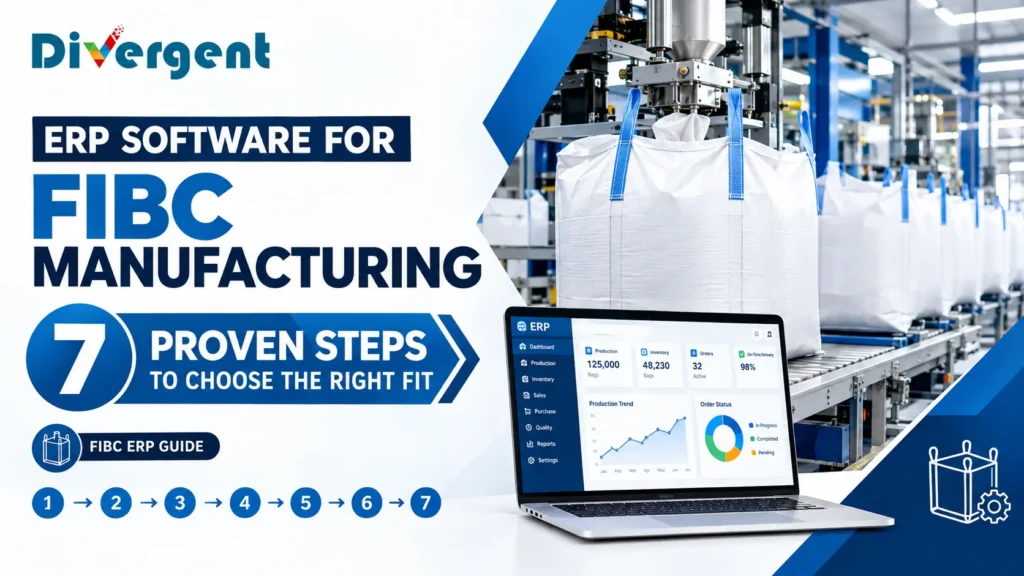
Table of Contents
• What Is ERP Software for FIBC Bag Manufacturing?
• Why Is ERP Software for FIBC Bag Manufacturing Important as the FIBC Industry Grows?
• What Are the Stages of FIBC Bag Manufacturing That ERP Software Needs to Track?
• Why Do FIBC Manufacturers Need Industry-Specific ERP Software Instead of Generic Software?
• What Happens If an FIBC Plant Doesn’t Use the Right ERP Software for FIBC Bag Manufacturing?
• What Key Features Should You Look for in ERP Software for FIBC Bag Manufacturing?
• How Do You Choose ERP Software for FIBC Bag Manufacturing? (7 Proven Steps)
• What Questions Should You Ask Vendors Before Buying ERP Software for FIBC Bag Manufacturing?
• Cloud ERP or On-Premise ERP Software for FIBC Bag Manufacturing: Which Is Better?
• Generic ERP or Industry-Specific ERP Software for FIBC Bag Manufacturing: Which Should You Pick?
• How Much Does ERP Software for FIBC Bag Manufacturing Cost to Implement?
• What Are the Red Flags to Watch for When Evaluating ERP Software for FIBC Bag Manufacturing Vendors?
• What Mistakes Do FIBC Manufacturers Make When Choosing ERP Software for FIBC Bag Manufacturing?
• How Does ERP Software for FIBC Bag Manufacturing Deliver ROI?
• Frequently Asked Questions About ERP Software for FIBC Bag Manufacturing
• What’s the Bottom Line on Choosing ERP Software for FIBC Bag Manufacturing?
What Is ERP Software for FIBC Bag Manufacturing?
ERP software for FIBC bag manufacturing is a management system that connects every stage of woven sack production — extrusion, weaving, cutting, printing, conversion, quality control, and dispatch — into one platform, so raw material usage, batch quality, and costing are tracked in real time instead of on spreadsheets or paper.
Unlike generic accounting or inventory tools, this category of ERP is built, or configured, around the specific workflow of FIBC and bulk bag production: denier and GSM tracking, batch-level traceability, and scrap percentage calculation at every stage of the process. It’s the difference between software that “does inventory” and software that actually understands how a bulk bag gets made.
Why Is ERP Software for FIBC Bag Manufacturing Important as the FIBC Industry Grows?
ERP software for FIBC bag manufacturing is becoming essential because rising export demand is exposing the limits of manual systems — paper travel cards, WhatsApp updates from the shop floor, and Excel costing sheets simply can’t keep pace with multi-shift, export-compliant production. Global demand for flexible intermediate bulk containers has grown steadily on the back of chemicals, agriculture, construction materials, and food-grade bulk packaging exports. As plants take on more export orders and more demanding clients, this is precisely the point at which most manufacturers begin actively searching for ERP software for FIBC bag manufacturing.
What Are the Stages of FIBC Bag Manufacturing That ERP Software Needs to Track?
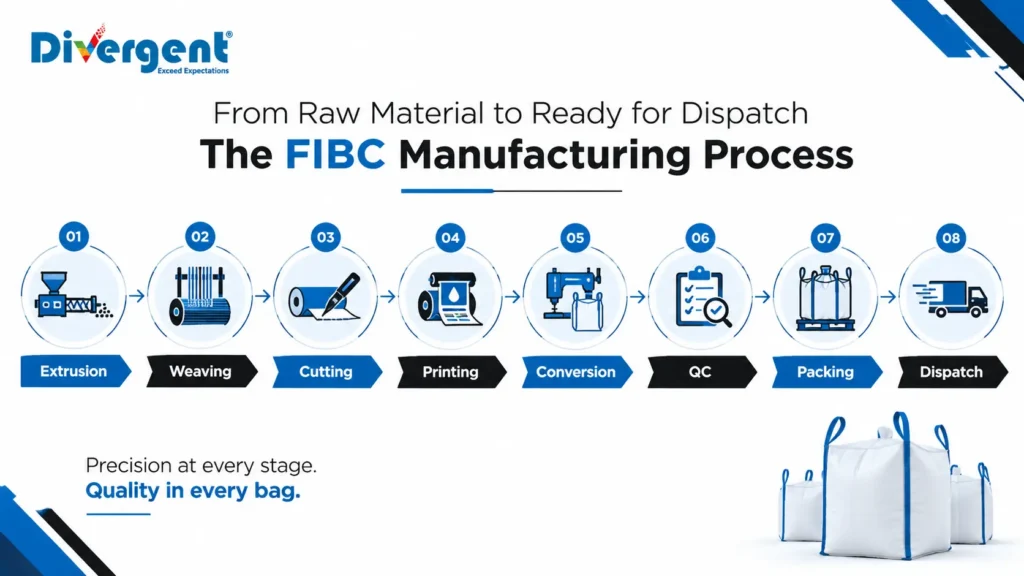
FIBC bag manufacturing has six core stages — extrusion, weaving, cutting and printing, conversion and stitching, quality control, and packing and dispatch — and ERP software for FIBC bag manufacturing needs to capture data at every one of them. Before evaluating any vendor, it helps to be precise about what a good system needs to track at each production stage.
Extrusion
PP or PE granules are melted and extruded into tape or film. The ERP needs to log granule and master batch consumption per batch, machine-wise output, and denier readings at this stage.
Weaving
Extruded tape is woven into fabric on circular or flat looms. GSM (grams per square meter), loom-wise output, and downtime need to be captured here, since this is usually the single biggest driver of fabric-quality variance.
Cutting and Printing
Fabric is cut to size and printed with client branding or handling instructions. Wastage from cutting, print registration quality, and ink consumption are the key data points.
Conversion and Stitching
Cut fabric panels are stitched, liners are inserted, and loops or spouts are attached depending on bag design. Labor time per bag type and rework rates matter most here.
Quality Control and Testing
Finished bags go through tensile strength, drop test, and seam strength checks, especially for export or UN-certified loads. This is where batch traceability becomes critical.
Packing and Dispatch
Bags are bundled, packed, and dispatched against sales orders. Order-wise stock allocation and dispatch documentation close the loop.
A system that can’t map cleanly onto these six stages isn’t really ERP software for FIBC bag manufacturing — it’s a generic tool wearing an industry label.
Why Do FIBC Manufacturers Need Industry-Specific ERP Software Instead of Generic Software?
FIBC manufacturers need industry-specific ERP software for FIBC bag manufacturing because generic accounting or “lite” inventory tools cannot track process-specific data like PP/PE granule consumption per kg of fabric, batch-level quality failures, or true conversion cost per bag.
A standard accounting tool can log a sale, but it can’t answer questions that matter daily on an FIBC shop floor:
- How much raw material was actually consumed per batch versus what was planned
- Which loom or line produced a batch that failed a tensile-strength test
- What the true cost per bag was, once master batch, liner, and labor are included
- Whether current raw material stock is enough to cover next month’s confirmed orders
- Which client orders are at risk because a particular fabric lot failed QC
This gap is exactly why manufacturers search specifically for ERP software for FIBC bag manufacturing rather than “ERP software” in general — the process-specific traceability and costing logic simply isn’t present in off-the-shelf tools built for retail, trading, or generic assembly manufacturing.
What Happens If an FIBC Plant Doesn’t Use the Right ERP Software for FIBC Bag Manufacturing?
Without the right ERP software for FIBC bag manufacturing, plants typically face five compounding problems, and they tend to show up in this order as a business scales:
- Raw material overconsumption — batch-level usage of PP/PE granule, master batch, and liner goes untracked until it surfaces as a margin problem at month-end, by which point the wastage has already happened across dozens of batches.
- Quality escapes — denier, GSM, and tensile strength specs tracked on paper mean a bad batch can reach packing, or worse, the customer, before anyone notices the deviation.
- Manual costing errors — Excel-based job costing rarely accounts for machine downtime, rework, or scrap accurately, so quoted prices drift further from real costs every quarter.
- Poor order visibility — sales teams commit to delivery dates without knowing actual production capacity or raw material availability, and then operations scrambles to cover the gap.
- Compliance gaps — export-oriented units need traceability for certifications like UN packaging certification or food-grade compliance, and spreadsheets rarely hold up during an actual audit.
What Key Features Should You Look for in ERP Software for FIBC Bag Manufacturing?
The key features to look for in ERP software for FIBC bag manufacturing are batch and lot traceability, configurable quality checkpoints, real-time job costing, BOM management for bag variants, and multi-unit support — not every “manufacturing ERP” on the market includes all of these. Use this list as your baseline checklist when comparing systems:
- Batch and lot traceability — trace any finished bag back to the fabric roll, granule lot, and shift that produced it.
- Configurable quality checkpoints — GSM, denier, tensile strength, drop test, and seam strength fields at each stage, not a generic pass/fail flag.
- Real-time job costing — cost per bag calculated from raw material, master batch, labor, machine time, and scrap, updated as production happens.
- BOM management for bag variants — different bag types (with liners, loops, spouts, baffles) need their own bill of materials, and the system should handle variants without duplicate setup work.
- Multi-unit and multi-warehouse support — inter-unit stock transfers and consolidated reporting if you run more than one plant.
- Machine and loom-wise reporting — output, downtime, and efficiency tracked per machine, not just per shift.
- Export documentation support — packing lists, certificates of analysis, and shipment tracking built in, if you export.
- Mobile or tablet-based shop-floor entry — so operators can log data at the machine instead of on paper that gets transcribed later.
- Role-based dashboards — production heads, QC, and accounts each need a different view of the same data.
- Scalable architecture — the system should support adding a second plant or product line without a rebuild.
How Do You Choose ERP Software for FIBC Bag Manufacturing? (7 Proven Steps)
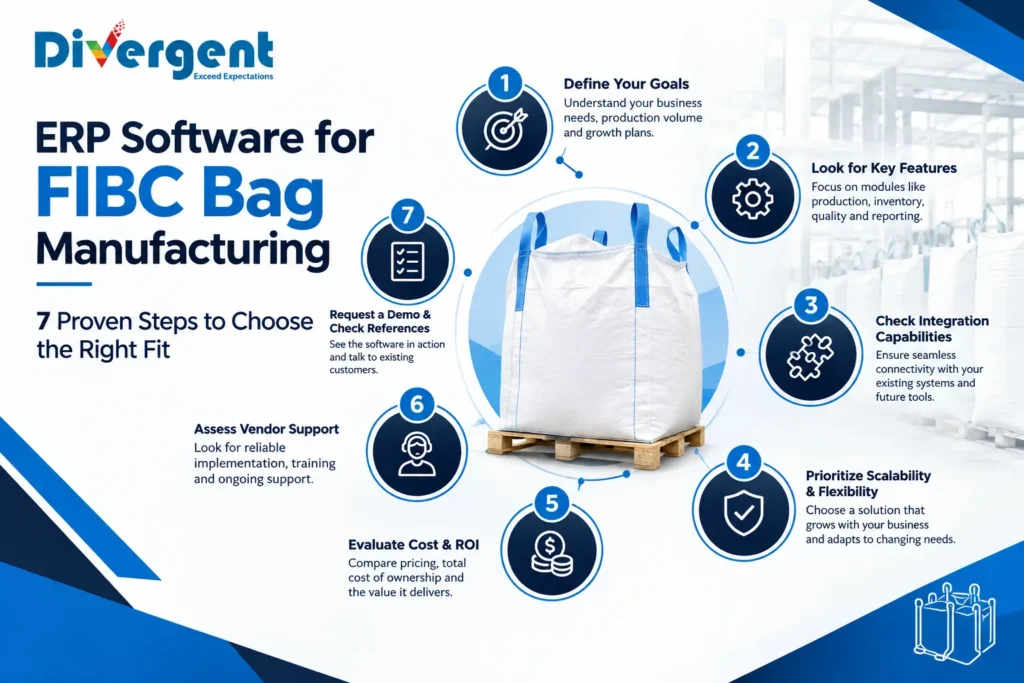
You choose ERP software for FIBC bag manufacturing by mapping your production workflow first, then evaluating vendors specifically on batch traceability, quality control depth, real-time job costing, and multi-plant support, and testing with your own data before signing. Here is the practical, step-by-step process, rather than one that just looks good in a generic demo.
Step 1: Map Your Actual Production Workflow First
Before looking at a single vendor demo, document your real process: how many extrusion lines, looms, and conversion stations you run; where quality checks happen; how raw material is issued and tracked; and where your current biggest bottleneck is, usually inventory reconciliation or costing. Any ERP software for FIBC bag manufacturing you shortlist needs to map cleanly onto this workflow, not the other way around.
Step 2: Prioritize Batch and Lot Traceability
This is non-negotiable for FIBC production, especially if you export or serve pharma, chemical, or food-grade clients. The system should let you trace a finished bag back to the exact fabric roll, granule lot, and machine or shift that produced it. This matters both for quality recalls and for UN or BIS certification audits.
Step 3: Check for Process-Specific Quality Control Modules
Look for configurable quality checkpoints — GSM, denier, tensile strength, drop test, seam strength — at each production stage, not just a generic pass/fail field. The best ERP software for FIBC bag manufacturing lets QC data flow automatically into batch records instead of being logged separately in a different system.
Step 4: Evaluate Job Costing and Wastage Tracking
Ask any vendor to show you, specifically, how the system calculates cost per bag including raw material, master batch, labor, machine time, and scrap percentage in real time, not just at month-end reconciliation. This single feature is often the difference between a system that “does inventory” and one that actually improves your margins.
Step 5: Confirm Multi-Unit and Multi-Warehouse Support
If you operate more than one plant, or send semi-finished fabric between units for conversion, make sure the ERP handles inter-unit stock transfers and consolidated reporting natively. This is a common gap in smaller, generic systems that were never designed for a multi-site production footprint.
Step 6: Insist on a Trial With Your Own Data
Don’t evaluate based on a generic demo. Load a real purchase order, a real bill of materials for one of your bag SKUs, and run it through extrusion-to-dispatch in the trial environment. This is the fastest way to see whether the ERP software for FIBC bag manufacturing you’re considering actually fits, or whether it will need expensive customization later.
Step 7: Factor in Implementation Support and Total Cost of Ownership
Licensing cost is only part of the picture. Ask about implementation timeline, data migration support, training for shop-floor staff who may not be highly tech-literate, and ongoing support or customization costs. A cheaper license with a poorly supported rollout usually ends up costing more over 12 to 18 months than a slightly pricier system with strong onboarding.
What Questions Should You Ask Vendors Before Buying ERP Software for FIBC Bag Manufacturing?
Before buying ERP software for FIBC bag manufacturing, ask vendors to demonstrate batch traceability live, explain how scrap is calculated, and confirm implementation timelines and support costs — the answers reveal more than any brochure. Take this list into every vendor call:
- Can you show batch traceability end-to-end using a real order, live, right now?
- How is scrap percentage calculated, and can it be broken down by machine and shift?
- What happens to in-progress data if the internet connection drops mid-shift, for cloud systems?
- How long does onboarding a new bag SKU with a new BOM typically take?
- What does a typical implementation timeline look like for a plant our size?
- Can we speak to an existing FIBC or woven sack manufacturing client using this system?
- What’s included in the license versus billed separately as customization?
Cloud ERP or On-Premise ERP Software for FIBC Bag Manufacturing: Which Is Better?
Cloud ERP is generally the better fit for small-to-mid-sized FIBC manufacturers because of lower upfront cost and easier multi-plant access, while on-premise ERP suits larger plants with dedicated IT teams and strict data-residency requirements.
| Factor | Cloud ERP | On-Premise ERP |
|---|---|---|
| Upfront cost | Lower (subscription-based) | Higher (license + infrastructure) |
| Multi-plant access | Easier, browser/mobile-based | Needs VPN/network setup |
| FIBC-specific customization | Depends on vendor flexibility | Usually deeper, but slower |
| Data control | Vendor-hosted | Fully in-house |
| IT maintenance | Handled by vendor | Requires internal IT team |
| Best for | Growing, multi-location plants | Large plants with in-house IT |
For most small-to-mid-sized FIBC manufacturers, cloud-based ERP software for FIBC bag manufacturing tends to offer the faster path to value, since it avoids heavy upfront infrastructure spend and lets you scale as you add plants or lines.
Generic ERP or Industry-Specific ERP Software for FIBC Bag Manufacturing: Which Should You Pick?
An FIBC manufacturer should pick industry-specific ERP software for FIBC bag manufacturing if their production workflow is unique or export-compliance-heavy, and a configured generic ERP if their process is fairly standard woven-sack production and budget is limited.
Three categories typically get evaluated:
- Large generic ERPs (SAP Business One, Microsoft Dynamics 365 Business Central, NetSuite) — powerful and scalable, but typically need heavy customization to handle FIBC-specific BOMs, denier and GSM quality fields, and scrap tracking.
- Mid-market manufacturing ERPs (Odoo, Epicor) — more configurable out of the box for process manufacturing, often a good middle ground if budget is a constraint.
- Custom-built or FIBC/textile-specific ERP — built specifically around woven sack or textile production workflows; steeper initial cost but far less configuration overhead later.
There’s no universally “best” answer here — it depends on your plant size, budget, and how standard versus unique your production workflow is.
How Much Does ERP Software for FIBC Bag Manufacturing Cost to Implement?
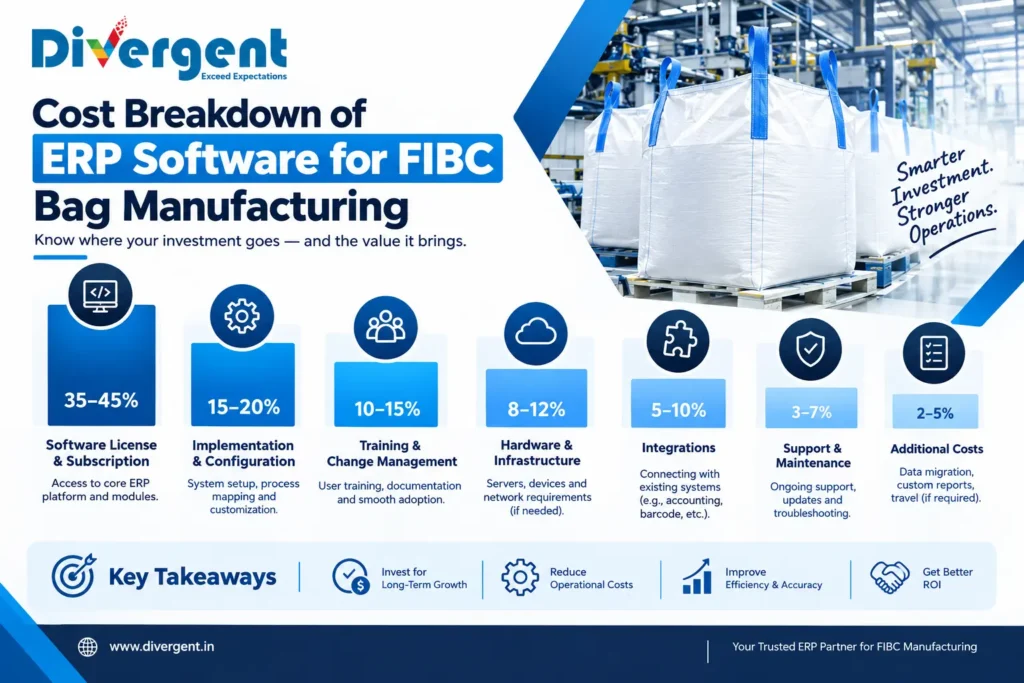
ERP software for FIBC bag manufacturing typically involves five cost components, and understanding all five upfront avoids budget surprises mid-project:
- Licensing or subscription fees — per-user or per-module, recurring for cloud systems.
- Implementation and configuration — mapping your specific BOMs, quality checkpoints, and reporting formats.
- Data migration — moving existing inventory, customer, and order data from spreadsheets or legacy systems.
- Training — for shop-floor supervisors, QC staff, and office or accounts teams.
- Ongoing support and customization — as your product mix or compliance needs evolve over time.
A phased rollout, starting with inventory and production modules before adding costing and CRM, is usually more manageable for FIBC units than a single “big bang” go-live across every department at once.
What Are the Red Flags to Watch for When Evaluating ERP Software for FIBC Bag Manufacturing Vendors?
The clearest red flags when evaluating ERP software for FIBC bag manufacturing vendors are a lack of reference clients in similar plants, vague answers about batch traceability, and pressure to sign before a trial.
- No FIBC or textile manufacturing reference clients — if a vendor can’t name a similar plant already using their system, expect heavy customization.
- Vague answers about batch traceability — if they can’t demo it live with your data, it’s probably not built in natively.
- Pricing that excludes implementation — a suspiciously low license fee often hides a large separate implementation bill.
- No shop-floor mobile or tablet entry option — this usually means data still gets entered on paper first and typed in later, defeating the purpose.
- Pressure to sign before a trial — a vendor confident in their fit will always support a trial with your own BOM and orders.
What Mistakes Do FIBC Manufacturers Make When Choosing ERP Software for FIBC Bag Manufacturing?
The most common mistakes are choosing ERP software for FIBC bag manufacturing based on price alone, skipping a trial with real data, underestimating shop-floor training time, and leaving QC and production heads out of the decision.
- Choosing based on price alone, without checking whether the system supports batch traceability or FIBC-specific BOMs.
- Skipping the trial-with-real-data step, only to discover major gaps after go-live.
- Underestimating training time for shop-floor staff who aren’t used to digital data entry.
- Ignoring scalability — picking a system that fits today’s single-plant operation but can’t handle a second unit or export compliance later.
- Not involving QC and production heads in the evaluation, leaving the decision entirely to accounts or IT.
How Does ERP Software for FIBC Bag Manufacturing Deliver ROI?
The return on ERP software for FIBC bag manufacturing usually shows up in three places within the first year: reduced raw material wastage from batch-level tracking, fewer quality escapes because deviations are caught at the checkpoint instead of at dispatch, and tighter costing that stops orders from being quoted below their real cost. Plants that track this closely often find that the wastage reduction alone covers a meaningful share of the annual subscription cost, before counting the time saved on manual reconciliation every month.
Frequently Asked Questions About ERP Software for FIBC Bag Manufacturing
What is the best ERP software for FIBC bag manufacturing?
There’s no single “best” system for every plant — it depends on your size, budget, and how standard your process is. What matters more than the brand name is whether the system supports batch traceability, FIBC-specific BOMs, and real-time costing, whether that’s a configured generic ERP, a mid-market manufacturing ERP, or a custom build.
How long does ERP implementation take for an FIBC manufacturing plant?
A phased rollout for a single-plant FIBC unit typically takes 2 to 4 months for core inventory and production modules, with costing, QC, and CRM modules added in subsequent phases. Multi-plant or heavily customized deployments can take longer.
Can ERP software track denier, GSM, and other FIBC quality parameters?
Yes, but only if the system has configurable quality-control fields at the process stage level. This is one of the key things to verify during a vendor demo or trial, since many generic ERPs only support basic pass/fail quality flags.
Is cloud ERP secure enough for a manufacturing business?
Reputable cloud ERP vendors use encryption, role-based access, and regular backups, and for most small-to-mid-sized FIBC manufacturers this is more secure than an internally-managed server without dedicated IT staff. If you have strict data residency requirements, ask vendors directly about their hosting location and compliance certifications.
Do I need a custom-built ERP, or can an off-the-shelf system work?
If your production process is fairly standard woven-sack manufacturing, a configured off-the-shelf or mid-market ERP is usually faster and cheaper to implement. Custom-built systems make more sense when your workflow, compliance needs, or product mix are unusually complex.
What ERP modules are essential for FIBC bag manufacturers?
At minimum, an FIBC manufacturer needs production and BOM management, batch and lot traceability, quality control with configurable checkpoints, real-time job costing, and inventory management across raw material, work-in-progress, and finished goods. Everything beyond that, like CRM or advanced export documentation, can be added in a later phase.
How is ERP software for FIBC bag manufacturing different from generic textile ERP?
Generic textile ERP is usually built around garment or fabric-only production and doesn’t account for FIBC-specific steps like liner insertion, loop and spout attachment, or drop-test and seam-strength QC. ERP software for FIBC bag manufacturing needs to model the full bag assembly process, not just fabric production.
What’s the Bottom Line on Choosing ERP Software for FIBC Bag Manufacturing?
Choosing ERP software for FIBC bag manufacturing isn’t about picking the biggest brand name — it’s about matching the system to your actual production workflow: batch traceability, process-specific quality control, and real-time job costing. Map your workflow first, insist on a trial with your own data, and weigh total cost of ownership, not just the license price.
If you’d like help evaluating or implementing an ERP system tailored to your FIBC production line, get in touch with our team for a free workflow assessment.
Further reading: Flexible Intermediate Bulk Container overview