Can Tally handle textile manufacturing?
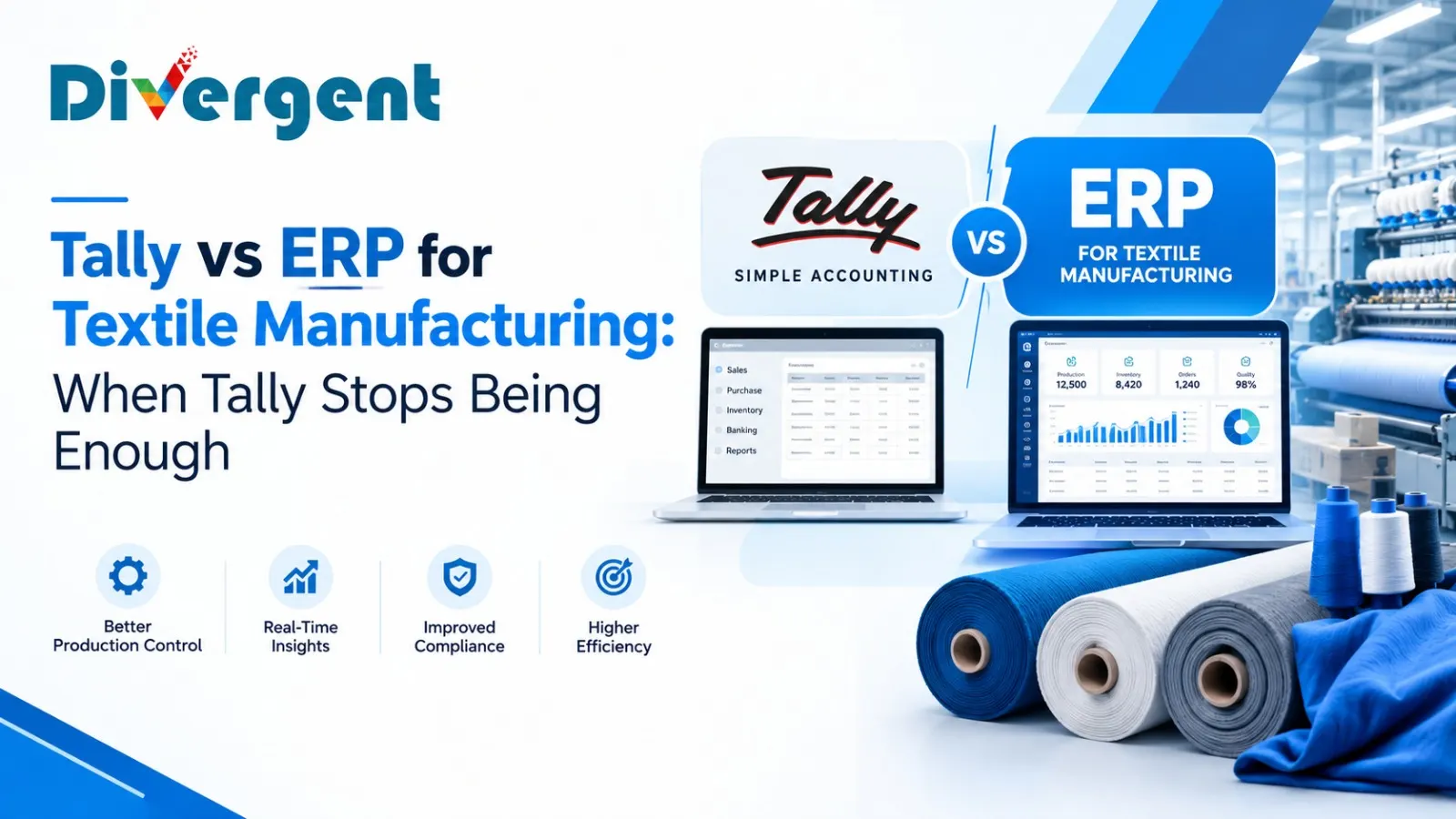
Tally vs ERP for textile manufacturing is a question of scope, not software quality. Tally is excellent accounting software. A manufacturing ERP is production software. Most Indian textile units start with the first and reach a point where they need the second. This article covers exactly where that point is.
That is the honest short answer, and it explains why thousands of Indian textile units run Tally profitably for years before suddenly finding it insufficient. Nothing about Tally got worse. The business got more complex.
This article covers what Tally genuinely does well, the specific points where it stops fitting a textile plant, how to tell whether you have crossed that line, and what the realistic options are — including the hybrid setup most manufacturers actually end up with.
What does Tally do well for textile manufacturers?
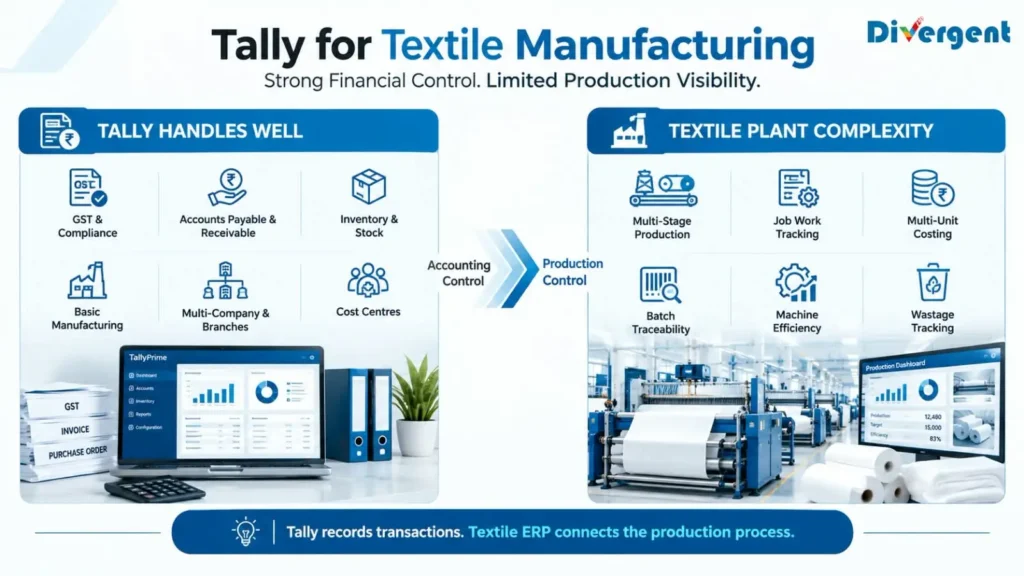
Tally’s strength is statutory and financial control, delivered cheaply and understood by every accountant you are likely to hire.
Specifically, it handles:
- GST compliance end to end — GSTR-1, GSTR-3B, e-invoicing and e-way bills, with the returns logic updated by Tally as rules change
- Accounts payable and receivable with ageing analysis and credit limit tracking
- Stock item management with batch numbers, expiry and multiple godowns
- Basic manufacturing journals — a bill of materials can be defined and a manufacturing voucher passed to convert inputs into outputs
- Multi-company and multi-branch books under one licence
- Offline operation, which still matters in plants with unreliable connectivity
- Cost centres for department-wise expense allocation
For a unit doing straightforward trading, or a manufacturer with one process step and a handful of SKUs, this is genuinely sufficient. Anyone telling you to replace Tally at ₹5 crore turnover is selling, not advising.
Tally vs ERP for textile manufacturing: where does Tally stop being enough?
Tally stops being enough at the point where production complexity exceeds what an accounting voucher can describe. In textiles, that usually means multiple process stages, job work, multi-unit costing and customer-mandated batch traceability. Tally records what was consumed and what was produced. It cannot tell you how, when, on which machine, at what efficiency, or with what wastage.
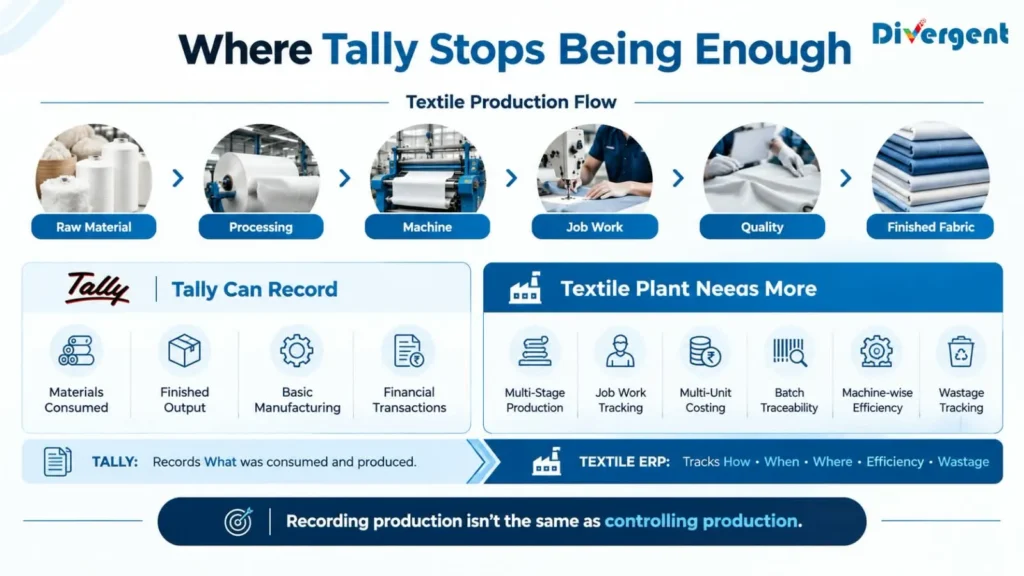
Here is where it breaks down, specifically.
1. There is no production planning or scheduling
Tally has no concept of machine capacity, shift calendars or production sequencing. It cannot tell you whether the order you just accepted can actually be delivered on the promised date, because it does not know what your looms are committed to next week.
In practice, planning moves to a whiteboard or a spreadsheet maintained by one person. That works until that person is on leave, or until two salespeople commit the same capacity to different customers.
2. Multi-UOM costing does not survive contact with reality
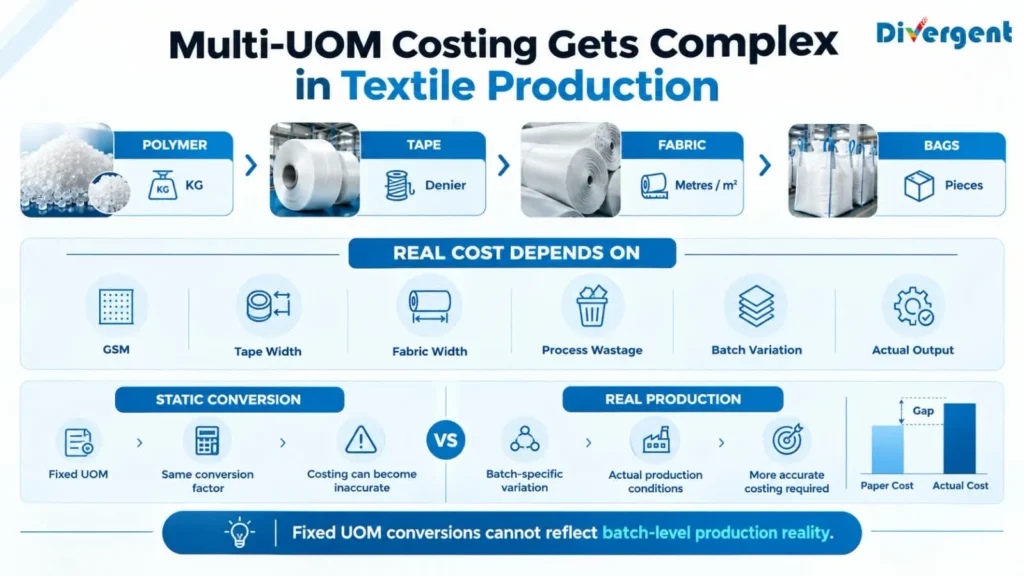
Textile production changes units at almost every stage. Polymer arrives in kilograms. Tape is produced at a denier. Fabric is woven and measured in metres or square metres. Bags are cut, stitched and sold in pieces. The conversion between these is not fixed — it depends on GSM, tape width, fabric width and process wastage, all of which vary batch to batch.
Tally supports alternate units, but with static conversion factors. When your actual GSM runs 3% over specification on a particular lot, Tally does not know, and your costing is quietly wrong for that entire order. Multiply across a year and the gap between your paper margin and your bank balance becomes hard to explain.
3. Work-in-progress is invisible between stages
A technical textile order might pass through extrusion, weaving, lamination, printing, cutting and stitching. Tally records the start and the finish. Everything in between is a black box.
That means you cannot answer basic operational questions: how much material is sitting at the lamination stage right now, how long an order has been stuck, which stage is the bottleneck this month. These are the questions that determine delivery performance, and they are unanswerable from your books.
4. Job work tracking becomes a manual reconciliation exercise
Most textile units send material out for at least one process — lamination, printing, coating, stitching. Under GST, that material has to go on a delivery challan, come back within the prescribed period, and be reported in ITC-04. If it does not return in time, the input tax credit is at risk.
Tally can record the challans. It will not proactively tell you that 2.4 tonnes of fabric has been sitting at a job worker for 140 days and your credit is about to lapse. That tracking ends up in a parallel register, and parallel registers drift.
5. Wastage and yield are calculated, not measured
Tally derives wastage as a residual — inputs minus outputs. That gives you one number at the end of a period, with no attribution. You cannot see that Loom 7 on the night shift is running 4% higher wastage than the plant average, because nothing captures output at machine and shift level.
For a commodity manufacturer running on single-digit margins, that one blind spot is often larger than the entire cost of an ERP.
6. Quality records live outside the system
Technical textile buyers purchase against specifications and demand test certificates — tensile strength, GSM, UV resistance, puncture resistance, depending on the segment you serve. A geotextile or a food-grade bulk bag carries documentation obligations that a woven bedsheet does not.
Tally has no field for a QC result tied to a batch. So test records go into a separate file, and when a customer reports a field failure eight months later, reconstructing which raw material lot produced that batch becomes an archaeology project.
7. Reporting is financial, not operational
Tally will tell you gross margin by product group. It will not tell you machine utilisation, order-wise actual versus estimated cost, on-time delivery percentage, wastage trend by shift, or job work ageing. Those are the numbers a plant is actually run on, and they end up being assembled manually in Excel every month — usually three weeks after they would have been useful.
8. Integration with plant hardware is not available
Weighbridges, barcode scanners, loom monitoring systems and label printers all produce data that should flow into your system automatically. Tally is not built to receive it. Every one of those data points gets keyed in by hand, with the error rate that implies.
How do I know if I have outgrown Tally?
The Tally vs ERP for textile manufacturing decision usually comes down to three or more of the following being true. These are operational symptoms, not turnover thresholds — a ₹15 crore unit with complex job work can outgrow Tally before a ₹60 crore unit running a single process.
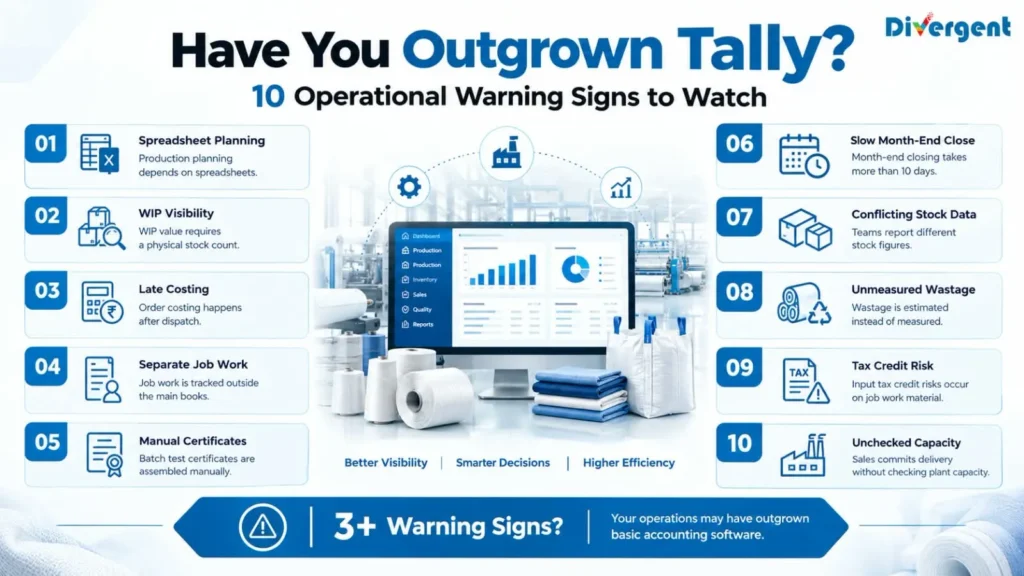
- Production planning lives in a spreadsheet that one person maintains
- You cannot state today’s work-in-progress value without a physical stock count
- Order costing is done after dispatch, not before quoting
- Job work challans are tracked in a separate register from your books
- Customers ask for batch test certificates and you assemble them manually
- Your month-end close takes more than ten days
- Two people give different answers to “how much stock do we have”
- Wastage is a number you argue about rather than measure
- You have lost or nearly lost input tax credit on job work material
- Sales commits delivery dates without checking plant capacity
Three or more, and the cost of the gap has probably already exceeded the cost of closing it.
What does an ERP add that Tally does not?
A manufacturing ERP adds the production layer: planning, shop-floor execution, batch genealogy, quality records and operational costing. It treats a production order as the central object and tracks it through every stage, whereas Tally treats a voucher as the central object and tracks value.
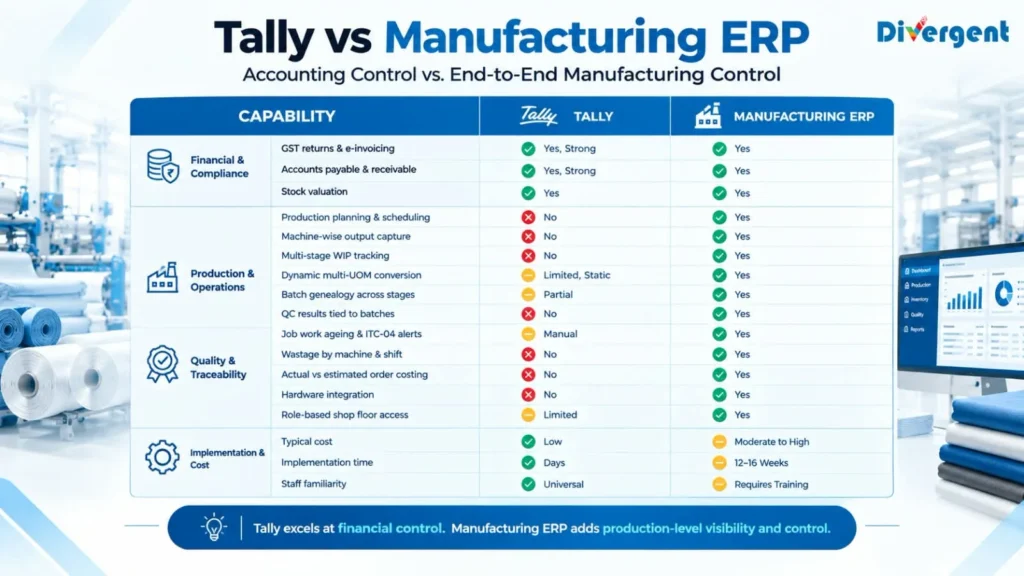
| Capability | Tally | Manufacturing ERP |
|---|---|---|
| GST returns and e-invoicing | Yes, strong | Yes |
| Accounts payable and receivable | Yes, strong | Yes |
| Stock valuation | Yes | Yes |
| Production planning and scheduling | No | Yes |
| Machine-wise output capture | No | Yes |
| Multi-stage WIP tracking | No | Yes |
| Dynamic multi-UOM conversion | Limited, static | Yes |
| Batch genealogy across stages | Partial | Yes |
| QC results tied to batches | No | Yes |
| Job work ageing and ITC-04 alerts | Manual | Yes |
| Wastage by machine and shift | No | Yes |
| Actual vs estimated order costing | No | Yes |
| Hardware integration | No | Yes |
| Role-based shop floor access | Limited | Yes |
| Typical cost | Low | Moderate to high |
| Implementation time | Days | 12–16 weeks |
| Staff familiarity | Universal | Requires training |
The Tally vs ERP for textile manufacturing comparison looks like this, capability by capability.
The last three rows matter as much as the first fourteen. An ERP is not strictly better — it is more capable and more demanding. A plant that is not ready to enter production data at the point it happens will get an expensive system that produces worse information than the spreadsheet it replaced.
Do I have to replace Tally completely?
No, and most textile manufacturers do not. The common arrangement is to keep Tally for statutory accounts and let the ERP own everything operational, with an integration passing financial entries between them.
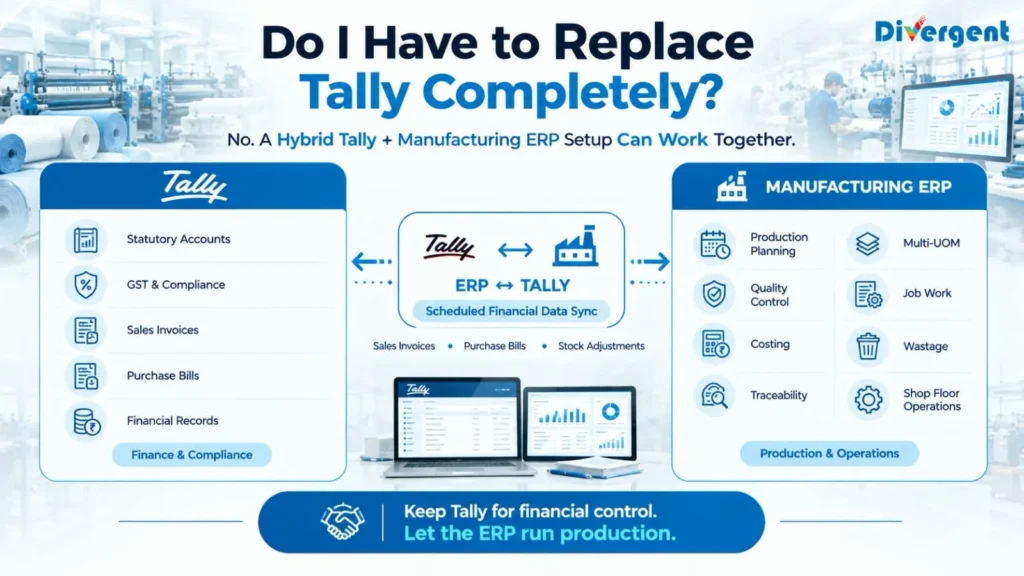
This works well because it plays to each system’s strength. Your CA and your accounts team keep working in the software they know. GST filing, which is the highest-risk compliance area, stays where it has been reliable for years. Meanwhile production, quality, costing and traceability move into a system actually designed for them.
The integration typically syncs sales invoices, purchase bills and stock adjustments from the ERP into Tally on a scheduled basis. Your books stay accurate; your shop floor gets a system that understands looms.
The alternative — a full-suite ERP that replaces Tally’s accounting as well — is viable, but adds migration risk, retraining cost and a statutory compliance dependency on a new vendor. Unless you have a specific reason to consolidate, the hybrid is the lower-risk path.
A technical textile ERP built for this industry should support that integration out of the box, along with the process stages, UOM handling and traceability requirements that generic manufacturing ERPs treat as customisations.
How do I migrate from Tally to an ERP?
Migration runs in phases, not as a single cutover. A realistic timeline for a mid-size textile unit is twelve to sixteen weeks from kickoff to stable running.
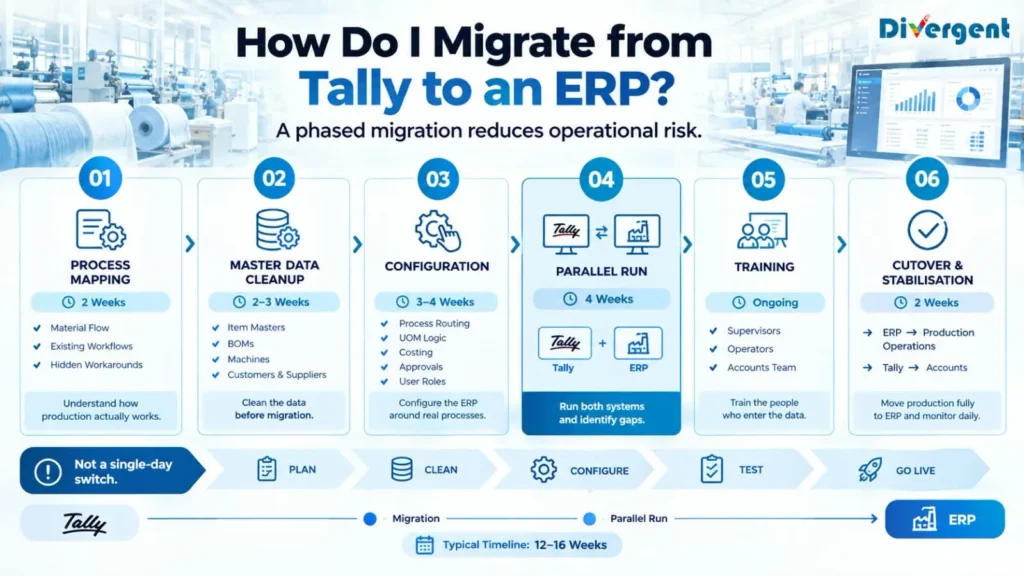
- Process mapping (2 weeks) — document how material actually moves, including the undocumented workarounds. This step gets skipped and is the single most common cause of failed implementations.
- Master data cleanup (2–3 weeks) — item masters, BOMs, machine lists, customer and supplier records. Most Tally databases carry a decade of duplicate and dead masters. Migrating that mess forward guarantees a messy ERP.
- Configuration (3–4 weeks) — process routings, UOM conversion logic, costing method, approval workflows, user roles.
- Parallel run (4 weeks) — both systems live simultaneously. Painful, non-negotiable. This is where you find the gaps while you still have a working fallback.
- Training (ongoing) — supervisors and operators, not just the accounts team. If the shop floor does not enter data, the ERP produces nothing.
- Cutover and stabilisation (2 weeks) — switch production entry fully, keep Tally on accounts, monitor daily.
Opening balances, outstanding job work challans and open sales orders carry forward. Historical transaction data usually stays in Tally as an archive rather than being migrated — there is rarely a good reason to move five years of vouchers.
Frequently asked questions
Can Tally handle production planning?
This is the core of the Tally vs ERP for textile manufacturing decision. Tally has no machine capacity, shift calendar or scheduling functionality. It can record that production happened through a manufacturing voucher, but it cannot plan when production should happen or check whether capacity exists for a new order.
Is Tally enough for a small textile manufacturing unit?
Usually yes, for units with a single process stage, limited job work and low SKU counts. Tally handles GST, accounting and basic stock well. The limits appear when multiple process stages, outsourced work and batch traceability requirements enter the picture.
What is the difference between Tally and an ERP?
Tally is accounting software with manufacturing features attached. A manufacturing ERP is production software with accounting attached. The difference shows up in what each system treats as its central record — a voucher versus a production order.
Can I run Tally and an ERP together?
Yes, and this is the most common setup among Indian textile manufacturers. The ERP handles production, quality and costing; Tally retains statutory accounting and GST filing; an integration syncs financial transactions between the two.
How much does a textile ERP cost in India?
It varies widely with user count, deployment model and module scope. Expect a meaningful multiple of your Tally spend, plus implementation services. Any vendor who quotes a price before understanding your process stages and job work volume is guessing.
Does an ERP handle GST and e-invoicing?
Most manufacturing ERPs do, but if you are running the hybrid setup, GST filing typically stays in Tally where your team already has established process and your CA is comfortable.
How long does ERP implementation take for a textile plant?
Twelve to sixteen weeks is realistic for a mid-size unit, including a four-week parallel run. Timelines of four to six weeks generally mean process mapping and parallel running are being skipped, which is where implementations fail.
Will my accounts team need to learn a new system?
In the hybrid model, minimally — they continue in Tally. The larger training requirement falls on production supervisors and quality staff, who will be entering data that previously existed only on paper.
Where to go from here
If you are weighing Tally vs ERP for textile manufacturing and recognised three or more signs from the checklist above, the useful next step is not a software demo. It is mapping where your production data currently lives — how many spreadsheets, registers and WhatsApp groups are holding information that should be in one system. That map tells you how big your gap actually is, and it is worth doing before you speak to any vendor, including us.
When you are ready to see what a purpose-built system looks like for technical textile production — lot traceability from polymer to dispatch, machine-wise wastage capture, multi-UOM costing and job work ageing — we can walk you through TechTex Pro against your own process.