
Your fabric passed every test in your own lab. Then the customer’s lab rejected the roll, and asked for the test certificate for that exact lot. Your team spent two days searching folders, registers and email to find it.
If that sounds familiar, you already know why technical textile manufacturers outgrow spreadsheets. In technical textiles, the product isn’t just fabric. It’s fabric plus proof: the right specification, the right test results, and a record that ties every roll to its raw material and machine.
Quick answer: Textile ERP software for technical textiles connects specifications, production planning, inventory, lot-wise testing, quality certificates and dispatch in one system. The right system should manage product specifications like GSM, width, tensile strength and coating, trace every roll to its raw material lot and machine, attach test results to each lot, and plan production across weaving, coating and finishing lines. Generic manufacturing ERP can be adapted, but industry-built textile ERP software like TechTex Pro by Divergent Software Labs is designed around this workflow.
Key takeaways:
- Technical textiles need ERP that handles specifications, lot traceability, and test certificates, not just orders and stock.
- Generic ERP systems for manufacturing often need heavy customisation for roll-wise tracking and lab results.
- The 9 must-have features include specification management, lot traceability, test certificate management and roll-wise inventory.
- Choosing between Excel, generic ERP and industry-built textile ERP depends on your product range and customer requirements.
- Always ask vendors to demonstrate the system with your own product specifications and test parameters.
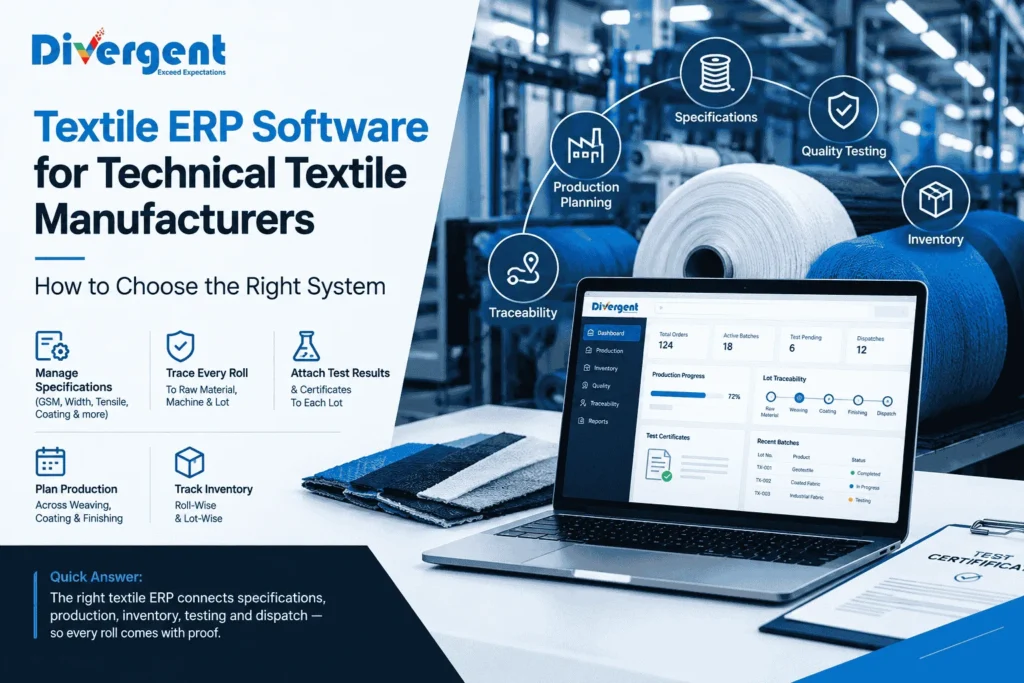
What Is Textile ERP Software?
Textile ERP software is an enterprise resource planning system built for textile manufacturers. It connects sales, product specifications, production planning, inventory, quality control, costing and dispatch in one system, using the language of a textile plant: yarn, tape, fabric rolls, GSM, width, lots and test results.
A general ERP system for manufacturing treats products as items with a price and a stock quantity. A textile plant needs much more detail. Every product has technical specifications, every roll has a lot number, and every lot needs test results that customers may ask for months later. Textile ERP software is built to handle that detail.
What Makes Technical Textiles Different?
Technical textiles are fabrics made for their performance, not their appearance. They include geotextiles for roads and construction, agrotextiles like shade nets and crop covers, industrial fabrics, nonwovens, protective textiles and packaging textiles.
That focus on performance changes how the plant has to work:
- Specifications are strict. GSM, width, tensile strength, elongation, UV resistance and coating weight must all match the order.
- Testing is part of every order. Customers, contractors and government projects often require lot-wise test certificates.
- Traceability matters. If a roll fails in the field, you need to know its raw material lot, machine and shift.
- Production has several stages. Tape or yarn, weaving or nonwoven formation, coating or lamination, finishing and cutting.
In India, technical textiles also have government support through the National Technical Textiles Mission, which is pushing more manufacturers to scale up and formalise their operations.
Why Do Excel and Generic ERP Struggle in Technical Textile Plants?
Excel and generic ERP struggle in technical textile plants because they weren’t built for specification-driven production with lot-wise testing. They can record orders and stock, but they can’t easily link a specification, a production lot, its test results and the rolls dispatched to a customer.
Here’s what that looks like in practice:
- Specifications live in separate files. Sales, production and quality each keep their own version.
- Test results sit in lab registers. Finding the certificate for one lot takes hours.
- Rolls aren’t tracked individually. Stock shows a total quantity, not which rolls belong to which lot.
- Costing ignores real yields. Wastage at weaving, coating and cutting isn’t measured. See our guide to manufacturing waste.
- Planning is done line by line. Weaving, coating and finishing aren’t planned together. Read more in production planning challenges.
- Quality problems are found late. A coating defect found at cutting has already wasted fabric. See quality control challenges.
Most ERP systems for manufacturing can be customised for some of this, but customisation takes time and money. That’s why many technical textile manufacturers look for textile ERP software built for their industry.
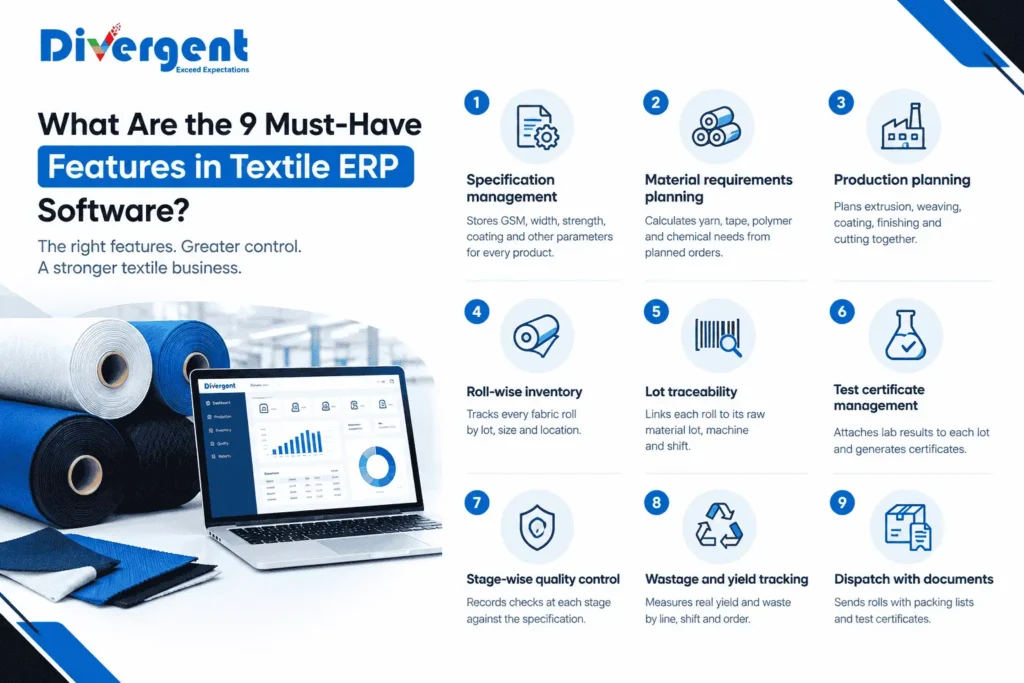
What Are the 9 Must-Have Features in Textile ERP Software?
The 9 must-have features in textile ERP software for technical textiles are specification management, material requirements planning, production planning across lines, roll-wise inventory, lot and batch traceability, lab testing and test certificates, stage-wise quality control, wastage and yield tracking, and dispatch with certificate documents.
| Feature | What it does for a technical textile plant |
|---|---|
| Specification management | Stores GSM, width, strength, coating and other parameters for every product |
| Material requirements planning | Calculates yarn, tape, polymer and chemical needs from planned orders |
| Production planning | Plans extrusion, weaving, coating, finishing and cutting together |
| Roll-wise inventory | Tracks every fabric roll by lot, size and location |
| Lot traceability | Links each roll to its raw material lot, machine and shift |
| Test certificate management | Attaches lab results to each lot and generates certificates |
| Stage-wise quality control | Records checks at each stage against the specification |
| Wastage and yield tracking | Measures real yield and waste by line, shift and order |
| Dispatch with documents | Sends rolls with packing lists and test certificates |
1. Specification Management
Specification management stores every product’s technical parameters in one place: GSM, width, weave or construction, tensile strength, elongation, UV stabilisation, coating weight and colour. Sales, production and quality all work from the same approved specification.
This prevents one of the most common and costly errors: producing to an outdated specification.
2. Material Requirements Planning
Material requirements planning (MRP) works out how much raw material each order needs: polymer granules, yarn, tape, coating chemicals, additives and packaging. Textile ERP software compares those needs with stock and raises purchase requests for shortages before they stop a line.
3. Production Planning Across Lines
Production planning schedules every stage, from extrusion and weaving to coating, finishing and cutting, against delivery dates. A good system groups similar products to reduce changeovers and shows where each order is at any time.
4. Roll-Wise Inventory
Roll-wise inventory tracks each fabric roll individually, with its lot number, length, width, weight and storage location. That means you always know exactly which rolls are available for an order, not just a total quantity.
5. Lot and Batch Traceability
Lot traceability links every roll to the raw material lot, machine, shift and operator that produced it. If a customer reports a problem in the field, you can trace the cause and find other affected rolls in minutes.
6. Lab Testing and Test Certificates
Test certificate management records lab results for each lot, such as tensile strength, elongation, puncture resistance, GSM and UV performance, and generates certificates automatically. When a customer or project engineer asks for proof, it’s ready instantly.
For technical textiles, this is often the feature that matters most, because many buyers won’t accept a delivery without it.
7. Stage-Wise Quality Control
Quality control records checks at each stage against the specification, so problems are caught before more material and time are added. Results are linked to the lot, creating a complete quality history.
8. Wastage and Yield Tracking
Yield tracking compares material input with good output at each stage, so you can see real waste by line, shift and order. Accurate yield figures also make your product costing far more reliable.
9. Dispatch With Certificate Documents
Dispatch management tracks each order from packing to delivery, and sends the right test certificates and packing lists with every shipment.
Textile ERP Software Options Compared
Technical textile manufacturers usually manage operations in one of three ways: Excel and paper, a generic manufacturing ERP system, or textile ERP software built for their industry, like TechTex Pro.
| Factor | Excel and paper | Generic manufacturing ERP | TechTex Pro |
|---|---|---|---|
| Setup cost | Very low | Medium to high | Medium |
| Technical specification management | Separate files | Needs customisation | Designed for it |
| Roll-wise inventory | Very difficult | Possible with setup | Designed for it |
| Lot traceability | Very difficult | Possible with setup | Designed for it |
| Test certificates per lot | Lab registers | Rarely available | Designed for it |
| Multi-stage production planning | Whiteboard | Needs customisation | Designed for it |
| Yield and wastage tracking | Rarely tracked | Possible with setup | Designed for it |
| Best for | Very small plants | Large multi-industry groups | Growing technical textile manufacturers |
If you make a few standard products for a handful of customers, Excel may still work. Once you handle many specifications, lot-wise testing and project or export customers, textile ERP software usually pays for itself through fewer errors, faster certificates and better yield.
How Does TechTex Pro Help Technical Textile Manufacturers?
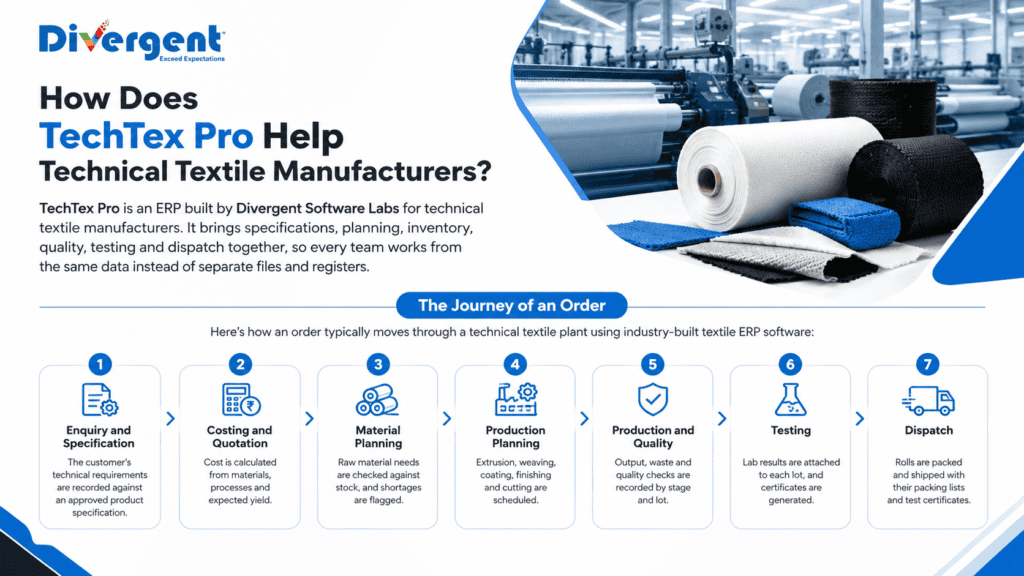
TechTex Pro is an ERP built by Divergent Software Labs for technical textile manufacturers. It brings specifications, planning, inventory, quality, testing and dispatch together, so every team works from the same data instead of separate files and registers.
Here’s how an order typically moves through a technical textile plant using industry-built textile ERP software:
- Enquiry and specification: the customer’s technical requirements are recorded against an approved product specification.
- Costing and quotation: cost is calculated from materials, processes and expected yield.
- Material planning: raw material needs are checked against stock, and shortages are flagged.
- Production planning: extrusion, weaving, coating, finishing and cutting are scheduled.
- Production and quality: output, waste and quality checks are recorded by stage and lot.
- Testing: lab results are attached to each lot, and certificates are generated.
- Dispatch: rolls are packed and shipped with their packing lists and test certificates.
What Will You See in a TechTex Pro Demo?
A demo is the best way to judge whether textile ERP software fits your plant. Bring real data, and ask to see:
- One of your product specifications set up with all its technical parameters
- A sample order moving from enquiry to production plan
- Material requirements calculated for that order
- A lot’s test results recorded and turned into a certificate
- A roll traced back to its raw material lot and machine
Bring your most demanding product, with its full test requirements. It’s the best way to test any textile ERP software.
Expert Insight
“Technical textile buyers don’t just buy fabric. They buy proof that the fabric meets their specification. The plants that win repeat orders are the ones that can hand over the right test certificate for any lot, the same day it’s requested.”
Hrishikesh Patidar, Delivery Manager, Divergent Software Labs
When Is Your Technical Textile Plant Ready for ERP?
Your plant is ready for textile ERP software when spreadsheets and registers can’t keep up with your specifications, lots and test records. Most plants reach this point as they add products, customers or government and export projects.
Look for these signs:
- Finding a test certificate for one lot takes hours or days
- Different teams use different versions of the same specification
- Stock shows total quantities, but nobody knows which rolls belong to which lot
- Real yield and wastage by line aren’t measured
- Customers or project engineers ask for documents you struggle to produce
- A field complaint takes days to trace back to its raw material
If three or more of these sound familiar, textile ERP software will likely save you more than it costs.
How Should You Prepare for Textile ERP Implementation?
The best way to prepare is to organise your specifications and test parameters first, clean your core data, and start with the area causing the most pain.
- List every active product specification with its technical parameters.
- Define your test parameters and the certificate format your customers expect.
- Clean your master data: customers, suppliers, materials and machines, each with one correct record.
- Decide your lot and roll numbering before go-live, so traceability starts clean.
- Pick a project owner inside the plant to make decisions and test the system.
- Train by role: sales, planning, production, lab, stores and dispatch.
What Should You Ask Before Choosing Textile ERP Software?
Before choosing textile ERP software, ask each vendor to show the system with your own specifications and test parameters, and check how it handles roll-wise stock, lot traceability and certificates.
- Can it store full technical specifications for each product?
- Does it track inventory roll by roll, with lot numbers?
- Can it attach lab test results to each lot and generate certificates?
- Can it trace a roll back to its raw material lot, machine and shift?
- Does it plan production across extrusion, weaving, coating and finishing?
- Does it track yield and wastage by line and shift?
- Is it cloud-based or on-premise, and which suits your plant?
- How long does implementation take, and who trains your team?
For a general overview of how these systems work, see enterprise resource planning on Wikipedia. If you also make bags or packaging, see our guides to FIBC ERP software and BOPP bag ERP software.
FAQs About Textile ERP Software
What is textile ERP software?
Textile ERP software is an ERP system built for textile manufacturers. It connects specifications, production planning, inventory, quality control, testing, costing and dispatch in one system, using textile terms like GSM, rolls and lots.
What is the best ERP for technical textile manufacturers?
The best ERP for technical textile manufacturers manages technical specifications, roll-wise inventory, lot traceability and lab test certificates without heavy customisation. TechTex Pro by Divergent Software Labs is built for technical textile manufacturers.
What is ERP in manufacturing?
ERP in manufacturing is software that connects sales, planning, inventory, production, quality and accounts in one system. It gives managers real-time information on orders, materials, output and costs.
What is the difference between MRP and ERP?
MRP (material requirements planning) calculates the materials needed for production. ERP is a wider system that includes MRP, along with sales, inventory, production, quality, purchasing and accounts.
Is QuickBooks or Tally an ERP system?
No. QuickBooks and Tally are accounting software. They handle invoices, ledgers and taxes, but not production planning, specifications, lot traceability or quality control. Many manufacturers keep their accounting software and add an ERP for operations.
What is cloud-based ERP?
Cloud-based ERP runs on the internet instead of on your own servers. Your team can use it from the plant, office or anywhere with a connection, and updates and backups are handled by the provider.
How long does textile ERP implementation take?
Implementation time depends on the modules, data quality and team readiness. An industry-built textile ERP is usually faster to implement than a generic system, because its workflows already match how a textile plant works.