
A customer calls. A full batch has failed at their end, and they want answers. You check your inspection report. It says “passed”.
If that has ever happened to you, you already know how expensive quality problems can be. You lose the material, the machine time and the labour, and sometimes the customer too. In this guide, you’ll learn the 7 biggest quality control challenges factories face, what poor quality really costs, which KPIs to track, and practical steps to fix each problem.
What Are Quality Control Challenges?
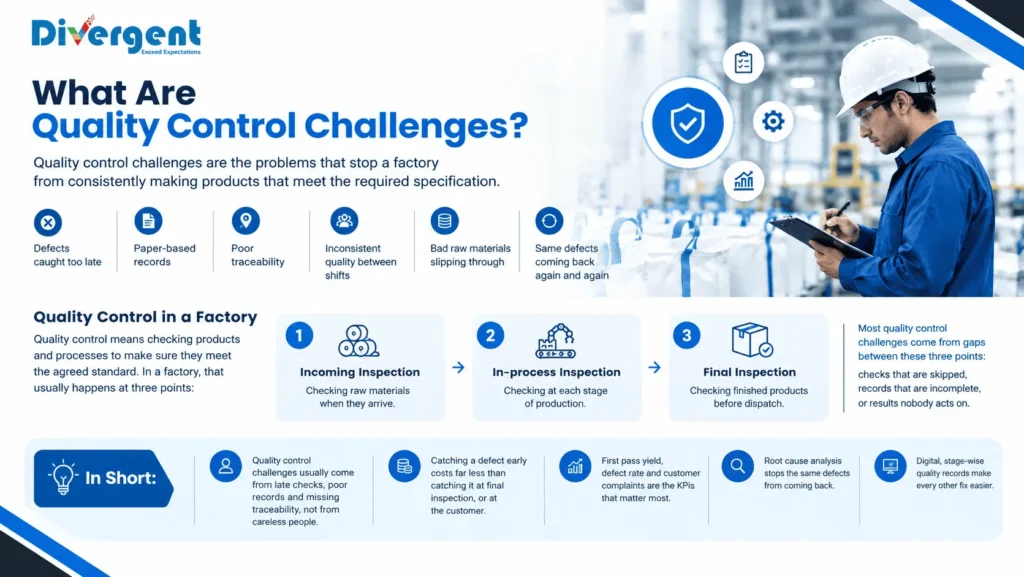
Quality control challenges are the problems that stop a factory from consistently making products that meet the required specification. They include defects caught too late, paper-based inspection records, poor traceability, inconsistent quality between shifts, bad raw materials slipping through, and the same defects coming back again and again.
Quality control means checking products and processes to make sure they meet the agreed standard. In a factory, that usually happens at three points:
- Incoming inspection: checking raw materials when they arrive
- In-process inspection: checking at each stage of production
- Final inspection: checking finished products before dispatch
Most quality control challenges come from gaps between these three points: checks that are skipped, records that are incomplete, or results nobody acts on.
In short:
- Quality control challenges usually come from late checks, poor records and missing traceability, not from careless people.
- Catching a defect early costs far less than catching it at final inspection, or at the customer.
- First pass yield, defect rate and customer complaints are the KPIs that matter most.
- Root cause analysis stops the same defects from coming back.
- Digital, stage-wise quality records make every other fix easier.
Why Is Quality Control Important in Manufacturing?
Quality control is important because every defect costs you twice: once to make the faulty product, and again to scrap, rework or replace it. Good quality control protects your margins, your delivery dates and, most importantly, your customers’ trust.
Think about what one rejected batch really costs. There’s the raw material, the machine hours, the labour, the rework or remake, the delayed delivery, and possibly a penalty. And if a defect reaches your customer, you may lose future orders too.
That’s why quality control challenges are never just a “quality department” problem. They affect costing, production planning, inventory and sales. When quality slips, the whole factory feels it.
What Are the 7 Biggest Quality Control Challenges in Manufacturing?
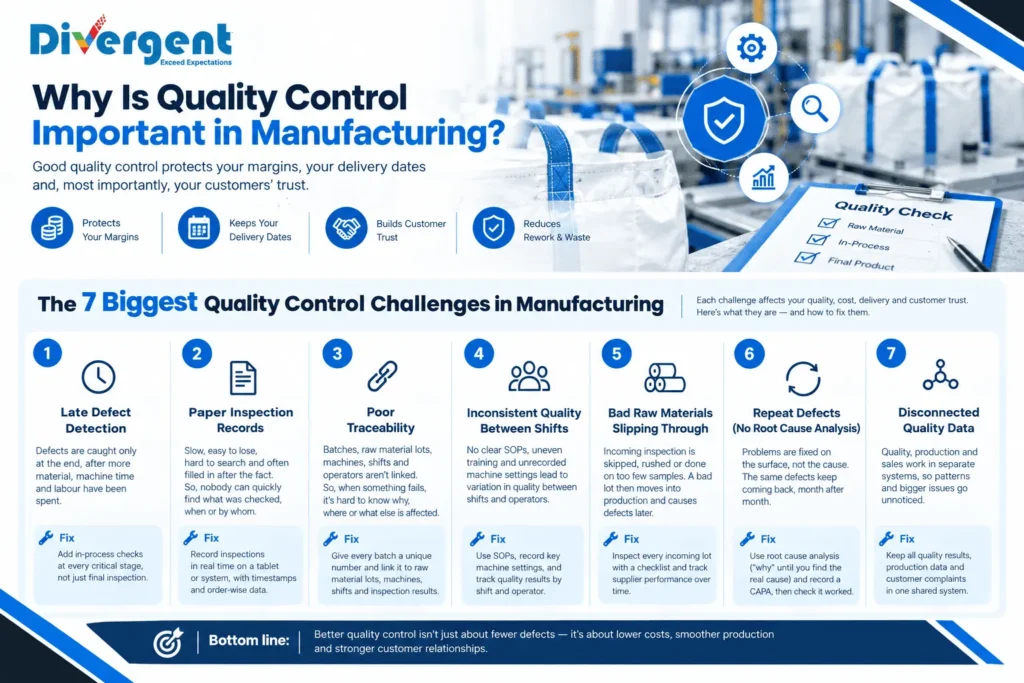
The 7 biggest quality control challenges in manufacturing are late defect detection, paper-based inspection records, poor traceability, inconsistent quality between shifts, bad raw materials slipping through, repeat defects with no root cause analysis, and disconnected quality data. Each one is explained below with a practical fix.
1. Why Do Defects Get Caught Too Late?
Defects get caught too late when inspection happens mainly at the end of the line instead of at every stage. By the time a problem is found, more material, machine time and labour have already gone into a product that can’t be sold.
Late detection is one of the most expensive quality control challenges, because the cost of a defect grows at every stage. Picture a printing error that isn’t noticed until cutting. The fabric, coating, lamination and printing are already wasted. Had the error been caught at the printing stage, the loss would have been a fraction of that.
Fix: Add simple in-process checks at each critical stage, not just at final inspection. The earlier you check, the cheaper the defect.
2. Why Are Paper Inspection Records a Problem?
Paper inspection records are a problem because they’re slow to fill, easy to lose, hard to search and often completed after the fact. When something goes wrong, nobody can quickly find out what was checked, when, by whom and with what result.
Paper records sit behind many other quality control challenges, because nobody can learn from data they can’t find. It’s common to find inspection sheets filled in at the end of a shift, all with neat, similar numbers. That’s not dishonesty; it’s what happens when recording is a chore. But it means your records can’t be trusted when you need them most.
Fix: Record inspections at the moment they happen, on a tablet or system linked to the order and stage, so results are complete, timestamped and searchable.
3. Why Is It Hard to Trace a Defect Back to Its Source?
Defects are hard to trace when batches, raw material lots, machines, shifts and operators aren’t linked in your records. Without that link, you can see that something failed, but not why, where or which other products are affected.
When a customer complains, you need to answer quickly: which raw material lot was used, which machine made it, which shift, and which other orders used the same material? Poor traceability turns a one-hour investigation into a week of searching. It’s one of the most stressful quality control challenges for any plant manager.
Fix: Give every batch a unique number, and link it to the raw material lots, machines, shifts and inspection results used to make it.
4. Why Does Quality Vary Between Shifts and Operators?
Quality varies between shifts when there are no clear, written standards for how each job should be run and checked. Each operator follows their own experience, so the same product comes out differently depending on who made it and when.
Shift-to-shift variation is one of the quality control challenges that’s easiest to miss. You might notice that night shift has higher rejections, or that one operator’s output is always better than another’s. That usually points to missing standard operating procedures (SOPs), uneven training or machine settings that aren’t recorded.
Fix: Write simple SOPs for critical jobs, record key machine settings for each order, and compare quality results by shift and operator every week.
5. Why Do Raw Material Quality Problems Slip Through?
Raw material problems slip through when incoming inspection is skipped, rushed or done on too few samples, especially when production is waiting for the material. A bad lot then moves into production and causes defects much later.
Supplier problems are quality control challenges that start outside your factory, which makes them easy to overlook. Under pressure, it’s tempting to say “the supplier is reliable, let’s use it straight away”. But one bad lot of granules, yarn, film or ink can spoil an entire run.
Fix: Inspect every incoming lot against a simple checklist before it’s released to production, and track quality results by supplier over time. This is the core of supplier quality management: rating suppliers on real results, and running a supplier audit when the same problems repeat.
6. Why Do the Same Defects Keep Coming Back?
The same defects keep coming back when problems are fixed on the surface but their root cause is never found. The faulty product is reworked or scrapped, everyone moves on, and the same issue appears again next month.
This is one of the most frustrating quality control challenges, because it feels like you’re always firefighting. Without root cause analysis, you treat the symptom, not the disease.
Fix: For every repeat defect, ask “why” until you reach the real cause, then record a corrective action and check that it worked. The CAPA section below explains how.
7. Why Don’t Quality, Production and Sales Share the Same Data?
Quality data stays disconnected when inspection results live in the quality department’s files, production uses its own registers, and customer complaints sit in sales emails. Nobody sees the full picture, so patterns go unnoticed.
For example, sales may know a customer has complained three times about the same issue, while production has no idea. Or quality may know a machine is producing more rejections, while planning keeps scheduling urgent orders on it. You can read more about this in our guide to production visibility challenges.
Fix: Keep quality results, production data and customer complaints in one shared system, so every team sees the same information.
What Is CAPA, and How Does It Stop Repeat Defects?
CAPA stands for corrective and preventive action. A corrective action fixes the cause of a problem that has already happened, while a preventive action stops a similar problem from happening in the future. Together, they’re the most reliable way to solve repeat quality control challenges.
The CAPA process usually starts with a nonconformance: any product or process that doesn’t meet its requirement. The problem is recorded in a non conformance report (NCR), and then the team works through these steps:
- Record the nonconformance: what failed, where, when and how many
- Contain it: stop affected products from moving forward or reaching customers
- Find the root cause: ask “why” until you reach the real reason
- Take corrective action: fix the cause, not just the faulty product
- Take preventive action: apply the lesson to similar products, machines or suppliers
- Check it worked: confirm the defect doesn’t come back
Without a CAPA system, every defect is handled from scratch, and lessons are forgotten. With one, every problem makes your process a little stronger.
What Is the Cost of Quality in Manufacturing?
The cost of quality is the total cost of preventing, finding and fixing defects. Poor quality costs a factory far more than the rejected products themselves. The full cost of poor quality includes scrap, rework, extra inspection, delayed deliveries, returns, penalties and lost customers.
The cost of quality is usually split into four types:
| Cost type | What it includes | Example |
|---|---|---|
| Prevention | Training, SOPs, process improvement | Teaching operators correct machine settings |
| Appraisal | Inspection and testing | Incoming, in-process and final checks |
| Internal failure | Defects found before dispatch | Scrap, rework, downgraded product |
| External failure | Defects found by the customer | Returns, penalties, lost orders |
A simple cost of poor quality formula is: internal failure costs (scrap and rework) plus external failure costs (returns, penalties and supplier defects passed on to customers). That’s why quality control challenges show up directly in your profit. Here’s the key point: money spent on prevention and early checks is almost always cheaper than money lost to failures. A defect stopped at the first stage costs a little. The same defect found by your customer can cost you the account.
Quality Control Examples From the Factory Floor
These three examples show how quality control challenges play out on a real factory floor. They’re illustrative, based on situations common in packaging and textile plants. See if any of them sound familiar.
Example 1: The late printing error. A colour mismatch isn’t noticed until the cutting stage, after lamination is complete. Thousands of printed bags are scrapped. What fixed it: a quick colour check against the approved sample at the start of every print run.
Example 2: The supplier lot nobody checked. Production urgently needs material, so a new lot of granules goes straight to extrusion without inspection. Tape strength is low, and the problem only appears in final testing. What fixed it: no material is released to production until incoming inspection is complete.
Example 3: The defect that kept coming back. A stitching defect appears every few weeks. Each time, the bags are reworked and the issue is forgotten. Root cause analysis finally shows a worn machine part. What fixed it: recording each defect with its root cause and corrective action, then checking the fix worked.
Which Quality Metrics Should You Track in Manufacturing?
The most useful quality metrics in manufacturing are first pass yield, defect rate, rework rate, customer complaint rate and cost of poor quality. Together, they show how often you get it right the first time, and what it costs when you don’t.
| KPI | How to calculate it | What it tells you |
|---|---|---|
| First pass yield (FPY) | Good units first time ÷ total units started × 100 | How often you get it right without rework |
| Defect rate | Defective units ÷ total units produced × 100 | How much of your output fails |
| Rework rate | Reworked units ÷ total units produced × 100 | How much extra work quality problems create |
| Customer complaint rate | Complaints ÷ orders delivered × 100 | How many problems reach your customers |
| Cost of poor quality | Scrap + rework + returns + penalties | What quality problems really cost you |
Here’s a quick example. If you start 1,000 bags and 940 pass inspection first time, your first pass yield is 94 percent. The other 60 needed rework or were scrapped.
Track these KPIs by product, machine, shift and customer, not just as one plant-wide number. That’s how you find where your quality control challenges really come from.
What Is the Difference Between QA and QC?
Quality control (QC) checks products to find defects. Quality assurance (QA) improves processes to prevent defects from happening in the first place. You need both: QC catches problems today, while QA stops them from coming back tomorrow.
| Quality control (QC) | Quality assurance (QA) | |
|---|---|---|
| Focus | The product | The process |
| Goal | Find defects | Prevent defects |
| When | During and after production | Before and during production |
| Examples | Inspection, testing, sampling | SOPs, training, audits, process design |
Together, the two are often called QA/QC, and strong QA prevents many quality control challenges before they begin. Many factories rely heavily on QC and very little on QA. That’s why they keep finding the same defects. Quality management standards such as ISO 9001 focus strongly on the QA side: documented processes, records and continuous improvement.
What Should a Quality Control Plan Include?
A quality control plan sets out what to check, where, how often, by whom and what to do when something fails. A good plan turns quality from guesswork into a routine, and it’s one of the simplest ways to prevent quality control challenges.
| Plan element | What to define | Example |
|---|---|---|
| Inspection points | Where quality checks happen | Incoming, in-process, final and pre-shipment inspection |
| What to check | Measurable specifications | Weight, size, strength, print colour, stitching |
| Sampling | How many items to check | A fixed sample size or an AQL sampling plan |
| Responsibility | Who performs each inspection | Operator, line inspector or quality team |
| Records | How results are recorded | Digital inspection form linked to the batch |
| Reaction plan | What happens if a check fails | Hold the batch, raise an NCR, start CAPA |
Many manufacturers use AQL sampling (acceptance quality limit), based on standards such as ANSI/ASQ Z1.4, to decide how many items to inspect from each lot. Whatever method you use, the key is consistency: the same checks, done the same way, every shift.
How Do You Overcome Quality Control Challenges?
You overcome quality control challenges by checking earlier, recording everything digitally, linking batches to their materials and machines, standardising how work is done, and fixing root causes instead of symptoms. These 7 steps work in most factories:
- Check at every critical stage, not just at the end of the line.
- Inspect every incoming material lot before releasing it to production.
- Record inspections as they happen, linked to the order, stage and batch.
- Give every batch a unique number and link it to materials, machines and shifts.
- Write simple SOPs for critical jobs, and train every shift on them.
- Run root cause analysis on repeat defects, and record the corrective action.
- Review quality KPIs weekly by product, machine, shift and customer.
If you’re wondering how to improve quality in production, these steps are the best place to start, and you don’t need expensive tools. Pick your most common defect this week, trace it back to its root cause, and fix that first. For a deeper look at how defects create waste, see our guide to manufacturing waste.
Statistical methods such as statistical process control can help later, once your basic records are reliable.
How Does ERP Help Solve Quality Control Challenges?
An ERP system helps solve quality control challenges by recording inspections at every stage, linking them to batches, materials, machines and orders, and making quality data visible to every department in real time. Instead of searching through paper files, you can trace any product in minutes.
For quality control, a manufacturing ERP typically gives you:
- Stage-wise inspection records linked to each order and batch
- Batch and lot traceability from raw material to finished goods
- Incoming inspection before materials are released to production
- Defect and rejection reports by product, machine, shift and operator
- Root cause and corrective action tracking for repeat problems
- Quality KPIs and dashboards such as first pass yield and defect rate
- Customer complaint records linked back to the original batch
- Production monitoring that flags problems while the order is still running
The biggest benefit is speed, which takes the pressure out of most quality control challenges. When a customer complains, you can see exactly which material, machine, shift and inspection results were involved, and which other orders might be affected. Better quality records also make your costing more accurate, as explained in our guide to costing and quotation challenges in manufacturing.
Quality Control Challenges and Solutions at a Glance
Here’s a quick summary of the quality control challenges covered in this guide, with the root cause and solution for each.
| Challenge | Root cause | Solution |
|---|---|---|
| Defects caught too late | Inspection only at the end | Checks at every critical stage |
| Paper inspection records | Manual, after-the-fact recording | Digital records linked to orders |
| Poor traceability | Batches not linked to inputs | Unique batch numbers with full links |
| Inconsistent quality between shifts | No standards or SOPs | Written SOPs and shift-wise review |
| Bad raw materials slipping through | Skipped incoming inspection | Inspect every lot before release |
| Repeat defects | No root cause analysis | Root cause and corrective action records |
| Disconnected quality data | Separate files in each team | One shared quality and production system |
FAQs About Quality Control Challenges
What are quality control challenges in manufacturing?
Quality control challenges in manufacturing are problems that stop a factory from consistently making products that meet specification. Common examples are late defect detection, paper inspection records, poor traceability, inconsistent quality between shifts and repeat defects.
Why is quality control important in manufacturing?
Quality control is important because defects waste material, time and money, delay deliveries and damage customer trust. Catching problems early is far cheaper than fixing them after dispatch.
What is the difference between QA and QC?
Quality control checks products to find defects, while quality assurance improves processes to prevent defects. QC focuses on the product; QA focuses on the process. Most factories need both.
What is corrective action in quality control?
Corrective action is a step taken to remove the root cause of a defect or nonconformance, so it doesn’t happen again. It’s different from simply fixing or replacing the faulty product.
What does CAPA stand for?
CAPA stands for corrective and preventive action. It’s a structured process for fixing the cause of quality problems and preventing similar problems in the future.
What is a nonconformity?
A nonconformity is any product, material or process that doesn’t meet its specified requirement. It’s usually recorded in a non conformance report (NCR) and investigated through the CAPA process.
What is first pass yield?
First pass yield is the percentage of products that pass inspection the first time, without rework or repair. It’s calculated as good units first time divided by total units started, multiplied by 100.