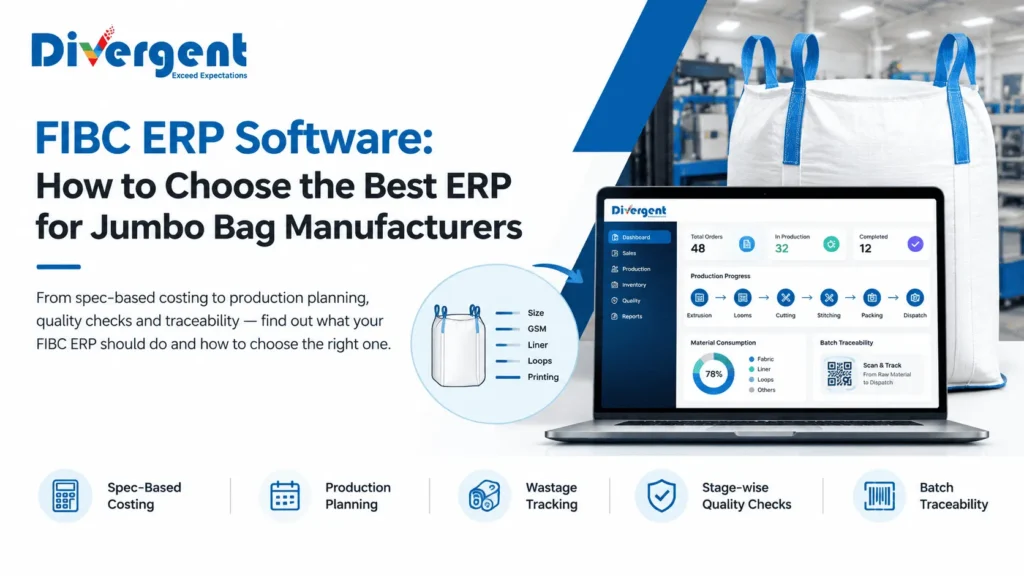
Quick answer: The best FIBC ERP software is one built specifically for jumbo bag manufacturing. It should calculate costing from bag specifications, plan production across extrusion, looms, cutting and stitching, track fabric wastage, record stage-wise quality checks, and trace every batch from raw material to dispatch. Generic ERP systems and Excel can be adapted, but FIBC-specific ERP software like FIBC Pro by Divergent Software Labs is designed around this workflow from the start.
If you run an FIBC plant, you already know the problem. One bag specification changes the fabric, GSM, loops, liner, stitching and test plan. Multiply that by dozens of customers, and spreadsheets start breaking. This guide explains what FIBC ERP software should do, how the options compare, and what to ask before you choose.
Key takeaways:
- FIBC ERP software is ERP built around jumbo bag specifications, processes and quality requirements.
- Generic ERP and Excel struggle with spec-based costing, loom planning, wastage and traceability.
- The 9 must-have features include spec-based costing, production planning, wastage tracking, stage-wise QC and batch traceability.
- Choosing between Excel, generic ERP and FIBC-specific ERP depends on your size, specifications and growth plans.
- Always ask vendors for an FIBC-specific demo using your own bag specifications.
What Is FIBC ERP Software?
FIBC ERP software is an enterprise resource planning system designed for manufacturers of flexible intermediate bulk containers, also called jumbo bags or bulk bags. It connects sales, costing, production planning, inventory, quality control, dispatch and accounts in one system, using the language and processes of an FIBC plant.
A general ERP thinks in terms of “items” and “orders”. An FIBC plant thinks in terms of bag type, construction, fabric GSM, coating, loops, top and bottom, liner, safety factor and test requirements. FIBC ERP software understands these specifications, so every department works from the same data.
If you’re new to how these specifications differ, our guide to types of FIBC bags explains each one.
Why Do Excel and Generic ERP Struggle in FIBC Plants?
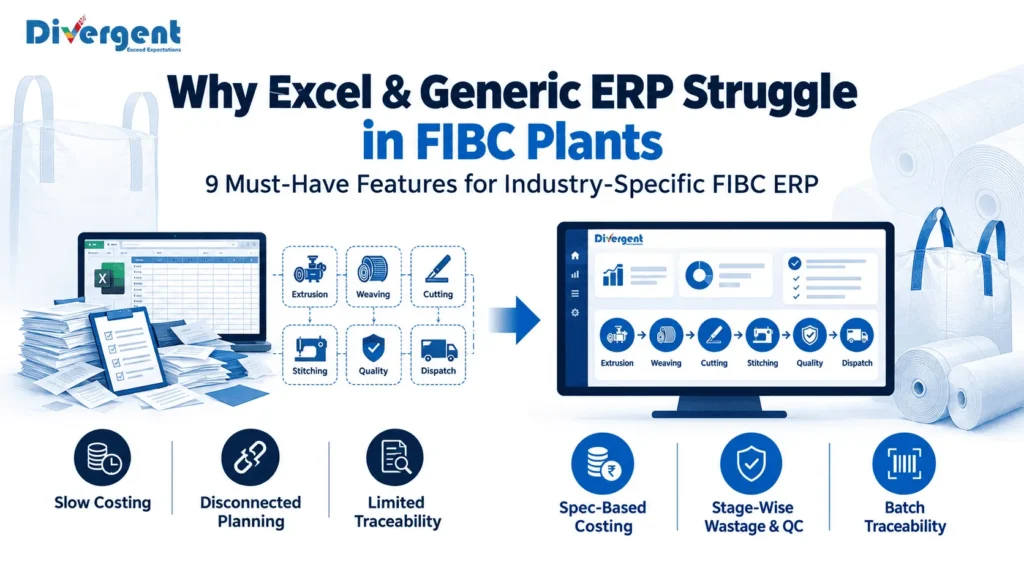
Excel and generic ERP struggle in FIBC plants because they weren’t built for spec-driven, multi-stage production. They can store data, but they can’t easily calculate bag cost from a specification, plan loom capacity, track wastage by stage or link a finished bag back to its fabric roll and granule lot.
Here’s what that looks like day to day:
- Costing takes too long. Each quote means rebuilding a sheet from fabric area, GSM, loops and liners.
- Planning happens on whiteboards. Extrusion, weaving, cutting and stitching aren’t planned together. Read more in production planning challenges.
- Stock numbers don’t match. Tape, fabric rolls and WIP move without being recorded. See inventory management challenges.
- Wastage is guessed. “Around 3 percent” replaces real measurement. See manufacturing waste.
- Quality records are on paper. Type C, Type D, food-grade, and UN bags need traceable test records. See quality control challenges.
Generic ERP systems can be customised to handle some of this, but customisation often takes months and costs more than expected. That’s why many FIBC manufacturers look for ERP software built for their industry.
What Are the 9 Must-Have Features in FIBC ERP Software?
The 9 must-have features in FIBC ERP software are spec-based costing and quotation, bill of materials by bag specification, production planning and machine scheduling, material requirements and inventory, loom efficiency and wastage tracking, stage-wise quality control, batch traceability, dispatch and export documentation, and real-time dashboards.
| Feature | What it does for an FIBC plant |
|---|---|
| Spec-based costing | Calculates bag cost from fabric, GSM, loops, liner and stitching |
| BOM by specification | Stores each bag spec once and reuses it for repeat orders |
| Production planning | Plans extrusion, looms, cutting and stitching against delivery dates |
| Material requirements | Works out tape, fabric and accessory needs from planned orders |
| Wastage tracking | Measures wastage by machine, shift and order |
| Stage-wise QC | Records inspections for GSM, stitching, loops, dimensions, print and moisture |
| Batch traceability | Links each batch to raw material lots, machines and shifts |
| Dispatch management | Tracks packing, loading, documents and delivery status |
| Dashboards | Shows orders, machine status, wastage and quality in real time |
1. Spec-Based Costing and Quotation
Spec-based costing calculates the cost of each bag directly from its specification: fabric area, GSM, coating, loops, liner, printing, stitching and testing. When a rate or specification changes, the cost updates automatically.
This is often the biggest time-saver. Instead of rebuilding a costing sheet for every enquiry, sales can prepare an accurate quote quickly.
2. Bill of Materials by Bag Specification
A bill of materials (BOM) lists every material and process needed to make a product. In FIBC ERP software, each bag specification has its own approved BOM, so repeat orders use the same data and new variants are built from existing ones.
3. Production Planning and Machine Scheduling
Production planning in FIBC ERP software groups confirmed orders, checks material availability and schedules work across extrusion lines, looms, cutting and stitching. A good system validates that the BOM is approved before planning, and prevents the same order being planned twice.
4. Material Requirements and Inventory
FIBC ERP software calculates the tape, fabric, liners, threads and accessories needed for all planned orders, compares them with stock, and raises purchase requisitions for shortages. Stock is issued on a first-in, first-out (FIFO) basis, so older material is used first.
5. Loom Efficiency and Wastage Tracking
Wastage tracking records material input and good output at each stage, so you can see real wastage by machine, shift and order. Loom efficiency tracking shows output against capacity, including downtime and its reasons.
6. Stage-Wise Quality Control
Quality control in FIBC ERP software records inspections at each stage against the product specification. FIBC plants typically check six categories: fabric GSM, stitching and seam strength, loop and lifting tests, dimensions and capacity, print and label verification, and moisture or contamination.
The best systems show the specified value next to the actual measured value, suggest pass or fail automatically, and keep a clean audit trail for every batch.
7. Batch Traceability
Batch traceability links every finished batch to the granule lots, fabric rolls, machines, shifts and inspection results used to make it. When a customer raises a complaint, you can trace the cause in minutes instead of days.
8. Dispatch and Export Documentation
Dispatch management tracks each order from packing to loading, documentation and delivery. For exporters, it keeps shipping documents, packing lists and dispatch status in one place, with clear roles for who can approve each step.
9. Real-Time Dashboards
Dashboards give owners and managers a live view of orders, machine status, wastage, quality results and pending dispatches, without waiting for end-of-day reports.
FIBC ERP Software Options Compared
There are three main ways FIBC manufacturers manage their operations: Excel and paper, a generic ERP, or FIBC-specific ERP software. Each suits a different stage of growth.
| Factor | Excel and paper | Generic ERP | Divergent PackPro |
|---|---|---|---|
| Setup cost | Very low | Medium to high | Medium |
| FIBC spec-based costing | Manual formulas | Needs customisation | Built in |
| Loom and machine planning | Whiteboard or sheets | Needs customisation | Built in |
| Wastage by machine and shift | Rarely tracked | Possible with setup | Built in |
| FIBC QC categories | Paper forms | Needs customisation | Built in |
| Batch traceability | Very difficult | Possible with setup | Built in |
| Time to go live | Immediate | Often months | Usually faster, as workflows already match |
| Best for | Very small plants | Large multi-industry groups | Growing FIBC and packaging manufacturers |
If you make only a few standard bags for a handful of customers, Excel may still work. Once you handle many specifications, multiple machines and export or certified bags, FIBC ERP software usually pays for itself through fewer costing errors, less wastage and faster quotes.
How Does FIBC Pro Work, From Enquiry to Dispatch?
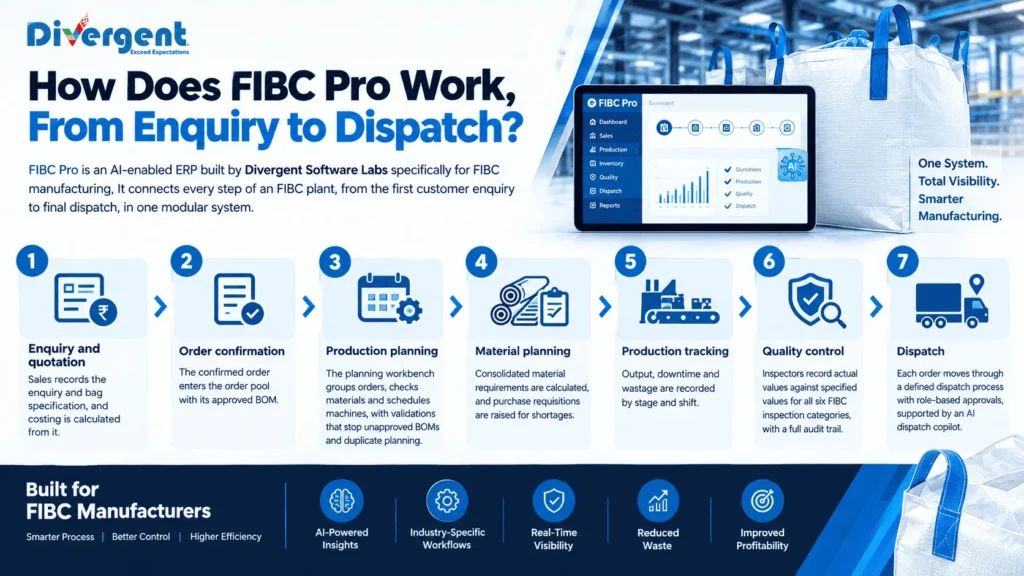
FIBC Pro is an AI-enabled ERP built by Divergent Software Labs specifically for FIBC manufacturing. It connects every step of an FIBC plant, from the first customer enquiry to final dispatch, in one modular system.
Here’s how an order moves through FIBC Pro:
- Enquiry and quotation: sales records the enquiry and bag specification, and costing is calculated from it.
- Order confirmation: the confirmed order enters the order pool with its approved BOM.
- Production planning: the planning workbench groups orders, checks materials and schedules machines, with validations that stop unapproved BOMs and duplicate planning.
- Material planning: consolidated material requirements are calculated, and purchase requisitions are raised for shortages.
- Production tracking: output, downtime and wastage are recorded by stage and shift.
- Quality control: inspectors record actual values against specified values for all six FIBC inspection categories, with a full audit trail.
- Dispatch: each order moves through a defined dispatch process with role-based approvals, supported by an AI dispatch copilot.
What you get with FIBC Pro:
- Costing and quotation based on full FIBC specifications
- Production planning with an order pool and planning workbench
- Material planning with consolidated requirements and purchase requisitions
- Production tracking for output, downtime and wastage by stage and shift
- Quality control for all six FIBC inspection categories, with a full audit trail
- Dispatch management with role-based approvals and an AI dispatch copilot
Every FIBC Pro demo is set up around your own bag specifications, so you can see exactly how it would work in your plant.
Looking for an FIBC-specific solution Book a Free Demo!
What Will You See in an FIBC Pro Demo?
An FIBC Pro demo uses your own data, not a generic sample. You’ll see:
- One of your real bag specifications turned into an automatic cost calculation
- A sample order moving from enquiry to production plan
- Material requirements calculated for that order
- A QC inspection recorded against your specification
- The dispatch process, from packing to delivery
Bring your most complicated bag specification. It’s the best way to test any FIBC ERP software.
Expert Insight
“Most FIBC plants we speak to don’t have a production problem. They have a data problem. The specification lives in sales, the plan lives on a whiteboard, and the wastage lives in someone’s memory. FIBC ERP software works when it connects those three.”
When Is Your FIBC Plant Ready for ERP Software?
Your FIBC plant is ready for ERP software when spreadsheets start costing you money: quotes take days, wastage is guessed, quality records can’t be traced, and managers spend more time chasing information than running production. Most plants reach this point as they add customers, specifications or machines.
Look for these signs:
- Quotes take more than a day because costing sheets are rebuilt every time
- Actual product costs regularly come out higher than quoted costs
- Nobody can say exactly how much fabric was wasted last week, by machine or shift
- Planning lives on a whiteboard, and urgent orders disrupt everything
- A customer complaint takes days to trace back to its batch
- Export or certified customers ask for records you struggle to produce
If three or more of these sound familiar, FIBC ERP software will likely save you more than it costs.
How Should You Prepare for FIBC ERP Implementation?
The best way to prepare for FIBC ERP implementation is to clean your core data first, choose one owner for the project, and start with the modules that solve your biggest problem. A well-prepared plant goes live faster and gets value sooner.
Here’s a simple preparation plan:
- List your bag specifications. Gather every active specification, with its materials and processes.
- Clean your master data. Customers, suppliers, materials and machines should each have one correct record.
- Pick a project owner. One person inside your plant should own decisions and testing.
- Start with your biggest pain. For many plants that’s costing or planning; add other modules after.
- Train by role. Sales, planning, stores, quality and dispatch each need short, focused training.
- Run in parallel briefly. Keep your old method for a short period while the team builds confidence.
What Should You Ask Before Choosing FIBC ERP Software?
Before choosing FIBC ERP software, ask each vendor to demonstrate it with your own bag specifications, and check how it handles costing, planning, wastage, QC and traceability for your real products. A generic demo tells you very little.
Use these questions in every demo:
- Can it calculate costing from a full FIBC specification, including loops, liners and coating?
- Can it plan extrusion, looms, cutting and stitching together?
- Does it track wastage by machine, shift and order?
- Does it support QC for Type C, Type D, food grade and UN bags?
- Can it trace a finished bag back to its fabric roll and granule lot?
- How long does implementation take, and who trains your team?
- Does it work with your existing accounting software?
- Can it grow with you as you add machines or plants?
For more on standard quality and testing requirements, see the FIBCA industry association and the general overview of enterprise resource planning.
FAQs About FIBC ERP Software
What is FIBC ERP software?
FIBC ERP software is an ERP system built for jumbo bag manufacturers. It connects costing, production planning, inventory, quality control, dispatch, and accounts, using FIBC specifications like GSM, loops, liners, and bag type.
What is the best ERP for FIBC manufacturers?
The best ERP for FIBC manufacturers is one that handles spec-based costing, loom and machine planning, wastage tracking, stage-wise QC and batch traceability without heavy customisation. FIBC Pro by Divergent Software Labs is built specifically for this workflow.
How much does FIBC ERP software cost?
The cost of FIBC ERP software depends on the number of users, modules, plants and the deployment type. Most vendors quote after understanding your operations, so ask for a quote based on your actual setup.
How long does it take to implement ERP in an FIBC plant?
Implementation time depends on the modules, data quality and team readiness. An industry-specific ERP is usually faster to implement than a generic ERP, because its workflows already match how an FIBC plant works.
Can FIBC ERP software calculate jumbo bag cost?
Yes. Good FIBC ERP software calculates bag cost from the full specification, including fabric area, GSM, coating, loops, liner, printing, stitching and testing, and updates it when rates change.
Do small FIBC manufacturers need ERP?
Small FIBC manufacturers with few specifications can often manage with spreadsheets at first. ERP becomes valuable once you handle many specifications, multiple machines, export orders or certified bags.
Can FIBC ERP software track wastage?
Yes. FIBC ERP software records material input and good output at each stage, so wastage can be measured by machine, shift, and order instead of being estimated.
x