
Workforce challenges in manufacturing are the one category of operational problem that most factory managers underestimate — not because they do not see them, but because they have accepted them as permanent. High turnover is seen as inevitable. Skills gaps are filled with overtime. Absenteeism is managed shift by shift. Productivity variation between workers is never measured, so it is never addressed.
The result is that workforce challenges in manufacturing become embedded in how the factory operates — hidden costs that never appear on a single line of the P&L but show up everywhere: in output shortfalls, in quality problems, in training costs, in the constant effort of recruiting and replacing workers who leave.
According to McKinsey, workforce-related problems account for up to 40 percent of avoidable manufacturing costs in mid-size plants — more than equipment downtime, more than material waste, more than any single operational category. For packaging and FIBC manufacturers, where margins are tight and competition is price-driven, that 40 percent is the difference between a profitable plant and one that struggles every quarter.
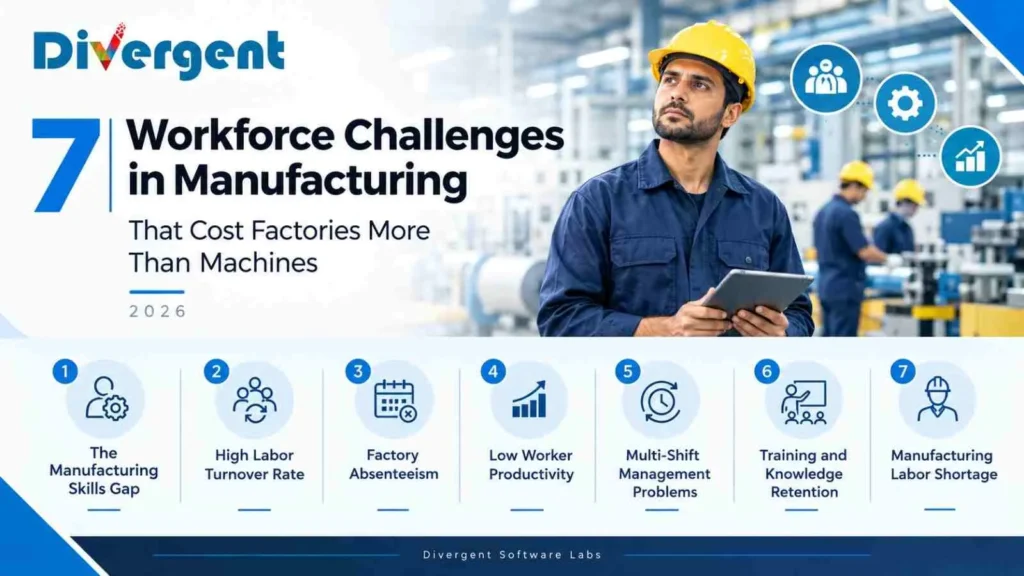
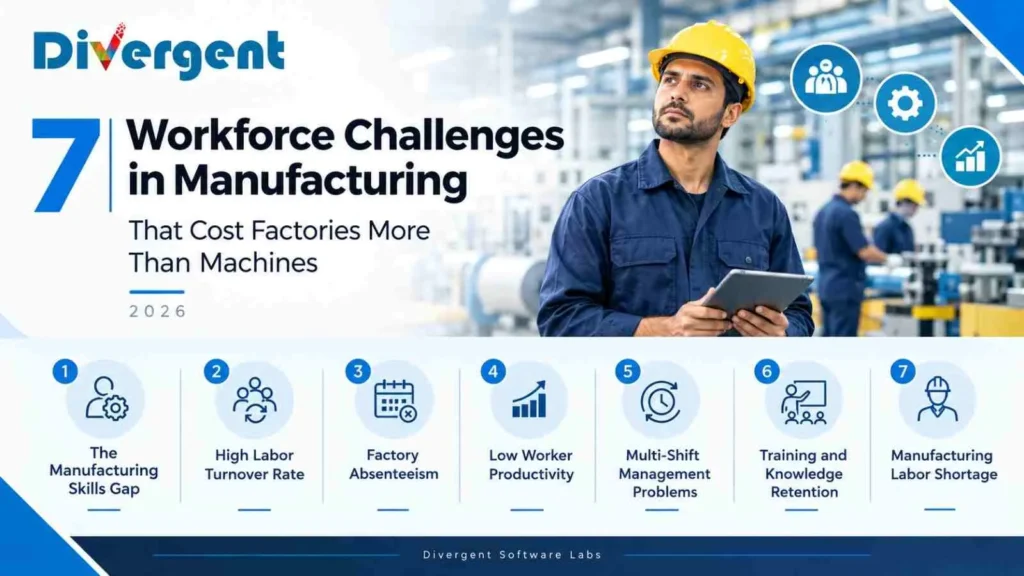
This guide covers the 7 biggest workforce challenges in manufacturing, what causes each one, what it costs, and how factory managers are addressing them in 2026.
Table of Contents
- What Is Workforce Management in Manufacturing?
- 7 Workforce Challenges in Manufacturing
- 1. The Manufacturing Skills Gap
- 2. High Labor Turnover Rate
- 3. Factory Absenteeism
- 4. Low Worker Productivity
- 5. Multi-Shift Management Problems
- 6. Training and Knowledge Retention
- 7. Manufacturing Labor Shortage
- How Does ERP Help With Workforce Management?
- How to Retain Employees in Manufacturing
- How to Improve Worker Productivity in a Factory
- How Divergent PackPro Supports Workforce Management
- Frequently Asked Questions
What Is Workforce Management in Manufacturing?
Workforce management in manufacturing is the set of processes, systems and practices that a factory uses to plan, deploy, track and develop its people — from shift scheduling and attendance to productivity measurement, training and performance management.
Effective workforce management in manufacturing connects people to production. It answers the questions: who is working which shift, what are they producing, how does their output compare to the target, where are the skill gaps, and who is at risk of leaving? Without answers to these questions, workforce challenges in manufacturing go unmanaged — not because managers do not care, but because the data to manage them does not exist.
Most packaging and FIBC plants manage their workforce the same way they managed it ten years ago — shift registers, verbal handovers, experience-based decisions. The workforce challenges that result are not new problems. They are old problems that have been allowed to persist because no one has measured their cost precisely enough to justify changing the approach.
7 Workforce Challenges in Manufacturing
These are the seven workforce challenges in manufacturing that cost packaging plants the most — in direct costs, lost output and management attention.
1. The Manufacturing Skills Gap
The manufacturing skills gap is the difference between the skills a factory needs and the skills available in its workforce. In packaging and FIBC plants, the skills gap shows up in specific ways: experienced loom operators who retire without training replacements, extrusion technicians who can diagnose a tape quality problem by sound but have never documented how, quality inspectors who apply different standards because no written specification exists.
The manufacturing skills gap has two components. The first is technical — the machinery and processes in modern packaging plants require skills that general labour does not have and that take months to develop. The second is knowledge transfer — the expertise that experienced workers carry in their heads is never captured, so when they leave, it leaves with them.
According to Deloitte’s Manufacturing Skills Gap research, the global manufacturing industry faces a shortage of 2.4 million skilled workers by 2028 — with the gap most severe in precision machinery operation, quality inspection and production planning.
What it costs: A single experienced loom operator produces 15 to 25 percent more output per shift than an untrained replacement. When a plant loses five experienced operators in a year — which is not unusual in high-turnover environments — the output impact is measurable in missed deliveries and overtime costs.
Fix: Document operating procedures for every critical process. Pair experienced operators with new hires for structured handover periods. Record machine-specific settings, troubleshooting steps and quality specifications in a format that survives the person who created them.
2. High Labor Turnover Rate in Manufacturing
High labor turnover is among the most expensive workforce challenges in manufacturing — not because the cost of each departure is catastrophic, but because the cost recurs constantly and is never totalled. Recruitment, induction, training, the lost productivity during ramp-up, the quality problems caused by inexperienced workers and the burden on supervisors managing new starters all accumulate month after month.
Annual turnover rates of 25 to 40 percent are common in packaging plants. At 30 percent turnover in a plant of 100 workers, 30 people leave and 30 new people start every year. If each departure and replacement costs ₹30,000 to ₹60,000 in direct and indirect costs — a conservative estimate — that is ₹9 to ₹18 lakhs per year in turnover cost alone, before accounting for the productivity loss during the ramp-up period of each new hire.
What causes high turnover in manufacturing: Repetitive work without visible progression, pay that does not reflect skill development, night shifts without adequate compensation, inconsistent management, and the perception that factory work offers no career path.
Fix: Track turnover by department, shift and supervisor — because turnover is rarely uniform across a plant. A department with 60 percent turnover sitting next to one with 15 percent is a management problem, not a market problem. Identify the pattern before spending on retention initiatives.
3. Factory Absenteeism
Factory absenteeism is the workforce challenge in manufacturing that disrupts production most unpredictably. A machine breakdown can be planned around — with a preventive maintenance schedule and spare parts inventory. An absent worker cannot be planned around unless the factory has a systematic way to identify it early and deploy a trained replacement.
In most packaging plants, absenteeism is managed reactively. The shift starts, three workers are absent, the supervisor redistributes the remaining team and output falls. No record is kept of which workers are absent most frequently, on which days or shifts, or what the output impact was. Without this data, absenteeism cannot be managed — only absorbed.
What factory absenteeism costs: An absenteeism rate of 5 percent — one worker absent for every 20 on shift — reduces effective capacity by 5 percent. In a plant running 300 production days per year, that is 15 days of lost capacity. For a plant producing ₹5 crore of output per year, 15 days of lost capacity is ₹25 lakhs of unproduced revenue.
How to reduce absenteeism in manufacturing: Record attendance at shift level with timestamps. Identify the workers, shifts and days with the highest absence rates. Understand the causes before designing solutions — Monday absenteeism after night shifts has a different root cause than Friday absenteeism before weekends.
4. Low Worker Productivity in Manufacturing
Low worker productivity is the most underestimated of all workforce challenges in manufacturing — because most plants do not measure individual or team productivity consistently enough to know how low it actually is. Output per shift is tracked. Output per worker per shift — against a defined target — is tracked in very few packaging plants.
The productivity gap between the best and worst workers on the same machine in the same plant is typically 20 to 35 percent. A loom operator who consistently runs at 95 percent efficiency and one who runs at 70 percent, on the same loom, with the same material, produce very different outputs. If the plant does not measure this, it cannot address it — through training, supervision, incentive or reassignment.
What causes low productivity in manufacturing: Unclear targets, no feedback on performance, poor workstation layout, inadequate tools or equipment, waiting time caused by material shortages or machine problems, and insufficient training for the specific task.
How to improve worker productivity in a factory: Set shift-wise output targets for each machine and operator. Record actual output against target at shift end. Share the comparison with operators and supervisors daily — not monthly. Workers who receive daily feedback on their performance improve faster than those who receive no feedback at all.
5. Multi-Shift Management Problems
Multi-shift operations multiply every workforce challenge in manufacturing. What happened on the night shift is not visible to the day shift supervisor who takes over. A quality problem that started at 2am is only discovered at 8am when the day team reviews the output — by which time several hours of defective production have already been completed.
Shift handover in most packaging plants is verbal. The outgoing supervisor tells the incoming supervisor what happened, what needs attention and what is pending. Verbal handovers are inconsistent, incomplete and undocumented. Critical information — a machine running slightly out of spec, a material batch that is borderline on quality, a customer order that moved up in priority — gets lost in translation between shifts.
How to manage shift workers in a factory: Standardise the shift handover with a written checklist — machine status, output achieved vs target, quality issues, pending actions, material status. A five-minute written handover prevents hours of detective work by the incoming shift. Store handover records in a shared system so any manager can see what happened on any shift without having to call the supervisor who was there.
6. Training and Knowledge Retention
Training is one of the most neglected workforce challenges in manufacturing — not because factory managers do not value it, but because the short-term cost of taking a worker off the line for training is visible and immediate, while the long-term cost of not training them is invisible and delayed.
The result is that most packaging plant training is reactive — a quality problem triggers a brief session on inspection standards, a machine breakdown triggers a review of operating procedure. Structured, scheduled training for skill development is rare. The result is a workforce that is trained to do what it currently does but not developed to do what the factory needs it to do as it grows and adds complexity.
Knowledge retention is the second half of this challenge. In a plant where experienced workers hold critical knowledge in their heads — machine settings, troubleshooting sequences, customer-specific quality requirements — that knowledge is permanently at risk. Every time an experienced worker leaves, some of that knowledge leaves with them. The plant that does not document its processes is constantly rebuilding expertise it has already paid to develop.
7. Manufacturing Labor Shortage
Manufacturing labor shortage is a structural workforce challenge that is getting worse, not better. In most industrial cities, the competition for experienced packaging plant workers — loom operators, extrusion technicians, quality inspectors — is increasing as more factories open and fewer young people choose factory work as a first-choice career.
The manufacturing labor shortage has two dimensions for packaging plants. The first is quantity — finding enough workers to run planned capacity. The second is quality — finding workers with the specific technical skills that packaging production requires. Both are becoming harder, and the factories that address them most effectively do so by retaining the skilled workers they already have rather than competing to hire from an increasingly thin market.
How to solve labor shortage in manufacturing: Reduce demand for labour by improving productivity of existing workers. Retain skilled workers through structured career paths and performance-based incentives. Cross-train workers across machines so that absence or departure on one machine does not stop production. Reduce the ramp-up time for new workers by documenting processes that currently exist only in experienced workers’ heads.
How Does ERP Help With Workforce Management in Manufacturing?
ERP helps with workforce management in manufacturing by connecting people data to production data — so that attendance, output, productivity and shift performance are measured automatically from production transactions rather than compiled manually from supervisor estimates.
| Workforce Challenge | Without ERP | With ERP |
|---|---|---|
| Skills gap | Known informally, never quantified | Output by operator visible — skill gaps identified from data |
| High turnover | Turnover rate estimated, causes unknown | Turnover tracked by department, shift and supervisor |
| Absenteeism | Managed shift by shift, no pattern visible | Absence rate by worker, shift and day — patterns identified |
| Low productivity | No target vs actual per operator | Output vs target per machine and shift, daily |
| Shift handover | Verbal, inconsistent | Structured shift report in system, visible to all managers |
| Training | Ad hoc, no record | Training records linked to operator performance data |
| Labor shortage | Reacted to when critical | Capacity gaps visible in advance from production planning |
The most significant contribution ERP makes to workforce management is measurement. Workforce challenges in manufacturing that are not measured cannot be managed. An ERP that captures production output by operator and shift, attendance by worker and department, and quality results by inspector gives management the data to address workforce challenges with evidence rather than intuition. See our guide to reporting challenges in manufacturing for how live production data transforms management decisions.
How to Retain Employees in Manufacturing
Retaining employees in manufacturing requires addressing the reasons they leave — which are not always pay. Research consistently shows that the top reasons manufacturing workers leave are:
- No visible career path. Workers who cannot see how they will progress — from operator to senior operator to supervisor — have no reason to stay beyond their current wage. Define and communicate a progression path with specific criteria for each level.
- Poor supervision. Turnover is concentrated under specific supervisors in most plants. Track turnover by supervisor. A supervisor with 60 percent annual turnover on their team is a workforce management problem, not a market problem.
- No recognition for performance. Workers who produce more than their peers and receive no acknowledgment have no incentive to continue performing. Shift-level output data makes performance visible — and visible performance can be recognised and rewarded.
- Uncomfortable working conditions. Noise, heat, poor lighting and inadequate rest areas are controllable. Plants that invest in working conditions retain workers longer than those that do not.
- Inconsistent pay practices. Workers who feel that pay decisions are arbitrary or inconsistent leave. Transparent, criteria-based pay progression reduces this perception significantly.
How to Improve Worker Productivity in a Factory
Improving worker productivity in a factory follows a consistent sequence: measure, baseline, target, feedback, improve.
- Measure actual output per operator per shift. You cannot improve what you do not measure. Set up a system — even a simple one — that records how many units each operator or team produces per shift on each machine.
- Establish a realistic target for each machine and product. The target should reflect what a skilled, experienced operator can consistently achieve — not the theoretical machine speed. Set it too high and workers become discouraged. Set it too low and it provides no improvement pressure.
- Give operators daily feedback on their performance against target. Workers who receive daily feedback improve faster than those who receive monthly or annual reviews. The feedback should be specific — machine 3, shift B, 87 percent of target — not generic.
- Identify and remove the causes of underperformance. When output is consistently below target, investigate why. Machine speed set incorrectly. Material quality causing frequent stops. Worker undertrained for the specific product. Each cause has a different fix. Fix the right thing.
- Recognise and reward consistent high performance. Workers who consistently exceed their target should be recognised — not just financially, but publicly within the plant. Performance recognition is one of the most cost-effective retention tools available.
How Divergent PackPro Supports Workforce Management in Manufacturing
Divergent PackPro is a manufacturing ERP built for FIBC, BOPP, PP woven bag and packaging plants. Its production tracking module captures the data that makes workforce management in manufacturing possible — connecting operator-level output to shift planning, quality results and production targets.
- Shift-wise production tracking: Actual output recorded per machine, per shift and per operator — compared against target automatically, visible to supervisors and management in real time.
- Attendance integration: Shift attendance linked to production records — so absenteeism impact on output is measurable, not estimated.
- Quality linked to operator: Quality inspection results recorded against the operator and shift that produced the batch — enabling training decisions based on data, not assumption.
- Shift handover records: Structured shift handover captured in the system — machine status, output, quality issues, pending actions — visible to all managers without requiring a phone call to the previous shift supervisor.
- Capacity planning: Forward production planning connected to shift staffing — so capacity gaps are visible before they cause delivery problems, not after.
See how Divergent PackPro works or speak to our team for a walkthrough of the production tracking and workforce management features.
Frequently Asked Questions — Workforce Challenges in Manufacturing
What are the biggest workforce challenges in manufacturing?
The biggest workforce challenges in manufacturing are the skills gap, high labor turnover, factory absenteeism, low worker productivity, multi-shift management problems, inadequate training and manufacturing labor shortage. Each has a direct financial cost — from the output lost to absenteeism to the recruitment and ramp-up cost of high turnover.
What is the skills gap in manufacturing?
The manufacturing skills gap is the difference between the technical skills a factory needs and the skills available in its workforce. It shows up as experienced operators who retire without trained replacements, knowledge that exists only in individuals’ heads rather than documented procedures, and new workers who take months to reach acceptable productivity on specialised machinery.
Why is manufacturing labor turnover so high?
Manufacturing labor turnover is high because factory work is physically demanding, shift-based and often offers no visible career progression. Workers leave when they see no path to advancement, when supervision is inconsistent or poor, when performance is not recognised, and when working conditions are uncomfortable. Pay is a factor but rarely the primary one — workers who feel valued and see a future in the role stay longer than those who do not.
How do you manage shift workers in a factory?
Managing shift workers in a factory requires a structured shift handover process, consistent attendance tracking, shift-wise output targets, daily performance feedback and clear escalation paths for problems that arise on shift. The most common failure in shift management is verbal handover — information that should transfer between shifts gets lost, and the incoming team starts without a complete picture of what happened before them.
What causes low productivity in manufacturing?
Low productivity in manufacturing is caused by unclear output targets, no feedback on performance, machine settings that are not optimised, material quality issues that cause frequent stops, undertrained workers and waiting time caused by material shortages or quality holds. Most plants do not measure individual or team productivity consistently, so they cannot identify which cause is dominant at any given time.
How to solve labor shortage in manufacturing?
Solving labor shortage in manufacturing requires reducing the demand for labour through productivity improvement, retaining the skilled workers already in the plant through better management and career development, cross-training workers across machines so that individual absences do not stop production, and reducing ramp-up time for new hires by documenting processes that currently exist only in experienced workers’ heads.
What is workforce management in manufacturing?
Workforce management in manufacturing is the set of processes and systems a factory uses to plan, deploy, track and develop its people. It covers shift scheduling, attendance management, output tracking per operator and team, training and skill development, and performance management. Effective workforce management connects people data to production data so that workforce challenges are identified and addressed from evidence rather than intuition.
How does ERP help with workforce management in manufacturing?
ERP helps with workforce management by capturing production output per operator and shift, linking attendance to production records, connecting quality results to the operator who produced the batch, and providing shift handover records that every manager can access. The primary contribution of ERP to workforce management is measurement — workforce challenges that are not measured cannot be managed.
How to retain employees in manufacturing?
Retaining employees in manufacturing requires addressing the reasons they leave: no visible career path, poor supervision, no recognition for performance, uncomfortable working conditions and inconsistent pay practices. Track turnover by department, shift and supervisor to identify where the problem is concentrated — turnover is rarely uniform across a plant and almost always reflects management quality as much as market conditions.
How to improve worker productivity in a factory?
Improving worker productivity in a factory requires measuring actual output per operator per shift, setting a realistic target for each machine and product, giving operators daily feedback on their performance against target, identifying and removing the causes of underperformance, and recognising consistent high performance. Daily feedback produces faster improvement than monthly or annual reviews.