What is an AI invoice processing agent?
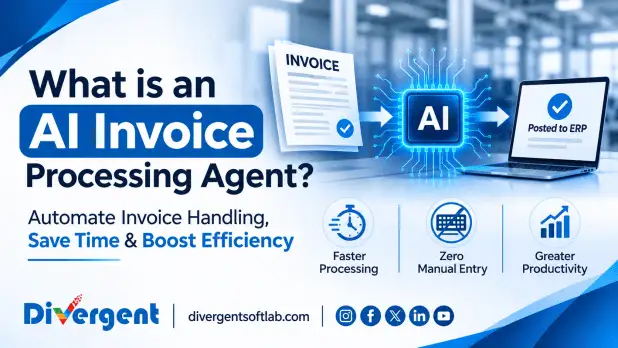
An AI invoice processing agent is a system that handles your supplier invoices end to end, capturing them, reading every field, checking them against your purchase orders, and posting them to your ERP, without anyone on your team touching a keyboard for routine invoices.
Here is a situation most manufacturing finance teams know well. An invoice lands in the inbox on Monday morning. By the time someone opens it, finds the PO, keys everything into the system, chases the approver, and files the document, it is Wednesday. That is two days and 20 minutes of skilled work spent on a task a machine can do in seconds.
Now multiply that by 300 invoices a month. That is 100 hours your finance team will never get back, every single month, forever unless something changes.
AI invoice processing is that change. And according to McKinsey, companies that make it typically cut invoice processing costs by 60 to 80 percent in the first year. That is not a forecast. That is what plants that have already implemented it report.
What Does AI Invoice Processing Actually Mean?
What does AI invoice processing mean for a manufacturing business?
People often confuse AI invoice processing with OCR, the software that reads scanned documents. OCR turns an image into text. That is where it stops. Your team still has to take that text, verify it, enter it into the ERP, and do the matching.
AI invoice processing goes the whole way. It does not just read the invoice; it understands it. It knows which number is the PO reference and which is the invoice number. It knows the difference between a quantity and a unit price. And once it has extracted everything, it checks the invoice against your purchase order and goods receipt note automatically, then either posts it or flags the issue, depending on what it finds.
As Wikipedia describes invoice processing — it is the workflow of receiving, reviewing, approving, and paying invoices. AI takes over the first three steps for every clean invoice, leaving your team to handle the edge cases that actually need a human decision.
How AI Invoice Processing Works: Each Step Explained
How does AI invoice processing work inside a manufacturing ERP?
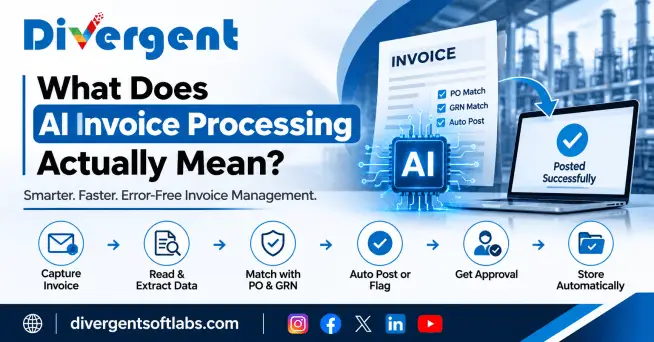
Step 1 – It Finds the Invoice Before You Do
The AI invoice processing agent watches your email inbox, supplier portal, document scanner, and EDI feed simultaneously. The moment an invoice appears, in any format, it picks it up and queues it for processing. No one needs to check the inbox. No invoice sits unnoticed for two days.
Step 2 – It Reads Every Field
Supplier name, invoice number, date, line items, quantities, unit prices, GST amounts, total value, payment terms — the agent extracts all of it. For structured PDF invoices from suppliers you work with regularly, accuracy is above 99 percent. For scanned paper invoices, the agent uses AI layout understanding to get the fields right even when the scan quality is not ideal.
Step 3 – It Checks the Invoice Against Your PO and GRN
This is where the real value is. The AI invoice processing agent pulls the matching purchase order and goods receipt note from your ERP and compares them against the invoice, same supplier, same items, same quantities, same prices. This is called three-way matching and it catches overcharging, quantity discrepancies, and wrong items before you pay. See how AI procurement agent for manufacturing creates the POs that feed directly into this matching step.
Step 4 – It Either Posts or Flags
Clean match? The invoice is posted to accounts payable automatically, within your defined authority limit. Discrepancy found. a price difference, a quantity that does not match, a GRN that has not been raised yet? The agent flags the specific issue with full context and sends it to the right person. It never quietly lets a mismatched invoice through.
Step 5 – Approvals Happen With One Click
Invoices above your auto-approval limit go to the approver with everything they need: the invoice, the PO, the GRN, and the discrepancy note, if there is one, in a single view. They click “approve” or “reject.” They do not spend 10 minutes looking things up first.
Step 6 – Everything Is Filed Automatically
The invoice posts to the ERP, files against the supplier record and the PO, and a full audit trail is created automatically. When your auditors ask for invoice documentation six months from now, it takes seconds to pull up, not a day of searching through email threads.
AI Invoice Processing vs Doing It Manually, The Honest Comparison
What is the real difference between AI invoice processing and manual invoice entry?
| What needs to happen? | How it works manually | How AI invoice processing handles it |
|---|---|---|
| The invoice arrives by email. | Someone checks the inbox when they get to it. | The agent captures it the moment it arrives. |
| Reading the invoice | 15 to 20 minutes of manual keying | Seconds, extracted automatically |
| Checking against the PO | Open ERP, find the PO, and compare line by line. | Three-way match runs automatically. |
| Spotting a price error | Only if the person checking notices it | Flagged every time, 100% consistent |
| Routing for approval | Send an email and wait. | Automatic routing with full context |
| Posting to ERP | More manual entry, with typo risk | Automatic same-day posting |
| Filing the document | Somewhere in a folder or email chain | Filed against supplier record and PO instantly |
| Total time per invoice | 2 to 5 days to start to finish | Same day for matched invoices |
| Error rate | 1 to 3% from manual keying | Less than 0.1% |
What Is Three-Way Matching, and Why It Matter So Much
What is 3-way matching in invoice processing?
Three-way matching is simply comparing three documents against each other: the purchase order you raised, the goods receipt note your stores team created when the material arrived, and the invoice your supplier has sent.
When all three agree on the same supplier, the same items, the same quantities, and the same prices, the invoice is clean. Pay it.
When they do not agree, maybe the invoice says 1,000 kg but your GRN says 980 kg was received, or the price per kg is Rs 2 higher than your PO; that is a discrepancy. Do not pay it without resolving it first.
In a manual process, doing this check properly takes 5 to 10 minutes per invoice and depends entirely on the person doing it being thorough. In AI invoice processing, the check happens automatically for every invoice, no shortcuts, no skipping, no dependency on who is doing it that day.
Why Manufacturing Plants Get More From AI Invoice Processing
What makes AI invoice processing different for manufacturing?
Generic finance automation tools are built for straightforward invoices, fixed prices, fixed quantities, and standard items. Manufacturing invoices are more complicated than that.
A PP granule invoice from your supplier is billed by weight. The quantity on the invoice is the actual weight delivered, which will be slightly different from the PO quantity because raw material comes in batches that vary. Is that a discrepancy or normal variation? A generic tool flags it every time. A manufacturing-specific AI invoice processing agent understands the tolerance and only flags it when the variance is outside acceptable limits.
A BOPP film invoice is billed by roll width and micron. A job work invoice combines labor and material. These structures need to be understood, not just read. Divergent PackPro’s AI invoice processing agent is built for FIBC, BOPP, and packaging manufacturing; it understands how your suppliers bill you without needing custom configuration for each one.
See how our complete agentic AI ERP for manufacturing connects invoice processing with procurement, quality control, and production planning in one system.
What AI Invoice Processing Did for a Packaging Plant in Indore
How does AI invoice processing work in a real manufacturing plant?
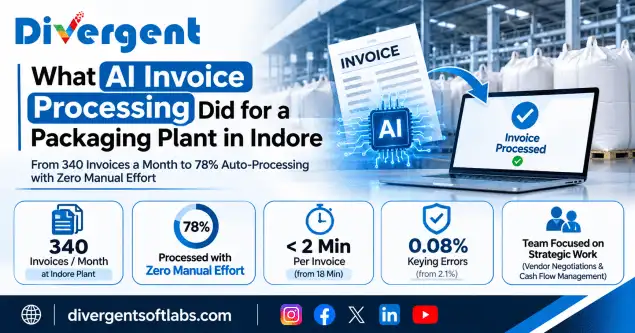
A FIBC bag manufacturer in Indore was processing 340 supplier invoices every month. Two accounts team members. 18 minutes per invoice on average, opening, entering, matching, routing, chasing, and and filing.
That is 102 hours a month. More than half of two people’s total working time was spent entirely on data entry.
Three months after going live with Divergent PackPro’s AI invoice processing agent:
- 265 out of 340 invoices, 78 percent, processed with zero manual effort.
- Average time per invoice dropped from 18 minutes to under 2 minutes.
- No more end-of-week invoice backlog, everything processed the same day.
- Keying errors dropped from 2.1 percent to 0.08 percent.
- Both accounts team members were redirected to vendor negotiations and cash flow management.
The plant did not hire anyone new. The invoices got processed faster. The errors stopped. And the accounts team finally had time to do work that actually required them.
Five Real Benefits of AI Invoice Processing
What are the actual benefits of AI invoice processing for a manufacturing business?
- Your accounts team stops doing data entry — They start doing actual finance work: vendor negotiations, payment planning, and cash flow management. The kind of work that requires judgment, not keystrokes.
- You pay suppliers faster — Same-day processing instead of 3 to 5 days means your suppliers get paid on time. That matters when you need priority delivery of PP granules before the weekend. See how reducing production costs through faster procurement cycles saves lakhs every year.
- Errors stop happening — Wrong quantities, transposed prices, incorrect GL codes these are manual keying problems. AI invoice processing extracts from the source document and validates against your ERP. The error rate drops below 0.1 percent.
- Your audit trail writes itself — Every invoice captured, every field extracted, every match result, every approval, and every posting is logged automatically. The next time an auditor asks for three months of invoice documentation, it takes two minutes to pull up.
- Your invoice volume can grow without your headcount growing — Whether you process 200 invoices a month or 2,000, the agent handles it with the same team. That is what scaling without overhead looks like.
How to Start With AI Invoice Processing — Without Disrupting Your Operations
How do you implement AI invoice processing safely?
- Start by understanding what you are dealing with — How many invoices per month? Which suppliers send structured PDFs and which send scanned paper? This shapes the configuration and tells you what to expect before you go live.
- Set clear boundaries for what the agent can do alone — Maximum invoice value for automatic posting, which suppliers are trusted for straight-through processing, which invoice types always need a human to review. These limits protect you while the system builds its track record.
- Run in read-only mode for the first four to six weeks — The agent processes everything and shows you what it would have done — but your team still approves each action. By week six, you have real accuracy data, not a promise from a sales deck.
- Go autonomous on low-value invoices first — Consumables, packaging materials, standard services. Build confidence before the system handles high-value raw material invoices on its own.
- Expand based on the data, not on a schedule — When three months of logs show consistent accuracy, you raise the limits. The system earns autonomy, it does not start with it.
The Numbers — Before and After AI Invoice Processing
| What we tracked | Before AI invoice processing | After AI invoice processing |
|---|---|---|
| Time per invoice | 15 to 20 minutes | Under 2 minutes including exceptions |
| Cost per invoice | Rs 150 to Rs 300 | Rs 20 to Rs 40 |
| Keying error rate | 1 to 3% | Under 0.1% |
| Time to pay after invoice receipt | 3 to 7 days | Same day for clean invoices |
| Finance team time on data entry | 60 to 70% of working time | Under 15% |
| Supplier payment disputes | Happen regularly | Near zero |
| Audit document retrieval | Takes a day or more | Under two minutes |
How Divergent Software Labs Builds AI Invoice Processing for Manufacturing
Divergent Software Labs builds AI invoice processing agents embedded in Divergent PackPro ERP — purpose-built for FIBC, BOPP, PP woven bag and packaging manufacturers. Not adapted from a generic finance tool. Built from scratch for how packaging plants actually receive and process invoices.
- Every format, one pipeline — Structured PDFs, scanned paper, email body invoices and EDI — all captured and processed the same way.
- Three-way matching that understands manufacturing — PO, GRN and invoice matched automatically with tolerance awareness for weight-based and batch-variable materials.
- No configuration per supplier — Rate-per-kg billing, roll-width invoicing, job work formats — understood natively without you having to set up templates for each supplier.
- Authority limits you control — Routine invoices post automatically. High-value ones go for approval. New suppliers always get reviewed. You set the rules.
- Lives inside the ERP — Not a separate system you have to maintain alongside your ERP. The agent reads and writes to Divergent PackPro directly — same records, same audit trail, no duplicate data.
If you want to see it working with your own invoices rather than a demo — here is an overview of Divergent PackPro or talk to our team directly. We will bring your supplier invoices into the session.
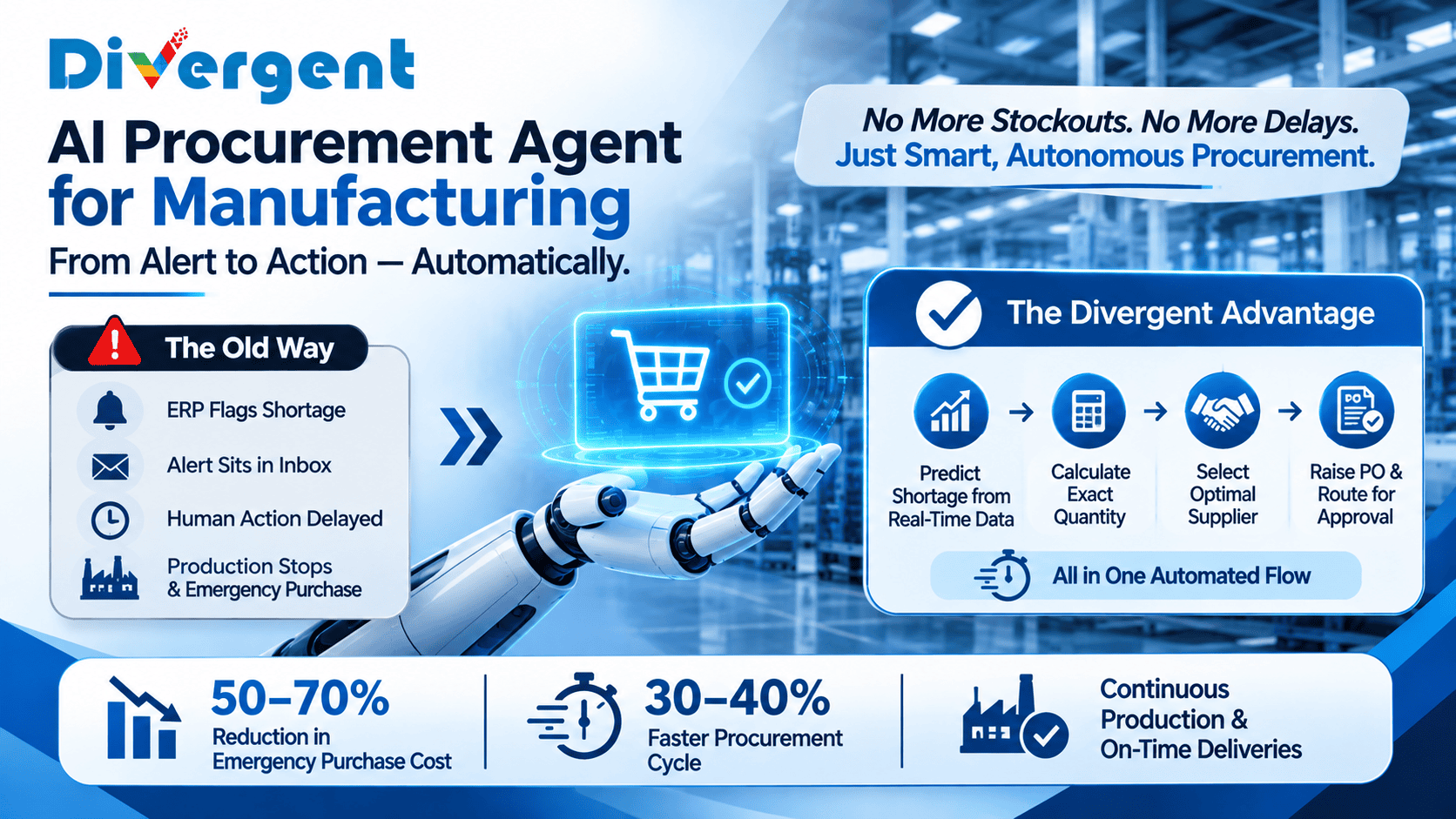
Also worth reading: how our AI procurement agent creates the purchase orders that feed into invoice matching, and how the AI sales agent handles the customer side of the same ERP.
People Also Ask — AI Invoice Processing
What is AI invoice processing?
AI invoice processing is a system that captures supplier invoices from any channel, reads every field automatically, matches against your purchase orders and goods receipt notes, and posts clean invoices to your ERP without manual data entry. It handles the routine 70 to 80 percent of invoices that match correctly — leaving your team to focus on the exceptions that need a human decision.
How does AI invoice processing work?
It works in six steps: the agent captures the invoice the moment it arrives, extracts every field automatically, runs a three-way match against your PO and GRN, posts clean invoices within your authority limits, flags any discrepancies with specific detail, and files everything with a complete audit trail. The whole process takes seconds for matched invoices.
What is three-way matching in invoice processing?
Three-way matching means checking an invoice against two other documents — the purchase order you raised and the goods receipt note your stores team created. When all three agree on supplier, items, quantities and prices, the invoice is clean and can be paid. When they do not agree, the specific discrepancy is flagged before payment happens. AI invoice processing does this check automatically for every invoice.
How much does AI invoice processing save?
Most manufacturing plants see processing cost drop by 60 to 80 percent per invoice — from Rs 150 to Rs 300 manually to Rs 20 to Rs 40 with AI. For a plant handling 300 invoices a month that is Rs 40,000 to Rs 80,000 a year in direct savings, plus faster payment cycles and the value of eliminating keying errors.
Can AI invoice processing handle scanned paper invoices?
Yes. Good-quality scans achieve above 95 percent extraction accuracy. When the scan quality falls below the confidence threshold, the agent flags it for human review rather than guessing and posting. Structured PDFs from regular suppliers hit above 99 percent accuracy.
How long does it take to implement AI invoice processing?
The phased approach typically takes 3 to 4 months to full autonomous operation: a two to four week configuration phase, then four to six weeks in read-only mode where humans review every action, then limited autonomous posting for low-value invoices, then progressive expansion as accuracy is proven. You earn confidence in the system before it operates independently.
Related Reading
- What Is Agentic AI: How Autonomous Agents Transform Manufacturing ERP
- AI Procurement Agent for Manufacturing
- AI Sales Agent for Manufacturing
- AI Quality Control in Manufacturing
- How to Reduce Production Cost in Manufacturing
- ERP Implementation in Manufacturing
Follow Divergent Softlab on Google
Enjoying our insights on manufacturing ERP, artificial intelligence and business technology? Add Divergent Softlab as a preferred source on Google to discover more of our latest articles.