What is an AI MIS reporting agent?
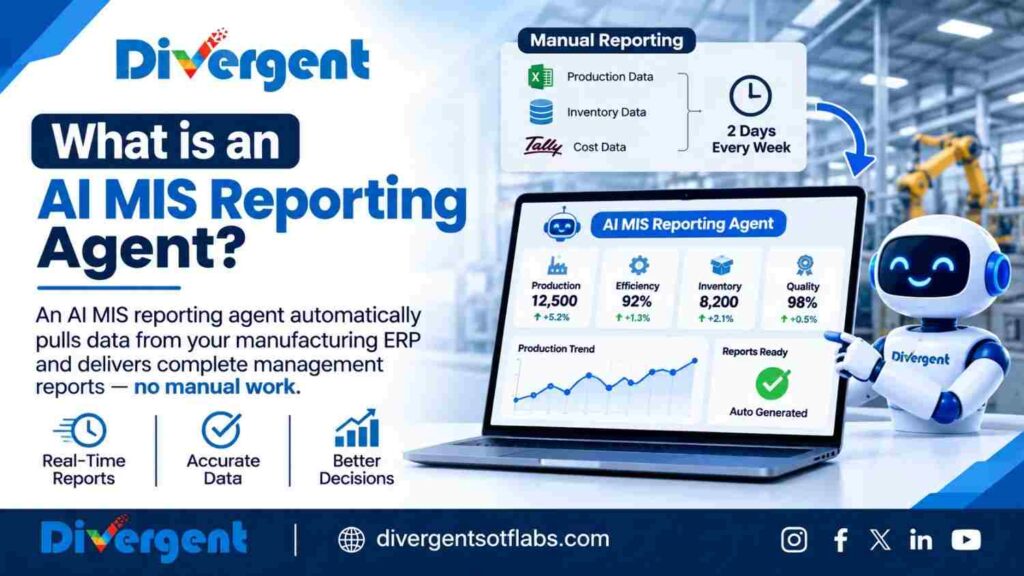
An AI MIS reporting agent is an autonomous system that connects to your manufacturing ERP, pulls production output, machine efficiency, inventory, quality and cost data automatically, and delivers a complete management information report, daily, weekly or monthly, without anyone on your team compiling it manually.
Here is what Monday morning looks like in most manufacturing plants. The plant manager wants last week’s numbers. The production executive opens three spreadsheets. The stores team pulls inventory from one system. The accounts person checks cost data in Tally. Someone compiles everything into a report format, finds a discrepancy, spends an hour reconciling it, and finally shares the report by Tuesday afternoon, sometimes Wednesday.
That is two full days of skilled work, every single week, producing information that was already sitting in the ERP. Your team did not create the data, they just moved it from one place to another.
An AI MIS reporting agent eliminates this entirely. The report compiles itself, checks itself and delivers itself, on schedule, every time, with zero manual effort. According to McKinsey, manufacturers implementing AI automation for reporting and analytics reduce management reporting time by 70 to 90 percent and improve decision speed significantly in the first year.
What Is MIS Reporting in Manufacturing?
What is MIS reporting in manufacturing?
MIS Management Information System, reporting in manufacturing is the regular compilation of operational data into a structured report for management decisions. A good manufacturing MIS report tells the plant owner and management team exactly what happened across production, inventory, quality, cost and dispatch in the reporting period, in one place, in one consistent format.
In practice, most manufacturing plants produce some version of an MIS report, a daily shift report, a weekly production summary, a monthly management pack. The problem is not what the report contains. The problem is how long it takes to produce and how reliable the numbers are by the time they reach management.
A report compiled manually from multiple systems on Tuesday is already three days old when the management team reads it on Wednesday. Decisions made from that report are based on last week’s reality, not today’s. An AI MIS reporting agent changes this, the report reflects the current state of the plant, compiled automatically, delivered on schedule.
What Data Does an AI MIS Report Include?
What data does an AI MIS report include for a manufacturing plant?
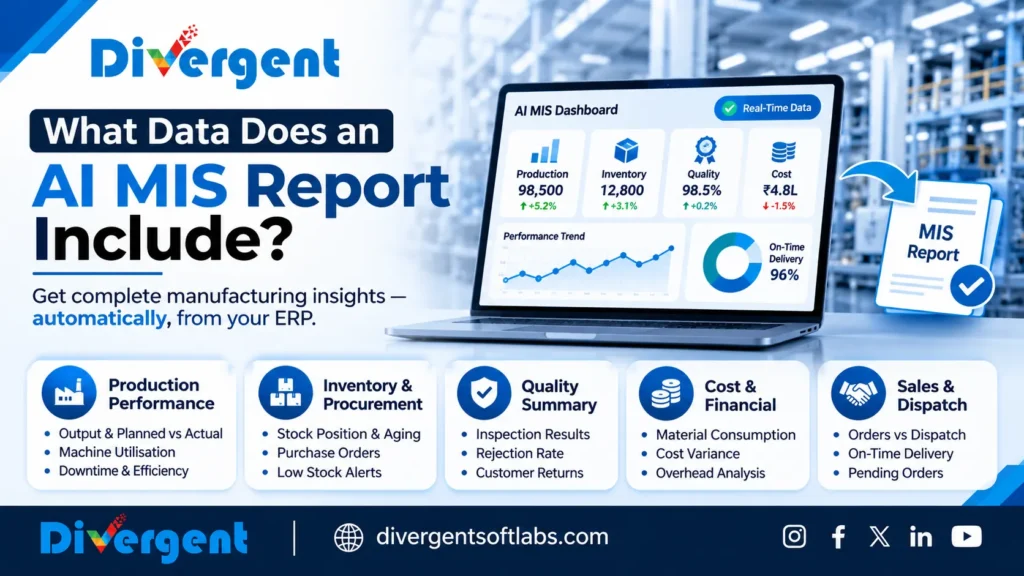
A complete AI MIS reporting agent pulls every operational metric from the ERP and structures it into a report management can actually use. Here is what a manufacturing MIS report covers:
Production Performance
Output by production line and shift, planned vs actual. Order completion rate. Work in progress by stage. Machine utilisation per line. Downtime hours and reason codes. Efficiency percentage per shift. The AI MIS reporting agent pulls this directly from production records in the ERP, no manual calculation, no shift supervisor chasing data.
Inventory and Procurement
Current stock position for all key materials — PP granules, BOPP film, ink, thread, packaging. Days of stock available against confirmed orders. Purchase orders raised vs received. Any material below reorder point. The AI MIS reporting agent connects with the inventory module in real time — the numbers in the report match the numbers in the system exactly. See how the AI procurement agent works alongside MIS reporting to act on inventory alerts automatically.
Quality Summary
Inspection results by production stage. Quality hold batches count, reason and status. Rejection rate by product type. Customer returns and complaints received. The AI MIS reporting agent pulls quality hold data from the ERP in real time — management sees the quality picture without waiting for the QC team to compile a separate report. See how the AI quality control agent creates the data the MIS report summarises.
Cost and Financial Summary
Material consumption vs standard. Cost variance per production order. Overhead absorption vs target. Any orders running above standard cost. The AI MIS reporting agent connects with the costing module management sees cost variance in the weekly report, not at month-end when it is too late to act. See our guide on how to reduce production cost in manufacturing for how early cost visibility changes decisions.
Sales and Dispatch
Orders received vs dispatched. On-time delivery rate. Pending orders with delivery dates at risk. Customer complaints logged. The AI MIS reporting agent connects with the sales and dispatch module — management sees delivery performance in the same report as production and quality. See how the AI sales agent acts on the delivery risk data the MIS report surfaces.
How AI MIS Reporting Works — Step by Step
How does AI automate MIS reports in manufacturing?
Step 1 — It Connects to Every Data Source in Your ERP
The AI MIS reporting agent connects to production, inventory, quality, costing and dispatch modules simultaneously. It does not wait for someone to export data — it reads directly from live ERP records. When a production entry is made at 6 PM, it is in the morning report. When a quality hold is placed at 3 AM, it is in the morning report. The report is as current as the data in the ERP.
Step 2 — It Calculates Every Metric Automatically
Efficiency percentage, cost variance, on-time delivery rate, rejection rate — the AI MIS reporting agent calculates every derived metric automatically from raw ERP data. No formulas to maintain. No calculation errors. No dependency on whoever set up the spreadsheet remembering to update the formula range when a new product was added.
Step 3 — It Checks the Numbers Before Sending
Before the report is delivered, the AI MIS reporting agent validates the data — checking for missing entries, unusually high or low values that might indicate a data error, and consistency between modules. If production recorded 10,000 bags dispatched but the dispatch module shows 8,500, the agent flags the discrepancy rather than sending a report with inconsistent numbers.
Step 4 — It Delivers on Your Schedule
Daily shift report at 7 AM. Weekly management summary every Monday at 8 AM. Monthly management pack on the first working day of the month. The AI MIS reporting agent delivers each report to the right people at the right time — by email, in the ERP dashboard or both, without anyone scheduling or triggering it.
Step 5 — It Highlights What Needs Attention
A report that presents 50 numbers equally is not useful. The AI MIS reporting agent highlights variances, production efficiency below target, cost running above standard, materials below reorder point, delivery dates at risk, so management attention goes to the things that actually need a decision, not to scanning through a table looking for a problem.
AI MIS Reporting vs Manual Reporting — The Real Difference
What is the difference between AI MIS reporting and manual report preparation?
| What needs to happen | Manual reporting | AI MIS reporting agent |
|---|---|---|
| Data collection from ERP | Someone exports from each module separately | Agent pulls directly, real time |
| Calculation of KPIs | Spreadsheet formulas, maintained manually | Calculated automatically every report |
| Cross-checking numbers | Depends on who is checking and when | Validated before every delivery |
| Report delivery | When someone finishes it — usually late | On schedule — 7 AM every morning |
| How current is the data? | As old as the last manual export | Current to the last ERP entry |
| Time to prepare | 2 to 3 hours daily, 1 to 2 days for weekly | Zero — fully automatic |
| Error rate | Human calculation and copy-paste errors | Near zero, system calculated |
| Consistency | Varies with who prepares it | Same format, same logic every time |
| Availability during leave | Report does not happen | Unaffected, no dependency on people |
What KPIs Should a Manufacturing MIS Report Include?
What KPIs should a manufacturing MIS report include?
The right KPIs depend on what decisions the report needs to support. For a manufacturing plant, these are the metrics that actually drive decisions:
| Category | KPI | Why it matters |
|---|---|---|
| Production | Output vs target per line | Identifies underperforming lines before the week ends |
| Production | Machine utilisation % | Shows capacity being wasted |
| Production | Downtime hours by reason | Directs maintenance priority |
| Inventory | Days of stock vs orders | Early warning on material shortages |
| Inventory | Materials below reorder point | Triggers procurement action |
| Quality | Rejection rate by product | Identifies quality problems early |
| Quality | Holds pending clearance | Flags production delay risk |
| Cost | Cost variance per order | Protects margin on each order |
| Dispatch | On-time delivery rate | Customer relationship health |
| Dispatch | Orders at delivery risk | Enables proactive customer communication |
AI MIS Reporting for Manufacturing Plants in India — The Specific Challenge
Why is MIS reporting particularly painful for Indian manufacturing plants?
Most manufacturing plants in India run a split system, production on paper or a basic ERP, accounts in Tally, inventory in Excel, quality in registers. Getting an MIS report means pulling data from three or four disconnected sources, reconciling differences between them and then formatting it for the management team.
The person doing this — usually a production executive, an accounts executive or the owner’s assistant, is spending 2 to 3 hours every morning and 6 to 8 hours every Monday doing work that produces no business value. The data was already in the systems. The report just moves it into a different format.
An AI MIS reporting agent embedded in a connected manufacturing ERP eliminates this problem entirely, because all the data is in one system to begin with, and the agent reads and formats it automatically. See our complete guide on agentic AI ERP for manufacturing for how connected systems make this possible.
Case Study — AI MIS Reporting at an Indore Packaging Plant
How does AI MIS reporting work in a real manufacturing plant?
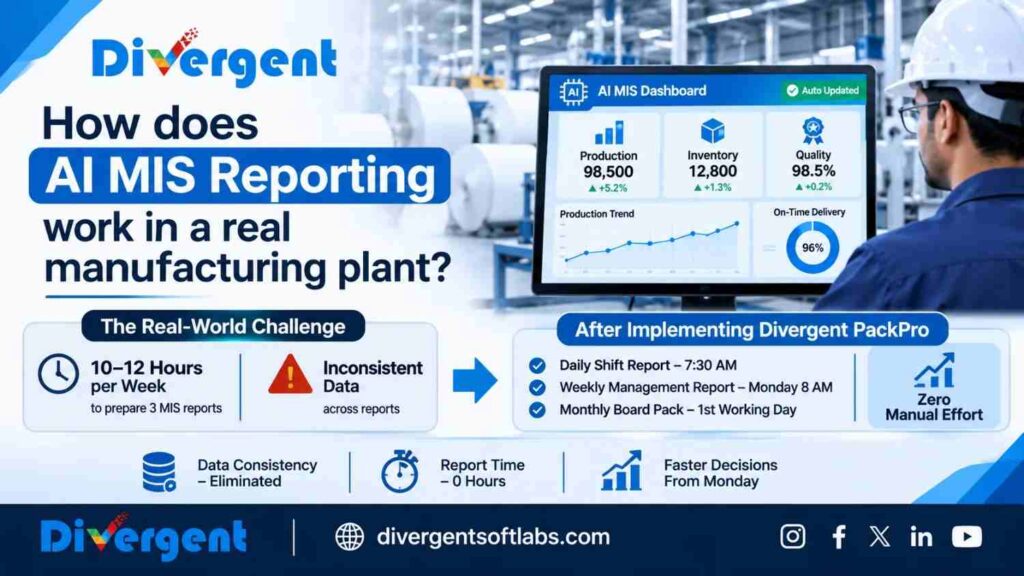
A FIBC bag manufacturer in Indore was producing three MIS reports every week, a daily shift summary, a weekly management report and a monthly board pack. Three people contributed data. One person compiled everything. The process took 10 to 12 hours per week reliably, more during month-end.
The numbers were also not always consistent. The production report sometimes showed different output figures from the dispatch report because one was updated at shift end and the other was updated the next morning. Management learned to treat some numbers as approximate, which defeated the purpose of the report.
Four months after implementing Divergent PackPro with the AI MIS reporting agent:
- Daily shift report delivered automatically at 7:30 AM — zero manual effort
- Weekly management report delivered every Monday at 8 AM — before the management meeting
- Monthly board pack compiled and delivered on the first working day — not the fourth
- Report preparation time: from 10 to 12 hours per week to zero
- Data consistency issues: eliminated — all numbers from one ERP source
- Management team began making production allocation decisions on Monday morning instead of Wednesday afternoon
The production executive who previously spent Monday mornings compiling reports now spends Monday mornings reviewing them and acting on them.
What Plants Achieve With AI MIS Reporting
| What we tracked | Before AI MIS reporting | After AI MIS reporting agent |
|---|---|---|
| Weekly report preparation time | 8 to 12 hours | Zero — fully automatic |
| Daily shift report time | 1 to 2 hours every morning | Zero — delivered at 7 AM |
| Report data currency | 1 to 3 days old | Current to last ERP entry |
| Number consistency across modules | Frequent discrepancies | Single source — always consistent |
| Management decision speed | Wednesday from Monday data | Monday morning from same-day data |
| Report availability during leave | Delayed or incomplete | Unaffected — automatic |
| Month-end MIS pack preparation | 4 to 6 days | First working day — automatic |
How Divergent Software Labs Builds AI MIS Reporting for Manufacturing
Divergent Software Labs builds AI MIS reporting agents embedded in Divergent PackPro ERP — purpose-built for FIBC, BOPP, PP woven bag and packaging manufacturers. The reporting agent is not a separate BI tool that needs to be integrated. It is part of the same ERP that runs production, inventory, quality and dispatch — reading the same live data, using the same records.
- Three report types built in — Daily shift report, weekly management summary and monthly board pack, each with the right level of detail for the audience and the decision.
- Configurable KPIs — Add or remove metrics based on what your management team actually uses. Reports stay relevant as your business priorities change.
- Variance highlighting — Every report highlights metrics outside target — production efficiency below threshold, cost variance above limit, materials below reorder point. Management attention goes where it is needed.
- Multiple delivery formats — Email digest, in-ERP dashboard and PDF — the report reaches the right people in the format they prefer.
- No separate system to maintain — The AI MIS reporting agent runs inside Divergent PackPro. No integration, no data sync, no duplicate data entry between systems.
To see how Divergent PackPro’s AI MIS reporting agent works with your plant’s specific data — here is an overview of Divergent PackPro or talk to our team. We will show you a sample report built from your plant’s KPIs before you decide anything.
Also see how our other AI agents work alongside MIS reporting: the AI invoice processing agent and the AI sales agent for manufacturing.
People Also Ask — AI MIS Reporting Agent
What is an AI MIS reporting agent?
An AI MIS reporting agent is an autonomous system that connects to your manufacturing ERP, pulls production, inventory, quality, cost and dispatch data automatically, and delivers a complete management information report on schedule — daily, weekly or monthly — without anyone compiling it manually. It eliminates report preparation time and ensures management always has current, consistent data.
How does AI automate MIS reports in manufacturing?
The AI MIS reporting agent connects to all ERP modules simultaneously, reads live data, calculates KPIs automatically, validates consistency across modules, formats the report and delivers it by email or dashboard on a fixed schedule. The process runs without human intervention for every routine report cycle.
How much time does AI MIS reporting save?
Most manufacturing plants save 8 to 12 hours per week on report preparation — the daily shift report (1 to 2 hours daily) and the weekly management summary (1 to 2 days) become fully automatic. Month-end MIS packs that previously took 4 to 6 days are delivered on the first working day of the month.
What data does a manufacturing MIS report include?
A complete manufacturing MIS report covers production output vs target, machine utilisation and downtime, inventory position and materials below reorder, quality rejection rate and holds, cost variance per order, on-time delivery rate and orders at delivery risk. The AI MIS reporting agent pulls all of this from live ERP data automatically.
Is AI MIS reporting suitable for small manufacturers?
Yes — particularly for plants with 20 to 200 employees where the same two or three people are responsible for both running operations and preparing management reports. AI MIS reporting frees those people from report preparation and lets them spend time on operational decisions instead.
How does AI MIS reporting connect with ERP?
The AI MIS reporting agent is embedded in the ERP — it reads directly from live production, inventory, quality, costing and dispatch records. There is no data export, no separate integration and no sync delay. The report reflects the current state of the ERP at the moment it is generated.
Related Reading
- What Is Agentic AI: How Autonomous Agents Transform Manufacturing ERP
- AI Procurement Agent for Manufacturing
- AI Invoice Processing Agent for Manufacturing
- AI Sales Agent for Manufacturing
- AI Quality Control in Manufacturing
- How to Reduce Production Cost in Manufacturing
Follow Divergent Softlab on Google
Enjoying our insights on manufacturing ERP, artificial intelligence and business technology? Add Divergent Softlab as a preferred source on Google to discover more of our latest articles.