AI to cut production costs in manufacturing is no longer an experiment. Plants across India are using it right now to eliminate stockouts, reduce raw material waste, catch quality problems early, and improve machine utilization—and the financial results are showing up in the numbers within 60 to 90 days.
Three years ago, a packaging plant owner in Madhya Pradesh sat across from his accountant and looked at numbers that did not make sense. His plant was running at 85 percent capacity. Orders were coming in. His team was working full shifts. But margins were shrinking every quarter.
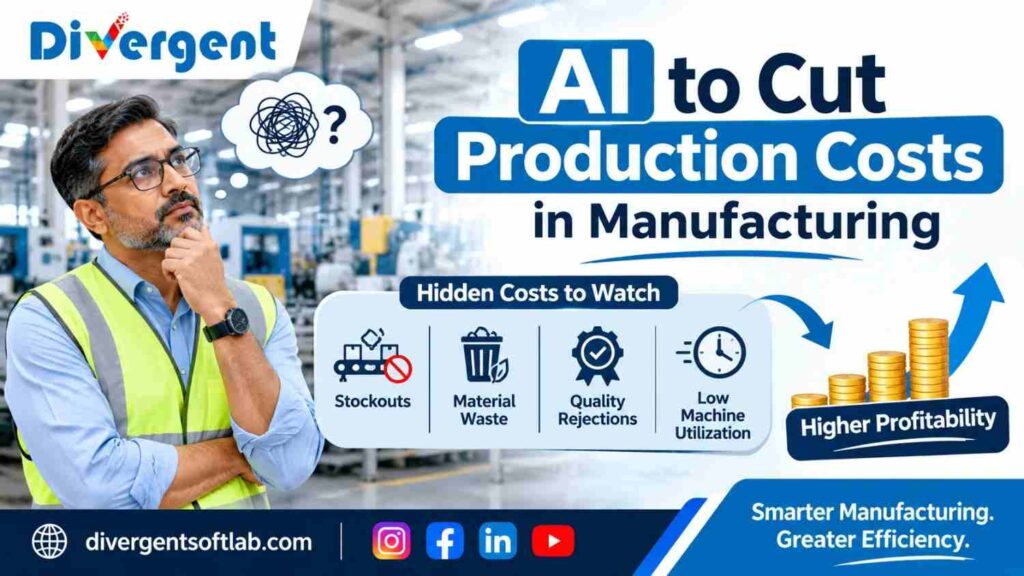
The accountant pointed at the usual suspects. Raw material prices. Labour costs. Power bills. All rising. All outside his control. What nobody pointed at were the production costs entirely within his control. Stockouts stopping production for two days every other month. Quality rejections nobody traced back to a source. Raw material sitting in the store 60 days longer than it needed to.
That invisible cost is exactly where AI to cut production costs in manufacturing delivers the most impact. This guide covers how it works, what the realistic results look like and how to identify where the hidden costs are in your own plant.
Why AI to Cut Production Costs Works Where Other Solutions Failed
Most plant owners have already tried the obvious solutions. They installed an ERP. They created reporting templates. They hired additional staff. None of it fully solved the problem because the root cause is not a process problem. It is a gap between where information lives and where decisions get made.
The ERP knows when stock is running low. But someone still has to check it, calculate what to order, raise a purchase request, get it approved and send it to the supplier. That gap, repeated hundreds of times a day across procurement, quality, dispatch and reporting, is where the costs accumulate.
AI to cut production costs in manufacturing closes that gap. Not by cutting headcount or squeezing suppliers. By giving the plant the information it needs to act before the cost has already been incurred.
plants that deploy AI across procurement, quality and production planning reduce total production costs by 10 to 20 percent within the first year of implementation.
5 Proven Ways to Use AI to Cut Production Costs in Manufacturing
Strategy 1: Use AI to Cut Production Costs Through Smarter Procurement
A stockout is never just a procurement failure. It is a production planning failure, an inventory monitoring failure and a supplier management failure, all arriving at the same moment. By the time the stockout happens, the cost is already locked in.
AI to cut production costs through procurement works by monitoring stock consumption in real time against the production schedule. It calculates exactly when a material will run out at current consumption rates, factors in supplier lead times and raises a purchase recommendation before the gap appears. The purchase executive approves in one click. The order goes out automatically.
Plants implementing this typically see stockouts drop to near zero within 60 to 90 days. A plant losing two production days per month to stockouts recovers those days immediately. At a fully loaded production cost of 50,000 rupees per day, that is 12 lakh rupees per year from one change.
Learn more: AI Procurement Agent for Manufacturing: Eliminate Stockouts Forever
Strategy 2: Use AI to Cut Production Costs by Reducing Raw Material Waste
In most plants, raw material consumption is tracked at a batch level at best. What actually goes into each production run, what is wasted and what is used for rework is a number very few plants know with precision.
AI to cut production costs through waste reduction tracks consumption at the job level. It compares actual material used against the standard bill of materials for each production run. When consumption is higher than expected, it flags the variance immediately for investigation. The discipline this creates is itself a cost reduction, when teams know variances are tracked automatically, material handling tightens.
Plants implementing this typically find three to seven percent reduction in raw material waste within six months. On a plant spending two crore rupees per month on raw material, that is six to fourteen lakh rupees per month in recovered waste cost.
Strategy 3: Use AI to Cut Production Costs Through Early Quality Detection
The most expensive quality problem is the one you find out about from a customer. By that point, the material has been processed, the labour has been spent and the product has shipped. The total cost of a customer quality complaint is typically five to ten times the value of the rejected goods.
AI to cut production costs through quality monitoring identifies patterns in inspection data before they reach the threshold of a customer complaint. When a machine, shift, or raw material batch starts showing rejection rates higher than the plant average, the system raises an alert while the batch is still in process — not three days after it has shipped.
plants implementing AI quality monitoring see rejection rates fall by 20 to 40 percent within six months. For a plant with a four percent rejection rate, reaching three percent represents significant savings in material, rework labour and customer complaint costs.
Strategy 4: Use AI to Cut Production Costs by Reducing Excess Inventory
Excess inventory is a form of production cost that most plant owners underestimate. Every rupee sitting in raw material in the store is a rupee not available for investment, subject to price movement, degradation, and obsolescence risk.
AI to cut production costs through inventory optimisation analyses production schedules, historical consumption patterns and pending order data to calculate material requirements with far more precision than manual planning. Instead of ordering a comfortable buffer, the system calculates exactly what is needed and when.
Plants moving to AI-driven inventory planning typically reduce raw material inventory by 15 to 25 percent while maintaining or improving production reliability. On a plant carrying one crore rupees in raw material inventory, reducing that by 20 percent frees up 20 lakh rupees in working capital immediately.
Read more: How to Reduce Production Cost in Manufacturing: 9 Proven Ways
Strategy 5: Use AI to Cut Production Costs Through Better Machine Scheduling
In a manually scheduled plant, production scheduling is a best effort exercise. When something changes, the plan has to be rebuilt manually. In the gap between the old plan and the new one, machines sit idle or run on suboptimal jobs.
AI to cut production costs through scheduling maintains a live plan that updates automatically when inputs change. When a material is delayed or a machine goes down, the system recalculates which jobs can still run and presents an optimised schedule for manager approval in minutes rather than hours.
The improvement in machine utilisation is typically three to eight percentage points. On a plant running at 80 percent utilisation, reaching 85 percent represents five percent more output from the same capital investment. At a production value of 50 lakh rupees per month, that is 2.5 lakh rupees in additional output every month.
Learn how AI agents connect these workflows: Agentic AI for Manufacturing: How AI Agents Are Replacing Manual Work
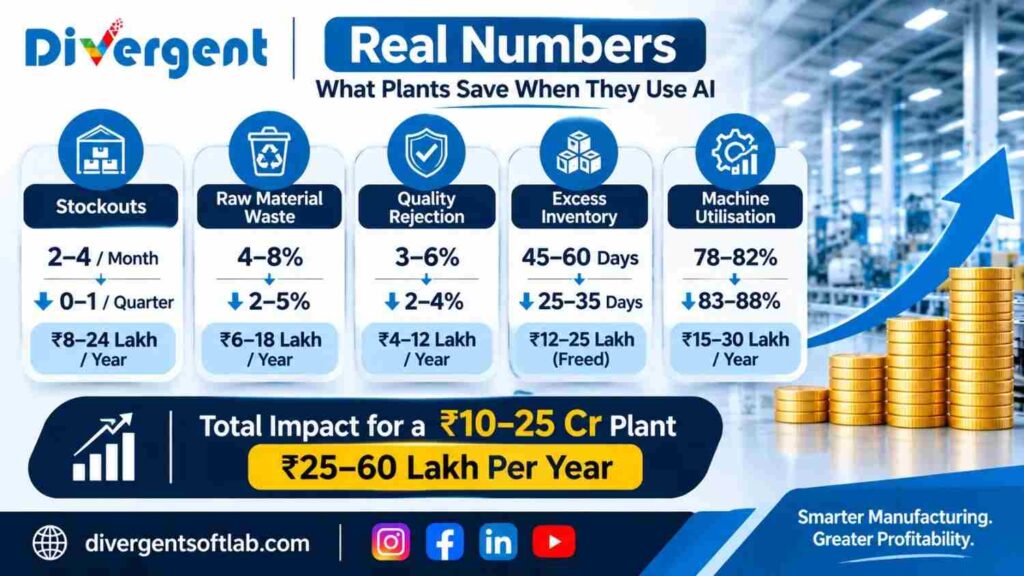
Real Numbers: What Plants Save When They Use AI to Cut Production Costs
| Area | Typical Before | After 6 Months | Annual Saving |
|---|---|---|---|
| Stockouts | 2 to 4 per month | 0 to 1 per quarter | 8 to 24 lakh |
| Raw material waste | 4 to 8 percent | 2 to 5 percent | 6 to 18 lakh |
| Quality rejection rate | 3 to 6 percent | 2 to 4 percent | 4 to 12 lakh |
| Excess inventory | 45 to 60 days cover | 25 to 35 days cover | 12 to 25 lakh freed |
| Machine utilisation | 78 to 82 percent | 83 to 88 percent | 15 to 30 lakh output |
The combined impact across these five areas for a plant turning over 10 to 25 crore rupees annually is typically 25 to 60 lakh rupees per year. The implementation investment is typically 5 to 15 lakh rupees, making the return on investment positive within six to twelve months.
How to Find the Hidden Costs Before Using AI to Cut Production Costs
The most valuable exercise before implementing AI to cut production costs in manufacturing is a simple hidden cost audit. These four questions reveal where the biggest opportunities are.
How many days of production did you lose to stockouts in the last 12 months? Multiply those days by your daily fully loaded production cost. That is your stockout cost for the year.
What is your current rejection rate? Calculate the full cost, including raw material, labor, machine time, and rework. That is your quality cost.
How many days of raw material do you typically carry in stock? Multiply your average daily material cost by those days. That is working capital tied up in inventory.
What percentage of machine capacity sits waiting for materials, instructions, or quality clearance? That gap is your utilization cost. The area with the largest number is where AI to cut production costs delivers the fastest return.
What AI Cannot Do When You Use It to Cut Production Costs
AI to cut production costs in manufacturing works best when you understand its limits clearly. Being honest about what AI cannot do prevents expensive implementation mistakes.
AI needs clean data. If your ERP has inconsistent item codes or incomplete production records, the AI system will produce unreliable recommendations. Data quality review comes before technology installation, not after.
AI surfaces problems. It does not automatically fix them. When an AI system flags that raw material waste is running 40 percent above standard on a particular machine, someone still has to investigate why and address the cause.
AI needs defined processes. The procurement agent that eliminates stockouts works because someone has defined reorder points, approved suppliers, lead times and approval workflows. Without those definitions, the agent cannot operate reliably.
the plants that get the strongest results from AI treat it as a tool that makes good processes faster — not a solution that replaces the need for good processes.
Frequently Asked Questions About AI to Cut Production Costs
How does AI cut production costs in manufacturing?
AI to cut production costs in manufacturing works across five areas: eliminating stockouts through smarter procurement, reducing raw material waste through consumption tracking, catching quality problems earlier, reducing excess inventory through demand forecasting and improving machine utilisation through live production scheduling. The combined impact for a mid-sized plant is typically 25 to 60 lakh rupees per year.
Which area gives the fastest results when using AI to cut production costs?
Procurement and stockout elimination typically delivers the fastest return because the cost of a stockout is immediate and measurable. Plants using AI to cut production costs through procurement report near-zero stockouts within 60 to 90 days. Quality monitoring and inventory reduction usually follow as the second and third areas with the strongest financial impact.
Does my plant need an ERP to use AI to cut production costs?
An ERP gives AI to cut production costs better data to work with and delivers faster results. However, AI can connect to spreadsheets and standalone systems as well. The critical requirement is clean, consistent data rather than a specific system.
How much does it cost to implement AI for production cost reduction in India?
For Indian manufacturing SMEs, purpose-built AI systems covering procurement, quality monitoring and production planning typically cost 5 to 15 lakh rupees for initial implementation. The return on investment is positive within six to twelve months for most plants turning over 10 to 25 crore rupees annually.
Will using AI to cut production costs reduce jobs in manufacturing?
AI to cut production costs replaces specific manual tasks, data entry, follow-up calls, report compilation not roles. The purchase executive who previously spent four hours per day chasing suppliers now spends those hours on supplier relationships and strategic decisions. The same team delivers more output with less stress.
How long before a plant sees results from AI to cut production costs?
Most plants see measurable results within 60 to 90 days in the areas they prioritise first. Quality improvements and inventory reductions typically become visible at the three to six month mark. The full financial impact is usually measurable by the six month review.
The Bottom Line: AI to Cut Production Costs Is Available Now
The manufacturing plants cutting production costs most effectively in 2027 are not waiting for the technology to mature. They are using AI to cut production costs in procurement, quality, inventory and scheduling right now — and the results are showing up within the first quarter of deployment.
The gap between what a plant knows and what it acts on is where the real production cost sits. AI closes that gap. Not by replacing the people who run the plant but by giving them the information they need to act before the cost is already incurred.
Divergent Software Labs works with manufacturing and packaging plants across India on exactly this problem. Book a free consultation to discuss where the hidden costs are in your operation and what a practical AI implementation would look like.
Also read: Agentic AI for Manufacturing · AI Procurement Agent for Manufacturing · AI in Manufacturing ERP: 7 Powerful Ways · What Is Agentic AI for Manufacturing ERP?
Follow Divergent Softlab on Google
Enjoying our insights on manufacturing ERP, artificial intelligence and business technology? Add Divergent Softlab as a preferred source on Google to discover more of our latest articles.