Your plant runs 6 days a week. Your team works hard. But somewhere between the morning shift report, the procurement follow-up calls, the quality register, and the month-end MIS, 30% to 40% of their time disappears into work that a machine could do.
That is exactly what agentic AI for manufacturing is built to fix. Plants using agentic AI for manufacturing are reporting measurable reductions in manual work within 60–90 days of deployment across procurement, MIS reporting, quality control and production planning.
Unlike basic automation that follows a fixed script, agentic AI for manufacturing acts independently. It observes your plant data, decides what needs to be done, takes action, and reports back, without waiting for someone to tell it what to do next.
In 2027, agentic AI for manufacturing is no longer a pilot project for large corporations. Indian packaging plants, FIBC manufacturers, BOPP units, and industrial companies are deploying AI agents to handle procurement, quality control, MIS reporting, production planning, and supplier follow-up tasks that previously consumed hours of manual work every single day.
This guide covers what agentic AI for manufacturing actually does in a plant, which tasks it replaces first, what results to expect and how to start without disrupting operations.
What Is Agentic AI for Manufacturing?
Agentic AI for manufacturing refers to AI systems that can pursue goals autonomously, planning their own steps, using tools and data, making decisions and completing multi-step tasks without constant human direction.
In a manufacturing context, this means an AI agent can monitor your ERP or inventory system in real time, identify a material shortage before it causes a stockout, calculate how much needs to be ordered and from which supplier, generate a purchase order draft for approval, send a WhatsApp or email follow-up to the supplier and update the ERP when the delivery is confirmed.
That entire sequence, which previously required a purchase executive, a store manager, a data entry operator, and a follow-up call, now runs automatically with a human reviewing and approving at key checkpoints.
According to McKinsey’s research on AI automation, agentic AI systems can reduce manual processing time in manufacturing operations by 40–70% across procurement, planning, and reporting functions. Gartner identifies agentic AI as the most significant enterprise technology shift of 2025–2027. The IBM Institute for Business Value reports that manufacturers deploying AI agents see an average 35% reduction in unplanned downtime and a 25% improvement in procurement cycle time.
To understand the foundations, read: What Is Agentic AI? 5 Ways It Transforms Manufacturing ERP Operations
Why Manual Work Is the Biggest Hidden Cost in Agentic AI for Manufacturing
Before understanding what agentic AI for manufacturing replaces, it helps to see how much manual work is actually happening in a typical plant every single day.
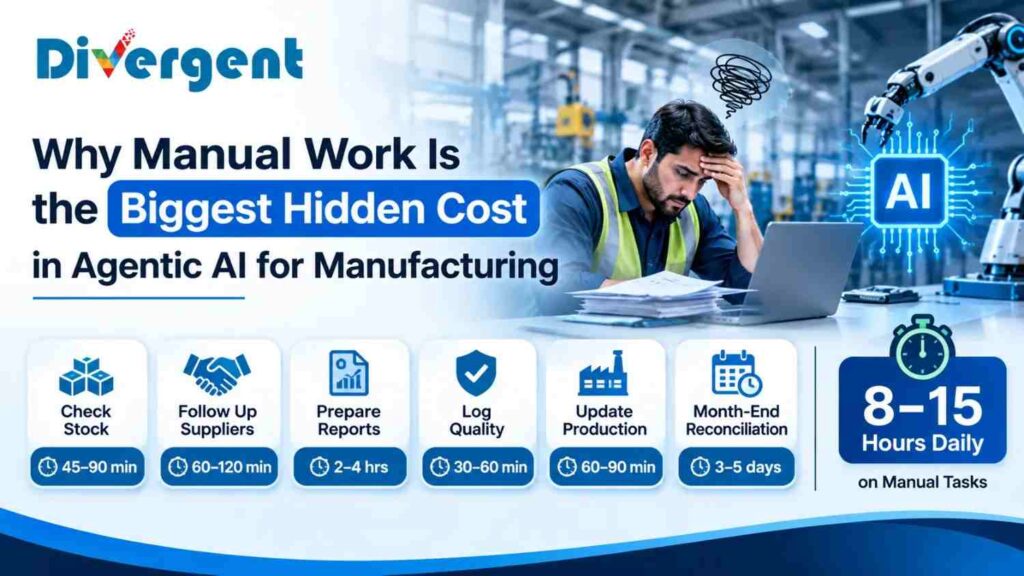
| Manual Task | Who Does It | Time Per Day | What Goes Wrong |
|---|---|---|---|
| Checking raw material stock | Store manager | 45–90 min | Counts are delayed or wrong |
| Following up with suppliers | Purchase exec | 60–120 min | Deliveries still get delayed |
| Preparing MIS reports | Operations team | 2–4 hours/day | Data is always a day old |
| Logging quality rejections | QC supervisor | 30–60 min | No link to batch or supplier |
| Updating production status | Production team | 60–90 min | Management gets info late |
| Month-end reconciliation | Accounts team | 3–5 days/month | Errors from multiple files |
Add it up and a mid-sized manufacturing plant of 50–150 people spends 8–15 hours of combined team time every single day on tasks that produce no finished goods, no sales and no value, only information that was already available in the system.
Agentic AI for manufacturing eliminates most of this. Not by firing staff — but by giving them back those hours for decisions, customer service and production quality that actually moves the business forward.
6 Manual Tasks Agentic AI for Manufacturing Is Replacing Right Now
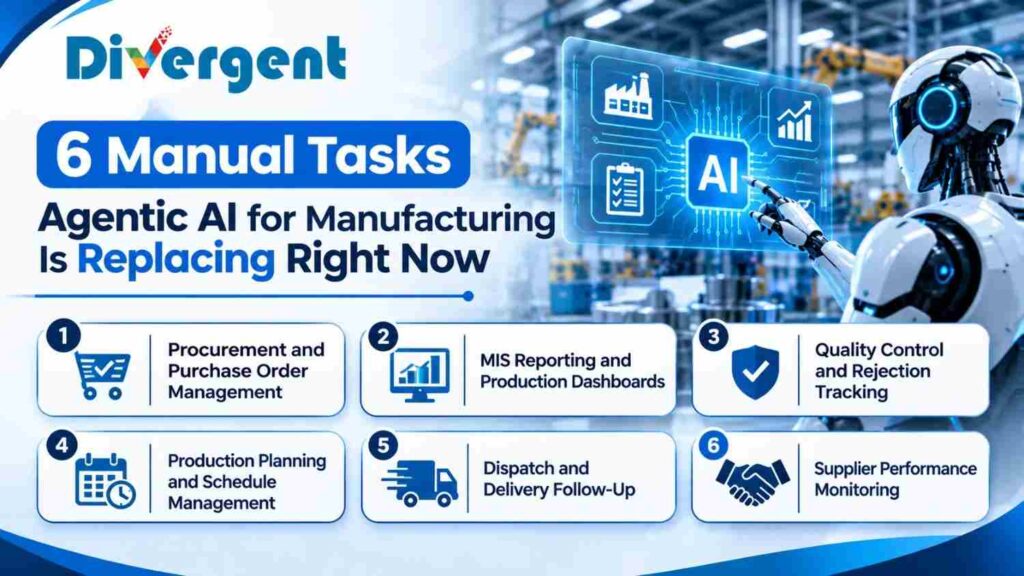
1. Procurement and Purchase Order Management
This is where agentic AI for manufacturing delivers the fastest, most measurable results. A procurement AI agent connects to your ERP or inventory system and monitors stock levels continuously. When a material drops below the reorder point, factoring in current production schedules, pending orders, and supplier lead times, the agent automatically calculates the exact quantity required, selects the preferred supplier, drafts the purchase order, sends it for one-click approval, follows up with the supplier and updates the ERP when the delivery is confirmed.
Plants using AI procurement agents report eliminating stockouts within 60–90 days of deployment. The purchase executive’s role shifts from chasing suppliers to managing exceptions.
Learn more: AI Procurement Agent for Manufacturing: Eliminate Stockouts Forever
2. MIS Reporting and Production Dashboards
In most manufacturing plants, the daily MIS report is assembled every morning by someone opening five Excel files, copying numbers and checking WhatsApp messages from shift supervisors. An agentic AI MIS agent replaces this entirely, pulling live data from your ERP, production system and store records, assembling the complete report, and delivering it to the plant manager’s phone before they even arrive at the plant.
What previously took 2–4 hours of manual work now takes 0 minutes, and the report is more accurate because it comes directly from the system rather than from memory.
3. Quality Control and Rejection Tracking
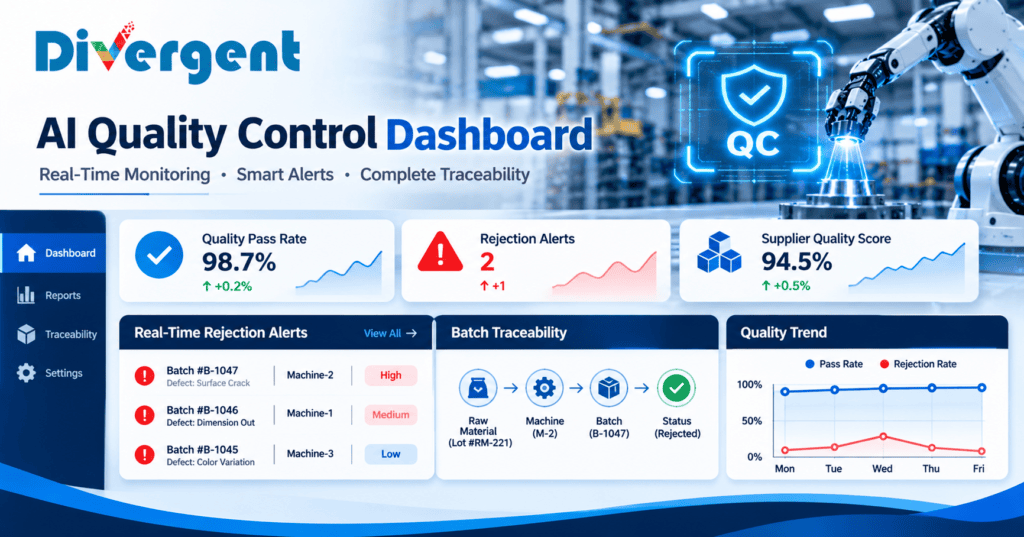
Agentic AI for manufacturing quality control monitors inspection data in real time, connects defects to their source batch, machine, shift, and raw material lot, and raises an alert the moment a pattern appears, not three days later when the batch is gone and the root cause is impossible to trace.
4. Production Planning and Schedule Management
An agentic production planning AI maintains a live schedule. When a variable changes, a material is delayed, a machine goes down, an urgent order arrives, the agent recalculates the schedule, identifies the impact on other orders, and presents revised options for the production manager to approve. This turns a 3-hour manual replanning exercise into a 10-minute review.
5. Dispatch and Delivery Follow-Up
A dispatch AI agent monitors finished goods inventory, matches it against pending customer orders, prepares dispatch instructions when stock is ready and sends automated status updates to customers via WhatsApp or email. When a delivery runs late, the agent proactively notifies the customer and the sales team before the customer calls to ask.
6. Supplier Performance Monitoring
An agentic AI supplier monitoring agent tracks every delivery, on-time vs delayed, quality accepted vs rejected, PO fulfillment rate—and builds a supplier scorecard automatically. When a supplier’s score drops below a threshold, the agent flags it for review and suggests alternatives from the approved vendor list.
Agentic AI for Manufacturing vs Traditional Automation
| Feature | Traditional Automation | Agentic AI for Manufacturing |
|---|---|---|
| How it works | Fixed, pre-programmed rules | Observes, decides, and acts independently |
| Handles exceptions | Breaks or requires manual override | Adapts to new situations automatically |
| Multi-step tasks | One step at a time | Completes full workflows end to end |
| Learning | Does not improve over time | Improves from patterns in your data |
| Human involvement | Required at each step | Required only for approvals and exceptions |
| Cost of change | High, rules must be reprogrammed | Lower, agent adapts when process changes |
Which Manufacturing Plants Benefit Most from Agentic AI?
Agentic AI for manufacturing delivers the strongest results in plants where production involves multiple raw materials with variable lead times (FIBC, BOPP, PP woven, and industrial packaging), quality control requires batch traceability, MIS reports are compiled manually every morning, procurement involves repeated follow-up with 10+ suppliers; and the management team needs real-time visibility but currently relies on delayed Excel reports.
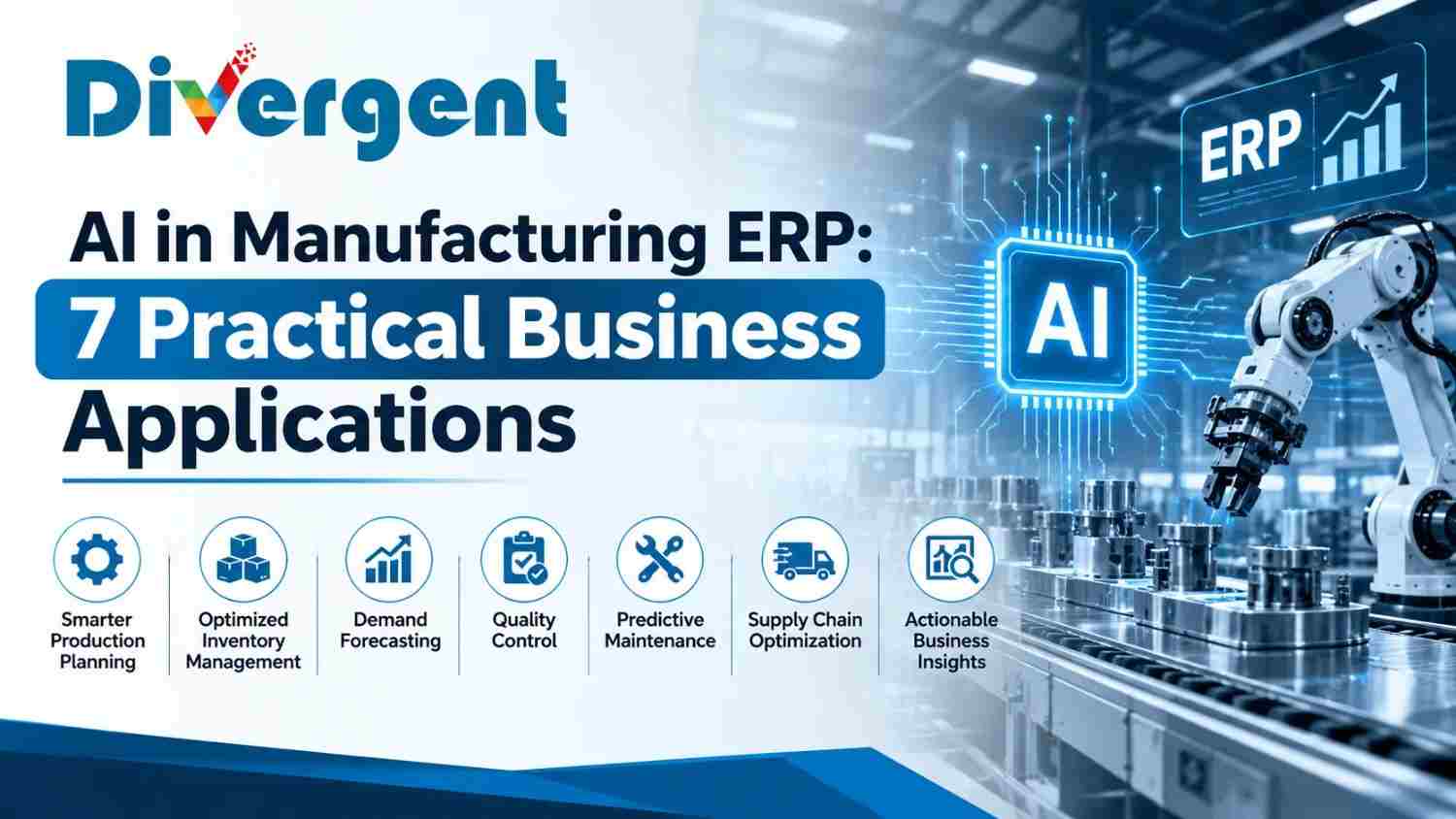
Plants already using an ERP system get the fastest results because the AI agent connects directly to existing data. Learn more: AI in Manufacturing ERP: 7 Powerful Ways to Transform Operations
According to Deloitte’s Global Manufacturing Competitiveness Index, manufacturers that adopt intelligent automation — including agentic AI, consistently outperform competitors on cost efficiency, quality and delivery reliability. The competitive advantage of agentic AI for manufacturing compounds over time as agents learn from plant-specific data.
How to Implement Agentic AI in a Manufacturing Plant: A 6-Step Roadmap
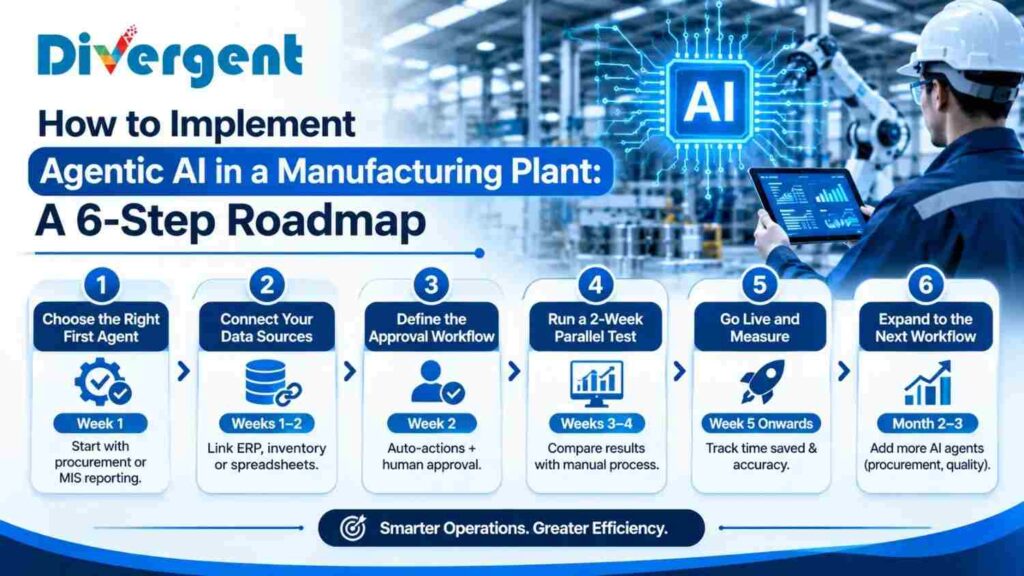
Step 1 — Choose the right first agent (Week 1): Select the workflow causing the most pain — procurement or MIS reporting are the best starting points. Well-defined, data-rich and immediately measurable.
Step 2 — Connect your data sources (Weeks 1–2): The agent needs access to your ERP, inventory system or spreadsheets. Define what data it reads and what actions it can take.
Step 3 — Define the approval workflow (Week 2): Decide which actions the agent takes automatically and which need human approval. Auto-draft PO → manager approves → agent sends to supplier keeps humans in control.
Step 4 — Run a 2-week parallel test (Weeks 3–4): Run the agent alongside your existing process. Compare outputs to what your team would have done manually.
Step 5 — Go live and measure (Week 5 onwards): Switch to the agent as primary workflow. Measure time saved, stockout frequency, report accuracy, supplier response rate.
Step 6 — Expand to the next workflow (Month 2–3): Within 6 months, most plants have 3–4 AI agents running in parallel — procurement, MIS, quality and dispatch.
What Results Does Agentic AI for Manufacturing Actually Deliver?
[IMAGE 5: Results comparison graphic — “Before vs After Agentic AI” — two columns with metrics, Divergent blue style, 1200x630px. Alt text: results agentic AI for manufacturing before after comparison metrics]
| Metric | Before Agentic AI | After Agentic AI (6 months) |
|---|---|---|
| Stockouts per quarter | 3–8 incidents | 0–1 incidents |
| MIS report preparation | 2–4 hours/day | 0 minutes (automated) |
| Procurement cycle time | 3–5 days per PO | Same day (approval only) |
| Quality defect detection | 24–72 hours | Real time |
| Supplier on-time delivery | 65–75% | 82–90% |
| Manual data entry hours | 8–15 hours/day | 1–3 hours/day |
Frequently Asked Questions About Agentic AI for Manufacturing
What is agentic AI for manufacturing?
Agentic AI for manufacturing is an AI system that monitors factory data, makes decisions and performs tasks automatically.
Which tasks can agentic AI replace in a manufacturing plant?
Agentic AI can automate procurement, purchase order management, daily MIS reports, quality tracking, production scheduling, dispatch follow-ups and supplier performance monitoring. Procurement and MIS reporting are often the best starting points for saving time and reducing manual work.
How long does it take to implement agentic AI in a manufacturing plant?
The first workflow, typically procurement or MIS reporting, goes live in 4–6 weeks. This
includes data connection, approval workflow setup,parallel testing and go-live. Each additional
agent takes 2–4 weeks after the first is stable.
Is agentic AI suitable for small manufacturing plants in India?
Yes. Agentic AI for manufacturing is ideal for Indian SME plants — FIBC, BOPP, PP woven and packaging manufacturers. The ROI from eliminating stockouts and automating MIS reporting alone typically covers the implementation cost within 6–12 months.
What is the cost of agentic AI for manufacturing in India?
For Indian SME manufacturers, purpose-built agentic AI solutions range from ₹3–15 lakh for initial deployment, significantly lower than enterprise AI platforms. Cost depends on the number of workflows automated and existing systems in place.
Agentic AI for Manufacturing Is Not the Future — It Is Happening Now
The plants deploying agentic AI for manufacturing today are not technology companies experimenting with new tools. They are FIBC bag plants, BOPP film units, PP woven sack manufacturers and industrial packaging companies that got tired of losing lakhs to stockouts, spending hours on MIS reports and finding out about quality problems three days too late.
Agentic AI for manufacturing does not require a large IT team, a year-long implementation project or a ₹1 crore budget. It requires the right starting workflow, clean data and a team willing to approve AI-generated actions while keeping control of the final decision.
The question is not whether agentic AI for manufacturing will change how plants operate. It already is. The question is whether your plant starts now or catches up later.
Divergent Software Labs builds agentic AI and ERP solutions specifically for manufacturing plants in India. If your plant is ready to eliminate manual work in procurement, MIS reporting or quality control, book a free consultation to discuss your specific requirements.
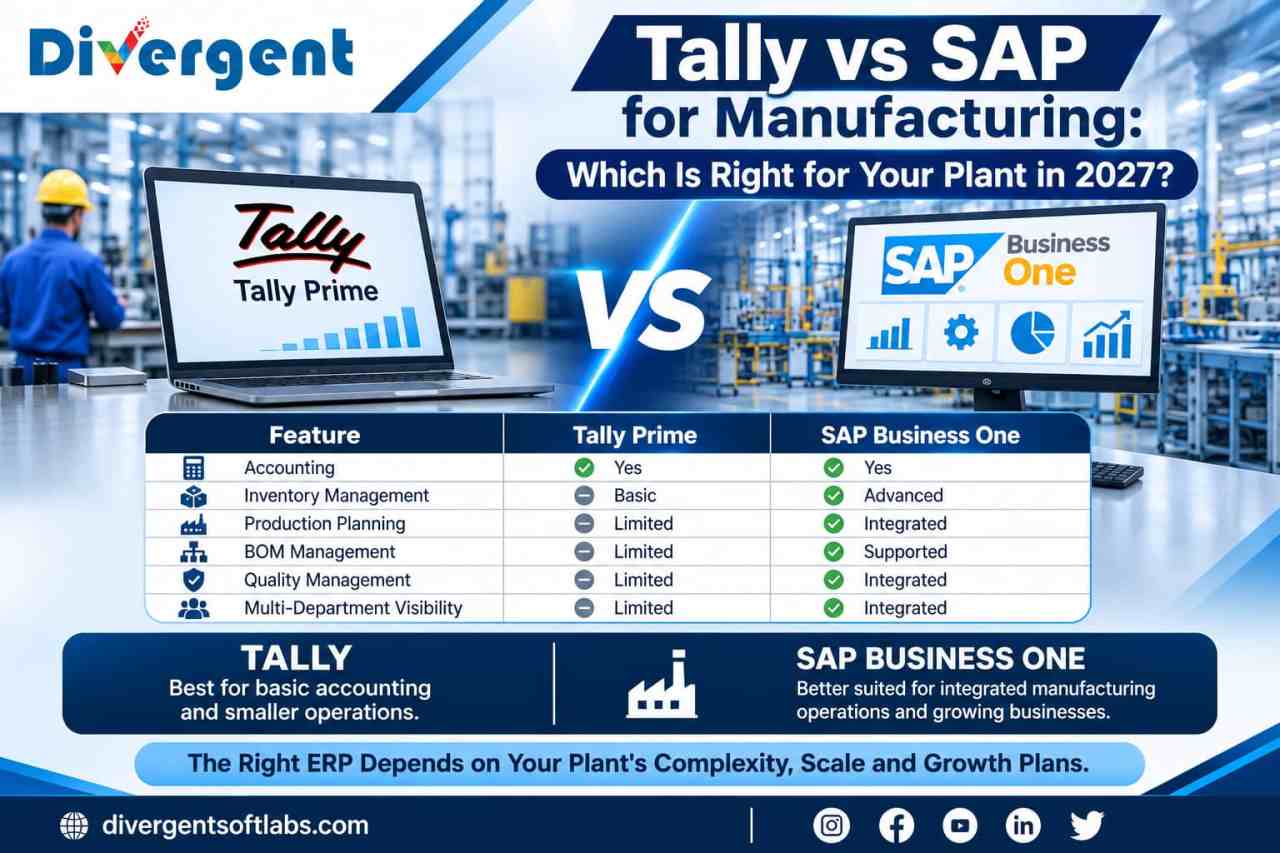
Also read: What Is Agentic AI? 5 Ways It Transforms Manufacturing ERP · AI Procurement Agent for Manufacturing · AI in Manufacturing ERP: 7 Powerful Ways · How to Reduce Production Cost in Manufacturing · Tally vs SAP for Manufacturing
Follow Divergent Softlab on Google
Enjoying our insights on manufacturing ERP, artificial intelligence and business technology? Add Divergent Softlab as a preferred source on Google to discover more of our latest articles.