Quick answer: The best BOPP bag ERP software is built for the way BOPP bag plants actually work. It should calculate costing across fabric, BOPP film, printing, lamination, and conversion, manage rotogravure cylinders and artwork approvals, plan printing and lamination to reduce changeovers, track film and wastage roll by roll, and trace every batch to dispatch. Generic ERP and Excel can be stretched to fit, but industry-built BOPP bag ERP software like BOPP Pro by Divergent Software Labs is designed around this workflow.
A BOPP bag looks simple on a shop shelf. Behind it are woven fabric, printed film, a set of cylinders, an approved artwork, a lamination run, and a conversion line, all of which have to come together on time and on cost. When that lives in spreadsheets and WhatsApp messages, orders slip, and margins disappear. This guide explains what BOPP bag ERP software should do, how the options compare, and what to ask before you choose.
Key takeaways:
- BOPP bag ERP software connects costing, artwork, cylinders, printing, lamination, conversion, quality, and dispatch in one system.
- BOPP plants need features generic ERP lacks, like cylinder management, print approval, and multi-stage costing.
- Grouping print jobs by colour and cylinder is one of the biggest ways to cut setup waste.
- Choosing between Excel, generic ERP, and industry-built ERP depends on your order volume and number of designs.
- Always ask vendors for a demo using your own bag designs and specifications.
What Is BOPP Bag ERP Software?
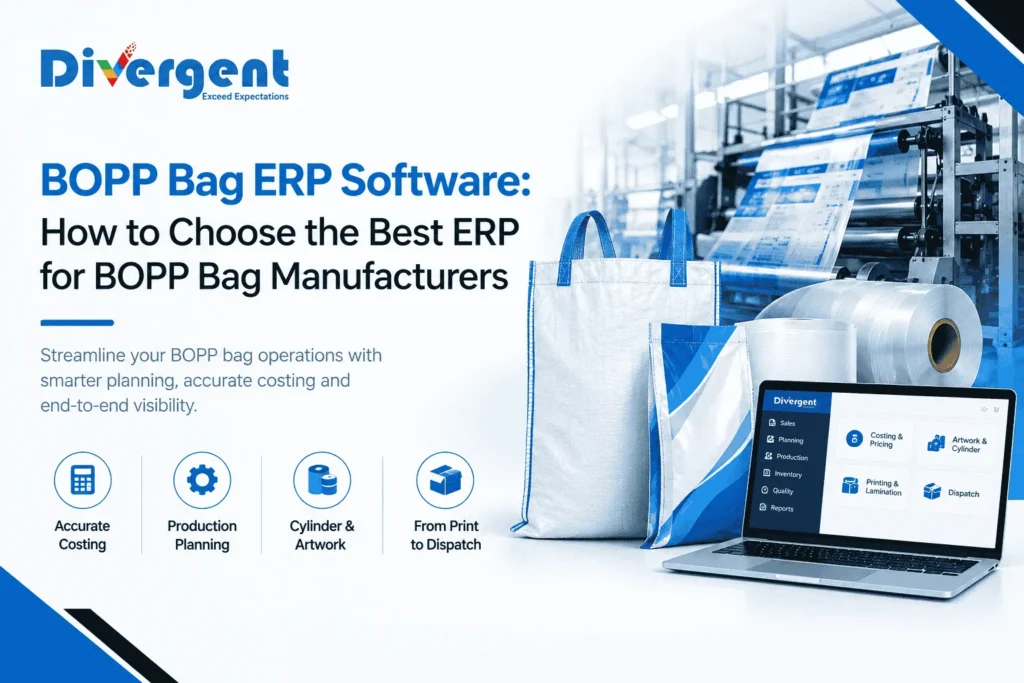
BOPP bag ERP software is an enterprise resource planning system designed for manufacturers of BOPP laminated woven bags. It connects sales, costing, artwork, cylinder management, production planning, inventory, quality control and dispatch in one system, using the language and processes of a BOPP bag plant.
A BOPP laminated bag is a woven polypropylene bag with a reverse-printed BOPP (biaxially oriented polypropylene) film laminated on the outside. That means every order passes through more stages than a plain woven sack: weaving, printing, lamination, and conversion, each with its own setup, waste, and quality checks. If you’re new to how these bags are made, our guide to woven polypropylene bags explains each type.
BOPP bag ERP software understands these stages, so sales, planning, printing, stores, and dispatch all work from the same order data.
Why Do Excel and Generic ERP Struggle in BOPP Bag Plants?
Excel and generic ERP struggle in BOPP bag plants because they weren’t built for design-driven, multi-stage production. They can store orders and stock, but they can’t easily track cylinders, manage artwork approvals, plan print runs by colour, or calculate cost across film, printing, lamination and conversion.
Here’s what that looks like day to day:
- Costing is slow and often wrong. Film, ink, adhesive, fabric and conversion costs are spread across sheets. See our guide to costing and quotation challenges.
- Cylinders go missing. Nobody knows which cylinder set is where, how many runs it has left, or whether a new one is needed.
- Print runs are planned in arrival order. Every switch means new cylinders and colour setup. Read more in production planning challenges.
- Film and ink stock don’t match. Rolls are issued and returned without being recorded. See inventory management challenges.
- Setup and trim waste is guessed. Proof runs, colour setup and edge trim add up quickly. See manufacturing waste.
- Print defects are found too late. A colour mismatch found after lamination wastes film, fabric and time. See quality control challenges.
Generic ERP systems can be customised for some of this, but the customisation often takes months. That’s why many BOPP bag manufacturers look for ERP software built for their industry.
What Are the 9 Must-Have Features in BOPP Bag ERP Software?
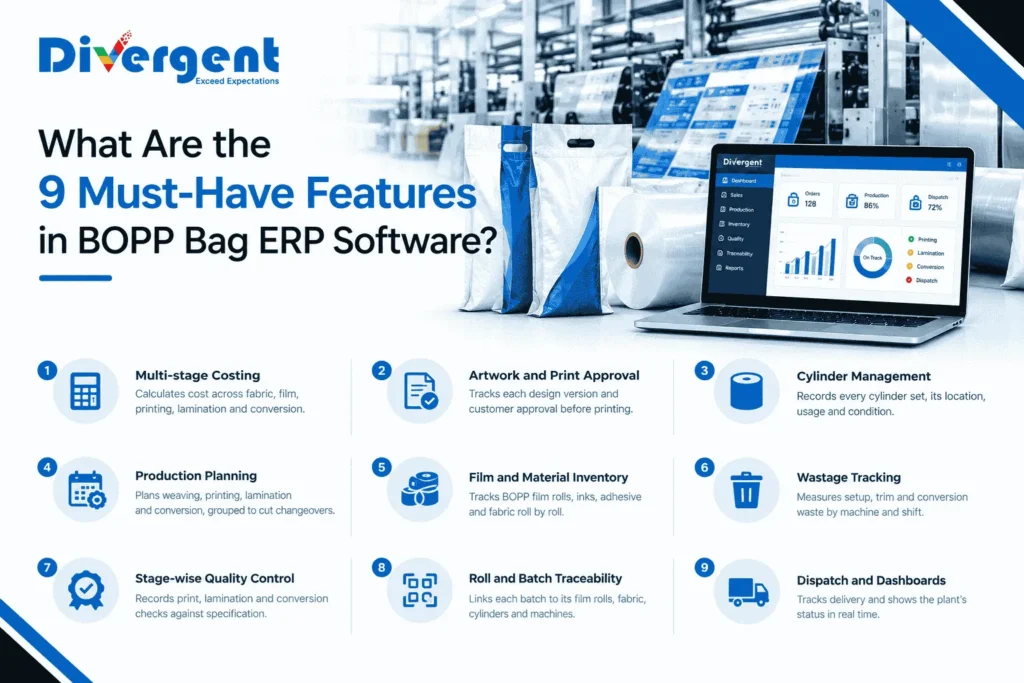
The 9 must-have features in BOPP bag ERP software are multi-stage costing, artwork and print approval, cylinder management, production planning by colour and cylinder, film and material inventory, wastage tracking, stage-wise quality control, roll and batch traceability, and dispatch with real-time dashboards.
| Feature | What it does for a BOPP bag plant |
|---|---|
| Multi-stage costing | Calculates cost across fabric, film, printing, lamination and conversion |
| Artwork and print approval | Tracks each design version and customer approval before printing |
| Cylinder management | Records every cylinder set, its location, usage and condition |
| Production planning | Plans weaving, printing, lamination and conversion, grouped to cut changeovers |
| Film and material inventory | Tracks BOPP film rolls, inks, adhesive and fabric roll by roll |
| Wastage tracking | Measures setup, trim and conversion waste by machine and shift |
| Stage-wise quality control | Records print, lamination and conversion checks against specification |
| Roll and batch traceability | Links each batch to its film rolls, fabric, cylinders and machines |
| Dispatch and dashboards | Tracks delivery and shows the plant’s status in real time |
1. Multi-Stage Costing
Multi-stage costing calculates the cost of a BOPP bag across every stage: woven fabric, BOPP film, number of printing colours, ink, lamination adhesive, conversion, stitching and packing. When film or ink prices change, the cost updates automatically.
This matters because BOPP bags carry more cost layers than plain woven sacks. A small error in film or ink cost, repeated across a large order, can wipe out the margin.
2. Artwork and Print Approval
Artwork management stores every design version and records the customer’s approval before printing starts. The approved artwork is linked to the order, so the printing team always works from the right file.
Printing an unapproved or outdated design is one of the most expensive mistakes in a BOPP plant, because the whole run, film and lamination included, may have to be scrapped.
3. Rotogravure Cylinder Management
Cylinder management keeps a record of every rotogravure cylinder set: which design it belongs to, where it’s stored, how many runs it has done, and its condition. Planners can see at a glance whether a repeat order can use existing cylinders or needs new ones.
Because cylinders are a significant upfront cost, tracking them properly also helps you recover that cost correctly in your quotations.
4. Production Planning by Colour and Cylinder
Production planning in BOPP bag ERP software schedules weaving, printing, lamination and conversion against delivery dates. A good system helps planners group print jobs by colour and cylinder set, so fewer changeovers are needed.
Fewer changeovers mean less setup waste, less waiting time and more output from the same printing machine.
5. Film and Material Inventory
BOPP bag ERP software tracks BOPP film, inks, adhesives, fabric rolls and threads, ideally roll by roll. It compares planned requirements with stock and flags shortages before they stop a print or lamination run.
Roll-wise tracking also means partly used film rolls are recorded correctly when they come back to the store, instead of disappearing from the books.
6. Wastage Tracking
Wastage tracking records material used and good output at each stage, so you can see real waste from proof runs, colour setup, lamination edge trim and conversion. It shows waste by machine, shift and order, not as one plant-wide guess.
7. Stage-Wise Quality Control
Quality control in BOPP bag ERP software records checks at each stage against the order’s specification. For BOPP bags, typical checks include print registration and colour match, lamination bonding, bag dimensions, stitching or sealing, and fabric strength.
Catching a colour or registration problem at printing, before lamination, saves both the film and the fabric.
8. Roll and Batch Traceability
Traceability links every finished batch to the film rolls, fabric rolls, cylinder set, machines and shifts used to make it. When a customer raises a complaint about colour, bonding or strength, you can trace the cause in minutes.
9. Dispatch and Real-Time Dashboards
Dispatch management tracks each order from packing to loading, documentation, and delivery. Dashboards give owners and managers a live view of orders, machine status, wastage, quality results and pending dispatches.
BOPP Bag ERP Software Options Compared
BOPP bag manufacturers usually manage operations in one of three ways: Excel and paper, a generic ERP, or ERP software built for BOPP bag manufacturing, like BOPP Pro. Each suits a different stage of growth.
| Factor | Excel and paper | Generic ERP | BOPP Pro |
|---|---|---|---|
| Setup cost | Very low | Medium to high | Medium |
| Multi-stage BOPP costing | Manual formulas | Needs customisation | Designed for it |
| Cylinder management | Separate register | Rarely available | Designed for it |
| Artwork and print approval | Email and WhatsApp | Needs customisation | Designed for it |
| Planning by colour and cylinder | Whiteboard | Needs customisation | Designed for it |
| Wastage by stage and shift | Rarely tracked | Possible with setup | Designed for it |
| Roll and batch traceability | Very difficult | Possible with setup | Designed for it |
| Best for | Very small plants | Large multi-industry groups | Growing BOPP bag manufacturers |
If you print only a few repeat designs for a handful of customers, Excel may still work. Once you handle many designs, cylinder sets, customers and export orders, BOPP bag ERP software usually pays for itself through faster quotes, fewer printing mistakes and less waste.
How Does BOPP Pro Help BOPP Bag Manufacturers?
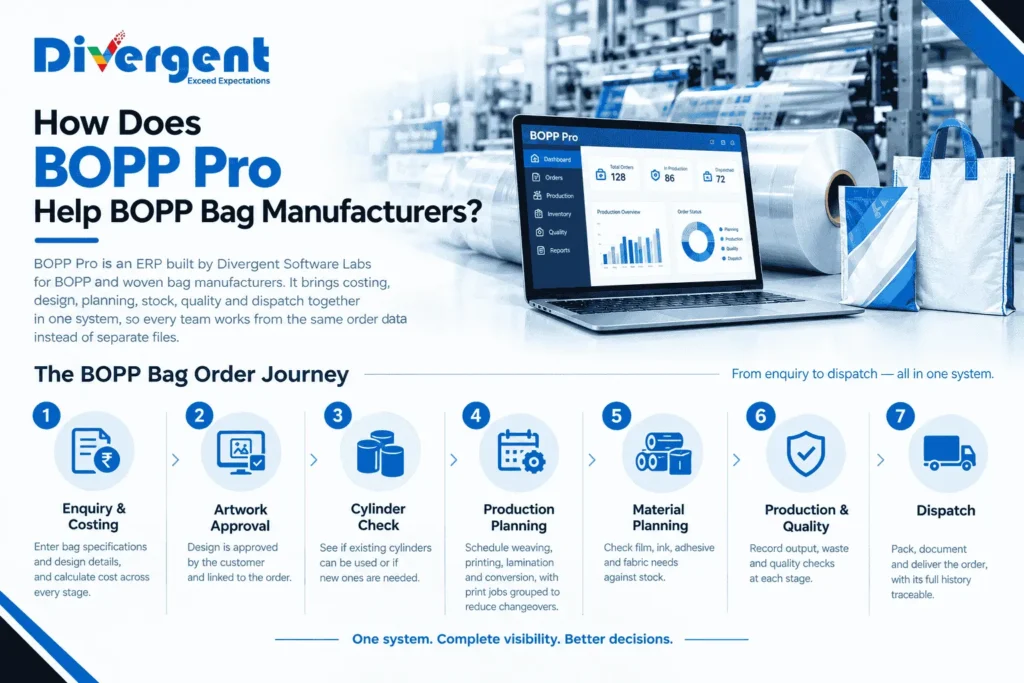
BOPP Pro is an ERP built by Divergent Software Labs for BOPP and woven bag manufacturers. It brings costing, design, planning, stock, quality and dispatch together in one system, so every team works from the same order data instead of separate files.
Here’s how an order typically moves through a BOPP bag plant using industry-built ERP software:
- Enquiry and costing: the bag specification and design details are entered, and cost is calculated across every stage.
- Artwork approval: the design is approved by the customer and linked to the order.
- Cylinder check: the planner sees whether existing cylinders can be used or new ones are needed.
- Production planning: weaving, printing, lamination and conversion are scheduled, with print jobs grouped to reduce changeovers.
- Material planning: film, ink, adhesive and fabric needs are checked against stock.
- Production and quality: output, waste and quality checks are recorded at each stage.
- Dispatch: the order is packed, documented and delivered, with its full history traceable.
What Will You See in a BOPP Pro Demo?
A BOPP Pro demo is the best way to judge whether it fits your plant. Bring real data, and ask to see:
- One of your real bag specifications costed across fabric, film, printing, lamination and conversion
- A design moving through approval, linked to its order
- A repeat order reusing an existing cylinder set
- A week of print jobs planned to reduce changeovers
- A quality check recorded at the printing or lamination stage
Bring your most complicated multi-colour design. It’s the best way to test any BOPP bag ERP software.
Expert Insight
“In BOPP bag plants, the expensive problems rarely start on the machine. They start earlier: an old artwork version, a cylinder nobody can find, or a print run scheduled out of colour order. BOPP bag ERP software pays off when it catches those problems before the press starts.”
When Is Your BOPP Bag Plant Ready for ERP Software?
Your BOPP bag plant is ready for ERP software when spreadsheets and messages can no longer keep up with your designs, cylinders and orders. Most plants reach this point as they add customers, colours and printing capacity.
Look for these signs:
- Quotes take more than a day because film, ink and conversion costs are spread across files
- Cylinders are misplaced, or new ones are ordered when usable sets already exist
- Wrong or outdated artwork has reached the printing machine
- Print jobs run in arrival order, with frequent colour and cylinder changes
- Nobody knows the real setup and trim waste by machine or shift
- A colour or bonding complaint takes days to trace back to its rolls
If three or more of these sound familiar, BOPP bag ERP software will likely save you more than it costs.
How Should You Prepare for BOPP ERP Implementation?
The best way to prepare for ERP in a BOPP bag plant is to organise your designs and cylinders first, clean your core data, and start with the area causing the most pain. Good preparation shortens implementation and builds your team’s confidence.
- List your active designs with their approved artwork versions.
- Create a cylinder register: every set, its design, location and condition.
- Clean your master data: customers, suppliers, materials and machines, each with one correct record.
- Pick a project owner inside the plant to make decisions and test the system.
- Start with your biggest pain, such as costing or print planning, then add other modules.
- Train by role: sales, planning, printing, stores, quality and dispatch.
What Should You Ask Before Choosing BOPP Bag ERP Software?
Before choosing BOPP bag ERP software, ask each vendor to demonstrate it with your own bag designs and specifications, and check how it handles costing, cylinders, artwork, print planning and traceability. A generic demo tells you very little.
Use these questions in every demo:
- Can it cost a bag across fabric, film, printing colours, lamination and conversion?
- Does it track cylinder sets, their location and usage?
- Can it manage artwork versions and customer approvals?
- Can it help plan print jobs by colour and cylinder to reduce changeovers?
- Does it track film rolls and wastage by stage and shift?
- Can it trace a finished batch to its film rolls, fabric and cylinders?
- How long does implementation take, and who trains your team?
- Does it work with your existing accounting software?
For a general overview of how these systems work, see enterprise resource planning on Wikipedia. If you also make jumbo bags, see our guide to FIBC ERP software.
FAQs About BOPP Bag ERP Software
What is BOPP bag ERP software?
BOPP bag ERP software is an ERP system built for manufacturers of BOPP laminated woven bags. It connects costing, artwork, cylinder management, production planning, inventory, quality control and dispatch in one system.
What is the best ERP for BOPP bag manufacturers?
The best ERP for BOPP bag manufacturers handles multi-stage costing, cylinder and artwork management, print planning by colour, film and wastage tracking, and batch traceability without heavy customisation. BOPP Pro by Divergent Software Labs is built for BOPP and woven bag manufacturers.
How does ERP help reduce printing waste in BOPP bag plants?
ERP helps reduce printing waste by grouping print jobs by colour and cylinder to cut changeovers, linking every job to approved artwork, and measuring setup and trim waste by machine and shift.
Can BOPP bag ERP software manage rotogravure cylinders?
Yes. Good BOPP bag ERP software keeps a register of every cylinder set, including its design, storage location, usage and condition, so planners know when existing cylinders can be reused.
How much does BOPP bag ERP software cost?
The cost depends on the number of users, modules, plants and the deployment type. Most vendors quote after understanding your operations, so ask for a quote based on your actual setup.
How long does ERP implementation take in a BOPP bag plant?
Implementation time depends on the modules, data quality and team readiness. An industry-built ERP is usually faster to implement than a generic ERP, because its workflows already match how a BOPP bag plant works.
Can BOPP bag ERP software work alongside Tally?
Many manufacturers keep Tally for accounting and use ERP for operations like costing, planning, inventory and quality. Ask any vendor exactly how their system shares data with your accounting software before you decide.