
What Are Reporting Challenges in Manufacturing?
Reporting challenges in manufacturing are the problems that stop a factory from getting accurate, timely numbers on production, wastage, stock, quality, dispatch, and profit. They include late MIS reports, manual Excel work, different numbers from different teams, and reports that nobody acts on. When reporting is slow or wrong, managers make decisions based on guesses instead of facts.
The Problem: Last Month’s Report Arrives on the 20th
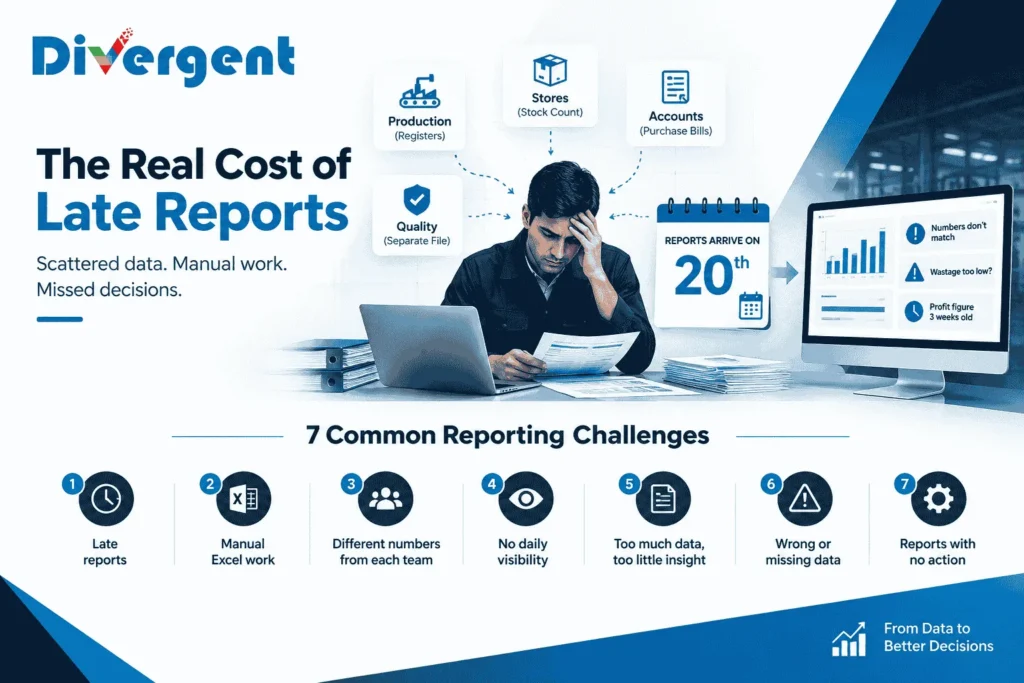
It’s the 5th of the month. The owner asks a simple question: “How much did we produce last month, how much did we waste, and did we make a profit?”
The production manager says he’ll check the registers. Stores needs to count stock. Accounts is still entering purchase bills. Quality has its numbers in a separate file.
The MIS report finally arrives on the 20th. Production numbers don’t match dispatch numbers, wastage looks too low to be true, and the profit figure is already three weeks old. By then, the next month is almost over.
This is one of the most common reporting challenges in manufacturing, in India and around the world. The data exists, scattered across departments, but it can’t be turned into a clear, timely report.
Here are the seven reporting challenges we see most often:
| Challenge | What happens in the plant | What it costs you |
|---|---|---|
| 1. Late reports | Monthly reports arrive weeks after month-end | Decisions are made on old information |
| 2. Manual Excel work | Staff spend days copying data into sheets | Wasted time and frequent errors |
| 3. Different numbers from each team | Production, stores and accounts report different figures | Arguments instead of action |
| 4. No daily visibility | Problems are seen only at month-end | Losses grow for weeks before anyone notices |
| 5. Too much data, too little insight | Long reports with no clear message | Managers don’t know what to act on |
| 6. Wrong or missing data | Entries are skipped or typed incorrectly | Reports can’t be trusted |
| 7. Reports with no action | Reports are shared but nothing changes | The same problems repeat |
The good news? You can fix each of these reporting challenges.
Key takeaways:
- Reporting challenges come from scattered data, manual work, and late entries, not from a lack of effort.
- An MIS report should help managers make decisions, not just record numbers.
- Every factory needs a small set of daily, weekly, and monthly reports.
- A few well-chosen manufacturing KPIs are more useful than long reports.
- An ERP dashboard turns daily data into real-time reports automatically.
What Is an MIS Report in Manufacturing?
An MIS (management information system) report in manufacturing is a regular summary that tells owners and managers how the factory is performing. It brings together production, wastage, stock, quality, dispatch, sales, and cost numbers, so managers can see what’s going well and what needs action.
MIS reports are especially common in India, where owners often review a monthly MIS pack with their managers and accountants. You can read more about management information systems on Wikipedia.
A good MIS report answers three questions quickly:
- What happened? Production, sales, wastage, and dispatch numbers.
- Is it good or bad? Compared with targets, last month or last year.
- What should we do? The problems that need action now.
Most reporting challenges come from reports that answer only the first question, and answer it too late.
Which Reports Does Every Factory Need?
Every factory needs a small set of reports at three levels: daily reports for supervisors, weekly reports for managers and monthly MIS reports for owners. More reports isn’t better. The right reports, on time, is what matters.
| Report | How often | Who uses it | What it shows |
|---|---|---|---|
| Daily production report | Daily | Supervisors, production manager | Output by machine, shift and order |
| Wastage report | Daily or weekly | Production manager | Waste by stage, machine and shift |
| Inventory report | Weekly | Stores, purchase | Stock levels, shortages, slow-moving items |
| Quality report | Weekly | Quality, production | Rejections, defects and their causes |
| Dispatch report | Daily | Dispatch, sales | Orders shipped, pending and late |
| Costing report | Monthly | Owner, accounts | Actual cost vs quoted cost by product |
| MIS summary | Monthly | Owner, management | Overall performance and key KPIs |
What Should a Daily Production Report Include?
A daily production report should show, for each machine or line and shift: planned output, actual output, downtime and its reasons, wastage and the orders worked on. Here’s a simple format:
| Date | Machine | Shift | Order | Planned output | Actual output | Downtime (min) | Reason | Wastage (kg) |
|---|---|---|---|---|---|---|---|---|
| 01-Nov | Loom 4 | A | 1452 | 1,200 m | 1,050 m | 45 | Tape break | 12 |
| 01-Nov | Loom 4 | B | 1452 | 1,200 m | 1,180 m | 10 | Beam change | 8 |
When this report is filled in at the machine, not at the end of the day, it becomes the foundation for every other report.
What Should a Monthly MIS Report Include?
A monthly MIS report should fit on one or two pages, with a short summary at the top and key numbers below. Here’s a simple format many factories use:
| Section | What to include |
|---|---|
| Summary | 3 to 5 lines: what went well, what went wrong, what needs action |
| Production | Total output vs plan, by product or line |
| Efficiency | Machine efficiency and main downtime reasons |
| Wastage | Wastage % by stage, compared with last month |
| Quality | Rejections, top defects and customer complaints |
| Inventory | Raw material and finished goods stock, slow-moving items |
| Dispatch | Orders shipped, on-time delivery %, pending orders |
| Costing and sales | Sales value, actual vs quoted cost, margin by product |
| Actions | Who will fix what, and by when |
The last section is the most important. Without clear actions, even a good report becomes one of the reporting challenges, because it’s read and then forgotten.
What Are the 7 Biggest Reporting Challenges in Manufacturing?
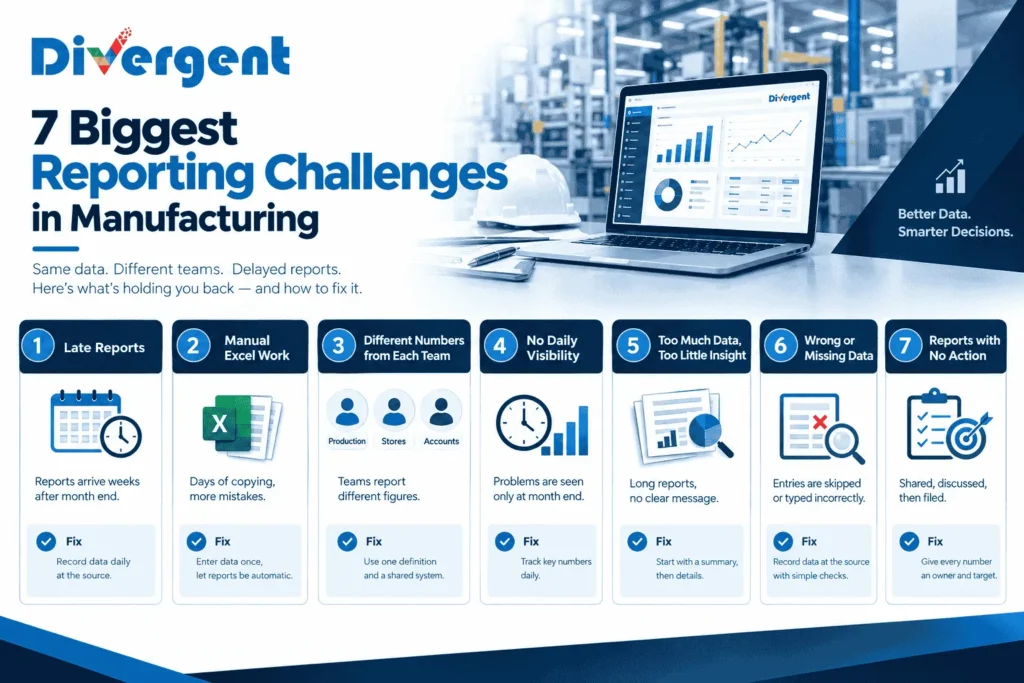
The 7 biggest reporting challenges in manufacturing are late reports, manual Excel work, different numbers from each team, no daily visibility, too much data with too little insight, wrong or missing data, and reports that lead to no action. Each one is explained below with a practical fix.
1. Why Do Manufacturing Reports Arrive So Late?
Reports arrive late because teams collect data only at month-end from many registers and files, then compile it by hand. Every department waits for another one before its numbers are final.
Late reports are the most common of all reporting challenges. A report that arrives three weeks late can only explain what went wrong, not prevent it.
Fix: Record data daily at the source, so monthly reports are just a summary of numbers that already exist.
2. Why Is Manual Excel Reporting a Problem?
Manual Excel reporting is a problem because people spend days copying numbers from registers into spreadsheets, and every copy is a chance for mistakes. One wrong formula or pasted row can change the whole result.
Excel is a useful tool, but using it as the main reporting system creates many reporting challenges as the factory grows.
Fix: Enter data once, at the source, and let reports be produced from that data automatically.
3. Why Do Different Teams Report Different Numbers?
Different teams report different numbers because each one keeps its own records and uses its own definitions. Production counts output at the machine, stores counts it at receipt, and accounts counts it at invoicing. All three can be “right” and still not match.
This is one of the most frustrating reporting challenges, because meetings turn into arguments about whose numbers are correct.
Fix: Agree one definition for each number, and keep all departments on one shared system. Our guide to production visibility challenges explains why shared data matters.
4. Why Is Daily Visibility So Important?
Daily visibility matters because most factory losses grow day by day: a slow machine, a high-waste shift, a stock shortage. If you only see them in the monthly report, they’ve already cost you for weeks.
Fix: Track a few key numbers daily, such as output, downtime, wastage and pending dispatches, so problems are caught within a day, not a month.
5. How Can a Report Have Too Much Data?
A report has too much data when it lists every number but doesn’t highlight what matters. Managers get 20-page reports, skim them and miss the one problem that needed action.
Fix: Start every report with a short summary of what’s good, what’s bad and what needs action, then put the detail below.
6. Why Do Factory Reports Contain Wrong Data?
Factory reports contain wrong data when entries are skipped, made from memory or typed incorrectly. A report is only as good as the data behind it.
Data quality is behind many reporting challenges, because once people stop trusting a report, they stop using it.
Fix: Record data as close to the work as possible, with simple checks for missing or unusual entries.
7. Why Don’t Reports Lead to Action?
Reports often lead to no action because nobody is responsible for following up. The report is shared, discussed and filed, and the same problems appear next month.
Fix: Give every key number an owner and a target, and review actions, not just numbers, in every meeting.
Which Manufacturing KPIs Should Your Reports Track?
The most useful manufacturing KPIs for reports are production output against plan, machine efficiency, wastage percentage, first pass yield, on-time delivery and cost per unit. A short list of the right KPIs is far more useful than a long report full of numbers.
| KPI | What it shows | Report |
|---|---|---|
| Output vs plan | How much was made compared with the target | Daily production |
| Machine efficiency (OEE) | How well machines are really performing | Daily production |
| Wastage % | Material lost at each stage | Wastage report |
| First pass yield | Products right the first time, without rework | Quality report |
| On-time delivery (OTIF) | Orders delivered on time and in full | Dispatch report |
| Cost per unit | Actual cost compared with quoted cost | Costing report |
| Inventory days | How many days of stock you’re holding | Inventory report |
These KPIs connect directly to the topics in our other guides: manufacturing waste, quality control challenges and dispatch management. You can read more about overall equipment effectiveness on Wikipedia.
What Do Reporting Challenges Really Cost a Factory?
Reporting challenges cost a factory in slow decisions, hidden losses and wasted staff time. The biggest cost isn’t the report itself. It’s the problems that keep growing because nobody saw them in time.
| Problem | What it costs |
|---|---|
| Late MIS reports | Decisions based on old numbers |
| Hidden wastage | Material losses that continue for weeks |
| Wrong costing numbers | Underpriced orders and lost margin |
| Staff time on manual reports | Days lost every month to copying data |
| No trust in reports | Managers rely on gut feeling instead of facts |
How Do You Fix Reporting Challenges, Step by Step?
You fix reporting challenges by recording data once at the source, agreeing on one definition for each number, keeping reports short and focused, and assigning owners for action. These seven steps work in most plants:
- List the decisions you need to make, then choose the reports that support them.
- Pick 6 to 8 key KPIs for the whole plant.
- Agree one definition for each number, such as how output and wastage are counted.
- Record data daily, at the source, not from memory at month-end.
- Keep reports short: summary first, detail after.
- Give each KPI an owner and a target.
- Review actions weekly, not just numbers.
You don’t need new software to start. Even with Excel, these steps will make your reports faster and more useful.
How Do ERP Dashboards Solve Reporting Challenges?
An ERP dashboard solves reporting challenges by producing reports automatically from the data your teams already enter: production, stock, quality, dispatch and accounts. Instead of waiting weeks for an MIS report, managers see real-time numbers every day.
For reporting, a manufacturing ERP typically provides:
- Real-time dashboards for output, wastage, stock and dispatch
- Daily production reports by machine, shift and order
- Automatic MIS reports at month-end, without manual work
- One set of numbers shared by every department
- Drill-down, from a summary number to the detail behind it
- Alerts when a KPI goes outside its target
The biggest change is speed and trust. When every department works in one system, the numbers match, and reports are ready the moment the day or month ends. For a general overview, see enterprise resource planning on Wikipedia.
Reporting Challenges and Solutions at a Glance
| Challenge | Root cause | Solution |
|---|---|---|
| Late reports | Data collected only at month end | Record data daily at the source |
| Manual Excel work | Data copied by hand | Enter once, report automatically |
| Different numbers from each team | Separate records and definitions | One system, one definition per number |
| No daily visibility | Only monthly reporting | Daily tracking of key numbers |
| Too much data | No summary or focus | Summary first, detail after |
| Wrong or missing data | Entries from memory | Record close to the work, with checks |
| Reports with no action | No owners or targets | KPI owners and weekly action reviews |
FAQs About Reporting Challenges in Manufacturing
What are reporting challenges in manufacturing?
Reporting challenges in manufacturing are problems that stop a factory from getting accurate, timely reports, such as late MIS reports, manual Excel work, mismatched numbers between teams and reports that don’t lead to action.
What is an MIS report?
An MIS (management information system) report is a regular summary of a business’s performance. In manufacturing, it covers production, wastage, stock, quality, dispatch, sales and costs, to help managers make decisions.
What should a daily production report include?
A daily production report should include the date, machine, shift, order, planned output, actual output, downtime and its reasons, and wastage.
What are the most important manufacturing KPIs?
The most important manufacturing KPIs are output against plan, machine efficiency (OEE), wastage percentage, first pass yield, on-time delivery and cost per unit.
How often should manufacturing reports be prepared?
Production, wastage and dispatch reports work best daily. Inventory and quality reports are usually weekly. A full MIS report is typically monthly.
How does ERP help with reporting?
ERP helps by producing reports automatically from daily data entered across the plant. Managers get real-time dashboards, matching numbers and month-end MIS reports without manual work.