What Is Traceability in Manufacturing?
Traceability in manufacturing is the ability to track a product’s full history: which raw materials went into it, which machines and people made it, which quality checks it passed, and which customers received it. Good traceability lets a factory answer any complaint or audit question in minutes, using batch, lot or serial numbers that link every stage together.
The Problem: One Complaint, Three Days of Searching
A customer calls. A batch you delivered last month has failed at their site. They want answers today.
Which raw material lot did you use? Which machine produced it? Which shift was working? Did it pass every quality check? And which other customers received bags or rolls from the same lot?
Your team starts searching. The purchase register shows the material, but not the lot number. The production file shows the date, but not the machine. The dispatch record shows the customer, but not which batch went where.
Three days later, you have a rough answer. By then, the customer has started asking other suppliers for quotes.
This is what poor traceability in manufacturing looks like. It doesn’t stop production, so it’s easy to ignore. Until the day a customer, auditor, or government buyer asks a question you can’t answer.
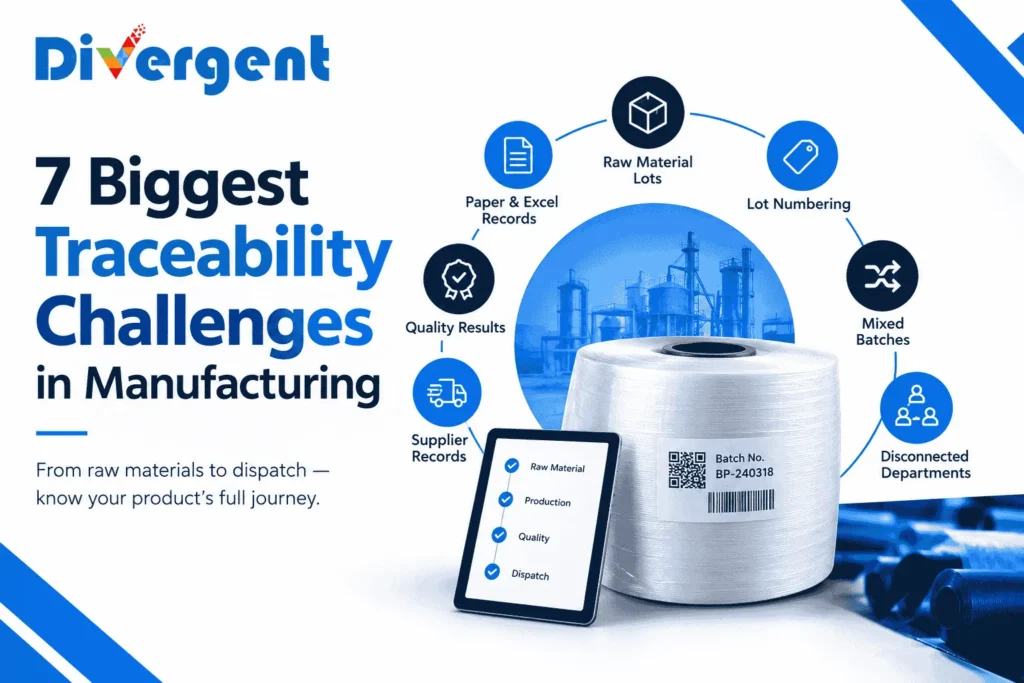
Here are the seven traceability challenges we see most often in Indian factories:
| Challenge | What happens in the plant | What it costs you |
|---|---|---|
| 1. Paper and Excel records | Each department keeps its own register | Hours or days to trace one batch |
| 2. No clear lot numbering | Batches aren’t numbered, or numbers change between stages | No way to link stages together |
| 3. Raw material lots not recorded | Materials are issued without their supplier lot | You can’t find which supplier caused a problem |
| 4. Batches split and mixed | WIP from different batches is combined | One complaint affects many orders |
| 5. Disconnected departments | Purchase, production, quality and dispatch don’t share data | No single history for any product |
| 6. Quality results not linked | Test results sit in the lab, not with the batch | You can’t prove a batch passed |
| 7. No supplier traceability | Supplier test certificates aren’t kept with materials | Problems can’t be traced upstream |
The good news? Every one of these can be fixed, step by step.
Key takeaways:
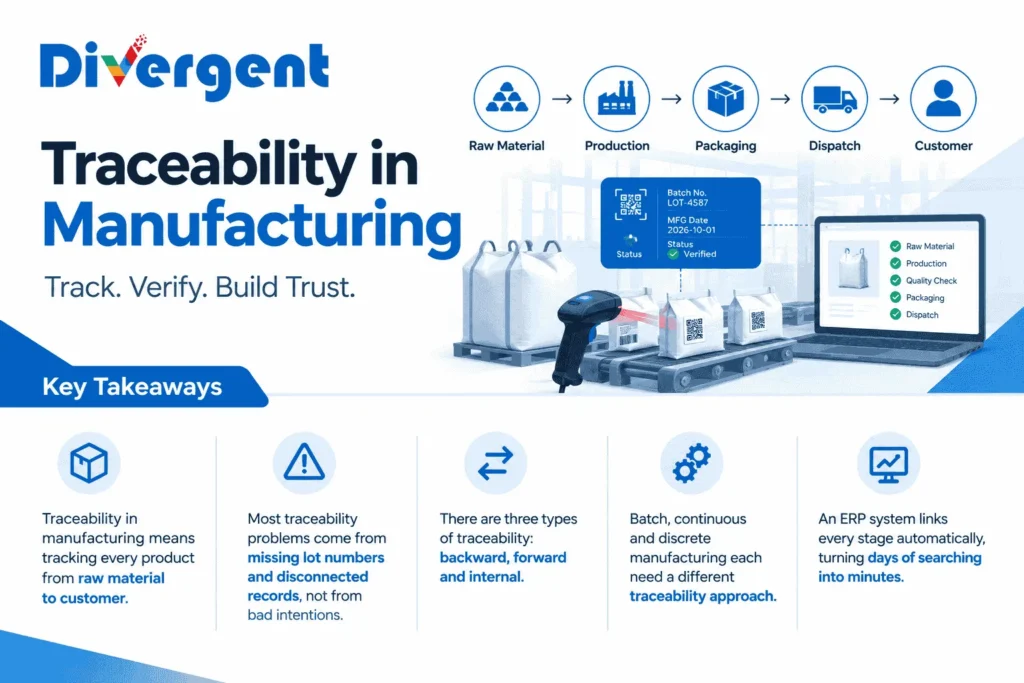
- Traceability in manufacturing means tracking every product from raw material to customer.
- Most traceability problems come from missing lot numbers and disconnected records, not from bad intentions.
- There are three types of traceability: backward, forward, and internal.
- Batch, continuous, and discrete manufacturing each need a different traceability approach.
- An ERP system links every stage automatically, turning days of searching into minutes.
What Does Traceability Mean?
The traceability meaning is simple: being able to follow something’s path: where it came from, where it went, and what happened to it along the way. In manufacturing, it means linking every finished product back to its materials, processes and checks, and forward to its customers.
You can read a general definition of traceability on Wikipedia. Traceability in manufacturing usually works in three directions:
| Type | Question it answers | Example |
|---|---|---|
| Backward traceability | Where did this product come from? | A customer complaint is traced back to a supplier’s granule lot |
| Forward traceability | Where did this material go? | A bad material lot is traced forward to every order that used it |
| Internal traceability | What happened inside the plant? | A batch is traced through each machine, shift and quality check |
Strong traceability in manufacturing needs all three. Backward traceability finds the cause, forward traceability finds everything affected, and internal traceability shows exactly where things went wrong.
Why Does Traceability Matter for Indian Manufacturers?
Traceability matters for Indian manufacturers because customers, auditors, and export buyers increasingly expect proof, not promises. A factory that can trace any batch quickly wins more trust, more repeat orders, and more export business.
Here’s where it makes the biggest difference:
- Export customers often ask for full batch history and test certificates before they accept a delivery.
- Government and project buyers may require documented quality records with every supply.
- Certified products need records that show every batch met the standard, for example during a BIS or ISO audit.
- Large brand customers expect fast, clear answers when something goes wrong.
- Your own costs drop when you can limit a problem to one batch instead of withdrawing everything.
In short, traceability in manufacturing isn’t just about solving complaints. It’s about being the kind of supplier serious customers want to work with.
What Are the 7 Biggest Traceability Challenges in Manufacturing?
The 7 biggest challenges of traceability in manufacturing are paper-based records, missing lot numbers, unrecorded raw material lots, mixed batches, disconnected departments, unlinked quality results, and missing supplier records. Each one is explained below with a practical fix.
1. Why Do Paper and Excel Records Break Traceability?
Paper and Excel records break traceability because each department keeps its own version, and nothing links them together. To trace one batch, someone has to search several registers and files by hand.
Paper records are the most common barrier to traceability in manufacturing, and the problem gets worse with time. Last week’s batch might take an hour to trace. Last year’s batch might take days, if the records still exist at all.
Fix: Move batch records into one shared system, where every stage adds its information to the same batch.
2. Why Is Lot Numbering So Important?
Lot numbering is important because the lot or batch number is the thread that ties every stage together. Without a clear number that follows the product from start to finish, there’s nothing to trace.
Lot numbering is the foundation of traceability in manufacturing. A common mistake is giving a batch one number at extrusion, another at weaving, and a third at dispatch, with no record linking them.
Fix: Create one numbering rule for the whole plant, and record how batch numbers connect when they change between stages.
3. Why Must Raw Material Lots Be Recorded?
Raw material lots must be recorded because many quality problems start with the material, not the process. If you don’t know which supplier lot went into which batch, you can’t find the cause or claim from the supplier.
Without material lots, traceability in manufacturing stops at your own gate.
Fix: Record the supplier’s lot number when material arrives, and again every time it’s issued to production.
4. What Happens When Batches Are Split or Mixed?
When batches are split or mixed, one problem can spread across many orders, and you lose the ability to say exactly which products are affected. It’s one of the hardest parts of traceability in manufacturing, especially with work-in-progress, like fabric rolls or partly finished goods from different batches.
Fix: Record every split and merge, so you always know which source batches went into each new batch.
5. Why Do Disconnected Departments Hurt Traceability?
Disconnected departments hurt traceability because each team only holds part of the story. Purchase knows the supplier, production knows the machine, quality knows the test result, and dispatch knows the customer. Nobody has the whole picture, so traceability in manufacturing breaks down at every handover.
Fix: Connect all departments to one record for each batch, so the full history is in one place. Our guide to production visibility challenges explains why this matters across the plant.
6. Why Should Quality Results Be Linked to Batches?
Quality results should be linked to batches because a test result is only useful if you can prove which batch it belongs to. Quality records are a key part of traceability in manufacturing. When results sit in a separate lab register, it’s hard to show a customer or auditor that a specific batch passed.
Fix: Record every inspection and test against its batch number. Our guide to quality control challenges covers this in detail.
7. Why Does Supplier Traceability Matter?
Supplier traceability matters because your product is only as reliable as your materials. If you don’t keep supplier test certificates and lot details, you can’t trace a problem back beyond your own gate. Complete traceability in manufacturing always starts with your suppliers
Fix: Store each supplier’s certificate and lot details with the material record, and rate suppliers on real quality results.
How Does Traceability Work in Batch, Continuous and Discrete Manufacturing?
Traceability in manufacturing works differently depending on how a factory produces. Batch production traces groups of products, continuous production traces time periods and material flows, and discrete manufacturing traces individual items with serial numbers.
| Production type | What it is | How traceability works | Examples |
|---|---|---|---|
| Batch production | Products made in groups, one batch at a time | Each batch gets a number linked to its materials and checks | Woven bags, FIBC, printed bags, food, chemicals |
| Continuous production | Material flows non-stop through the process | Output is traced by time period, shift and material lot | Polymer, cement, steel, paper |
| Discrete manufacturing | Individual, countable items are made | Each item or group gets a serial number | Machines, vehicles, electronics |
What Is Batch Production?
Batch production is a manufacturing method where products are made in groups, or batches, rather than one at a time or in a non-stop flow. Each batch goes through the same steps before the next one starts. Most packaging, textile and woven bag plants use batch production, also called batch manufacturing, so traceability in manufacturing for them is built around batch numbers.
What Is a Continuous Process?
A continuous process runs non-stop, with raw material entering at one end and finished product leaving at the other. Because there are no natural batches, traceability is based on time windows, shifts and raw material lots.
What Is Discrete Manufacturing?
Discrete manufacturing makes separate, countable products, like machines or electronic devices. Traceability usually uses serial numbers, so each unit can be tracked individually.
Many plants mix these methods, which makes traceability in manufacturing harder to design. For example, tape extrusion can run as a continuous process, while weaving, cutting and stitching are done in batches. Good traceability links both.
What Does Poor Traceability Cost a Factory?
Poor traceability costs a factory in time, money and trust. When you can’t trace a problem, you spend days searching, withdraw more products than necessary, and give customers vague answers that damage the relationship.
| Problem | What it costs |
|---|---|
| Slow complaint handling | Lost customer confidence and repeat orders |
| No clear recall scope | Withdrawing far more products than needed |
| Missing records in audits | Failed audits or lost certification |
| No proof for export buyers | Rejected shipments or lost export contracts |
| Unknown root cause | The same problem happens again |
The highest hidden cost of weak traceability in manufacturing is lost opportunity. Many large buyers simply won’t work with a supplier who can’t show full batch history.
How Do You Build Traceability in Manufacturing, Step by Step?
You build traceability in manufacturing by numbering every batch, recording every material and process against that number, and linking all departments to one shared record. These seven steps work in most plants:
- Set one batch numbering rule for the whole plant.
- Record supplier lot numbers when material arrives and when it’s issued.
- Link each production stage to the batch: machine, shift and operator.
- Record every split and merge of WIP batches.
- Attach quality results to each batch at every stage.
- Record which batches go to which customer at dispatch.
- Test your system by tracing a random batch every month, and time how long it takes.
That last step is the simplest health check. If tracing one batch takes more than a few minutes, there’s still a gap to fix.
Which KPIs Show How Good Your Traceability Is?
The best KPIs for traceability in manufacturing are trace time, traceability coverage, and recall scope. They sit alongside your other manufacturing KPIs and show how quickly and completely you can trace any product.
| KPI | What it measures | Good target |
|---|---|---|
| Trace time | Minutes to trace one batch from customer back to raw material | Minutes, not days |
| Traceability coverage | Percentage of batches with complete records | As close to 100% as possible |
| Recall scope | How many batches are affected when one material lot fails | Only the batches that really used it |
| Supplier record completeness | Percentage of material lots with supplier certificates | Every lot |
How Does ERP Improve Traceability in Manufacturing?
An ERP system improves traceability in manufacturing by recording materials, production, quality and dispatch against the same batch automatically. Instead of searching registers, you type a batch number and see its full history, backward to raw material and forward to every customer.
For traceability, a manufacturing ERP typically provides:
- Batch and lot numbering that follows the product through every stage
- Raw material lot tracking from receipt to issue
- Split and merge records for WIP batches
- Quality results linked to each batch
- Dispatch records showing which batches went to which customer
- Instant trace reports, both backward and forward
ERP also helps other parts of the plant. Accurate batch records make inventory more reliable, as explained in our guide to inventory management challenges, and connect quality problems to their real causes. For a general overview, see enterprise resource planning on Wikipedia.
If you work in a specific industry, our guides to FIBC ERP software, BOPP bag ERP software and textile ERP software explain how traceability works in each one.
Traceability Challenges and Solutions at a Glance
| Challenge | Root cause | Solution |
|---|---|---|
| Paper and Excel records | Each department keeps its own register | One shared batch record |
| No clear lot numbering | No plant-wide rule | One numbering rule for every stage |
| Raw material lots not recorded | Lots skipped at receipt or issue | Record supplier lots every time |
| Batches split and mixed | Splits and merges not recorded | Record every split and merge |
| Disconnected departments | Separate files and systems | Connect all teams to one record |
| Quality results not linked | Results kept in the lab register | Attach results to each batch |
| No supplier traceability | Certificates not stored | Keep certificates with material lots |
FAQs About Traceability in Manufacturing
What is traceability?
Traceability is the ability to track a product’s history, location and use through recorded identification, such as batch, lot or serial numbers. In manufacturing, it links every product to its materials, processes, checks and customers.
What is the meaning of traceability in manufacturing?
In manufacturing, traceability means you can follow any product backward to its raw materials and forward to its customers, and see every machine, shift, and quality check in between.
What are the types of traceability?
The three main types are backward traceability (from product to source), forward traceability (from material to customers), and internal traceability (through each stage inside the plant).
What is batch production?
Batch production is a manufacturing method where products are made in groups, one batch at a time. Each batch goes through the same steps, and each can be given its own batch number for traceability.
Which manufacturing system is best suited for batch production?
Batch production suits plants that make many product types in medium quantities, such as packaging, textiles, chemicals and food. A system with batch-wise planning, inventory and quality records, like a manufacturing ERP, is the best fit.
What is mass production?
Mass production is the large-scale production of standard products, often on continuous or highly automated lines. Traceability in mass production usually relies on batch or time-based records.
Final Thoughts on Traceability in Manufacturing
Traceability in manufacturing is like insurance: you don’t notice it until you need it, and then it’s the only thing that matters. The plants that can trace any batch in minutes handle complaints calmly, pass audits easily and win the trust of serious customers.
Start small. Set one batch numbering rule, record supplier lots, and trace one random batch this month. Time how long it takes. That number will tell you exactly how much work is left.
Related reading:
- 12 Critical Manufacturing Challenges in Modern Manufacturing Industry
- Quality Control Challenges in Manufacturing
- Inventory Management Challenges in Manufacturing
- Manufacturing Waste: The 8 Costly Types and How ERP Helps Reduce Them
- Production Planning Challenges
why