What Is Tarpaulin Manufacturing ERP?
Tarpaulin manufacturing ERP is software that helps tarpaulin and container liner manufacturers manage made-to-size orders, fabric cutting, lamination, finishing, stock, quality and dispatch in one system. It calculates cost from GSM and size, reduces cutting waste and tracks every order from enquiry to delivery. Divergent PackPro, by Divergent Software Labs, is a tarpaulin manufacturing ERP built for this workflow, including plants in Saudi Arabia.
The Problem: 500 Tarpaulins, 14 Sizes, Due Monday
A contractor in Riyadh orders 500 tarpaulins for a construction site. They need 14 different sizes, heavy-duty GSM, UV protection for the summer heat, and delivery by Monday.
Your team starts working it out. How much fabric is needed? Which roll widths will waste the least? Is the laminated fabric in stock? Which shift can do the eyelets and hems? What’s the right price?
The answers are spread across spreadsheets, a cutting notebook and the store register. By the time the quote is ready, the contractor has already called another supplier.
This is daily life in many tarpaulin and container liner plants. Here are the problems we see most often:
| Problem | What happens in the plant | What it costs you |
|---|---|---|
| 1. Made-to-size orders | Every customer wants different sizes and quantities | Slow quotes and frequent calculation mistakes |
| 2. Cutting waste | Panels are cut without planning against roll widths | Expensive fabric is lost as offcuts |
| 3. Wrong costing | GSM, lamination and finishing costs are estimated | Actual cost ends up higher than the quoted price |
| 4. Finishing bottlenecks | Eyelets, hems, seams and welding aren’t planned | Orders wait at the last stage and deliveries slip |
| 5. Export paperwork | Container liner specs and shipping documents are handled by email | Errors, delays, and unhappy export buyers |
Each problem looks small. Together, they decide whether your plant makes a profit on an order or loses money on it.
The Answer: Tarpaulin Manufacturing ERP Built for Your Plant
The answer is one system that connects every order, roll, machine and delivery, so your team works from the same numbers.
At Divergent Software Labs, we built Divergent PackPro for manufacturers like you. PackPro is an AI-enabled, end-to-end ERP for flexible packaging, including tarpaulin, truck cover and container liner plants.
Here’s how PackPro helps with each problem:
| Problem | How PackPro helps |
|---|---|
| 1. Made-to-size orders | Each size is entered once, and fabric needs and cost are calculated automatically |
| 2. Cutting waste | Cutting is planned against available roll widths to reduce offcuts |
| 3. Wrong costing | Cost is calculated from GSM, size, lamination and finishing, and updates with material rates |
| 4. Finishing bottlenecks | Eyelet, hemming, seaming and welding work is scheduled with the rest of production |
| 5. Export paperwork | Specifications, packing lists and dispatch documents are kept with each order |
How we work: we don’t start by selling software. We start by understanding your plant: your products, your customers, where records are kept today, and where orders get delayed. Then we set up PackPro around how you work.
Key takeaways:
- Tarpaulin plants make many sizes for many customers, which makes costing and cutting hard to manage by hand.
- Most losses come from cutting waste, estimated costs and finishing delays.
- Tarpaulin manufacturing ERP connects orders, fabric rolls, cutting, finishing, quality and dispatch in one system.
- Saudi plants also need to plan for summer UV demand, construction project deadlines and e-invoicing rules.
- Divergent PackPro is set up around your products and processes, not a generic template.
What Does Tarpaulin Manufacturing ERP Cover?
Tarpaulin manufacturing ERP covers every product a tarpaulin and liner plant makes, from standard tarpaulins to fully custom container liners.
| Product | Used for | Key requirement |
|---|---|---|
| HDPE laminated tarpaulins | Construction, storage, general covering | GSM, UV protection, waterproofing |
| PVC-coated tarpaulins | Truck covers, heavy-duty covers | Strength, coating weight, welding |
| Truck and trailer covers | Logistics and transport | Exact sizes, eyelets, reinforced edges |
| Container liners | Bulk export of granules, grain and powders | Exact container dimensions, liner film, loading specification |
| Agricultural covers | Hay, grain and greenhouse covering | UV stability for long outdoor use |
| Pond and pit liners | Water storage, farms, industry | Waterproofing and puncture resistance |
Most tarpaulins are made from woven polyethylene or polypropylene fabric, laminated or coated for waterproofing. You can read more about tarpaulins on Wikipedia, and about the woven fabrics behind them in our guide to woven polypropylene bags.
Why Is Tarpaulin Manufacturing Growing in Saudi Arabia?
Tarpaulin and liner manufacturing in Saudi Arabia is growing because of three things: local polymer supply, large construction and logistics projects, and the country’s push to expand local manufacturing.
- Local raw material. Saudi Arabia is one of the world’s largest producers of polyethylene and polypropylene, the main materials used in tarpaulins and liners.
- Construction and infrastructure. Large projects across the Kingdom create steady demand for site covers, scaffolding sheets and material protection.
- Logistics and exports. Busy ports and growing trade mean more demand for truck covers and container liners for bulk exports.
- Local manufacturing goals. Under Saudi Vision 2030, the Kingdom is encouraging more local industrial production, which pushes manufacturers to modernise their operations.
The Saudi climate adds its own needs too. Strong sun and high summer temperatures mean customers expect UV-stabilised fabrics and reliable quality, especially for long outdoor use.
Why Don’t Excel and Normal ERP Work Well for Tarpaulin Plants?
Excel and normal ERP struggle because tarpaulin orders are made to size. Every order needs its own fabric calculation, cutting plan, finishing steps and cost, and most general systems aren’t built to handle that detail.
In a typical plant, this means:
- Quotes take too long, because every size is calculated by hand. See our guide to costing and quotation challenges.
- Cutting isn’t planned, so offcuts pile up. See manufacturing waste.
- Fabric stock is a total, not roll by roll, so the right roll width is hard to find. See inventory management challenges.
- Finishing isn’t scheduled, so orders wait at the eyelet or welding stage. See production planning challenges.
- Quality checks are on paper, so GSM or waterproofing problems are found late. See quality control challenges.
That’s why many tarpaulin manufacturers move to a tarpaulin manufacturing ERP built for their industry.
What Are the 9 Must-Have Features in Tarpaulin Manufacturing ERP?
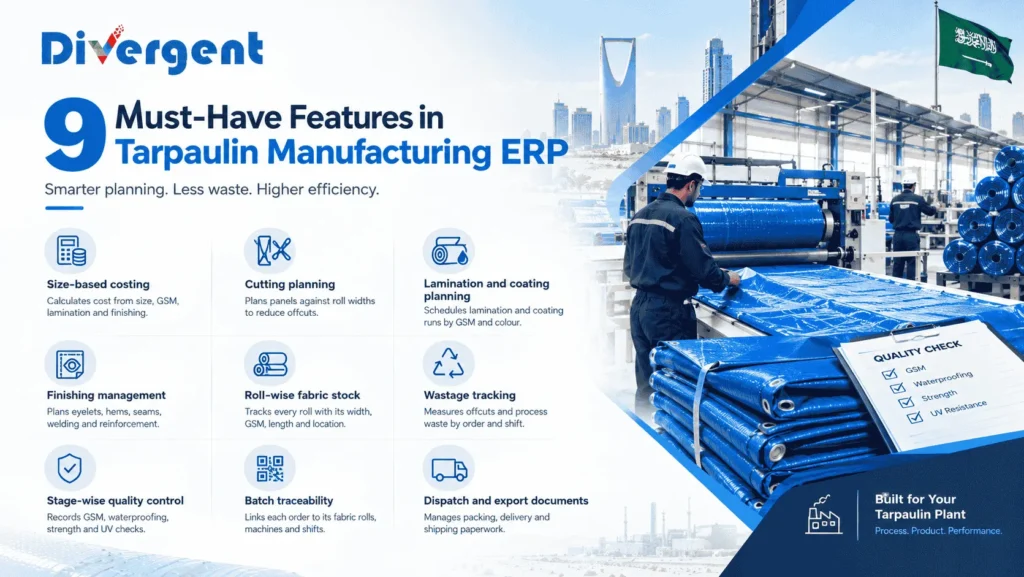
The 9 must-have features in tarpaulin manufacturing ERP are size-based costing, cutting planning, lamination and coating planning, finishing management, roll-wise fabric stock, wastage tracking, stage-wise quality control, batch traceability, and dispatch with export documents.
| Feature | What it does for a tarpaulin plant |
|---|---|
| Size-based costing | Calculates cost from size, GSM, lamination and finishing |
| Cutting planning | Plans panels against roll widths to reduce offcuts |
| Lamination and coating planning | Schedules lamination and coating runs by GSM and colour |
| Finishing management | Plans eyelets, hems, seams, welding and reinforcement |
| Roll-wise fabric stock | Tracks every roll with its width, GSM, length and location |
| Wastage tracking | Measures offcuts and process waste by order and shift |
| Stage-wise quality control | Records GSM, waterproofing, strength and UV checks |
| Batch traceability | Links each order to its fabric rolls, machines and shifts |
| Dispatch and export documents | Manages packing, delivery and shipping paperwork |
1. Size-Based Costing
Size-based costing calculates the cost of each tarpaulin from its length, width, GSM, lamination, colour, eyelets and edges. For orders with many sizes, it adds everything up automatically, so your team can send an accurate quote quickly.
2. Cutting Planning
Cutting planning works out how to cut the required panels from your available fabric roll widths with the least waste. On large tarpaulins, the right cutting plan can save a significant amount of fabric on every order.
3. Lamination and Coating Planning
Lamination and coating planning groups jobs by GSM, colour and coating type, so you change settings less often. Fewer changeovers mean less setup waste and more output from the same machine.
4. Finishing Management
Finishing is often where tarpaulin orders get stuck. Finishing management schedules eyelets, hemming, seaming, heat welding and reinforcement alongside the rest of production, so orders don’t pile up at the final stage.
5. Roll-Wise Fabric Stock
Roll-wise stock tracks every fabric roll individually: width, GSM, colour, length and location. When a new order arrives, your team can find the right roll instantly, and partly used rolls are recorded correctly.
6. Wastage Tracking
Wastage tracking measures offcuts, edge trim and process waste for every order and shift. It shows where fabric is really being lost, instead of relying on a rough estimate.
7. Stage-Wise Quality Control
Quality control records checks at each stage: fabric GSM, lamination bonding, waterproofing, tensile strength, UV stabilisation, size accuracy and eyelet strength. In a hot climate like Saudi Arabia, UV and coating quality are especially important for outdoor products.
8. Batch Traceability
Batch traceability links each order to the fabric rolls, machines and shifts used to make it. If a contractor reports a tarpaulin tearing early, you can trace the cause and check other orders made from the same rolls.
9. Dispatch and Export Documents
Dispatch management tracks packing, loading and delivery for local customers and export buyers. For container liners, it keeps the specification, packing list and shipping documents together with each order.
What Should Saudi Manufacturers Check in an ERP?
Saudi manufacturers should check that any ERP fits local business requirements as well as their production needs. Three areas matter most:
- E-invoicing. Businesses in Saudi Arabia must follow the e-invoicing rules of the Zakat, Tax and Customs Authority (ZATCA). Ask every vendor how their system creates compliant invoices, or how it connects to your existing invoicing or accounting system.
- VAT. Your system must handle Saudi VAT correctly on quotes, invoices and reports.
- Arabic and English documents. Many customers and authorities expect bilingual documents. Check whether quotes, invoices and delivery notes can be produced in both languages.
These rules can change, so confirm the current requirements with your tax advisor and ask vendors to show how they handle them today.
Tarpaulin Manufacturing ERP Options Compared
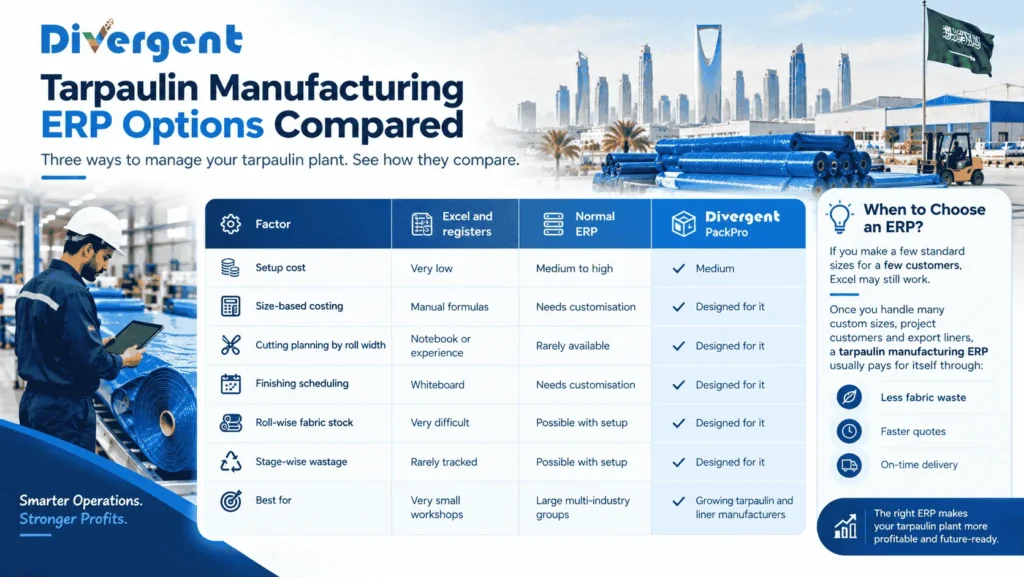
Tarpaulin manufacturers usually manage operations in one of three ways: Excel and registers, a normal ERP, or ERP built for packaging and tarpaulin manufacturers, like Divergent PackPro.
| Factor | Excel and registers | Normal ERP | Divergent PackPro |
|---|---|---|---|
| Setup cost | Very low | Medium to high | Medium |
| Size-based costing | Manual formulas | Needs customisation | Designed for it |
| Cutting planning by roll width | Notebook or experience | Rarely available | Designed for it |
| Finishing scheduling | Whiteboard | Needs customisation | Designed for it |
| Roll-wise fabric stock | Very difficult | Possible with setup | Designed for it |
| Stage-wise wastage | Rarely tracked | Possible with setup | Designed for it |
| Best for | Very small workshops | Large multi-industry groups | Growing tarpaulin and liner manufacturers |
If you make a few standard sizes for a few customers, Excel may still work. Once you handle many custom sizes, project customers and export liners, tarpaulin manufacturing ERP usually pays for itself through less fabric waste, faster quotes and on-time delivery.
How Does Divergent PackPro Work for Tarpaulin Plants?
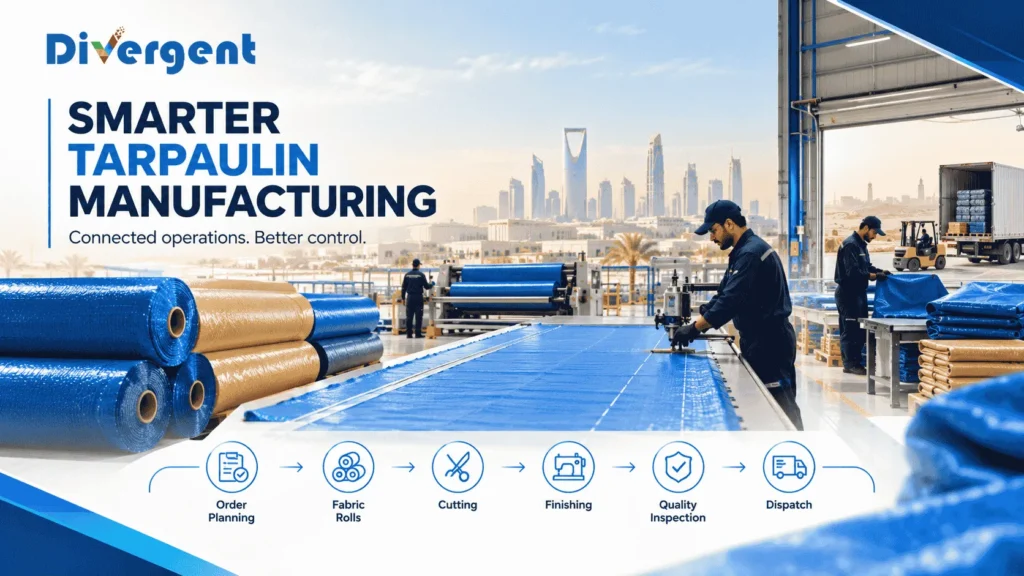
Here’s how an order typically moves through a tarpaulin plant using Divergent PackPro:
- Enquiry: the customer’s sizes, GSM, colour and finishing are entered.
- Costing and quote: fabric needs and cost are calculated for every size.
- Cutting plan: panels are planned against available roll widths.
- Production planning: lamination, cutting, finishing and welding are scheduled.
- Production and quality: output, waste and quality checks are recorded at each stage.
- Packing: finished tarpaulins or liners are packed and labelled by size.
- Dispatch: the order is delivered or shipped, with all documents attached.
What Will You See in a PackPro Demo?
Bring a real multi-size order, and ask to see:
- Your order costed across all sizes, GSM and finishing
- A cutting plan made from your actual roll widths
- Finishing work scheduled alongside production
- Fabric rolls tracked one by one
- A quality check recorded for GSM, waterproofing and strength
Bring your most complicated order, with many sizes and finishes. It’s the best way to test any tarpaulin manufacturing ERP.
Expert Insight
“In tarpaulin plants, the money is made or lost before the first cut. If your costing and cutting plan are right, the order is profitable. If they’re guessed, the offcuts and rework quietly eat the margin. That’s where tarpaulin manufacturing ERP makes the biggest difference.”
Is Your Plant Ready for Tarpaulin Manufacturing ERP?
Check these signs. If three or more are true, it’s time to think about tarpaulin manufacturing ERP:
- Quotes for multi-size orders take a day or more
- Offcuts and fabric waste are high, but nobody measures them by order
- The right roll width is hard to find in the store
- Orders wait at the eyelet, hemming or welding stage
- Actual costs often come out higher than quoted
- Export or project customers ask for documents you struggle to produce
How Should You Prepare for ERP in a Tarpaulin Plant?
- List your standard products and sizes, with their GSM, colours and finishes.
- Record your fabric roll widths and how you choose them for cutting.
- Clean your master data: customers, suppliers, materials and machines.
- Decide your roll and order numbering before going live.
- Check your invoicing requirements, including ZATCA e-invoicing.
- Pick one project owner inside the plant, and train each team on the screens they’ll use.
What Should You Ask Before Choosing Tarpaulin Manufacturing ERP?
Ask every vendor to show the system with your own sizes and products. Then ask:
- Can it cost a multi-size order from GSM, lamination and finishing?
- Can it plan cutting against our actual roll widths?
- Can it schedule eyelets, hemming and welding with the rest of production?
- Does it track fabric stock roll by roll?
- Does it support ZATCA e-invoicing, or connect to our invoicing system?
- Can it produce Arabic and English documents?
- How long does setup take, and who trains our team?
For a general overview, see enterprise resource planning on Wikipedia. You may also find our guides to PP woven bag ERP software and agriculture packaging ERP useful.
FAQs About Tarpaulin Manufacturing ERP
What is tarpaulin manufacturing ERP?
Tarpaulin manufacturing ERP is an ERP system built for tarpaulin, truck cover and container liner manufacturers. It connects made-to-size orders, costing, cutting, lamination, finishing, stock, quality and dispatch in one system.
What is GSM in tarpaulin?
GSM means grams per square metre. It shows how heavy the tarpaulin fabric is. Higher GSM usually means a thicker, stronger tarpaulin for heavy-duty use, while lower GSM is lighter and cheaper.
What is the difference between HDPE and PVC tarpaulin?
HDPE tarpaulin is made from woven polyethylene fabric with a laminated coating. It’s light and low-cost. PVC tarpaulin has a PVC coating, which makes it heavier, stronger and better for truck covers and heavy-duty use.
What is a container liner?
A container liner is a large bag fitted inside a shipping container, so bulk products like granules, grain or powders can be loaded loose. It protects the product and keeps the container clean.
How does ERP reduce fabric waste in tarpaulin plants?
ERP reduces fabric waste by planning cuts against available roll widths, recording offcuts by order and shift, and showing where waste is highest, so teams can fix the biggest losses first.
Do Saudi manufacturers need ZATCA-compliant invoicing?
Businesses in Saudi Arabia must follow ZATCA’s e-invoicing rules. When choosing an ERP, ask the vendor how it creates compliant invoices or connects to your invoicing system, and confirm current rules with your tax advisor.
How much does tarpaulin manufacturing ERP cost?
The cost depends on the number of users, modules, plants and deployment type. Most vendors quote after understanding your operations, so ask for a quote based on your setup.