
Disconnected departments in manufacturing are the most common and most expensive operational problem that packaging and FIBC plants face — and the most consistently underestimated. Every plant manager knows their disconnected departments do not work from the same information. Most accept it as a fact of factory life. Almost none have calculated what disconnected departments in manufacturing actually cost.
Here is a typical example. A sales manager confirms a delivery date to a customer based on what he believes is available production capacity. At the same moment, the production head is already running that capacity for a different urgent order — information that never reached the sales manager. The customer’s order is confirmed. The production plan cannot accommodate it. The delivery is late. The customer complains. The investigation finds no single person at fault — just two departments working from different information.
This is what disconnected departments in manufacturing look like in practice. Not dramatic failures — quiet, daily losses. A stockout that production did not see coming because stores and production use different systems. A quality problem that shipping did not know about because quality records never reach dispatch. A purchase order raised for material already sitting in the store under a different item code.
This guide covers what causes disconnected departments in manufacturing, how departmental silos affect every function, what the real cost of disconnected departments in manufacturing is, and how manufacturing ERP software eliminates the problem by connecting every department to a single live data source.
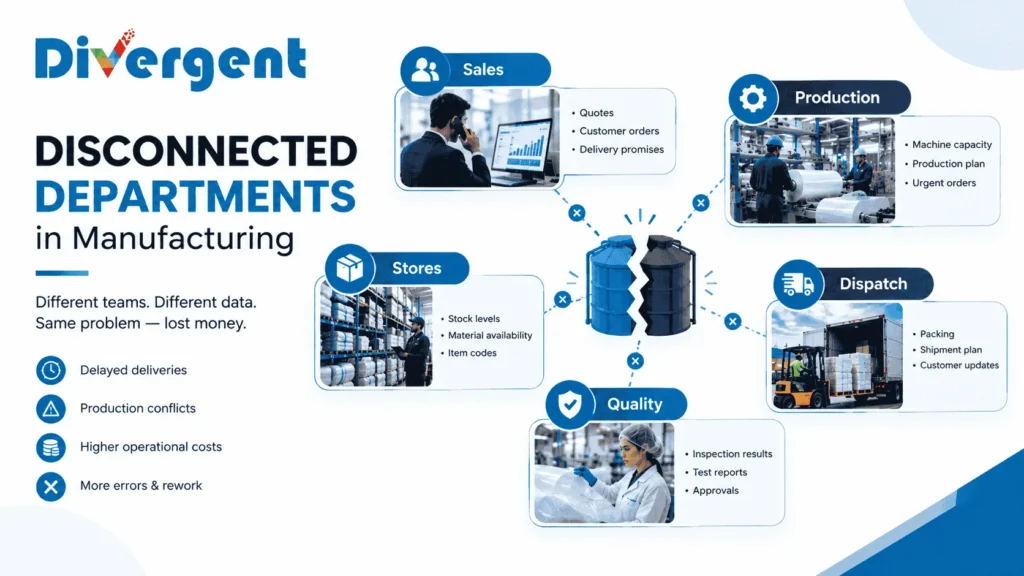
Table of Contents
- What Are Disconnected Departments in Manufacturing?
- What Are Departmental Silos?
- What Causes Silos in an Organization?
- The 6 Most Disconnected Department Pairs in Manufacturing
- How Do Silos Affect Manufacturing?
- The Real Cost of Disconnected Departments
- How to Break Down Silos in Manufacturing
- How Does ERP Connect Departments?
- Real Time Data Manufacturing: The Solution
- How to Improve Communication Between Departments in a Factory
- How Divergent PackPro Connects All Departments
- Frequently Asked Questions
What Are Disconnected Departments in Manufacturing?
Disconnected departments in manufacturing are departments that operate from different, inconsistent or out-of-date information — so decisions made in one department are based on a picture of the factory that does not match what other departments are seeing.
In a connected factory, every department — sales, production, stores, quality, purchase, dispatch and accounts — works from the same live data, updated in real time as transactions happen. When a production order is raised, stores sees it immediately. When material is issued, production sees the updated stock balance. When quality fails a batch, dispatch cannot release it.
In a factory with disconnected departments, each team works from its own records, spreadsheets, registers, WhatsApp messages, and verbal updates. Those records are never fully synchronised. The store’s stock count does not match the production team’s expectation. The sales team’s delivery commitment does not match the production schedule. The quality team’s rejection record never reaches the dispatch team.
What Are Departmental Silos?
Departmental silos are the barriers of data, process, and communication that prevent information from flowing freely between departments in an organisation. In manufacturing, a silo exists whenever one department holds information that another department needs but cannot access in real time.
The word silo comes from grain storage — a silo holds grain in isolation, separate from everything around it. A departmental silo holds information in isolation, separate from the departments that need it. Quality data sits in quality’s register. Production data sits in the supervisor’s notebook. Stock data sits in the storekeeper’s spreadsheet. None of it connects.
What Are Information Silos in Business?
Information silos in business are systems, processes or habits that result in data being stored and used within one team without being shared with others who need it. They occur in every industry but are particularly damaging in manufacturing because manufacturing decisions — when to produce, how much to buy, what to dispatch — depend on real-time information from multiple departments simultaneously.
According to McKinsey, manufacturers with poor cross-departmental data sharing spend up to 30 percent more on operational costs than those with connected systems — primarily through excess inventory, unplanned downtime and rework caused by decisions based on incomplete information.
What Causes Silos in an Organization?
Silos in manufacturing organisations develop for predictable reasons. Understanding these causes is the first step to eliminating them.
- Different systems per department: Production uses one software. Accounts uses Tally. Quality uses Excel. Stores uses a register. Each system records data in its own format, and none of them talk to each other. Every cross-department update requires a manual transfer — phone call, message or email — which introduces delay and the risk of error.
- No shared data standard: The same material has three different names in three different departments. The production team calls it PP granules. The store calls it RM-001. The accounts team records it by supplier invoice description. When someone tries to reconcile stock across these records, they cannot match them.
- Manual update processes: Data that requires someone to physically transfer it between systems is always delayed and often wrong. The store updates its register at the end of the day. Production gets yesterday’s stock position. Decisions made on yesterday’s stock position in a fast-moving plant are decisions made on wrong information.
- Organisational culture: In some factories, departments protect their data — not maliciously, but because they have always operated independently and sharing feels like extra work. This habit reinforces silos even where technology would allow connection.
- Growth without system upgrade: A factory that started with 10 employees and ran on verbal coordination reaches 100 employees still running on the same coordination methods. The processes did not scale with the business. What worked when everyone was in the same room breaks down when there are multiple shifts, multiple product lines and multiple departments.
The 6 Most Disconnected Department Pairs in Manufacturing
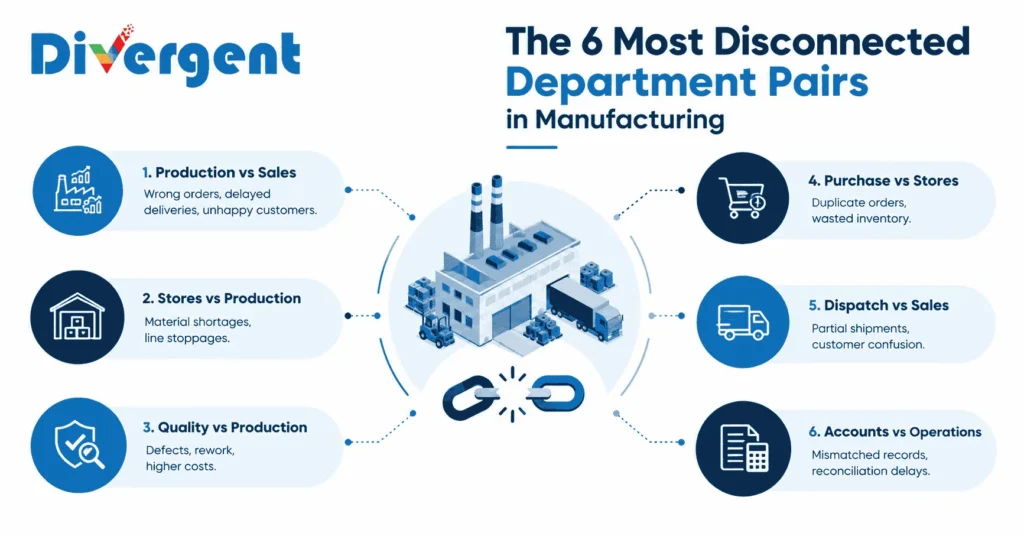
In packaging and FIBC plants, these six department pairs account for the majority of operational problems caused by disconnected departments in manufacturing.
1. Production vs Sales
Sales confirms delivery dates without checking production capacity. Production schedules orders without knowing which deliveries are most urgent to the customer. The result: the factory is busy but the wrong orders are being produced first, and customers who need their order urgently are waiting for a batch that is nowhere near the front of the schedule.
This is the most common and most costly disconnected department pair in packaging manufacturing. It is also the most fixable — a shared live order pool, visible to both sales and production, resolves it completely.
2. Stores vs Production
Production plans a run based on the stock it believes is available. When the material is issued, the actual quantity is less than expected — short weight, a rejected batch that was not removed from the stock record, or material allocated to another order that production did not know about. The line stops. The planning team scrambles.
In a connected factory, the production plan is built on real-time stock data — not yesterday’s tally. Material availability is confirmed before the production order is released, not discovered to be insufficient when the shift starts.
3. Quality vs Production
A batch fails quality inspection. The quality record is written in the quality register. Production continues making more of the same batch — because the machine operator was not informed. By the time the rejection is communicated up the chain and back down to the floor, hundreds of defective units have been produced.
With connected departments, a quality rejection triggers an automatic hold on the production order — visible to the floor supervisor, the production head and the planning team simultaneously, the moment the QC team records the rejection.
4. Purchase vs Stores
Purchase raises a purchase order for material that is already in the store — under a different item code, or in a quantity the storekeeper could not find because the bin location was not updated. Duplicate purchasing inflates inventory and wastes cash. It happens in almost every factory that does not have a shared, real-time material master.
5. Dispatch vs Sales
Dispatch ships a partial order without informing sales. The sales executive finds out when the customer calls to ask where the rest of their order is. The dispatch team did not know the full quantity was committed — they only saw the stock available that day. Sales did not know a partial shipment was planned — they assumed the full order was dispatched.
6. Accounts vs Operations
Accounts records raw material receipts based on supplier invoices. Operations records material consumption based on production entries. At month end, the two records do not match — because some receipts were not entered in time, some consumption was estimated rather than measured, and some wastage was never recorded at all. Reconciliation takes days and still leaves unexplained variances.
How Do Silos Affect Manufacturing?
Departmental silos in manufacturing create five categories of operational damage — each with a direct cost that can be measured.
| Silo Effect | What Happens | Direct Cost |
|---|---|---|
| Late deliveries | Sales commits without checking production; production schedules without knowing urgency | Customer penalties, lost repeat orders |
| Excess inventory | Purchase orders raised on stale stock data; safety stock set without visibility of actual consumption | Working capital tied up, storage cost |
| Quality escapes | Defects reach dispatch because quality rejection did not reach the floor or dispatch in time | Customer returns, rework, freight cost |
| Unplanned downtime | Production line stops because material shortage was not visible until the shift started | Machine idle time, overtime to recover |
| Management reporting delay | MIS compiled manually from multiple department records; arrives too late to act on | Wrong decisions, missed opportunities |
The Real Cost of Disconnected Departments in Manufacturing
Most factory managers feel the cost of disconnected departments in manufacturing every day — in late deliveries, firefighting and reconciliation work — but few have calculated it precisely. Here is a conservative estimate of what disconnected departments in manufacturing cost a mid-size packaging plant running three shifts.
| Cost Category | Estimated Annual Cost | Root Cause |
|---|---|---|
| Excess inventory (10% above optimal) | ₹15–40 lakhs | Purchase decisions on stale stock data |
| Emergency procurement premium | ₹5–15 lakhs | Stockouts not visible until too late |
| Rework and quality escapes | ₹8–20 lakhs | Quality data not reaching production/dispatch |
| Late delivery penalties | ₹3–10 lakhs | Sales committing without production visibility |
| Management reconciliation time | ₹2–5 lakhs | Manual MIS compilation from multiple sources |
| Total estimated annual cost | ₹33–90 lakhs | Disconnected departments |
These numbers vary by plant size and product mix. But the direction is consistent — disconnected departments in manufacturing cost significantly more than the ERP system that would connect them. Every packaging plant with disconnected departments is paying this cost today, whether or not it has been calculated.
How to Break Down Silos in Manufacturing
Breaking down disconnected departments in manufacturing requires both a technology change and a process change. Technology alone does not eliminate disconnected departments — a new system that departments use in isolation creates digital silos as fast as it removes paper ones. But process change without technology is equally limited — you cannot enforce real-time data sharing across disconnected departments in manufacturing using spreadsheets and WhatsApp.
The combination that works is a shared system — a manufacturing ERP — with standard processes that require every department to record transactions in that system as they happen.
- Start with a shared material master. Every material, product and item should have one code, one name and one unit of measure — used consistently across purchase, stores, production, quality and accounts. This single step eliminates most of the reconciliation problems between departments.
- Make stock updates real time. Every goods receipt, material issue and return must be recorded in the system the moment it happens — not at end of shift or end of day. Real-time stock visibility eliminates the most common cause of production stoppages and emergency procurement.
- Connect sales and production through a shared order pool. Every confirmed customer order should be visible to production and planning immediately. Production scheduling should be done in the same system — so delivery date feasibility is checked against real capacity before the commitment is made to the customer.
- Link quality to production and dispatch. Quality inspection results should be recorded against the production batch in the system — and dispatch should be automatically blocked until the batch is cleared. This eliminates the quality-to-dispatch communication gap entirely.
- Replace manual MIS with live dashboards. Management should not wait for a weekly or monthly report to see how the factory is performing. A live dashboard — showing production output, stock levels, quality pass rates and dispatch status — gives management real-time visibility without any report compilation effort from any department.
How Does ERP Connect Departments in Manufacturing?
ERP — Enterprise Resource Planning — connects departments by replacing multiple isolated records with a single shared system. Every transaction entered by any department is immediately visible to every other department that needs it.
According to Gartner, ERP systems are the primary technology solution for eliminating departmental silos in manufacturing — providing a single source of truth for production, inventory, quality, procurement and finance data across the organisation.
In a packaging plant running on ERP, here is what the same scenario looks like with connected departments:
- Sales checks available production capacity in the system before confirming a delivery date
- Production sees the order the moment it is confirmed and schedules it against real capacity
- Stores receives a material requirement automatically when the production order is created
- Purchase sees a reorder alert the moment any material falls below its reorder point
- Quality records the inspection result against the batch — dispatch is automatically held until cleared
- Dispatch sees cleared batches and generates the delivery note from the same system
- Accounts sees the dispatch record and raises the invoice — no separate data entry needed
Every department works from the same data. No phone calls to check stock. No WhatsApp messages to confirm delivery dates. No end-of-month reconciliation between records that should have matched all along. See our guide to reporting challenges in manufacturing for how connected departments transform MIS reporting.
Real-Time Data Manufacturing: The Solution to Departmental Silos
Real-time data manufacturing means every transaction — a goods receipt, a material issue, a production entry, a quality inspection, a dispatch — is recorded in the system the moment it happens and is immediately visible to every department that needs it.
This is the technical foundation that eliminates disconnected departments in manufacturing. When data is real-time, there is no gap between what happened and what the system shows. A storekeeper issues material at 10:15am. At 10:15am, the production head can see the updated stock balance. At 10:15am, the purchase team’s reorder alert is recalculated. At 10:15am, the management dashboard reflects the change.
The shift from batch updates — at end of shift, end of day or end of week — to real-time data entry is the single most impactful change a packaging plant can make to reduce the cost of disconnected departments. It requires no new processes to be invented. It requires existing processes to be moved from paper and spreadsheets into a shared system, and for that system to be used at the point of the transaction rather than hours later.
How to Improve Communication Between Departments in a Factory
Improving communication between departments in a factory is not primarily a people problem — it is a systems problem. When departments share the same live data, communication improves automatically because the need for verbal or written updates is eliminated for routine information.
Production does not need to call stores to check stock — they can see it. Sales does not need to call production to check order status — they can see it. Management does not need to wait for a report — they can see the dashboard.
The communication that remains — exception handling, problem solving, customer negotiations — is the communication that requires human judgment. Eliminating the routine information-chasing frees up time for the meaningful communication that actually improves the factory’s performance. See our guide to production visibility challenges for how real-time data transforms cross-department coordination.
How Divergent PackPro Eliminates Disconnected Departments
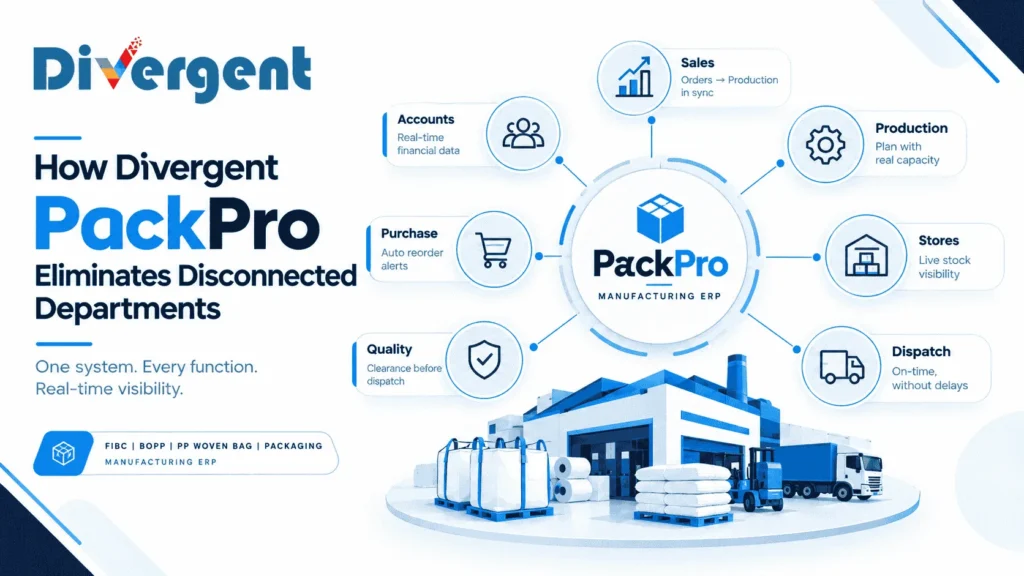
Divergent PackPro is a manufacturing ERP built specifically for FIBC, BOPP, PP woven bag and packaging plants. It eliminates disconnected departments in manufacturing by connecting every function — sales, production, stores, purchase, quality, dispatch and accounts — in one shared system. For plants dealing with disconnected departments in manufacturing, PackPro replaces isolated spreadsheets and registers with a single live data source, with every transaction recorded in real time.
- Sales and production connected: Production planning sees every confirmed order immediately. Delivery date feasibility is checked against real capacity before commitment — not discovered to be impossible after the customer has been promised.
- Stores and production connected: Production sees material availability in real time. Shortages are flagged before the shift starts, not discovered when the line stops.
- Quality and dispatch connected: Batches cannot be dispatched until quality clearance is recorded in the system. No phone call required — the system enforces the check automatically.
- Purchase and stores connected: Reorder alerts are generated automatically from real-time consumption data. Purchase teams see actual stock levels, not yesterday’s register.
- Live management dashboard: Production output, stock levels, quality pass rates, dispatch status and financial data — all on one screen, updated as transactions happen, without any report compilation effort from any department.
See how Divergent PackPro works or speak to our team for a walkthrough using your own production process.
Frequently Asked Questions — Disconnected Departments in Manufacturing
What are disconnected departments in manufacturing?
Disconnected departments in manufacturing are departments that operate from different, inconsistent or out-of-date information — so decisions made in one department are based on a picture of the factory that does not match what other departments are seeing. The result is late deliveries, stockouts, quality escapes and wasted management time.
What are departmental silos?
Departmental silos are the barriers of data, process and communication that prevent information from flowing freely between departments. In manufacturing, a silo exists whenever one department holds information that another department needs but cannot access in real time — for example, when quality data stays in the quality register and never reaches dispatch.
What are information silos in business?
Information silos in business are systems, processes or habits that result in data being stored and used within one team without being shared with others who need it. In manufacturing, information silos cause decisions to be made on incomplete or outdated data, leading to operational errors that compound across departments.
What causes silos in an organization?
Silos in manufacturing organisations are caused by different systems per department, no shared data standard, manual update processes, organisational habit and growth without system upgrade. The most common cause is each department using a different tool — one uses Excel, another uses Tally, another uses a paper register — with no automated connection between them.
How do silos affect manufacturing?
Silos affect manufacturing through late deliveries, excess inventory, quality escapes, unplanned downtime and delayed management reporting. Each effect has a direct financial cost — from customer penalties for late delivery to working capital tied up in excess stock.
How to break down silos in manufacturing?
Breaking down silos in manufacturing requires a shared ERP system and standard processes that require every department to record transactions in real time. The key steps are: create a shared material master, make stock updates real time, connect sales and production through a shared order pool, link quality to dispatch, and replace manual MIS with live dashboards.
How does ERP connect departments in manufacturing?
ERP connects departments by replacing multiple isolated records with a single shared system. Every transaction entered by any department — a goods receipt, a material issue, a quality inspection, a dispatch — is immediately visible to every other department that needs it. There is no manual transfer of data between departments.
What is real time data manufacturing?
Real time data manufacturing means every transaction is recorded in the system the moment it happens and is immediately visible to every department. When a storekeeper issues material, the production team sees the updated stock balance instantly. When quality fails a batch, dispatch sees the hold immediately. There is no delay between what happened and what the system shows.
How to improve communication between departments in a factory?
The most effective way to improve communication between departments in a factory is to give every department access to the same live data. When production can see stock levels in real time, they do not need to call stores. When sales can see order progress in real time, they do not need to call production. Eliminating routine information-chasing frees departments for the communication that requires human judgment.
What is manufacturing data silos problem?
Manufacturing data silos occur when each department stores its operational data in its own system or format — a spreadsheet, a register, a separate software — without sharing it with other departments. The data silo problem in manufacturing compounds over time: as the factory grows, the gap between what different departments believe to be true widens, and the operational cost of acting on wrong information increases.