What is the best ERP software for FIBC manufacturers?
The best ERP software for FIBC manufacturers is one built specifically for bulk bag production, covering GSM-based costing, extrusion yield tracking, loom efficiency monitoring, roll-wise fabric stock and stage-wise quality control in one connected system. Generic ERP systems can be configured to handle these requirements, but purpose-built FIBC ERP software delivers faster implementation, lower customisation cost and better fit for the specific workflows of a woven bag plant.
In 2026, the FIBC manufacturers getting the most from their ERP software are those who chose a system that understood their production process from the start, not one they spent months trying to configure into shape.
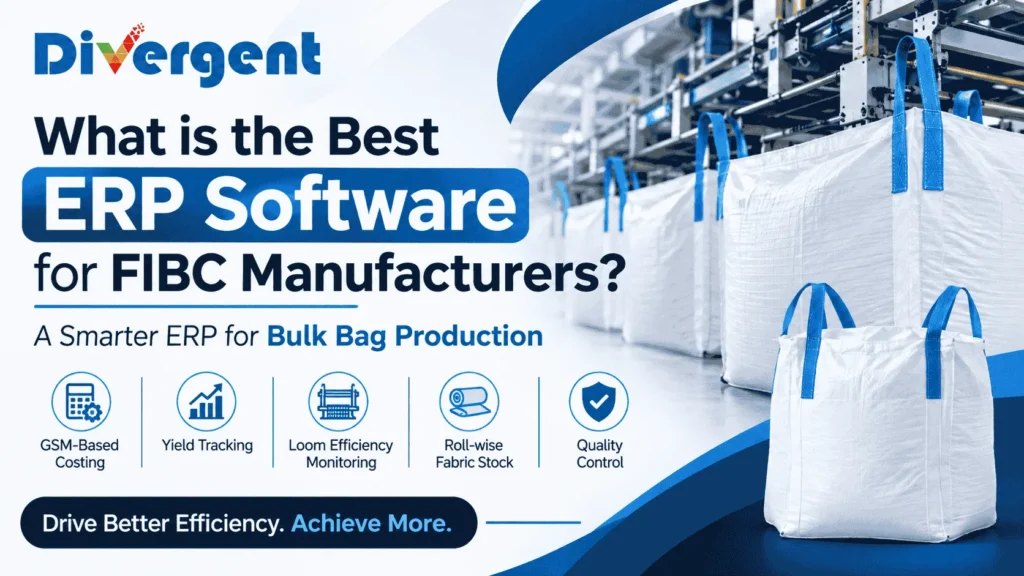
Table of Contents
- What Is ERP Software for FIBC Manufacturers?
- Why Generic ERP Fails in FIBC Plants
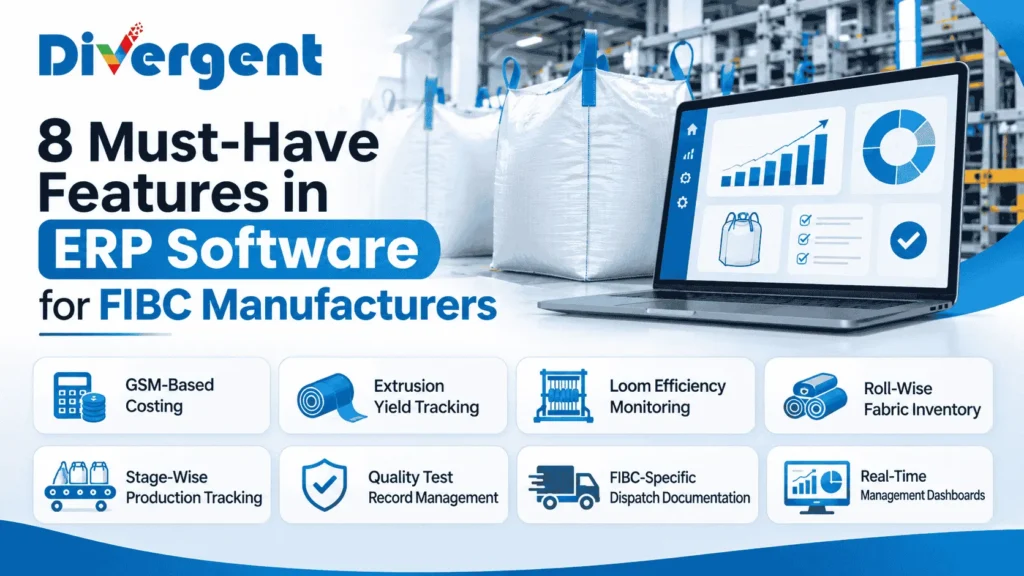
- 8 Must-Have Features in FIBC ERP Software
- Questions to Ask Every ERP Vendor
- What FIBC ERP Implementation Looks Like
- What FIBC Plants Achieve With the Right ERP
- Divergent PackPro: ERP Built for FIBC Manufacturers
- Frequently Asked Questions
What Is ERP Software for FIBC Manufacturers?
What does ERP software do for an FIBC manufacturing plant?
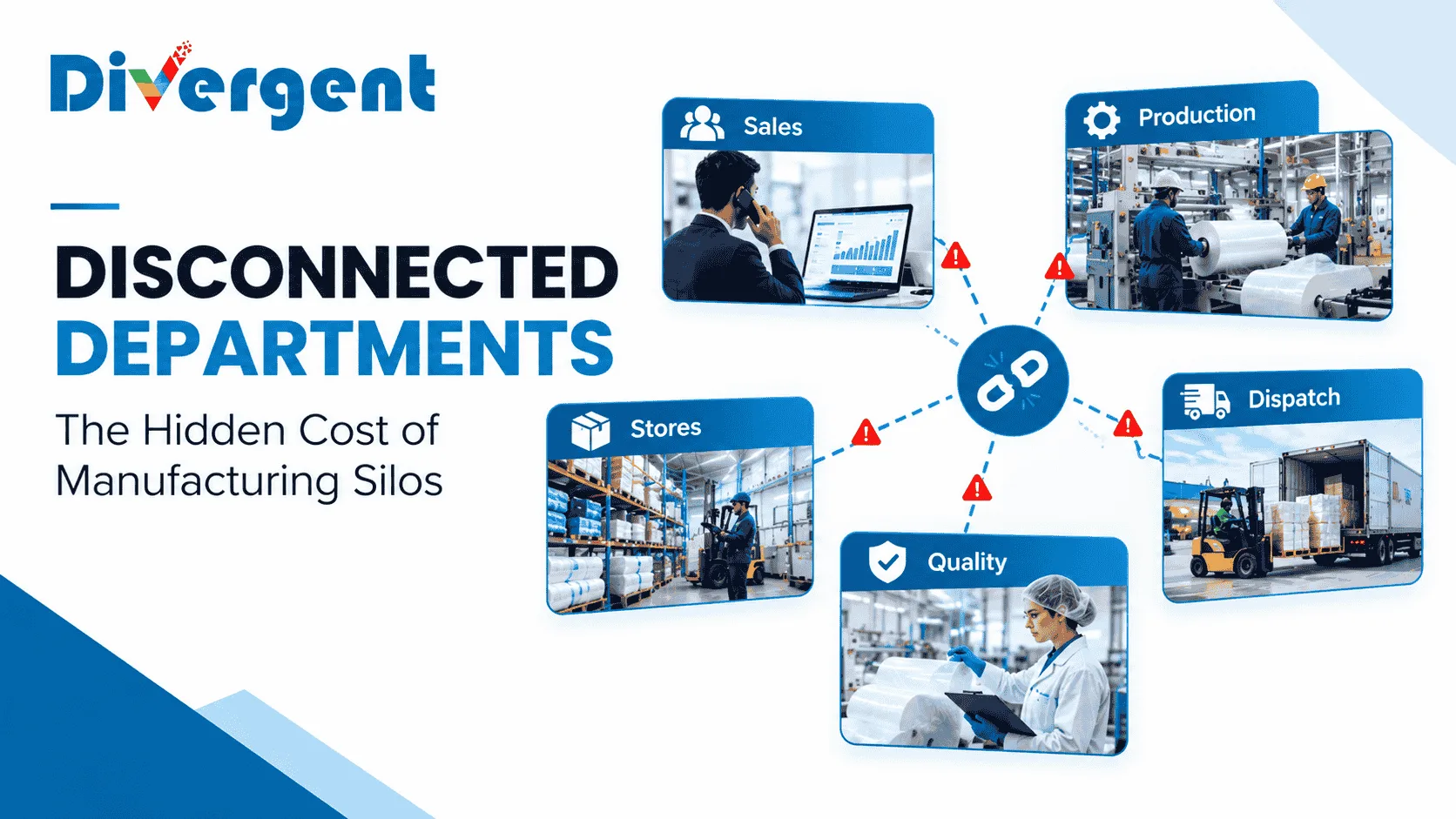
ERP software for FIBC manufacturers connects every department — sales, production, stores, quality, dispatch and accounts — in one system, so every decision is based on the same live data. It replaces the spreadsheets, registers and WhatsApp messages that most bulk bag plants currently use to coordinate between departments.
An FIBC plant without ERP software typically runs with sales confirming delivery dates without checking production capacity, production planning without knowing material availability, stores issuing material without knowing which order it is for, and quality recording results on paper that never reaches dispatch. Each department works from its own records — and none of those records agree.
ERP software for FIBC manufacturers eliminates these disconnections. When a sales order is entered, production can see it immediately. When material is issued, stores balance updates in real time. When quality passes a batch, dispatch can release it without waiting for a phone call. The entire plant operates from one source of truth.
According to McKinsey, manufacturing plants that implement connected ERP systems reduce operational costs by 15 to 20 percent within the first two years — primarily through reduced inventory, lower emergency procurement costs and elimination of manual reporting time.
Why Generic ERP Fails in FIBC Manufacturing Plants
Can a generic ERP handle FIBC manufacturing?
A generic ERP can be configured to handle FIBC manufacturing, but the configuration effort is significant, the result is often fragile and the total cost — software plus customisation plus extended implementation — typically exceeds purpose-built FIBC ERP software by a wide margin.
FIBC production has specific requirements that generic ERP systems do not handle out of the box:
- GSM-based costing: A quote for an FIBC bag starts with the fabric GSM, mesh count and bag dimensions — then calculates tape weight, extrusion requirement, fabric consumption, accessory cost and conversion cost. Generic ERP has no concept of GSM. Every cost calculation must be built from scratch in customisation.
- Multi-stage production tracking: FIBC production runs through extrusion, weaving, printing, cutting, stitching and finishing — often across different lines with different speeds and yields. Generic ERP treats production as a single step from raw material to finished goods. Stage-wise tracking, WIP at each stage and inter-stage yield measurement require significant custom development.
- Roll-wise fabric inventory: Woven fabric is received and stored as rolls, each with its own GSM, width and length. Generic ERP tracks inventory by quantity or weight — not by roll identity. Roll-wise tracking, which is essential for traceability and for matching fabric rolls to production orders, is not a standard feature.
- Loom efficiency tracking: Loom output varies by fabric specification, warp count and machine condition. Tracking actual efficiency against target, by loom and by shift, requires production data capture at machine level — which generic ERP does not provide without custom development.
- Safety factor and test record management: FIBC bags for industrial, chemical or food use require documentation of safety factor compliance, drop tests and topple tests. Managing these test records against each production batch — and linking them to dispatch documentation — requires a quality module designed for FIBC, not a generic QC checklist.
The practical result is that FIBC plants implementing generic ERP spend 6 to 18 months in customisation before go-live, discover gaps during implementation that require further development, and end up with a system that handles the basics but misses the production-specific requirements that would actually transform how the plant operates.
8 Must-Have Features in ERP Software for FIBC Manufacturers
What features should FIBC ERP software include?
FIBC ERP software must cover GSM-based costing, extrusion yield tracking, loom efficiency monitoring, roll-wise fabric inventory, stage-wise production tracking, quality test record management, FIBC-specific dispatch documentation and real-time management dashboards. Any system that cannot demonstrate all eight in a live production environment — not a demo — is not ready for a serious FIBC plant.
1. GSM-Based Costing and Quotation
Every FIBC quote starts with a specification — fabric GSM, mesh count, bag dimensions, loop type, liner requirement, print specification. The ERP should calculate material consumption, production time and total cost from these inputs automatically, producing a quote in minutes rather than hours. When raw material prices change, the system should recalculate all open quotes and flag which ones need revision.
This is the feature that most distinguishes purpose-built FIBC ERP from generic systems. A costing engine that understands GSM, denier, tape width and conversion factors is not something that can be built in a generic ERP configuration without significant custom development.
2. Extrusion Yield Tracking
The extruder converts polypropylene granules into tape. Yield — the weight of tape produced per kilogram of granule — varies with temperature profiles, line speed and granule quality. FIBC ERP software should track actual yield per shift against the standard yield in the BOM, flag deviations and accumulate enough data to identify which extrusion parameters deliver the best yield consistency.
A one percent improvement in extrusion yield on a plant consuming 200 tonnes of PP per month saves approximately 2 tonnes of raw material — which at current PP prices represents a significant monthly saving from a single tracked metric.
3. Loom Efficiency Monitoring
Each loom produces fabric at a rate that depends on the warp count, tape denier and machine condition. FIBC ERP software should track actual metres woven per shift against target, by loom, identifying which looms are consistently underperforming and which operators achieve the best efficiency on which specifications. This data drives maintenance scheduling, operator assignment and production planning.
4. Roll-Wise Fabric Inventory
Woven fabric rolls are individually identified by GSM, width, length and the loom that produced them. FIBC ERP software should track each roll from the loom output through cutting and allocation to production orders. This roll-wise traceability supports quality investigations — if a GSM non-conformance is found in finished bags, the system should identify which rolls were used and which other orders received fabric from the same rolls.
5. Stage-Wise Production Tracking
FIBC production runs through multiple stages — extrusion, weaving, printing, cutting, stitching and finishing. FIBC ERP software should track WIP at each stage, recording the quantity entering and leaving each stage, the yield between stages and the time at each stage. This stage-wise data is what makes production planning accurate — when the planner knows how much WIP is at each stage, they can schedule the next stage without guessing.
6. Quality Test Record Management
FIBC bags for industrial, chemical and food applications require documented quality testing — GSM verification, UV stabiliser content, drop test, topple test and safety factor calculation. FIBC ERP software should manage these test records against each production batch, link them to the dispatch documentation and generate the quality certificates that export customers and certification bodies require.
7. FIBC-Specific Dispatch Documentation
FIBC dispatch documentation includes packing lists with bag counts per pallet, quality certificates, test reports and — for export shipments — documentation linked to the letter of credit terms. FIBC ERP software should generate all of these from the dispatch entry, rather than requiring manual preparation of each document separately.
8. Real-Time Management Dashboards
The plant head of an FIBC manufacturer needs to see — at any moment — how many bags are being produced per shift, where each major order stands in production, what the current stock position is for key raw materials, what the dispatch plan looks like for the next seven days and what the quality pass rate has been for the current week. FIBC ERP software should deliver all of this on one screen, updated as transactions happen, without requiring anyone to compile a report.
Questions to Ask Every FIBC ERP Software Vendor
How do you evaluate ERP vendors for an FIBC plant?
Evaluate FIBC ERP vendors by asking them to demonstrate your specific production process — not a generic manufacturing process — using your actual products and specifications. Ask for references from FIBC plants of similar size, visit one reference site before deciding, and confirm in writing what is included in the implementation fee and what costs extra.
- How many FIBC plant implementations have you completed? Ask for a list of references and call three of them. Ask each reference specifically about the implementation process, the post-go-live support and whether the system handled FIBC-specific requirements without additional custom development.
- Can you demonstrate GSM-based costing using my actual bag specifications? Bring three of your most complex bag specifications to the demonstration and ask the vendor to produce quotes for each. A system that requires manual calculation at any step is not purpose-built for FIBC.
- How does the system handle roll-wise fabric tracking? Ask the vendor to show roll receipt, roll allocation to a production order and roll traceability — the ability to identify every order that used fabric from a specific roll batch. If this requires a workaround, the traceability requirement will not be met.
- What does implementation include and what costs extra? Data migration, training, go-live support and post-go-live hypercare should all be explicitly included or explicitly priced. A vendor who cannot give clear answers to this question will create cost surprises during implementation.
- What is your implementation timeline for a plant of our size? A realistic timeline for a mid-size FIBC plant — 20 to 100 looms, multiple product types, export customers — is 14 to 24 weeks. Vendors quoting less than 12 weeks are either underestimating the complexity or planning to skip steps.
What FIBC ERP Implementation Looks Like
How long does ERP implementation take for an FIBC manufacturer?
ERP implementation for a mid-size FIBC manufacturer typically takes 14 to 24 weeks from project kick-off to stable go-live. The timeline depends on data readiness — specifically whether the plant has a documented item master and BOM — and on how much time the internal team can dedicate to the implementation alongside their regular operational responsibilities.
| Phase | What Happens | Typical Duration |
|---|---|---|
| Discovery and scoping | Process mapping, requirements confirmation, vendor finalisation | 2–3 weeks |
| Data preparation | Item master, BOM, customer and supplier data, opening stock count | 4–6 weeks |
| Configuration and testing | System setup, UAT with plant team, issue resolution | 4–8 weeks |
| Training | Role-based training for all users, close to go-live | 1–2 weeks |
| Go-live and hypercare | Phased go-live, dedicated support for first 4 weeks | 4–6 weeks |
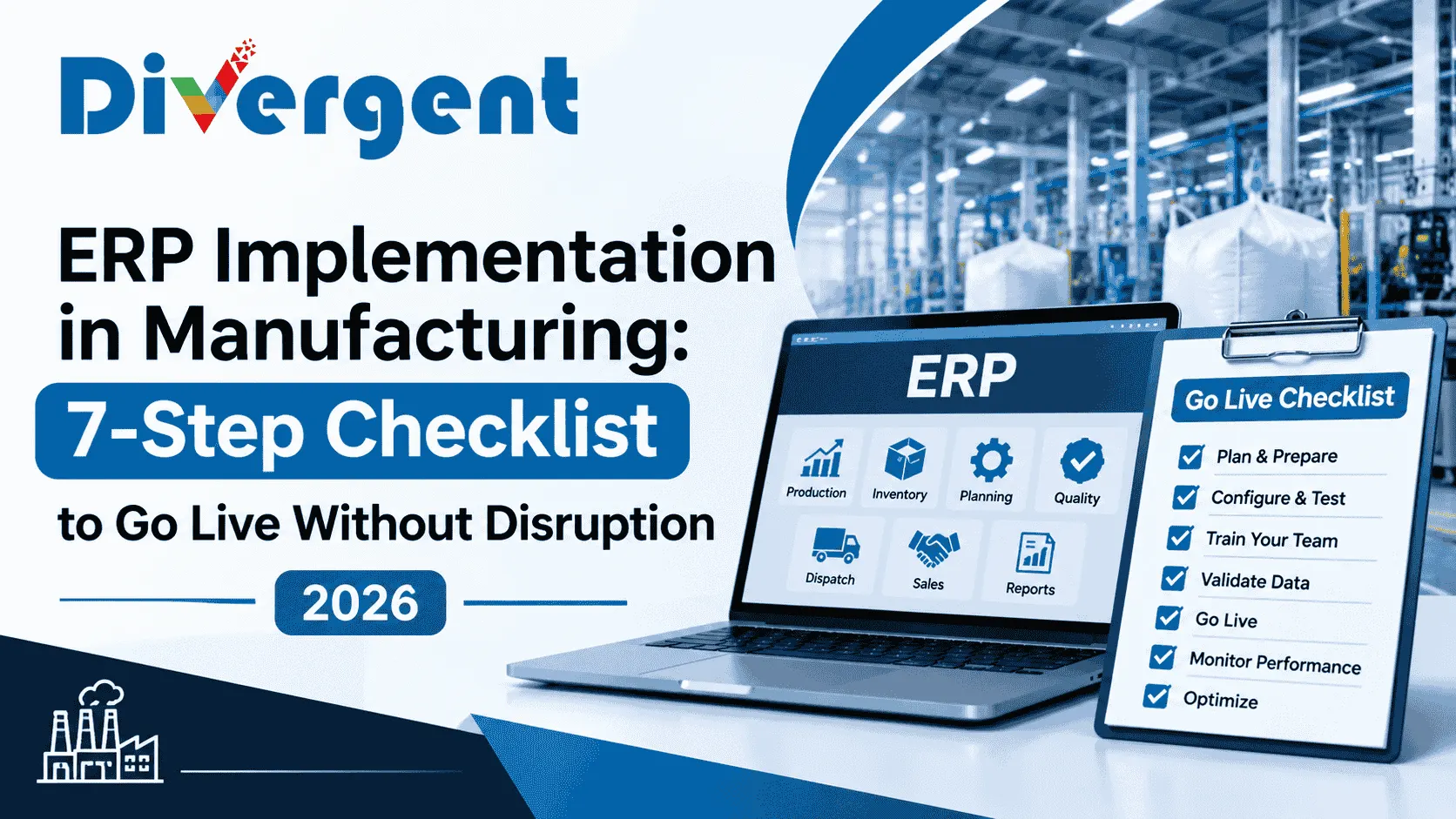
The most critical success factor in FIBC ERP implementation is data quality. An item master with incomplete or inconsistent entries, BOMs that have never been formally documented, or opening stock quantities that have not been verified against a physical count — any of these will cause problems from the first day of live operation. See our guide to ERP implementation in manufacturing for the complete 7-step checklist.
What FIBC Plants Achieve With the Right ERP Software
What results do FIBC manufacturers get from ERP software?
FIBC manufacturers with the right ERP software typically achieve 15 to 25 percent reduction in raw material inventory, 20 to 35 percent improvement in on-time delivery rate, significant reduction in customer returns through better quality tracking, and elimination of the manual reporting burden that takes management time away from operational decisions.
| Area | Before ERP | After ERP |
|---|---|---|
| Costing accuracy | Manual calculation, errors common | Spec-based, consistent, fast |
| Production visibility | End-of-day verbal update | Real-time by order and stage |
| Inventory accuracy | Monthly count, always out of date | Real-time, roll-wise, by location |
| Quality documentation | Paper records, hard to retrieve | Digital, batch-linked, auto-generated |
| Dispatch documentation | Manual preparation, errors frequent | System-generated from dispatch entry |
| Management reporting | Weekly Excel compilation | Live dashboard, always current |
These results are not from large plants with dedicated IT teams. They are from mid-size FIBC manufacturers — typically 20 to 100 looms — who chose the right system, implemented it correctly and gave their team time to adopt it properly. See our guide to 12 critical manufacturing challenges for how ERP addresses the full range of operational problems FIBC plants face.
Divergent PackPro: ERP Software Built for FIBC Manufacturers
Divergent PackPro is a manufacturing ERP built specifically for FIBC, BOPP, PP woven bag and flexible packaging plants. It is not a generic ERP configured for packaging — it is a system designed from the ground up around the specific workflows, measurements and requirements of woven bag and bulk bag manufacturing.
What PackPro Covers for FIBC Manufacturers
- GSM-based costing and quotation: Enter the bag specification — GSM, mesh, dimensions, loops, liner, print — and PackPro calculates material consumption, production time and total cost automatically. Quotes in minutes. Margin visibility on every order.
- Extrusion yield tracking: Actual granule consumption and tape output recorded per shift. Yield variance against BOM standard flagged automatically. Cumulative data identifies which temperature profiles and line speeds deliver the best yield.
- Loom efficiency monitoring: Actual metres woven per shift tracked by loom and operator against target. Efficiency dashboard visible to the production head in real time — no end-of-shift data entry required.
- Roll-wise fabric inventory: Every fabric roll tracked by identity from loom output through cutting to production order allocation. Full roll-to-bag traceability — find every bag produced from any specific fabric roll.
- Stage-wise production tracking: WIP quantity tracked at every stage — extrusion, weaving, printing, cutting, stitching, finishing. Production planning built on actual WIP data, not estimates.
- Quality module for FIBC: Test records for GSM verification, UV content, drop test and topple test managed against each batch. Quality certificates generated automatically. Dispatch blocked until quality clearance recorded.
- Export documentation: Packing lists, quality certificates and dispatch documents generated from system data. Consistent format, no manual preparation, no errors from retyping.
- Tally integration: Financial entries from PackPro flow into Tally automatically. The accounts team stays in Tally. Operations runs in PackPro. Both systems stay in sync.
PackPro is implemented and supported by Divergent Software Labs, based in Indore, India. Implementations cover FIBC plants in India and internationally, ranging from 20-loom startups to 200-loom established exporters.
See how Divergent PackPro works for FIBC manufacturers or speak to our team for a demonstration using your own bag specifications and production process.
Frequently Asked Questions — ERP Software for FIBC Manufacturers
What is the best ERP software for FIBC manufacturers?
The best ERP software for FIBC manufacturers is one built specifically for bulk bag production — covering GSM-based costing, extrusion yield tracking, loom efficiency monitoring, roll-wise fabric inventory and stage-wise quality control. Purpose-built FIBC ERP software delivers faster implementation and better fit than generic ERP configured for packaging.
What features should FIBC ERP software include?
FIBC ERP software must include GSM-based costing, extrusion yield tracking, loom efficiency monitoring, roll-wise fabric inventory, stage-wise production tracking, quality test record management, FIBC-specific dispatch documentation and real-time management dashboards. Any system missing these features will require significant custom development to meet FIBC production requirements.
Can a generic ERP handle FIBC manufacturing?
A generic ERP can be configured for FIBC manufacturing, but the configuration effort is significant and the result often misses critical requirements like GSM-based costing, roll-wise fabric tracking and stage-wise production visibility. The total cost of a generic ERP with customisation typically exceeds purpose-built FIBC ERP software, with a longer implementation timeline and higher ongoing maintenance cost.
How long does ERP implementation take for an FIBC manufacturer?
ERP implementation for a mid-size FIBC manufacturer typically takes 14 to 24 weeks from project kick-off to stable go-live. The main variable is data readiness — plants with a documented item master and verified BOM implement faster than those building this data from scratch during implementation.
What does FIBC ERP software cost?
FIBC ERP software costs vary based on plant size, number of users and implementation scope. For a mid-size FIBC plant, Year 1 total cost — software licence, implementation, data migration and training — typically ranges from ₹8 to ₹30 lakhs. Most plants recover this investment within 18 to 24 months through reduced inventory, lower procurement costs and eliminated manual reporting time.
How does ERP software improve FIBC quality control?
ERP software improves FIBC quality control by managing test records — GSM verification, UV content, drop and topple tests — against each production batch digitally. Quality clearance is required before dispatch can proceed, eliminating the risk of non-conforming bags leaving the plant. Quality certificates are generated automatically from the system, replacing manual preparation.
What is GSM-based costing in FIBC ERP software?
GSM-based costing in FIBC ERP software is a costing engine that calculates material consumption and production cost from bag specifications — GSM, mesh count, dimensions, loop type, liner and print. The system calculates tape weight from GSM and bag area, extrusion requirement from tape weight and yield, fabric consumption from loom efficiency, and total cost from all inputs automatically. This eliminates manual costing calculation and ensures consistent, accurate quotes.
What is roll-wise tracking in FIBC ERP software?
Roll-wise tracking in FIBC ERP software means each fabric roll is individually identified — by GSM, width, length and source loom — and tracked from weaving output through cutting and into production. The system records which rolls were allocated to which production orders, enabling full traceability: if a GSM non-conformance is found in finished bags, the system identifies all orders that used fabric from the same roll batch.
Does FIBC ERP software integrate with Tally?
Yes. Purpose-built FIBC ERP software typically includes a standard Tally integration that passes financial entries — sales invoices, purchase receipts, payment records — from the ERP to Tally automatically. The accounts team continues working in Tally while all operational functions — production, stores, quality, dispatch — run in the ERP. The two systems stay synchronised without manual data entry in either.
How do I choose between ERP vendors for my FIBC plant?
Choose FIBC ERP vendors by asking them to demonstrate your specific production process using your actual bag specifications — not a generic manufacturing demo. Ask for references from FIBC plants of similar size, call three references and visit one before deciding. Confirm what is included in the implementation fee, what the post-go-live support period covers and what happens when you need changes after go-live.
Related Reading
- FIBC ERP Software: How to Choose the Best System
- ERP Implementation in Manufacturing: 7-Step Checklist
- Inventory Management Challenges in Manufacturing
- Quality Control Challenges in Manufacturing
- 12 Critical Manufacturing Challenges and How ERP Solves Them
Follow Divergent Softlab on Google
Enjoying our insights on manufacturing ERP, artificial intelligence and business technology? Add Divergent Softlab as a preferred source on Google to discover more of our latest articles.