Every packaging plant has the same quality problem. A bag reaches the customer with a stitching skip, a print misalignment or a GSM that falls below specification. The customer complains. The plant investigates. By the time the root cause is found, hundreds more bags with the same defect have already left the factory.
Manual quality inspection catches some defects. It misses many more — because human inspectors tire, sample rates are low and end-of-line checks happen too late to stop a bad batch.
AI quality control in manufacturing solves this at the source. Computer vision systems inspect every unit, at full production speed, against a digital specification. Defects are flagged the moment they appear — not after the batch is complete.
This guide covers how AI quality control works in packaging and FIBC plants, what it detects, what it costs, and how to implement it step by step.
Table of Contents
- What Is AI Quality Control in Manufacturing?
- Why Is Manufacturing Quality Control Software Becoming Essential?
- How Does AI Quality Control Work? Step by Step
- What Defects Does AI Quality Control Detect?
- AI Quality Control vs Manual Inspection
- AI Quality Control for FIBC Bags: Specific Use Cases
- How Manufacturing Quality Control Software Connects to ERP
- How to Implement AI Quality Control: A Practical Roadmap
- What Does AI Quality Control Software Cost?
- How Divergent PackPro Connects to AI Quality Control
- Frequently Asked Questions
What Is AI Quality Control in Manufacturing?
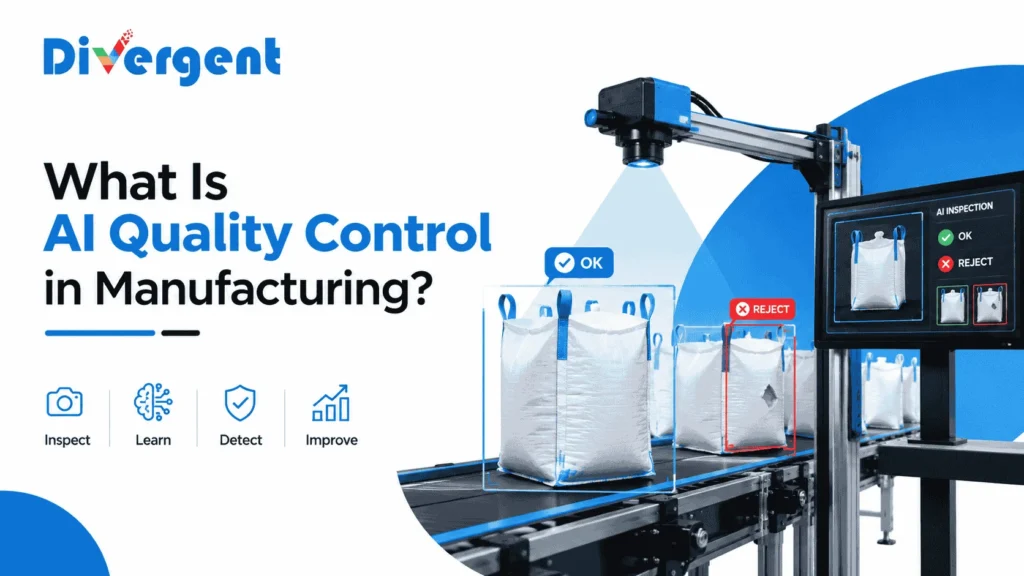
AI quality control in manufacturing is the use of computer vision cameras and machine learning models to automatically inspect products on a production line. The system compares each unit against a stored specification and flags any unit that falls outside the accepted range — without human involvement.
The difference between AI quality control and conventional automated inspection is that AI learns from data. A conventional system checks fixed thresholds you program manually. An AI system trains on thousands of images of good and bad products, learns what defects look like across varying lighting, angles and production conditions, and improves its detection accuracy over time.
For packaging and FIBC manufacturers, AI quality control means a camera at the end of a printing line, a cutting line or a stitching line — inspecting every bag as it passes, comparing it against the order specification, and sending a reject signal for any unit that fails.
Why Is Manufacturing Quality Control Software Becoming Essential?
Manufacturing quality control software has moved from a nice-to-have to a competitive requirement in packaging and bulk bag manufacturing for three reasons.
Export customers now audit quality systems. A customer in Europe or the Middle East buying FIBC bags for chemicals, food or construction materials wants documented proof that every bag was inspected — not a sample. AI-based manufacturing quality control software generates that documentation automatically.
Defect costs are rising. Raw material prices, shipping costs and customer penalties for returns have all increased. A single customer return shipment — freight, replacement production, lost goodwill — costs more than most plants spend on quality inspection in a year.
Labour for inspection is unreliable. Inspection is repetitive, attention-demanding and difficult to staff consistently. AI quality control software runs at consistent accuracy across every shift, without fatigue.
According to McKinsey, manufacturers using AI-powered quality inspection report defect escape rates 50 to 90 percent lower than those using manual sampling. Deloitte’s Smart Factory research found that AI quality control delivers a measurable ROI within 12 to 18 months in most manufacturing environments.
How Does AI Quality Control Work? Step by Step
- Camera captures the image. A high-resolution camera mounted at a fixed point on the production line captures an image of each unit as it passes. Capture speed is matched to line speed, so there is no production slowdown.
- AI model analyses the image. The image is passed to a machine learning model in real time. The model was trained on thousands of labelled images — good bags and bags with every defect type the plant has seen.
- Defect is classified. If the model detects a defect, it classifies it — print misalignment, stitching skip, GSM variation, colour mismatch, loop placement error — and records the defect type, severity and the image.
- Reject signal is sent. The system sends a signal to a reject mechanism that removes or flags the defective unit before it reaches the packing station.
- Data feeds into quality records. Every inspection result — pass or fail — is logged with a timestamp, shift, line and operator. This data feeds directly into your quality control system or ERP, creating an automatic audit trail.
What Defects Does AI Quality Control Detect in Packaging Plants?
AI quality control in manufacturing detects any defect that is visually distinguishable. For packaging and FIBC plants, the most common detectable defects are:
- Print defects: colour shift, registration error, missing text, smearing, faded areas
- Fabric defects: GSM variation, weaving gaps, broken threads, contamination, hole in fabric
- Stitching defects: skipped stitches, uneven seam allowance, loose thread, double stitching
- Dimensional defects: bag length or width outside tolerance, incorrect gusset size
- Loop defects: loop not attached, loop placed off-centre, loop stitching insufficient
- Label and coding defects: barcode unreadable, label misplaced, batch code missing or incorrect
AI Quality Control vs Manual Inspection: The Real Comparison
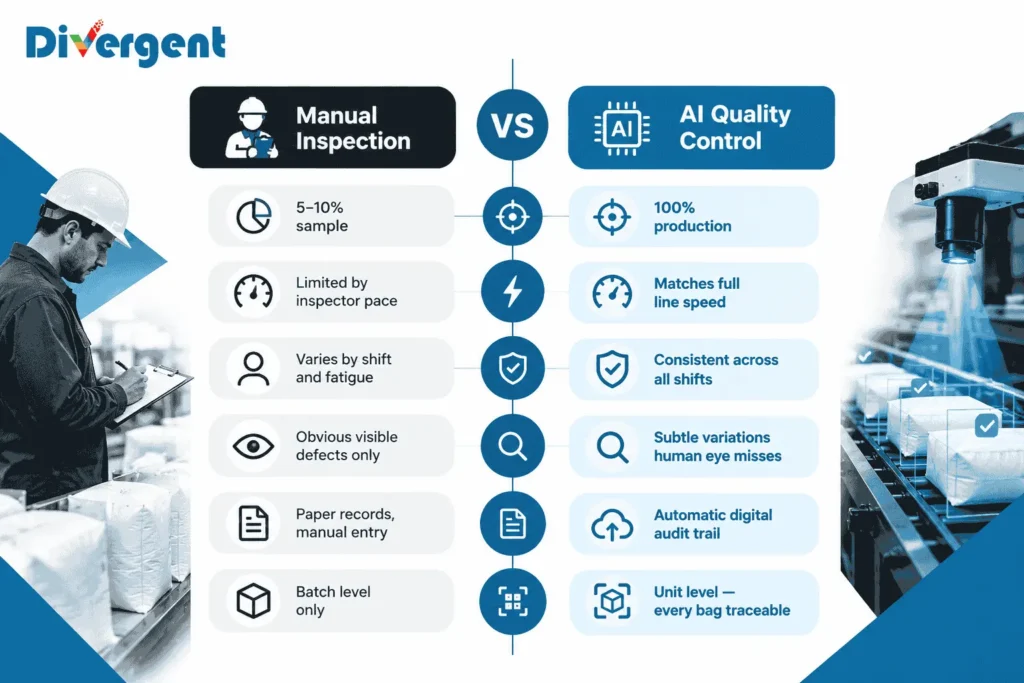
| Factor | Manual Inspection | AI Quality Control |
|---|---|---|
| Coverage | 5-10% sample | 100% of production |
| Speed | Limited by inspector pace | Matches full line speed |
| Consistency | Varies by shift and fatigue | Consistent across all shifts |
| Defect types | Obvious visible defects only | Subtle variations human eye misses |
| Documentation | Paper records, manual entry | Automatic digital audit trail |
| Traceability | Batch level only | Unit level — every bag traceable |
AI Quality Control for FIBC Bags: Specific Use Cases
- Safety factor compliance: AI inspection of GSM and stitching density adds a non-destructive check at line speed for every bag.
- Food grade inspection: Food grade FIBC bags require documentation that every bag was inspected. AI generates that documentation automatically.
- Export customer requirements: AI-generated inspection logs satisfy audit requirements without additional staff time.
- Print and label compliance: Camera-based inspection checks print and label correctness at full production speed.
How Does Manufacturing Quality Control Software Connect to ERP?
The most effective implementation connects AI quality control software directly to your manufacturing ERP. When the inspection system detects a defect, the data flows automatically into the quality module — no manual entry, no separate spreadsheet.
- Batch quarantine: When defect rate exceeds a set threshold, the ERP automatically quarantines the batch.
- Root cause analysis: Defects clustered by machine, shift or operator become visible in ERP quality data.
- Customer documentation: Inspection records for any shipment generated in seconds from ERP data.
See our guide on traceability in manufacturing for how batch-level inspection records connect to full end-to-end traceability.
How to Implement AI Quality Control in a Packaging Plant: A Practical Roadmap
- Define what you want to detect. List the top five defect types that cause customer returns or internal rework.
- Choose the right inspection point. For most packaging plants, the printing line output and stitching line output are the two highest-value points.
- Collect training images. A well-trained model needs 500 to 2,000 labelled images of each defect type.
- Run a pilot. Install a single camera and run in observation mode first — flagging without rejecting — to validate accuracy.
- Connect to your ERP. Configure inspection results to write directly to your quality module.
- Go live and measure. Track first-pass yield, defect escape rate and customer return rate before and after.
What Does AI Quality Control Software Cost?
| System Type | Cost Range | Best For |
|---|---|---|
| Entry-level | USD 5,000–15,000 per point | Single line, standard defects |
| Mid-range | USD 20,000–60,000 | Custom training, ERP integration |
| Enterprise | USD 80,000+ | Full-line, automatic reject, dashboards |
How Divergent PackPro Connects to AI Quality Control
Divergent PackPro is a manufacturing ERP built for FIBC, BOPP, PP woven bag and packaging plants. Its quality module is designed to receive inspection data from AI quality control systems and connect it to production, inventory and dispatch.
- Defect records against each batch — automatic status update
- Automatic batch quarantine when defect threshold is breached
- Quality dashboard: first-pass yield, defect rate by product and shift
- Customer inspection documentation generated from system data
See how Divergent PackPro works or speak to our team for a walkthrough of the quality module.
AI Quality Control in Manufacturing: Real Numbers From the Factory Floor
The clearest way to understand what AI quality control in manufacturing delivers is through real production numbers. These figures come from packaging and industrial manufacturing plants that have published results from their implementations.
A woven bag plant in South Asia implemented computer vision inspection at its printing and cutting lines. Within six months, customer return rate dropped from 1.8 percent of dispatched orders to 0.3 percent. Rework cost per month fell by 62 percent. The AI quality control system paid for itself in eight months.
A flexible packaging plant in Europe deployed AI quality control on its lamination line, targeting seal integrity defects. Defect escape rate fell from 0.4 percent to 0.02 percent. The plant passed its BRC audit with zero quality system non-conformances for the first time in four years.
A bulk bag manufacturer in the Middle East implemented AI quality control at its stitching line. Loop attachment defects previously caught only by end-of-line sampling were detected at source. The plant eliminated three customer complaints related to loop failure in the twelve months following implementation, against an average of eleven per year in the three years prior.
These results are representative of what AI quality control in manufacturing delivers when implemented correctly — at the right inspection point, with sufficient training data and connected to the ERP system.
AI Quality Control in Manufacturing: Industry Standards and Compliance
AI quality control in manufacturing supports compliance with the standards that packaging and FIBC export customers require. Understanding which standards apply to your product type helps you specify the right inspection parameters from the start.
- ISO 9001:2015: AI quality control supports compliance by generating documented inspection records automatically. The audit trail it creates satisfies clause 8.6 requirements for evidence of product conformity before release.
- ISO 21898 (FIBC standard): Specifies design, testing and performance requirements for FIBCs. AI quality control supports compliance by documenting GSM, stitching and dimensional checks against specification for every bag.
- BRC/IOP Packaging Standard: Required by major food retailers. AI quality control supports BRC compliance by providing 100 percent inspection records, batch-level traceability and documented defect rates per production run.
- Customer-specific quality plans: Export buyers increasingly require documented inspection coverage in supplier agreements. AI quality control provides the 100 percent coverage and digital documentation these agreements specify.
Common Mistakes When Implementing AI Quality Control in Manufacturing
Most AI quality control implementations that underperform do so for predictable reasons. Understanding these mistakes before you start is the fastest way to avoid them.
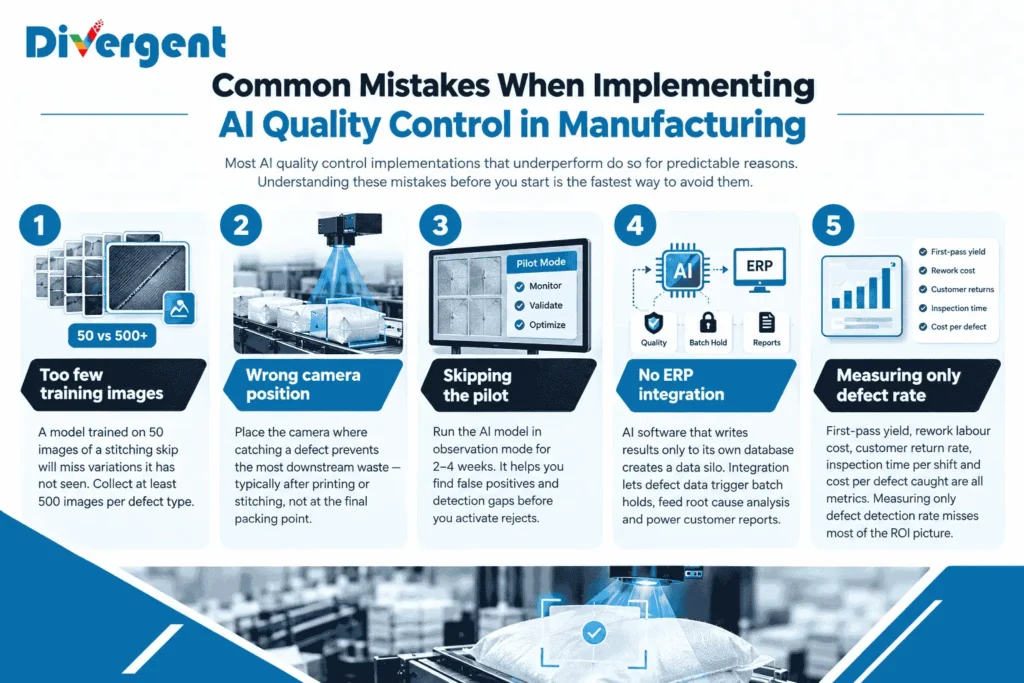
Mistake 1: Too few training images. A model trained on 50 images of a stitching skip will miss variations it has not seen. Collect at least 500 images per defect type. Your rework and quarantine records from the past two to three years already contain these images — they need to be labelled, not created from scratch.
Mistake 2: Wrong camera position. A camera at the end of the line catches defects after value has been added through stitching, printing and handling. Position the camera where catching a defect prevents the most downstream waste — typically the output of the printing station or the stitching line, not the final packing point.
Mistake 3: Skipping the pilot. Run the AI model in observation mode for two to four weeks before activating the reject mechanism. Your plant lighting, line speed and product variation are different from the training environment. The pilot identifies false positive rate and detection gaps before they cause production disruption.
Mistake 4: No ERP integration. AI quality control software that writes results only to its own database creates a data silo. Defect data that does not flow into the ERP quality module does not trigger batch holds, does not feed root cause analysis and cannot be included in customer quality reports. Integration is what converts the inspection data into factory-wide value.
Mistake 5: Measuring only defect rate. First-pass yield, rework labour cost, customer return rate, inspection time per shift and cost per defect caught are all metrics that AI quality control in manufacturing affects. Measuring only defect detection rate misses most of the ROI picture.
AI Quality Control Cost Analysis: Manual Inspection vs AI Over 3 Years
The business case for AI quality control in manufacturing becomes clear when you compare the full cost of traditional manual inspection against an AI system over three years. These figures are indicative for a mid-size packaging plant running three shifts.
| Cost Category | Manual Inspection (Annual) | AI Quality Control (Annual) |
|---|---|---|
| Inspector labour (2 per shift, 3 shifts) | USD 18,000-36,000 | USD 0 (eliminated) |
| Rework cost at 5% defect rate | USD 15,000-40,000 | USD 3,000-8,000 (80% reduction) |
| Customer returns and penalties | USD 10,000-30,000 | USD 1,000-5,000 |
| System cost (amortised over 3 years) | USD 0 | USD 7,000-20,000 |
| Maintenance and model updates | USD 500 | USD 2,000-5,000 |
| Total annual cost | USD 44,000-107,000 | USD 13,000-38,000 |
AI quality control in manufacturing costs less to operate than manual inspection once the system is in place. The cost advantage grows as production volume increases because AI inspection scales at zero marginal cost — inspecting 5,000 bags per shift costs the same as inspecting 3,000 — while manual inspection requires proportionally more people as volume grows.
The Future of AI Quality Control in Manufacturing
AI quality control in manufacturing continues to advance rapidly. The systems available today are significantly more capable and more affordable than those available five years ago, and the next generation of capabilities is already in early deployment at leading plants.
- Inline GSM measurement: Next-generation systems use near-infrared spectroscopy to measure fabric GSM directly at line speed, eliminating lab sampling for GSM verification entirely.
- Predictive defect detection: Rather than detecting defects after they occur, future AI systems will predict when production conditions are trending toward a defect and alert operators before the first defective unit is produced.
- Automatic parameter adjustment: AI systems will adjust extrusion temperature profiles and line speed automatically when sensor data indicates quality is drifting outside specification, closing the loop between detection and correction.
- Natural language quality reports: Reports generated automatically in plain language — identifying root cause, trend and recommended corrective action — without anyone writing a word.
- Smartphone inspection for smaller plants: AI models running on a standard smartphone camera provide a lower-cost entry point where full camera infrastructure is not yet justified, delivering partial automation at minimal capital cost.
Plants that implement AI quality control now build the data infrastructure and team experience that makes these next-generation capabilities faster and cheaper to adopt when they become commercially available.
How to Choose the Right AI Quality Control Software for Your Plant
Choosing manufacturing quality control software for AI inspection is not purely a technology decision. The right system for a 50-loom FIBC plant is different from the right system for a 10-machine BOPP bag line. These are the questions to ask before selecting a vendor:
- Does the vendor have packaging or FIBC experience? A vendor who has deployed only in automotive or electronics will not understand FIBC-specific defect types or the production environment of a woven bag plant. Ask for packaging industry references specifically.
- How is the AI model trained for your product? Generic defect models underperform against models trained on your specific products, your lighting conditions and your defect types. Ask whether the vendor trains a custom model for your plant or deploys a pre-trained generic model.
- Does the system integrate with your ERP? Ask specifically how data flows from the inspection system to your ERP quality module — not just whether integration is possible, but how it works and what data fields are mapped.
- What is the false positive rate from existing deployments? A system that flags too many good bags slows the line and frustrates operators. Get real numbers from reference sites, not estimated rates from the vendor.
- What does the support contract include? Model retraining, system updates and on-site support when the line stops are recurring costs that belong in your total cost of ownership calculation before you commit.
The single most useful step in vendor selection is visiting a reference site — a plant similar to yours that has been running the AI quality control system for at least twelve months. Two hours at a working reference site is worth more than any product demonstration or specification document.
Frequently Asked Questions — AI Quality Control in Manufacturing
What is AI quality control in manufacturing?
AI quality control in manufacturing is the use of computer vision cameras and machine learning models to automatically inspect products on a production line.
How does computer vision detect defects in manufacturing?
Computer vision captures a high-resolution image of each unit and a machine learning model identifies any feature outside the accepted specification.
What defects can AI quality control detect in packaging plants?
Print defects, GSM variation, stitching skips, dimensional errors, loop placement faults, label misalignment and barcode readability issues.
Is AI quality control better than manual inspection?
Yes. AI inspects 100% of production at full speed with consistent accuracy. Manual inspection covers only 5-10% and is subject to fatigue.
Can a small packaging plant use AI quality control?
Yes. Start with a single camera at one inspection point — typically the printing or stitching line output.
Related Reading
- Quality Control Challenges in Manufacturing: 7 Costly Problems
- Traceability in Manufacturing: 7 Challenges and How to Fix Them
- AI in Manufacturing: The Essential Guide for FIBC and Packaging Plants
- 12 Critical Manufacturing Challenges and How ERP Solves Them
- FIBC ERP Software: How to Choose the Best System