What Is Agriculture Packaging ERP?
Agriculture packaging ERP is software that helps manufacturers of fertilizer bags, seed bags, grain sacks and mesh bags plan seasonal demand, materials, machines, brand artwork and deliveries in one system. It lets plants prepare for sowing and harvest peaks weeks in advance, instead of rushing when orders arrive. Divergent PackPro, by Divergent Software Labs, is an agriculture packaging ERP built for this workflow.
The Problem: Sowing Season Is Next Week, and You’re Not Ready
Sowing season starts next week. Your biggest fertilizer customer has just doubled their order. A seed company wants 2 lakh printed bags in a new design. A cooperative wants onion mesh bags delivered to three districts by Friday.
Do you have the fabric? The UV-stabilised material? Free looms? The approved artwork? Nobody in your plant can answer quickly, because the answers sit in different registers, WhatsApp groups and people’s heads.
This is what agriculture packaging looks like for most manufacturers: quiet for months, then a rush when the whole season arrives at once. Here are the problems we see most often:
| Problem | What happens in the plant | What it costs you |
|---|---|---|
| 1. Seasonal rush | Orders pile up just before sowing and harvest | Late deliveries, overtime and lost customers |
| 2. Material shortages | UV masterbatch, granules or thread run out mid-season | Lines stop when you need them most |
| 3. Too many product types | Woven sacks, mesh bags, nets and films all run together | Planning chaos and frequent changeovers |
| 4. Brand and print mix-ups | Seed and fertilizer brands change designs every season | Wrong prints, rejected bags and wasted film |
| 5. Bulk deadlines | Cooperatives and government buyers set strict dates | Penalties or lost tenders when you’re late |
Each problem is hard on its own. In peak season, they all hit at the same time.
The Answer: Agriculture Packaging ERP Built for Seasonal Demand
The answer is one system that connects your orders, materials, machines, designs and deliveries, so you can plan for the season before it arrives.
At Divergent Software Labs, we built Divergent PackPro for manufacturers like you. PackPro is an AI-enabled, end-to-end ERP for flexible packaging, including agriculture packaging plants.
Here’s how PackPro helps with each problem:
| Problem | How PackPro helps |
|---|---|
| 1. Seasonal rush | Shows past seasons and confirmed orders, so you can plan capacity weeks ahead |
| 2. Material shortages | Calculates material needs for all planned orders and flags shortages early |
| 3. Too many product types | Keeps a separate specification and bill of materials for every product |
| 4. Brand and print mix-ups | Links every order to its approved brand artwork |
| 5. Bulk deadlines | Schedules large orders against delivery dates and shows progress live |
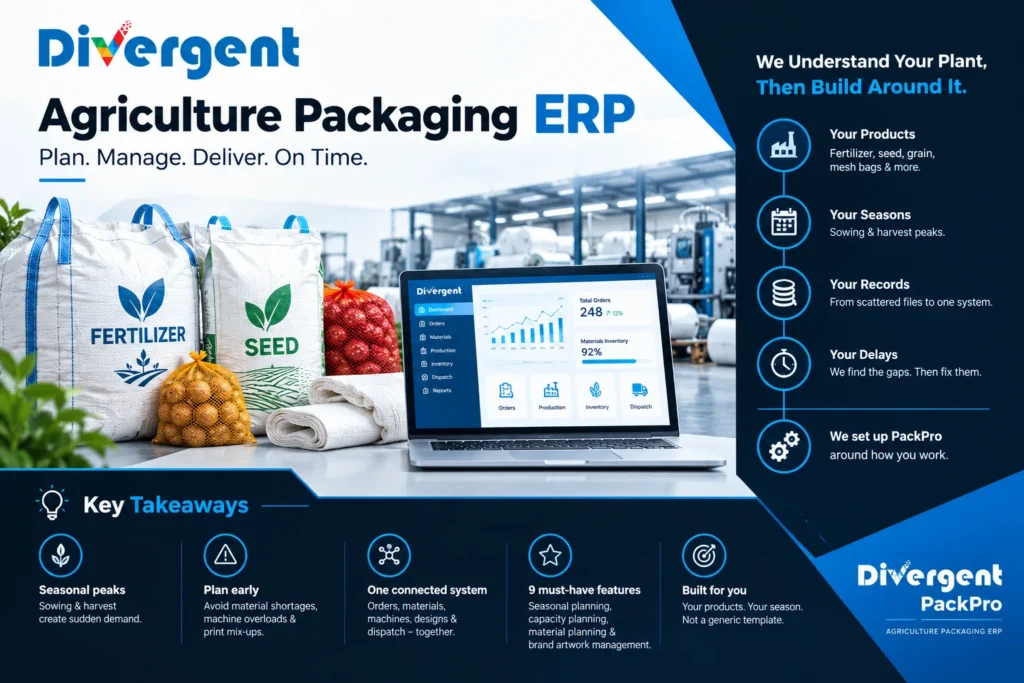
How we work: we don’t start by selling software. We start by understanding your plant: your products, your busiest seasons, where records are kept today, and where orders get delayed. Then we set up PackPro around how you work.
Key takeaways:
- Agriculture packaging plants face sharp seasonal peaks around sowing and harvest.
- Most losses come from planning too late: material shortages, overloaded machines and print mix-ups.
- Agriculture packaging ERP connects orders, materials, machines, designs and dispatch in one system.
- The 9 must-have features include seasonal planning, capacity planning, material planning and brand artwork management.
- Divergent PackPro is set up around your products and your season, not a generic template.
What Does Agriculture Packaging ERP Cover?
Agriculture packaging ERP covers every product a farm packaging plant makes: fertilizer bags, seed bags, grain and feed sacks, onion and potato mesh bags, sugar bags and other agricultural packaging.
A normal ERP treats every product the same way. An agriculture packaging plant needs more: different specifications for each product, UV-stabilised materials, brand artwork that changes every season, and capacity planning for sharp seasonal peaks. Agriculture packaging ERP is built to handle all of this in one place.
What Kinds of Agriculture Packaging Do Plants Make?
Agriculture packaging covers a wide range of products, each with its own material, process and quality checks.
| Product | Used for | Key requirement |
|---|---|---|
| Fertilizer bags | Urea, DAP, NPK | Moisture protection, UV stability, often a liner |
| Seed bags | Branded seed packs | High-quality print, often BOPP laminated |
| Grain and feed sacks | Wheat, rice, pulses, animal feed | Strength at low cost |
| Mesh (leno) bags | Onions, potatoes, citrus | Airflow so produce doesn’t rot |
| Sugar and flour bags | Sugar, atta | Coated or lined for hygiene |
| Bulk container bags | Large loads of grain or fertilizer | High strength and safe lifting |
Most of these are woven polypropylene bags. If you want to understand each type in detail, see our guide to woven polypropylene bags.
Why Is Agriculture Packaging So Hard to Plan?
Agriculture packaging is hard to plan because demand follows farming seasons, not a steady monthly pattern. Orders spike before sowing and around harvest, and every customer wants delivery at the same time.
On top of that:
- Weather changes the timing. An early or late monsoon can move the whole season by weeks.
- Big buyers order late. Fertilizer and seed companies often confirm volumes close to the season.
- Designs change every year. New brands, new packs and new government printing rules mean new artwork.
- Materials have long lead times. UV masterbatch and special granules need to be ordered well before the rush.
When all of this is managed in spreadsheets, plants end up planning in reaction to orders instead of ahead of them. Our guide to production planning challenges explains why this causes so many delays.
Why Don’t Excel and Normal ERP Work Well Here?
Excel and normal ERP struggle because they can’t connect seasonal forecasts, material lead times, machine capacity and brand artwork in one view. You can see your orders, but not whether your plant can actually deliver them on time.
In a typical plant, this means:
- Material is ordered too late, because nobody calculated total needs for the season. See inventory management challenges.
- Machines are overloaded in peak weeks and idle in quiet ones.
- Old artwork reaches the printing machine, wasting film and fabric.
- Wastage is guessed, especially during rushed peak production. See manufacturing waste.
- Quality checks get skipped when deadlines are tight. See quality control challenges.
That’s why many agriculture packaging manufacturers move to an agriculture packaging ERP built for their industry.
What Are the 9 Must-Have Features in Agriculture Packaging ERP?
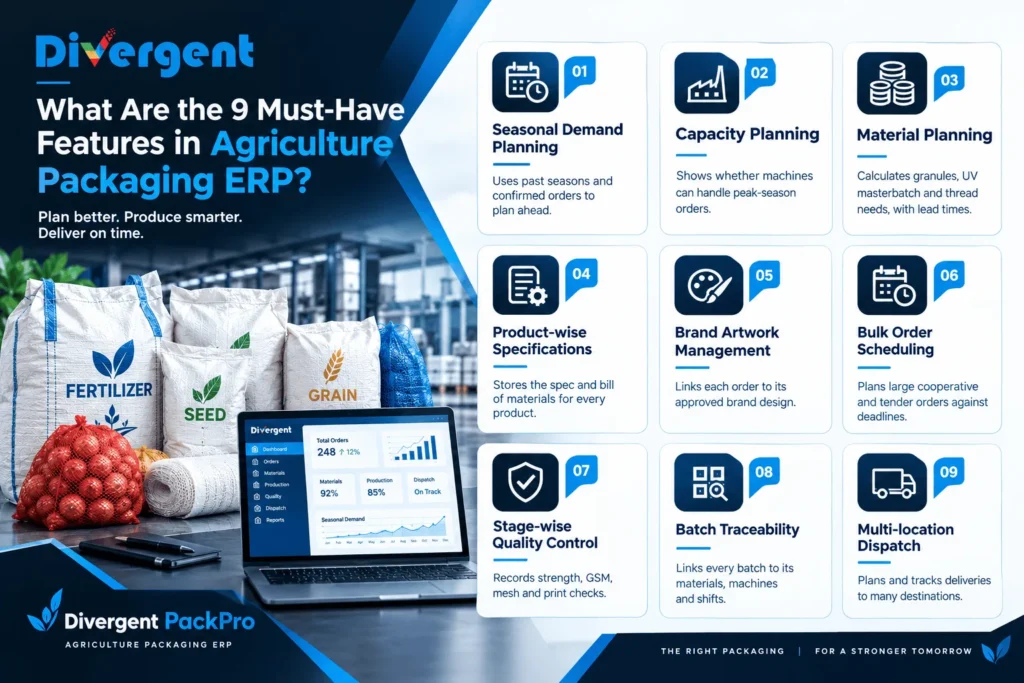
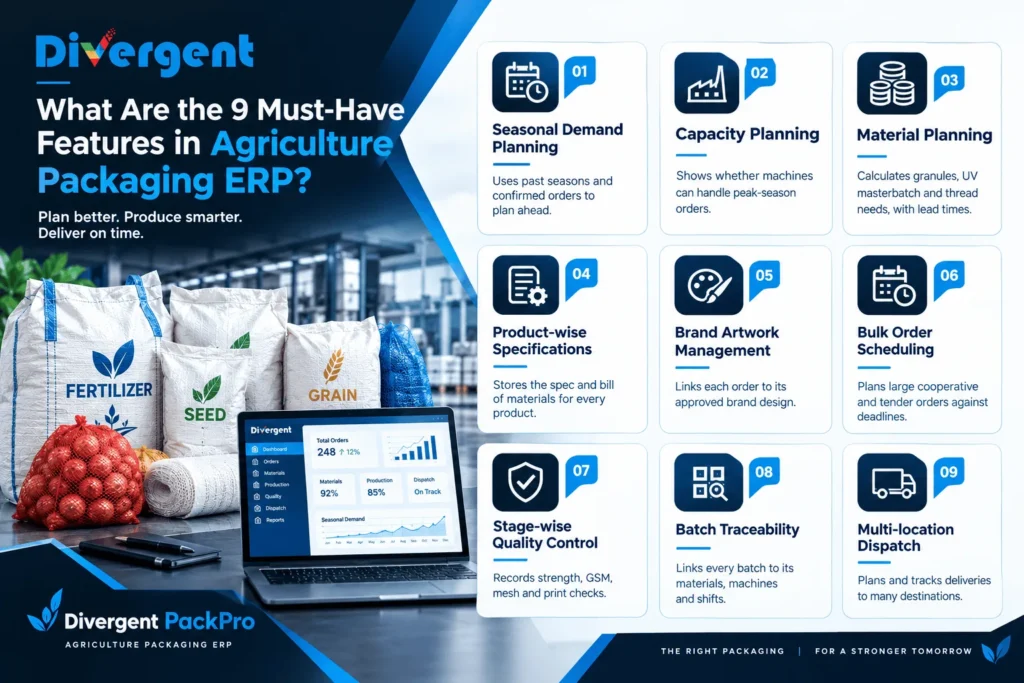
The 9 must-have features in agriculture packaging ERP are seasonal demand planning, capacity planning, material planning with lead times, product-wise specifications, brand artwork management, bulk order scheduling, stage-wise quality control, batch traceability, and dispatch to multiple locations.
| Feature | What it does for an agriculture packaging plant |
|---|---|
| Seasonal demand planning | Uses past seasons and confirmed orders to plan ahead |
| Capacity planning | Shows whether machines can handle peak-season orders |
| Material planning | Calculates granules, UV masterbatch and thread needs, with lead times |
| Product-wise specifications | Stores the spec and bill of materials for every product |
| Brand artwork management | Links each order to its approved brand design |
| Bulk order scheduling | Plans large cooperative and tender orders against deadlines |
| Stage-wise quality control | Records strength, GSM, mesh and print checks |
| Batch traceability | Links every batch to its materials, machines and shifts |
| Multi-location dispatch | Plans and tracks deliveries to many destinations |
1. Seasonal Demand Planning
Seasonal demand planning looks at past seasons, confirmed orders and expected customer volumes, so you can see the peak coming weeks before it arrives. It turns “we’ll manage somehow” into a real plan.
2. Capacity Planning
Capacity planning shows how much your extrusion lines, looms, printing machines and stitching lines can produce, and compares it with the orders ahead. You can spot overloaded weeks early, and decide whether to start production sooner or add shifts.
3. Material Planning With Lead Times
Material planning calculates how much granules, UV masterbatch, filler, thread, liner film and ink you’ll need for the season, and reminds you when to order based on supplier lead times. Running out of UV masterbatch in peak season is one of the most avoidable losses.
4. Product-Wise Specifications
Each agriculture product needs its own specification: fabric GSM, mesh, size, UV level, coating, liner and print. Storing them in one place means repeat orders are made correctly, every time.
5. Brand Artwork Management
Seed and fertilizer companies often change designs every season, and printing rules on agricultural packs can change too. Artwork management keeps every design version and approval linked to the right order, so old artwork never reaches the printing machine.
6. Bulk Order Scheduling
Cooperatives, government agencies and large agri companies place big orders with strict delivery dates. Bulk order scheduling breaks these into production lots, plans them across machines and shows progress in real time.
7. Stage-Wise Quality Control
Quality control records checks at each stage: tape strength, fabric GSM and mesh, UV stabilisation, print quality, bag size and stitching. Even in peak season, problems are caught before more material is used.
8. Batch Traceability
Batch traceability links each batch of bags to its raw material lots, machines and shifts. If a fertilizer company reports split bags in the field, you can trace the cause quickly and protect the relationship.
9. Multi-Location Dispatch
Agriculture orders often go to many destinations: depots, districts and dealers. Dispatch management plans and tracks deliveries across all of them, so nothing is missed in the rush.
How Does Agriculture Packaging ERP Improve the Agricultural Supply Chain?
Agriculture packaging ERP improves the agricultural supply chain by making sure the right bags reach farmers, depots and dealers on time. Packaging is a small part of the farm supply chain, but when bags arrive late, fertilizer, seed and harvested crops can’t move.
With better planning, packaging manufacturers can:
- Deliver before the season, not in the middle of it
- Reduce rush production, which lowers waste and quality problems
- Give buyers reliable delivery dates, which builds long-term contracts
Read more about how a supply chain connects producers, suppliers and customers.
Agriculture Packaging ERP Options Compared
Agriculture packaging manufacturers usually manage operations in one of three ways: Excel and registers, a normal ERP, or ERP built for packaging manufacturers, like Divergent PackPro.
| Factor | Excel and registers | Normal ERP | Divergent PackPro |
|---|---|---|---|
| Setup cost | Very low | Medium to high | Medium |
| Seasonal demand planning | Guesswork | Basic forecasting | Designed for it |
| Capacity planning for peak weeks | Whiteboard | Needs customisation | Designed for it |
| Material planning with lead times | Manual reminders | Possible with setup | Designed for it |
| Brand artwork management | Email and WhatsApp | Rarely available | Designed for it |
| Stage-wise quality control | Paper forms | Needs customisation | Designed for it |
| Best for | Very small plants | Large multi-industry groups | Growing agriculture packaging manufacturers |
If you make a few standard bags for a few customers, Excel may still work. Once you handle seasonal peaks, many products and brand customers, agriculture packaging ERP usually pays for itself through on-time deliveries and fewer peak-season mistakes.
How Does Divergent PackPro Work for Agriculture Packaging Plants?
Here’s how an order typically moves through an agriculture packaging plant using Divergent PackPro:
- Season planning: past seasons and expected orders are reviewed weeks in advance.
- Enquiry and costing: the product specification is entered, and cost is calculated.
- Artwork approval: the brand design is approved and linked to the order.
- Material planning: granules, UV masterbatch and accessories are checked against stock and lead times.
- Production planning: extrusion, weaving, printing and conversion are scheduled across machines.
- Production and quality: output, waste and quality checks are recorded at each stage.
- Dispatch: bags are delivered to each depot or dealer, with full order history.
What Will You See in a PackPro Demo?
Bring your real products and last season’s orders, and ask to see:
- Last season’s peak turned into a capacity plan for next season
- One of your products costed from its specification
- Material needs for a large order, with order-by dates
- A brand artwork approved and linked to its order
- A bulk order scheduled across your machines
Expert Insight
“In agriculture packaging, the season doesn’t wait for anyone. The plants that win are the ones that plan their materials and machines a month before the rush, not the week it starts. That’s what good agriculture packaging ERP makes possible.”
Is Your Plant Ready for Agriculture Packaging ERP?
Check these signs. If three or more are true, it’s time to think about agriculture packaging ERP:
- Every season feels like a rush, with overtime and late deliveries
- UV masterbatch or granules have run out during peak production
- Old or wrong artwork has reached the printing machine
- You can’t tell whether your machines can handle next month’s orders
- Large buyers have penalised you or moved orders elsewhere for late delivery
- Planning is done on a whiteboard or in someone’s head
How Should You Prepare for ERP Before the Next Season?
The best time to set up ERP is during your quiet months, so it’s ready before the next peak.
- List all your agriculture products with their specifications.
- Collect last season’s order data to understand your real peaks.
- Record supplier lead times for granules, masterbatch and other materials.
- Organise brand artworks by customer and season.
- Pick one project owner inside the plant.
- Go live in the quiet season, so your team is comfortable before the rush.
What Should You Ask Before Choosing Agriculture Packaging ERP?
Ask every vendor to show the system with your own products and last season’s orders. Then ask:
- Can it plan capacity for seasonal peaks?
- Can it calculate material needs with supplier lead times?
- Does it manage brand artwork versions and approvals?
- Can it schedule large bulk orders against delivery dates?
- Does it track quality checks at every stage?
- Can it plan deliveries to many locations?
- How long does setup take, and who trains our team?
For a general overview, see enterprise resource planning on Wikipedia. You may also find our guides to PP woven bag ERP software and BOPP bag ERP software useful.
FAQs About Agriculture Packaging ERP
What is agriculture packaging ERP?
Agriculture packaging ERP is an ERP system built for manufacturers of fertilizer bags, seed bags, grain sacks, mesh bags and other agricultural packaging. It connects orders, materials, machines, brand artwork, quality and dispatch in one system.
Why is agriculture packaging demand seasonal?
Agriculture packaging demand follows farming seasons. Orders for fertilizer and seed bags peak before sowing, and orders for grain sacks and mesh bags peak around harvest.
What are polypropylene bags used for in agriculture?
Polypropylene bags are used for fertilizer, seeds, grain, animal feed, sugar and flour. Woven PP bags are strong, light and low-cost, and can be coated, laminated or lined for extra protection.
What is a PE bag?
A PE bag is a bag made from polyethylene. In agriculture packaging, PE is often used as a liner inside woven PP bags to keep out moisture, especially for fertilizer.
What is the difference between polyethylene and polypropylene bags?
Polypropylene is stiffer and stronger for its weight, so it’s used for woven sacks. Polyethylene is softer and more flexible, so it’s often used for liners and films.
How does ERP help with seasonal demand?
ERP helps by using past seasons and confirmed orders to plan capacity and materials weeks in advance, so plants can start production before the rush instead of during it.
How much does agriculture packaging ERP cost?
The cost depends on the number of users, modules, plants and deployment type. Most vendors quote after understanding your operations, so ask for a quote based on your setup.