
What Is Dispatch Management in Manufacturing?
Dispatch management in manufacturing is the process of getting finished goods out of the factory correctly and on time: picking the right products, packing them, preparing invoices and transport documents, loading the vehicle and tracking delivery to the customer. Good dispatch management means every order leaves complete, with the right paperwork, on the promised date.
The Problem: The Truck Is at the Gate, and Nothing Is Ready
It’s 5 pm. The truck has been waiting at your gate since noon. The customer has called three times.
Inside the plant, the team is still searching. Two bundles are missing from the finished goods store. The invoice isn’t ready because accounts doesn’t have the final quantity. The transport documents can’t be generated until the invoice is done. And nobody is sure whether the last batch passed its final quality check.
The truck finally leaves at 9 pm, one bundle short.
This is a common scene in many factories, in India and around the world. Production may have done its job well, but poor dispatch management turns a good order into an unhappy customer.
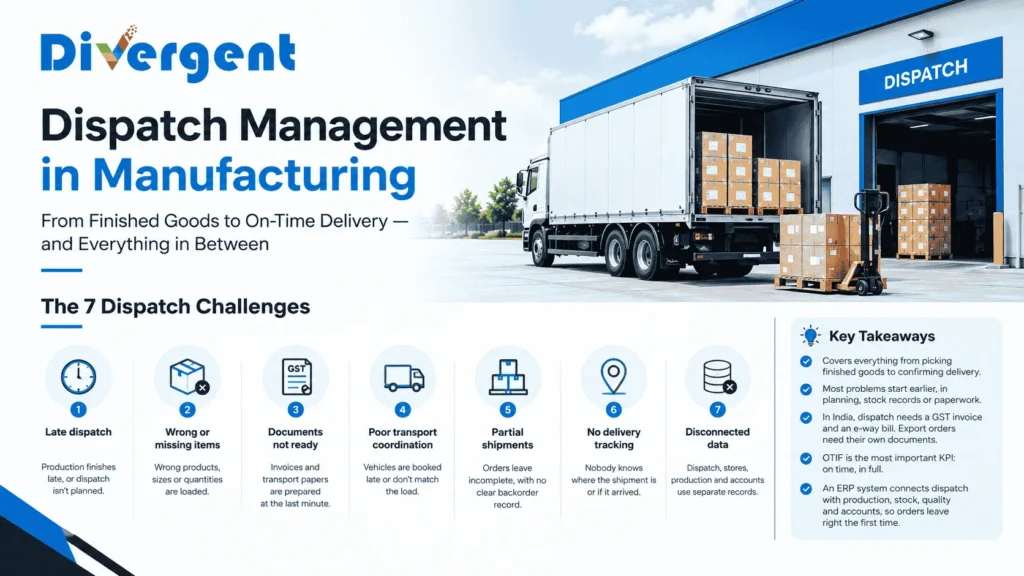
Here are the seven dispatch challenges we see most often:
| Challenge | What happens in the plant | What it costs you |
|---|---|---|
| 1. Late dispatch | Production finishes late, or dispatch isn’t planned | Missed delivery dates and penalties |
| 2. Wrong or missing items | Wrong products, sizes or quantities are loaded | Returns, re-delivery and complaints |
| 3. Documents not ready | Invoices and transport papers are prepared at the last minute | Trucks wait for hours at the gate |
| 4. Poor transport coordination | Vehicles are booked late or don’t match the load | Extra cost and delays |
| 5. Partial shipments | Orders leave incomplete, with no clear backorder record | Confused customers and lost follow-ups |
| 6. No delivery tracking | Nobody knows where the shipment is or if it arrived | Disputes and delayed payments |
| 7. Disconnected data | Dispatch, stores, production and accounts use separate records | Mistakes at every handover |
The good news? All seven can be fixed with clear processes and connected data.
Key takeaways:
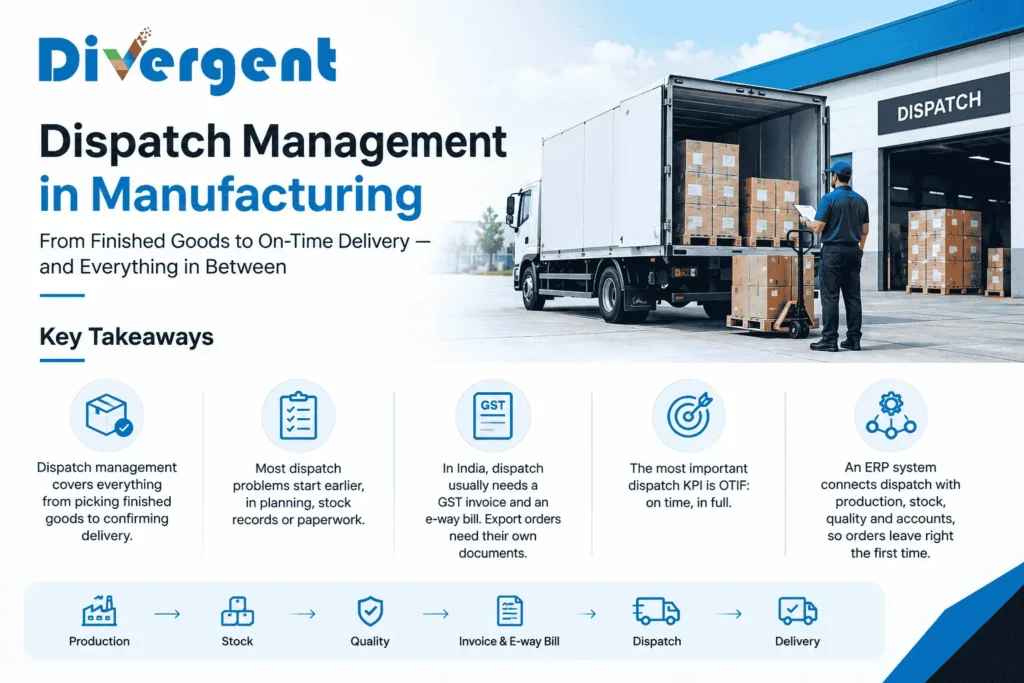
- Dispatch management in manufacturing covers everything from picking finished goods to confirming delivery.
- Most dispatch problems start earlier, in planning, stock records or paperwork.
- In India, dispatch usually needs a GST invoice and an e-way bill. Export orders need their own documents.
- The most important dispatch KPI is OTIF: on time, in full.
- An ERP system connects dispatch with production, stock, quality and accounts, so orders leave right the first time.
What Does Dispatch Mean?
The dispatch meaning is simple: dispatch means sending something off to a destination, usually quickly or for a specific purpose. In business, to dispatch goods means to send them out to a customer. “Dispatched” means the goods have already left, so if your order says “dispatched”, it’s on its way.
You’ll also see the spelling despatch, especially in India and the UK. Dispatch and despatch mean exactly the same thing. Dispatch is the more common spelling worldwide.
In manufacturing, dispatch is the last stage of an order, after production and quality checks, when goods leave the factory for the customer. Dispatch management is how a factory plans and controls that stage.
What Is the Dispatch Process in Manufacturing?
The dispatch process in manufacturing is the set of steps that turns finished goods into a delivered order. A typical process has eight steps:
- Order confirmation: the order is ready for dispatch, with quantity and delivery date.
- Stock allocation: finished goods are reserved for the order in the store.
- Final quality check: the goods are confirmed as passed and ready to ship.
- Packing and labelling: products are packed, bundled or baled, and labelled.
- Documentation: the invoice, packing list and transport documents are prepared.
- Vehicle and loading: the truck or container is arranged and loaded.
- Gate out: the vehicle leaves, and the order is marked as dispatched.
- Delivery and proof: the shipment is tracked, and proof of delivery is collected.
Good dispatch management makes sure each step is ready before the next one begins, so the truck never waits for paperwork or missing stock. This is also part of order fulfillment, the wider process of getting an order to the customer.
What Are the 7 Biggest Dispatch Management Challenges?
The 7 biggest dispatch management challenges in manufacturing are late dispatch, wrong or missing items, documents not ready, poor transport coordination, partial shipments, no delivery tracking and disconnected data. Each one is explained below with a practical fix.
1. Why Do Dispatches Go Out Late?
Dispatches go out late mostly because problems upstream aren’t visible in time. Production runs late, a quality check is pending or stock is short, but the dispatch team only finds out when the truck arrives.
Late dispatch is the most visible dispatch management problem, because the customer feels it directly. Our guide to production planning challenges explains how better planning prevents it.
Fix: Plan dispatch dates when the order is planned, and flag any order at risk of missing its date while there’s still time to act.
2. Why Do Wrong or Missing Items Get Loaded?
Wrong or missing items get loaded when the dispatch team works from paper lists, or when finished goods stock isn’t recorded accurately. Similar products, sizes or batches are easy to mix up in a busy store.
Fix: Pick and load against a system-generated list, and check each bundle or bale against the order before loading. Accurate finished goods stock makes this far easier. See our guide to inventory management challenges.
3. Why Are Dispatch Documents Always Late?
Dispatch documents are often late because they’re prepared only after loading, by a different team, using numbers copied by hand. In India, the GST invoice and e-way bill depend on exact quantities and values, so any mistake holds up the truck.
Paperwork is one of the most frustrating dispatch management delays, because the goods are ready but can’t leave.
Fix: Prepare documents from the same order and packing data the dispatch team uses, so they’re ready the moment loading is complete.
4. Why Is Transport So Hard to Coordinate?
Transport is hard to coordinate when vehicles are booked at the last minute, without knowing the exact load size or dispatch time. The result is trucks that are too small, too big, late or waiting for hours.
Fix: Share a dispatch schedule with your transporters in advance, with expected load size and timing.
5. What Goes Wrong With Partial Shipments?
Partial shipments go wrong when part of an order is sent but nobody records what’s still pending. The customer is unsure what they’ll receive, and the balance quantity is often forgotten.
Fix: Record every partial dispatch against the order, so the pending balance is always visible to sales, production and the customer.
6. Why Does Delivery Tracking Matter?
Delivery tracking matters because dispatch isn’t finished until the customer receives the goods. Without tracking and proof of delivery, disputes about quantity or timing are hard to settle, and payments are delayed.
Fix: Track each shipment after it leaves, and collect proof of delivery, signed or digital, for every order.
7. Why Does Disconnected Data Cause Dispatch Mistakes?
Disconnected data causes mistakes because dispatch depends on information from many teams: sales for the order, production for quantities, quality for approval, stores for stock and accounts for invoicing. When each team uses separate files, numbers don’t match.
This is the root cause behind most dispatch management problems. Our guide to production visibility challenges explains why shared, real-time data matters across the plant.
Fix: Connect dispatch to one shared order record that every team updates.
Which Dispatch Documents Do Manufacturers Need?
The documents needed for dispatch depend on whether goods are sold within India or exported. Good dispatch management prepares the right set for every order, without last-minute rush.
| Document | Used for | Domestic (India) | Export |
|---|---|---|---|
| Tax invoice | Sale of goods and tax details | GST invoice | Commercial invoice |
| Packing list | What’s inside each package | ✅ | ✅ |
| E-way bill | Movement of goods by road | Required for most movements above the value threshold | For domestic transport to the port |
| Delivery challan | Goods moved without a sale, such as job work | When applicable | When applicable |
| Bill of lading or airway bill | Proof of shipment by sea or air | Not usually | ✅ |
| Certificate of origin | Country where goods were made | Not usually | Often required by the buyer’s country |
| Test certificates | Quality proof for the batch | If the customer asks | Often required |
In India, e-way bills are generated through the government’s e-way bill portal. Rules and thresholds can change, so confirm current requirements with your tax advisor. For exports, a bill of lading is the key shipping document for sea freight.
What Does Poor Dispatch Management Cost a Factory?
Poor dispatch management costs a factory in penalties, extra transport, rework and lost customers. It’s often the most visible failure in the whole order, because it’s the part the customer sees.
| Problem | What it costs |
|---|---|
| Late deliveries | Penalties, lost repeat orders and damaged reputation |
| Wrong or missing items | Return transport, re-delivery and complaints |
| Trucks waiting for documents | Detention charges and wasted transport capacity |
| Missing proof of delivery | Payment disputes and slower cash flow |
| Forgotten backorders | Lost sales and frustrated customers |
Which KPIs Should You Track for Dispatch?
The most useful dispatch KPIs are on time in full (OTIF), order accuracy, dispatch lead time and cost per dispatch. Together, they show how reliably your factory delivers what it promises.
| KPI | How to calculate it | What it tells you |
|---|---|---|
| OTIF (on time in full) | Orders delivered on time and complete ÷ total orders × 100 | How reliable your deliveries are |
| Order accuracy | Orders shipped without errors ÷ total orders × 100 | How often you send the right items |
| Dispatch lead time | Time from “ready for dispatch” to gate out | How fast your dispatch team works |
| Truck waiting time | Average hours a vehicle waits at the gate | Hidden delays and detention cost |
| Cost per dispatch | Total dispatch and transport cost ÷ number of dispatches | How efficient your dispatch is |
OTIF is the KPI most large buyers track for their suppliers. Improving it is one of the fastest ways to win repeat business.
How Do You Improve Dispatch Management, Step by Step?
You improve dispatch management by planning dispatch early, keeping finished goods stock accurate, preparing documents from shared data and tracking every shipment to delivery. These seven steps work in most plants:
- Plan dispatch dates when you plan production, not on the day of dispatch.
- Keep finished goods stock accurate, bundle by bundle or bale by bale.
- Use a pick list generated from the order, and check before loading.
- Prepare documents from the same data used for packing.
- Share a dispatch schedule with transporters in advance.
- Record partial dispatches and pending balances.
- Track delivery and collect proof of delivery for every order.
Start with the step causing the most delays. For many plants, that’s documents or stock accuracy.
Dispatching Software, Logistics Software or ERP: Which Do You Need?
Manufacturers often compare dispatching software, logistics management software and ERP when trying to fix dispatch logistics problems. They solve different parts of the problem.
| Option | What it does well | What it misses for factories |
|---|---|---|
| Dispatching software | Assigns drivers or vehicles and plans routes | Doesn’t know your production, stock or quality status |
| Logistics management software | Manages transport, freight and delivery tracking | Usually separate from factory operations |
| Manufacturing ERP with dispatch | Connects orders, production, stock, quality, documents and dispatch | Transport routing may be simpler than dedicated tools |
For most manufacturers, the biggest dispatch problems happen inside the factory: stock, quality approval and paperwork. That’s why a manufacturing ERP with a dispatch module usually solves more than standalone dispatching software.
How Does ERP Improve Dispatch Management?
An ERP system improves dispatch management by connecting dispatch to the same order, stock, quality and accounts data used across the factory. When an order is ready, the dispatch team sees exactly what to pick, the documents are created from the same data, and delivery is tracked against the order.
For dispatch, a manufacturing ERP typically provides:
- A dispatch plan based on order dates and production progress
- Finished goods stock by bundle, bale, roll or batch
- Pick lists generated from the order
- Quality approval checks before goods can be dispatched
- Invoices and packing lists created from dispatch data
- Partial dispatch and backorder tracking
- Delivery status and proof of delivery linked to each order
ERP also records which batch went to which customer, which is the forward half of traceability. See our guide to traceability in manufacturing for more. For a general overview, see enterprise resource planning on Wikipedia.
Dispatch Challenges and Solutions at a Glance
| Challenge | Root cause | Solution |
|---|---|---|
| Late dispatch | Upstream delays not visible | Plan dispatch with production and flag risks early |
| Wrong or missing items | Paper lists and poor stock records | System pick lists and pre-loading checks |
| Documents not ready | Paperwork prepared last, by hand | Documents created from shared dispatch data |
| Poor transport coordination | Last-minute vehicle booking | Advance dispatch schedule for transporters |
| Partial shipments | Balances not recorded | Record every partial dispatch |
| No delivery tracking | Dispatch ends at the gate | Track shipments and collect proof of delivery |
| Disconnected data | Separate files in each team | One shared order record |
FAQs About Dispatch Management
What does dispatch mean?
Dispatch means sending goods or a message to a destination. In business, dispatching goods means sending them out to a customer, and “dispatched” means they’ve already left.
What is the difference between dispatch and despatch?
There’s no difference in meaning. Dispatch and despatch are two spellings of the same word. Despatch is more common in India and the UK, while dispatch is more common worldwide.
What is dispatch management in manufacturing?
Dispatch management in manufacturing is planning and controlling how finished goods leave the factory: picking, packing, documentation, loading and delivery tracking.
What is a dispatch system?
A dispatch system is software or a process that organises outgoing orders, including what to send, when, in which vehicle and with which documents. In factories, it’s often part of an ERP.
What is OTIF in dispatch?
OTIF means on time in full. It measures the percentage of orders delivered on the promised date and in the full quantity. Many large buyers use it to rate their suppliers.
Is an e-way bill required for dispatch in India?
An e-way bill is generally required in India for moving goods by road when the consignment value is above the set threshold, with some exceptions. Rules can change, so check current requirements with your tax advisor.
How can ERP improve dispatch?
ERP improves dispatch by linking it to orders, stock, quality and accounts. Pick lists and documents are created from the same data, and every shipment is tracked until delivery.
Final Thoughts on Dispatch Management
Dispatch is where your customer judges the whole order. Production, quality and planning can all go well, but if the truck leaves late, short or without the right papers, that’s what the customer remembers.
Good dispatch management starts long before the truck arrives: accurate stock, early planning and documents prepared from shared data. Start by measuring your OTIF this month. That one number will show you how much your customers can rely on you.
Related reading: