What is the PP woven bag manufacturing process?
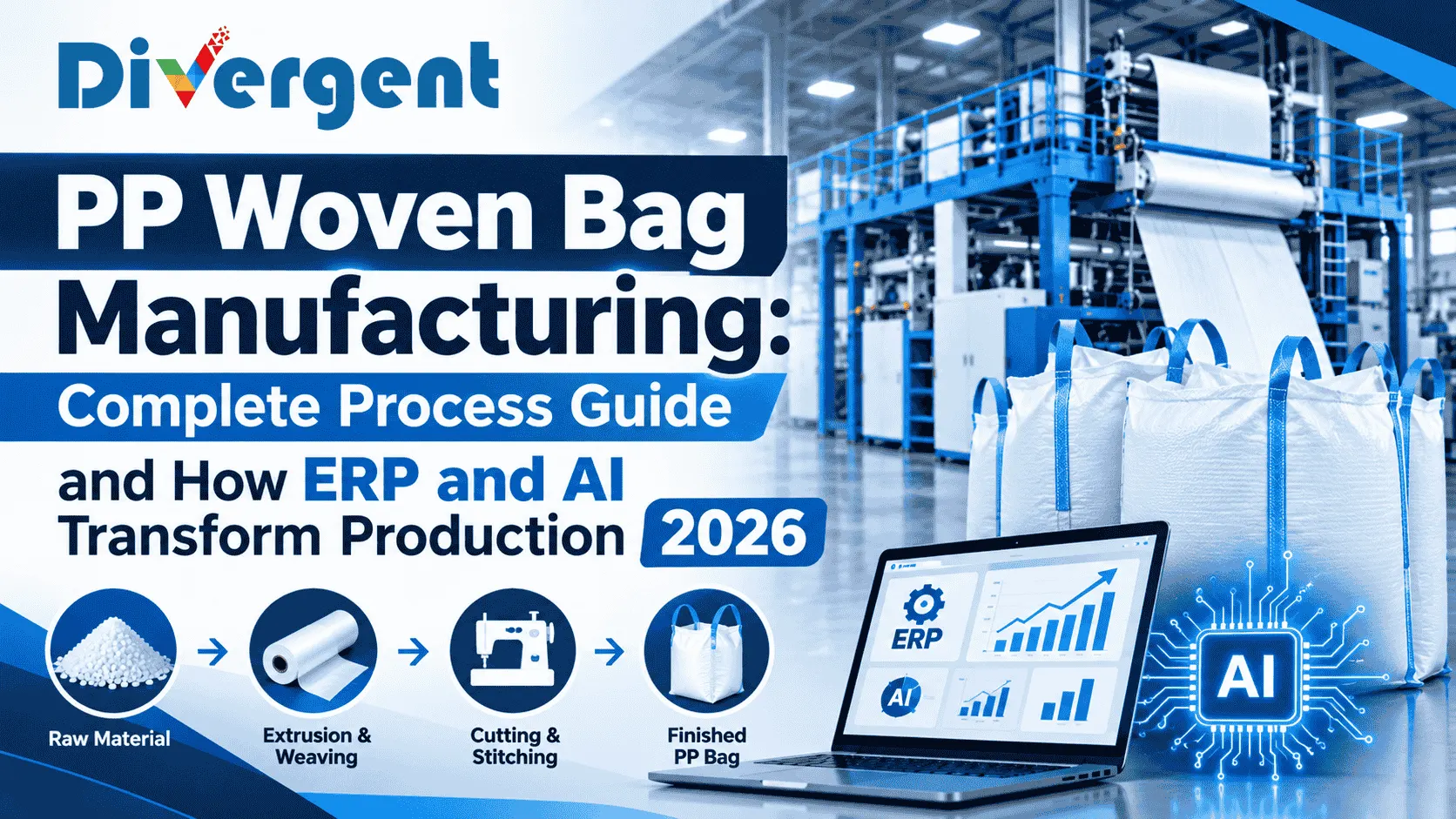
The PP woven bag manufacturing process converts polypropylene granules into finished woven sacks through six sequential production stages: extrusion of PP tapes, circular weaving of fabric, printing, cutting, stitching and finishing. Each stage requires specific machinery, trained operators and quality checks to produce bags that meet the dimensional, strength and appearance specifications required by buyers across agriculture, cement, chemicals, food and industrial sectors.
PP woven bags — also called woven sacks, PP sacks or polypropylene bags — are among the most widely manufactured flexible packaging products in the world. India is one of the largest producers globally, with significant manufacturing clusters in Gujarat, Rajasthan, Madhya Pradesh, Uttar Pradesh and Andhra Pradesh serving both domestic and export markets across the Middle East, Africa, Europe and North America.
This guide covers the complete PP woven bag manufacturing process step by step, the raw materials required, the machinery used at each stage, the quality standards that govern production and what buyers and manufacturers need to understand about how woven sacks are made.
Table of Contents
- What Is a PP Woven Bag?
- Raw Materials for PP Woven Bag Manufacturing
- PP Woven Bag Manufacturing Process — 6 Stages
- Stage 1: Extrusion — Making PP Tapes
- Stage 2: Circular Weaving — Making Fabric
- Stage 3: Printing — Adding Branding
- Stage 4: Cutting — Making Bag Blanks
- Stage 5: Stitching — Closing the Bag
- Stage 6: Finishing and Packing
- PP Woven Bag Quality Standards
- Types of PP Woven Bags
- PP Woven Bag Manufacturing Machinery
- How ERP Software Manages PP Woven Bag Manufacturing
- Frequently Asked Questions
What Is a PP Woven Bag?
What are PP woven bags made of?
PP woven bags are made from polypropylene — a thermoplastic polymer — that is first extruded into flat tapes, then woven into a tubular fabric on circular looms, and finally converted into bags through cutting, stitching and finishing operations. The result is a lightweight, strong, moisture-resistant flexible packaging product that can carry loads from 5kg to 50kg and beyond.
PP woven bags are used across a wide range of industries:
- Agriculture: Rice, wheat, sugar, fertiliser, seeds, animal feed
- Construction: Cement, sand, gypsum, aggregates
- Chemicals: Powders, granules, resins, pigments
- Food: Flour, salt, starch, food-grade powders
- Industrial: Minerals, ores, recycled materials, waste
The key advantage of PP woven bags over paper or jute sacks is their combination of high tensile strength, moisture resistance, light weight and the ability to print high-quality graphics for branding and regulatory information. They are also significantly cheaper to produce than comparable alternatives at high volumes.
Raw Materials for PP Woven Bag Manufacturing
What raw materials are used in PP woven bag manufacturing?
The primary raw material for PP woven bag manufacturing is polypropylene homopolymer granules, supplemented by UV stabiliser masterbatch, colour masterbatch, calcium carbonate filler (optional), lamination film (for laminated bags), printing inks and stitching thread. The quality and specification of each raw material directly affects the quality and performance of the finished bag.
| Raw Material | Purpose | Typical Specification |
|---|---|---|
| PP homopolymer granules | Base material for tape extrusion | MFI 2-4 g/10min, density 0.905 g/cc |
| UV stabiliser masterbatch | Protects against UV degradation | 2-5% loading depending on end use |
| Colour masterbatch | Tape colour for fabric appearance | White, natural, or customer specified |
| LDPE/LLDPE film | Lamination for moisture barrier | 18-25 micron, food grade if required |
| Printing inks | Branding and product information | Flexographic inks, food-safe if required |
| HDPE/PP stitching thread | Closing bag seams | 840 denier or as specified |
| Liner (PE film) | Inner moisture barrier for sensitive products | 50-150 micron as specified |
PP granule quality is the most critical raw material decision in PP woven bag manufacturing. Granules with inconsistent MFI (Melt Flow Index) produce tapes with variable strength and width, leading to fabric that fails to meet GSM specifications and bags that fail strength tests. Most serious manufacturers source PP from established petrochemical producers — Reliance, HPCL, IOCL, GAIL in India — and maintain incoming quality inspection for every lot received.
PP Woven Bag Manufacturing Process — 6 Stages
How are PP woven bags manufactured step by step?
PP woven bags are manufactured through six sequential stages: extrusion of PP tapes, circular weaving of fabric, printing, cutting to bag length, stitching to close the bag, and finishing and packing. Each stage must be completed to specification before material passes to the next — a quality problem at extrusion affects every subsequent stage, which is why incoming inspection at each stage handover is essential.
Stage 1: Extrusion — Making PP Tapes
What happens in the extrusion stage of PP woven bag manufacturing?
In the extrusion stage, PP granules are melted in an extruder and pushed through a flat die to form a continuous film. This film is then slit into tapes of the required width, stretched under controlled heat to orient the polymer chains and increase tensile strength, and wound onto bobbins ready for weaving. The extrusion stage determines the fundamental properties of the tape — width, denier, tenacity and elongation — that govern the fabric quality in the next stage.
- Extruder: Single-screw extruder melts PP granules at 220-260°C. Masterbatch is added at the hopper for colour and UV stabilisation. Die temperature is controlled to maintain consistent melt viscosity and film thickness.
- Slitting: The extruded film is slit into tapes by a set of razor blades. Tape width is typically 2-4mm for circular woven fabric, depending on the mesh count and denier specification.
- Stretching: Tapes pass through a hot air oven or over heated rollers at 120-140°C and are drawn at a stretch ratio of 1:6 to 1:8. This biaxial orientation significantly increases tensile strength — typically from 20 MPa to 180-220 MPa — which is what gives PP woven bags their characteristic strength.
- Winding: Stretched tapes are wound onto bobbins at controlled tension. Bobbin weight and tape denier are recorded for quality traceability.
Key quality checks at extrusion: Tape width (±0.1mm), denier (±5%), tenacity (minimum as per specification), elongation at break, and visual inspection for splits, loops and uneven width.
Stage 2: Circular Weaving — Making Fabric
How is PP woven fabric made?
PP woven fabric is made on circular looms that interlace warp tapes (running vertically along the fabric) and weft tapes (running horizontally across the fabric) in a plain weave pattern. The circular loom produces a seamless tubular fabric — which is exactly the right form for making bags, as it eliminates the need for a side seam. Loom speed, mesh count and tape denier together determine the fabric GSM (grams per square metre), which is the primary quality specification for woven bag fabric.
- Warping: Bobbins of warp tape are loaded onto the loom creel. The number of warp ends determines the fabric width and mesh count in the warp direction.
- Weaving: The circular loom interlaces warp and weft tapes at the specified mesh count — typically 10×10 to 14×14 threads per inch for standard woven bags. Higher mesh count produces denser, heavier fabric.
- Fabric inspection: Fabric is inspected on the loom for missing threads, loose tapes, holes and GSM variation. Defective sections are marked for rejection before fabric moves to the next stage.
- Roll forming: Woven fabric is collected as rolls. Roll weight, width and GSM are recorded against the production order for traceability.
Key quality checks at weaving: GSM (±5% of specification), mesh count, fabric width, tensile strength (warp and weft), elongation at break and visual inspection for weaving defects.
Loom efficiency — the percentage of time the loom is actually weaving versus stopped for maintenance, thread breaks or changeovers — is the key production metric at the weaving stage. A well-maintained loom running quality tape should achieve 85 to 92 percent efficiency. Efficiency below 75 percent indicates either maintenance issues, tape quality problems or operator skill gaps.
Stage 3: Printing — Adding Branding
How is printing done on PP woven bags?
Printing on PP woven bags is done using flexographic printing machines that apply solvent-based or water-based inks directly onto the fabric surface before or after lamination. Most woven bag printing is done on fabric rolls before cutting — this allows high-speed, continuous printing and is significantly more efficient than printing on finished bags. The number of colours, the registration accuracy between colours and the ink adhesion to the PP surface are the key quality parameters at this stage.
- Surface treatment: PP fabric is corona-treated before printing to increase surface energy and improve ink adhesion. Without corona treatment, inks do not bond to the low-surface-energy PP surface and will peel or smear in handling.
- Flexographic printing: Printing is done in line using anilox rollers that transfer ink to the printing plate, which transfers it to the fabric. Each colour requires a separate printing unit. Standard PP woven bag printing uses 2 to 6 colours.
- Lamination (for laminated bags): LDPE or BOPP film is laminated onto the fabric surface in line with printing or as a separate process. Lamination improves moisture resistance and print quality significantly — the smooth film surface accepts sharper, more vivid printing than the textured woven surface.
- Drying and rewinding: Printed and laminated fabric is dried and rewound for transfer to cutting.
Key quality checks at printing: Colour match against approved standard, registration accuracy between colours, ink adhesion (tape test), lamination bond strength and visual inspection for missing print, smearing, ghosting and blade marks.
Stage 4: Cutting — Making Bag Blanks
How is PP woven fabric cut into bags?
In the cutting stage, the tubular woven fabric roll is cut to the required bag length using a heat-cut or ultrasonic cutting machine. Heat cutting melts and seals the cut edge simultaneously, preventing the fabric from fraying — this is critical for PP woven fabric, which will unravel rapidly from a raw cut edge. The cut bag blank has an open top, a heat-sealed bottom edge and two open sides that will be stitched in the next stage.
- Length setting: The cutting machine is set to the specified bag length — typically 600mm to 1200mm for standard agricultural and industrial bags. Length accuracy is typically maintained to ±5mm.
- Heat cutting: A heated blade or wire cuts through the fabric while simultaneously sealing the cut edge. The sealing prevents fraying during stitching and in service.
- Bottom fold (for valve bags): Some bag designs require the bottom to be folded and stitched rather than heat-sealed. This is done at the cutting stage or as a separate operation before stitching.
Key quality checks at cutting: Bag length (±5mm), width (±5mm), edge seal quality, print position relative to cut line and visual inspection for defects in the fabric that were missed at earlier stages.
Stage 5: Stitching — Closing the Bag
How are PP woven bags stitched?
PP woven bags are stitched on industrial sewing machines using HDPE or PP thread. The stitching closes the bottom of the bag — and the top if it is a closed-mouth bag — and must meet specified seam strength requirements that are typically 80 to 90 percent of the bag’s rated load capacity. Stitch count, thread type and seam configuration are specified in the bag drawing and must be verified against the production standard at regular intervals during the stitching operation.
- Bottom stitching: The bottom seam is the most critical structural element of a woven bag. It is typically a double-stitch seam with a fold-over to distribute the load across two stitch lines. Stitch count is typically 4 to 6 stitches per centimetre.
- Top closure: Open-mouth bags have an open top that is stitched after filling. Valve bags have a valve insert stitched into one corner. Block-bottom bags have a folded and stitched bottom gusset.
- Liner insertion (if required): For products requiring moisture protection, a PE liner is inserted into the bag at the stitching stage and stitched into the top seam.
Key quality checks at stitching: Stitch count per centimetre, seam strength (pull test), thread tension consistency, liner position and visual inspection for skipped stitches, thread breaks and seam alignment.
Stage 6: Finishing and Packing
What is the finishing stage in PP woven bag manufacturing?
The finishing stage covers all operations that bring the bag to its final specification before packing and dispatch: trimming excess thread, inserting liners if not done at stitching, adding labels or stickers, final visual inspection and counting into bales for dispatch. The finishing stage is the last opportunity to catch defects before bags reach the customer — and defects caught at this stage are significantly cheaper to address than defects discovered after delivery.
- Trimming: Excess thread from stitching is trimmed. Long thread tails can catch in filling machinery and cause stoppages at the customer’s plant.
- Final inspection: Each bag is inspected for print defects, stitching faults, dimensional compliance and appearance. Defective bags are removed from the batch and segregated.
- Counting and baling: Accepted bags are counted into the specified bale quantity — typically 500 to 1,000 bags per bale — and baled using a hydraulic press. Bale weight and count are recorded against the dispatch order.
- Labelling: Each bale is labelled with the customer name, bag specification, batch number, quantity, manufacturer name and production date. Export bales carry additional documentation for customs clearance.
PP Woven Bag Quality Standards
What quality standards apply to PP woven bags?
PP woven bags are governed by national and international quality standards that specify minimum requirements for fabric GSM, tensile strength, elongation, seam strength, dimensions and other properties. The applicable standard depends on the end use and the market the bags are sold into.
| Standard | Market | Key Requirements |
|---|---|---|
| IS 9755 (India) | India | Fabric GSM, tensile strength, elongation, seam strength |
| ISO 7965-1 | International | Sack drop test, vibration test, stacking test |
| EN 277 | Europe | Cement bag specification — dimensions and strength |
| UN certification | Hazardous goods | Drop, stacking and vibration tests per UN regulations |
| BIS certification | India (food grade) | Food contact safety for food-grade PP bags |
| FIBC Safe code | International (FIBC) | Safety factor, test methods for bulk bags |
For export markets — particularly the Middle East, Europe and North America — buyers typically specify the applicable standard in their purchase order and require a test certificate from an accredited laboratory confirming that the bags meet the specified requirements. Maintaining test records against each production batch and being able to retrieve them quickly is a key requirement for export-focused PP woven bag manufacturers.
Types of PP Woven Bags
What are the different types of PP woven bags?
PP woven bags are available in several configurations, each suited to specific filling, handling and storage requirements. The main types are open-mouth bags, valve bags, block-bottom bags, laminated bags, liner bags and multiwall bags.
| Type | Description | Common Uses |
|---|---|---|
| Open-mouth bag | Top open for filling, stitched or heat-sealed after | Rice, wheat, sugar, fertiliser, cement |
| Valve bag | Valve in corner for automatic filling lines | Cement, chemicals, powders |
| Block-bottom bag | Flat bottom for stable stacking | Premium packaging, retail display |
| Laminated bag | BOPP or LDPE film laminated for print quality and moisture resistance | Rice, flour, animal feed |
| Liner bag | PE liner inside woven bag for moisture-sensitive products | Chemicals, food ingredients, hygroscopic powders |
| Multiwall bag | Woven outer with paper or film inner layers | Cement, chemicals, construction materials |
PP Woven Bag Manufacturing Machinery
What machinery is used in PP woven bag manufacturing?
PP woven bag manufacturing requires six categories of machinery corresponding to the six production stages. Capital cost for a complete plant varies from Rs 3 to Rs 15 crore depending on capacity, automation level and whether second-hand machinery is used. Indian machinery manufacturers — Lohia Corp, Starlinger India, Windmoeller and Hoelscher — supply most of the equipment used in Indian woven bag plants.
| Stage | Machinery | Key Specification |
|---|---|---|
| Extrusion | Tape extrusion line | Output 100-300 kg/hour, 500-1500 tapes/line |
| Weaving | Circular loom | 4-shuttle or 6-shuttle, 500-1200mm fabric width |
| Printing | Flexographic printing machine | 2-6 colour, 50-150m/min |
| Lamination | Lamination machine | Extrusion lamination or dry lamination |
| Cutting | Heat-cut cutting machine | Automatic length setting, 50-120 cuts/min |
| Stitching | Industrial sewing machine | Double needle, flatbed or cylinder arm |
How ERP Software Manages PP Woven Bag Manufacturing
What ERP features does a PP woven bag manufacturer need?
A PP woven bag manufacturer needs ERP software that understands the specific production flow of woven bag manufacturing — from granule receipt through extrusion, weaving, printing, cutting and stitching to finished bag dispatch — and can track material, quality and production data at each stage in real time. Generic ERP systems require significant customisation to handle woven bag-specific requirements such as GSM-based costing, tape denier tracking, loom efficiency monitoring and roll-wise fabric traceability.
- GSM-based costing: Every bag quote starts with the fabric GSM, mesh count and bag dimensions. The ERP should calculate material consumption and production cost from these inputs automatically — converting GSM and bag area to fabric weight, fabric weight to tape requirement, tape requirement to granule requirement, and adding conversion costs for each stage.
- Stage-wise production tracking: Material quantity is tracked through every stage — extrusion output, loom output, print output, cut quantity and stitched quantity. The yield between stages is measured and compared to standard, flagging wastage above the acceptable level for investigation.
- Loom efficiency monitoring: Actual metres woven per shift are tracked by loom against target. Efficiency below standard triggers a maintenance or quality investigation before the problem compounds across multiple production orders.
- Quality test record management: GSM test results, tensile strength test results and seam strength test results are recorded against each production batch — and dispatch is blocked until the batch passes quality inspection.
- Export documentation: For export orders, the ERP generates packing lists, quality certificates and dispatch documents from the production and dispatch data — without manual preparation of each document separately.
Divergent PackPro is a manufacturing ERP built specifically for PP woven bag, FIBC and packaging plants. It is designed around the specific workflows, measurements and quality requirements of woven bag manufacturing — not configured from a generic ERP. See how Divergent PackPro works for PP woven bag manufacturers or speak to our team for a demonstration using your own bag specifications.
See our related guide on PP woven bag ERP software for a detailed comparison of ERP features for woven sack manufacturers.
Frequently Asked Questions — PP Woven Bag Manufacturing
What is the PP woven bag manufacturing process?
The PP woven bag manufacturing process converts polypropylene granules into finished woven sacks through six stages: extrusion of PP tapes, circular weaving of fabric, printing, cutting to bag length, stitching to close the bag, and finishing and packing. Each stage requires specific machinery, trained operators and quality checks.
What raw materials are used in PP woven bag manufacturing?
The primary raw material is polypropylene homopolymer granules. Additional materials include UV stabiliser masterbatch, colour masterbatch, LDPE lamination film (for laminated bags), flexographic printing inks, HDPE stitching thread and PE liner film for moisture-sensitive applications.
What is GSM in PP woven bags?
GSM stands for grams per square metre — the weight of woven fabric per unit area. It is the primary quality specification for woven bag fabric, determined by the tape denier, mesh count and weave density. Standard PP woven bag fabric ranges from 50 to 120 GSM depending on the load capacity and application.
What are the types of PP woven bags?
The main types of PP woven bags are open-mouth bags (top open for filling), valve bags (with a filling valve for automatic lines), block-bottom bags (flat bottom for stable stacking), laminated bags (with BOPP or LDPE film lamination), liner bags (with an inner PE liner) and multiwall bags (woven outer with paper or film inner layers).
What quality standards apply to PP woven bags?
PP woven bags are governed by IS 9755 in India, ISO 7965-1 internationally, EN 277 for cement bags in Europe and UN certification for hazardous goods packaging. Export buyers typically specify the applicable standard in their purchase order and require a test certificate from an accredited laboratory.
What machinery is used in PP woven bag manufacturing?
PP woven bag manufacturing requires a tape extrusion line, circular looms for weaving, a flexographic printing machine, a lamination machine (for laminated bags), a heat-cut cutting machine and industrial sewing machines for stitching. Major machinery suppliers include Lohia Corp, Starlinger India and Windmoeller and Hoelscher.
How is PP woven fabric made?
PP woven fabric is made on circular looms that interlace warp tapes (running vertically) and weft tapes (running horizontally) in a plain weave pattern. The circular loom produces a seamless tubular fabric ready for conversion into bags. Mesh count and tape denier together determine the fabric GSM.
What is extrusion in PP woven bag manufacturing?
Extrusion is the first stage of PP woven bag manufacturing, in which PP granules are melted and pushed through a die to form a film, slit into tapes of the required width, stretched to increase tensile strength, and wound onto bobbins for weaving. Extrusion determines the fundamental tape properties that govern fabric quality.
What is the difference between laminated and unlaminated PP woven bags?
Laminated PP woven bags have a layer of BOPP or LDPE film bonded to the fabric surface, which improves moisture resistance and allows higher-quality printing than the textured woven surface. Unlaminated bags are lighter and cheaper but have lower moisture resistance and coarser print quality. Lamination adds 15-25 percent to bag cost.
How does ERP software help PP woven bag manufacturers?
ERP software helps PP woven bag manufacturers by tracking production through each manufacturing stage, calculating material requirements from GSM-based costing, monitoring loom efficiency, managing quality test records and generating dispatch and export documentation automatically. Purpose-built woven bag ERP handles GSM calculations and stage-wise tracking that generic ERP cannot do without significant customisation.
Related Reading
- PP Woven Bag ERP Software: How to Choose the Right System
- Best ERP Software for FIBC Manufacturers
- Quality Control Challenges in Manufacturing
- Inventory Management Challenges in Manufacturing
- 12 Critical Manufacturing Challenges and How ERP Solves Them
Follow Divergent Softlab on Google
Enjoying our insights on manufacturing ERP, artificial intelligence and business technology? Add Divergent Softlab as a preferred source on Google to discover more of our latest articles.