What is PP woven bag manufacturing?
PP woven bag manufacturing is the process of converting polypropylene granules into finished woven sacks through a sequence of production stages — extrusion, weaving, printing, cutting and stitching — each of which must be precisely controlled to produce a bag that meets the customer’s weight, strength and print specification. It is one of the most process-intensive segments of flexible packaging manufacturing, with tight tolerances, significant raw material cost and high-volume production runs that leave little room for error.
India is the world’s largest producer of PP woven bags, supplying agriculture, cement, chemical and food packaging markets globally. According to McKinsey, manufacturers that implement connected digital systems reduce operational costs by 15 to 20 percent within two years. The plants that compete most effectively — on price, quality and delivery — are those that have moved beyond manual production management to connected ERP systems that give every department real-time visibility of what is happening at every stage of the process.
This guide covers the complete PP woven bag manufacturing process from granule to finished bag, the common quality and efficiency challenges at each stage, and how ERP software and artificial intelligence are transforming how the best plants manage production, inventory and quality in 2026.
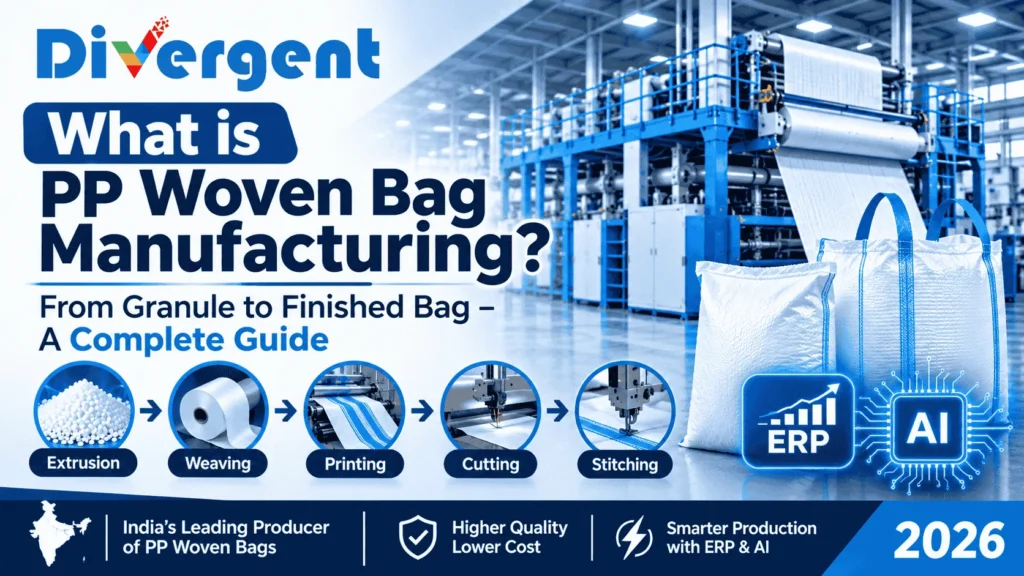
Table of Contents
- What Is a PP Woven Bag?
- Raw Materials for PP Woven Bag Manufacturing
- PP Woven Bag Manufacturing Process: Stage by Stage
- Stage 1: Extrusion — Converting Granules to Tape
- Stage 2: Weaving — Converting Tape to Fabric
- Stage 3: Printing — Adding Brand and Product Information
- Stage 4: Cutting and Stitching — Forming the Finished Bag
- Quality Control in PP Woven Bag Manufacturing
- Common Challenges in PP Woven Bag Manufacturing
- How ERP Software Transforms PP Woven Bag Manufacturing
- How AI Improves PP Woven Bag Manufacturing
- Divergent PackPro: ERP and AI for PP Woven Bag Plants
- Frequently Asked Questions
What Is a PP Woven Bag?
What is a PP woven bag made of?
A PP woven bag is a flexible packaging container made from woven polypropylene tape — a flat, narrow strip of oriented polypropylene film that is woven on a circular or flat loom into a tubular or flat fabric, then cut and stitched into a bag. The polypropylene tape gives the bag its strength — the interlocked warp and weft tapes distribute load across the entire bag surface rather than concentrating it at seams or corners.
PP woven bags are used across a wide range of industries because they combine high strength-to-weight ratio with low cost and excellent printability. Common applications include:
- Agriculture: Rice, wheat, sugar, fertiliser, seed packaging in 25kg to 50kg bags
- Cement and construction: Cement, sand, gravel, dry mix in 25kg to 50kg bags
- Chemicals: Polymer granules, industrial chemicals, minerals
- Food: Animal feed, flour, salt, sugar in food-grade laminated bags
- Retail: Shopping bags, promotional bags, reusable carrier bags
Raw Materials for PP Woven Bag Manufacturing
What raw materials are used in PP woven bag manufacturing?
The primary raw material in PP woven bag manufacturing is polypropylene homopolymer or copolymer granules — typically sourced from petrochemical manufacturers and graded by melt flow index, which determines how the material behaves during extrusion. Secondary raw materials include UV stabiliser masterbatch to protect bags used in outdoor conditions, colour masterbatch for coloured tape or fabric, and HDPE granules sometimes blended for specific properties.
| Raw Material | Purpose | Typical Cost Share |
|---|---|---|
| PP homopolymer granules | Base material for tape extrusion | 65-75% |
| UV stabiliser masterbatch | UV protection for outdoor bags | 3-5% |
| Colour masterbatch | Coloured tape or fabric | 2-4% |
| LDPE/LLDPE for lamination | Laminated liner for moisture resistance | 5-10% |
| Printing inks | Branding and product information | 2-4% |
| Thread | Stitching bottom and top seams | 1-2% |
Raw material cost represents 60 to 75 percent of the total manufacturing cost of a PP woven bag — which is why raw material procurement, consumption tracking and wastage control are the most significant operational levers available to a PP woven bag manufacturer. According to PlastIndia Foundation, India is one of the world’s largest producers of PP woven sacks, with the industry growing at 8 to 10 percent annually driven by agriculture and infrastructure demand.
PP Woven Bag Manufacturing Process: Stage by Stage
What are the stages of PP woven bag manufacturing?
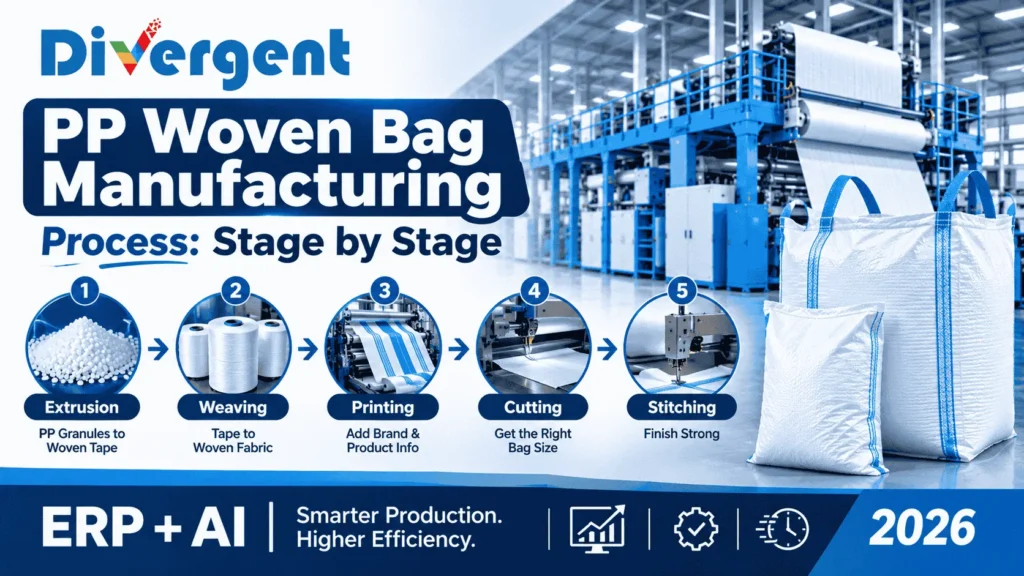
PP woven bag manufacturing follows five main production stages: extrusion converts PP granules into flat tape, weaving converts tape into tubular or flat fabric, printing adds customer branding and product information, cutting converts fabric into bag panels of the correct size, and stitching assembles the panels into finished bags. Each stage produces semi-finished goods that become the input for the next stage — creating a production chain where a problem at any stage affects every stage that follows.
Stage 1: Extrusion — Converting PP Granules to Woven Tape
How is PP tape made in woven bag manufacturing?
PP tape is made by melting polypropylene granules in an extruder, forcing the melt through a flat die to form a film, stretching the film to orient the polymer chains and increase tensile strength, then slitting the oriented film into narrow tapes of the specified width and winding the tapes onto bobbins for use on the loom.
The extrusion process has five sub-steps:
- Granule feeding and melting: PP granules and masterbatch are fed into the extruder hopper. The rotating screw melts and homogenises the material as it moves toward the die. Temperature profiles across the extruder barrel — typically five to seven zones ranging from 180°C to 240°C — control melt viscosity and homogeneity.
- Film extrusion: The melt is forced through a flat die, forming a continuous film of uniform thickness. Die lip gap and melt temperature determine film thickness — the primary variable that controls tape GSM (grams per square metre).
- Quenching: The extruded film passes through a water bath or over a chilled roller to solidify it rapidly. Quench temperature affects crystallinity and therefore the stretchability of the film in the next stage.
- Stretching (orientation): The solidified film passes through a hot air oven and is stretched to 6 to 8 times its original length between slow and fast roller pairs. This longitudinal orientation aligns the polymer chains, increasing tensile strength in the tape direction by 300 to 500 percent. The process of oriented polypropylene production is well documented and is the fundamental process that gives PP tape its exceptional strength-to-weight ratio.
- Slitting and winding: The oriented film passes through a slitting station where circular blades cut it into tapes of the specified width — typically 2mm to 4mm for standard woven bags. The tapes are wound onto individual bobbins at high speed for transfer to the loom.
Key extrusion quality parameters: tape denier (weight per unit length), tape tenacity (breaking strength per denier), tape width consistency, elongation at break and UV stabiliser content. Deviations in any of these affect fabric GSM, bag strength and customer compliance.
Stage 2: Weaving — Converting Tape Bobbins to Woven Fabric
How is PP woven fabric made?
PP woven fabric is made by interlacing warp tapes (running lengthwise) and weft tapes (running across) on a circular or flat loom. Circular looms produce a tubular fabric that can be cut to form the main body of a bag directly, while flat looms produce a flat fabric that requires separate cutting and seaming. Most high-volume PP woven bag plants use circular looms for their speed and efficiency.
The weave pattern — typically plain weave (1 over, 1 under) for standard bags — determines the mesh count, which is the number of tapes per inch in both warp and weft directions. Mesh count directly determines the fabric GSM: a higher mesh count with the same tape denier produces a heavier fabric. Fabric GSM is the primary quality specification that customers order against and that production planning is built around.
Key weaving quality parameters: mesh count (tapes per inch), fabric GSM, fabric width, fabric tensile strength in both directions, and absence of weaving defects — missing tapes, broken tapes, loose edges and uneven tension.
Stage 3: Printing — Adding Brand and Product Information
How are PP woven bags printed?
PP woven bags are printed by flexographic or gravure printing on the fabric — either before cutting (roll-to-roll printing) or after cutting (sheet printing). Most high-volume plants use roll-to-roll flexographic printing, where the fabric roll passes through a printing station with one printing cylinder per colour, each applying a layer of fast-drying ink before the next colour is applied.
Print quality in PP woven bag manufacturing is affected by ink viscosity, anilox roller specification, impression pressure, printing speed, fabric surface energy and drying efficiency. Colour registration — the precise alignment of each colour layer — is the most common printing quality challenge, particularly on woven fabric whose surface texture creates more variation than smooth film.
Bags for food or high-moisture applications are typically laminated before or after printing — a thin LDPE or BOPP film is bonded to the fabric surface to provide moisture barrier and improve print quality. Laminated bags command a price premium and require additional process control at the lamination stage.
Stage 4: Cutting and Stitching — Forming the Finished Bag
How are PP woven bags cut and stitched?
PP woven bags are cut from the printed fabric roll at the specified bag length using a hot knife or ultrasonic cutter that simultaneously cuts and seals the cut edge to prevent tape unravelling. The cut tube — for circular loom fabric — is then stitched at the bottom seam using an industrial sewing machine with UV-stabilised thread. For valve bags, the top is also stitched with a valve insert. For open-top bags, the top is hemmed or folded and stitched.
Stitching quality — stitch density, seam strength and thread tension — is critical for bags used in high-weight applications. A stitching failure in a 50kg cement bag in the field is a customer complaint, a bag replacement cost and a potential loss of the account. Stitch density is specified in stitches per inch and must be verified against the customer’s specification at regular intervals during production.
After stitching, bags are bundled in the specified pack quantity, baled and moved to the finished goods store for dispatch.
Quality Control in PP Woven Bag Manufacturing
What are the quality checks in PP woven bag manufacturing?
Quality control in PP woven bag manufacturing covers incoming raw material inspection, in-process checks at each production stage and final bag inspection before dispatch. The critical quality parameters are tape denier and tenacity at extrusion, fabric GSM and mesh count at weaving, print registration and colour density at printing, and seam strength and stitch count at stitching.
| Stage | Quality Check | Frequency | Reject Risk |
|---|---|---|---|
| Incoming raw material | MFI, moisture content, visual | Every lot | Poor tape quality, brittleness |
| Extrusion | Tape denier, width, tenacity, elongation | Every 2 hours per line | Weak bags, GSM shortfall |
| Weaving | Fabric GSM, mesh count, width, defects | Every roll | Customer rejection, delamination |
| Printing | Colour registration, density, adhesion | Every 500 bags | Customer brand compliance failure |
| Cutting | Bag dimensions, cut quality | Every lot | Wrong size, unravelling edges |
| Stitching | Stitch count, seam strength, thread | Every 100 bags | Seam failure in field |
| Final inspection | Visual, weight, print, dimensions | Every lot before dispatch | Customer returns |
Common Challenges in PP Woven Bag Manufacturing
What are the main challenges in PP woven bag manufacturing?
The main challenges in PP woven bag manufacturing are raw material price volatility, extrusion yield variation, loom efficiency inconsistency, quality defects that propagate across stages before they are caught, and production planning complexity across multiple interdependent stages. Each of these challenges costs money — either directly in material waste and rework, or indirectly in late deliveries and customer dissatisfaction.
- PP price volatility: Polypropylene prices fluctuate with crude oil prices and petrochemical supply cycles. According to ICIS, PP prices have shown 15-25% annual volatility in recent years. A plant that quotes a bag price based on today’s PP cost and receives the order 30 days later may find that the material cost has increased by 5 to 10 percent — compressing margin significantly on a product already sold at a tight price.
- Extrusion yield variation: Actual granule consumption per kilogram of tape produced varies with temperature profiles, line speed, granule quality and operator consistency. A plant targeting 97 percent yield but actually running at 95 percent is losing 2 percent of its most expensive input without knowing it — until the month-end reconciliation reveals an unexplained variance.
- Loom efficiency inconsistency: Individual loom efficiency — bags or metres of fabric produced per shift against target — varies significantly between looms, shifts and operators. A plant with 50 looms where 10 are consistently running at 70 percent efficiency while the rest run at 90 percent is losing the equivalent of 4 to 5 looms of capacity that it has already paid for.
- Quality defects propagating across stages: A tape quality deviation at extrusion does not show up as a bag rejection at stitching — it shows up as a GSM shortfall at weaving, which the weaving team may not catch until several rolls of fabric have been produced. By the time the rejection is identified, significant material and machine time have been consumed.
- Production planning across interdependent stages: Planning production in a PP woven bag plant means managing five interdependent stages simultaneously — each with its own machine capacity, speed and WIP buffer. A bottleneck at any stage backs up all upstream stages and starves all downstream stages. Manual planning cannot keep up with the real-time changes that happen in a multi-shift operation.
How ERP Software Transforms PP Woven Bag Manufacturing
What does ERP software do for PP woven bag manufacturers?
According to Gartner, ERP is the primary technology that eliminates departmental silos in manufacturing — providing a single source of truth for production, inventory, quality and finance data across the organisation.
ERP software transforms PP woven bag manufacturing by connecting every production stage — extrusion, weaving, printing, cutting and stitching — in one live system, so production managers can see the status of every order, every machine and every material at any moment. Instead of calling the floor supervisor for a status update, the production manager opens a dashboard. Instead of calculating material requirements manually, the system calculates them from the production plan. Instead of discovering a quality problem at dispatch, the system flags it at the stage where it occurred.
| Challenge | Without ERP | With ERP |
|---|---|---|
| PP price volatility | Manual requoting — slow and error-prone | Automatic cost recalculation when material price updates |
| Extrusion yield tracking | Month-end variance — too late to act | Real-time yield per line per shift — corrected immediately |
| Loom efficiency | Estimated from supervisor reports | Actual metres/bags per loom per shift vs target |
| Quality defect propagation | Discovered downstream — excess waste | Flagged at stage of occurrence — contained immediately |
| Production planning | Manual spreadsheet — updated once a day | Live — updates when any input changes |
| Inventory management | Periodic count — always outdated | Real-time by material, location and status |
| Dispatch documentation | Manual preparation — errors common | System-generated from dispatch entry |
The most significant impact of ERP in PP woven bag manufacturing is stage-wise WIP visibility. When every stage handover — tape to loom, fabric to printing, printed fabric to cutting, cut panels to stitching — is recorded as a system transaction, the production manager can see exactly how much is queued at each stage, how much is in process and how much has been completed. Production planning becomes a data-driven exercise rather than a daily negotiation between departments. See our guide to production visibility challenges in manufacturing for how live data changes operational decisions.
How ERP Connects Every Department in a PP Woven Bag Plant
In a PP woven bag plant without ERP, departments work in isolation. Sales confirms a delivery date without checking production capacity. Production plans a run without knowing whether PP granules are available. Stores issues material without knowing which order it is for. Quality records a rejection on paper that never reaches dispatch. Each department does its job correctly — but the information never reaches the people who need it in time to act on it.
With ERP, every transaction connects every department in real time:
- Sales confirms an order — production sees it immediately, checks capacity and schedules it. If capacity is insufficient, the system flags it before the customer is given a delivery date that cannot be met.
- Production raises a production order — stores receives a material requirement automatically. The system checks PP granule availability and flags any shortfall before the production run starts, not when the line stops.
- Extrusion completes a batch of tape — the tape quantity is recorded against the production order and the WIP balance updates. Weaving can see exactly how much tape is available without calling the extrusion supervisor.
- Quality flags a fabric roll as rejected — the roll is quarantined in the system. It cannot be issued to printing or cutting. The production team and dispatch can both see it immediately without a phone call.
- Finished bags move to the finished goods store — dispatch can see the quantity immediately. The management dashboard updates. No end-of-day stock count required.
ERP Implementation Steps for PP Woven Bag Manufacturers
How do you implement ERP in a PP woven bag plant?
ERP implementation in a PP woven bag plant follows a structured sequence that minimises production disruption. The key difference from a generic manufacturing implementation is the need to configure stage-wise production tracking for extrusion, weaving, printing, cutting and stitching — each with its own yield measurements, quality parameters and WIP tracking requirements.
- Build the item master and BOM: Every raw material (PP granules by grade, masterbatch by type), semi-finished item (tape by denier and width, fabric by GSM and mesh count) and finished item (bag by specification) needs a unique code and a verified BOM. In most PP woven bag plants, BOMs exist informally — the ERP implementation is the opportunity to document and standardise them. This step typically takes 4 to 6 weeks and is the most critical foundation of the entire implementation.
- Configure stage-wise production routing: Set up the production routing for each bag specification — which stages it passes through, what the standard yield is at each stage, and what quality parameters are checked at each handover. This configuration connects the production plan to material requirements and to WIP tracking automatically.
- Set up loom and machine master: Every extrusion line, circular loom, flat loom, printing machine and stitching machine entered in the system with its standard speed and efficiency targets. This enables actual vs target tracking at machine level — the foundation of AI-driven efficiency analysis.
- Train team by role: The extrusion supervisor learns how to record shift production and yield. The loom operator learns how to record fabric output against the job card. The quality inspector learns how to record inspection results and quality holds. Each role trains on what they specifically do — not the entire system.
- Go live with parallel running: Run the ERP alongside existing spreadsheets for 4 to 8 weeks. This allows the team to build confidence in the system while maintaining the safety net of the old process. After parallel running, the spreadsheets are retired and the ERP becomes the single source of truth.
See our complete guide to ERP implementation in manufacturing for the full 7-step checklist used by packaging plants going live without production disruption.
How AI Improves PP Woven Bag Manufacturing
How is AI used in PP woven bag manufacturing?
AI is used in PP woven bag manufacturing to predict raw material requirements before stockouts occur, optimise extrusion parameters for maximum yield, identify loom efficiency patterns that reveal which machines and operators produce the best output at which specifications, and forecast demand across seasonal peaks to prevent both stockouts and excess inventory. AI does not replace the production team — it gives them information they could not access from manual systems.
AI for Raw Material Planning in PP Woven Bag Manufacturing
AI-driven inventory management calculates PP granule requirements from confirmed production orders, actual consumption rates and actual BOM yields — not from estimates or standard costs that may be months out of date. When PP prices are rising, the AI flags which open orders are at risk of margin compression before the production run starts, giving the commercial team time to requote or reschedule. When a large order is confirmed, the AI immediately checks whether sufficient PP is available, identifies any shortfall and generates a purchase recommendation with the correct quantity and timing.
See our detailed guide on AI demand forecasting in manufacturing for how AI predicts material needs weeks before shortages occur.
AI for Extrusion Yield Optimisation
AI analyses extrusion data — temperature profiles, line speeds, granule batch properties and actual yield measurements — to identify the parameter combinations that consistently deliver the highest yield and the best tape quality. Over time, the AI builds a recommendation model: for this granule batch, at this ambient temperature, these temperature profiles and this line speed deliver the best combination of yield and tape properties. This kind of optimisation is not achievable through manual analysis — the number of variables and interactions is too large for any team to track without data.
AI for Loom Efficiency and Predictive Maintenance
AI monitors loom efficiency by shift, operator and specification and identifies patterns that manual analysis misses: which looms consistently underperform on high-mesh specifications, which operators achieve better efficiency on which loom types, which efficiency drops precede mechanical problems. Combined with sensor data from loom bearings and drive motors, AI-powered predictive maintenance prevents the unplanned loom stoppages that disrupt production plans and push deliveries late. See our guide on predictive maintenance in manufacturing for how AI prevents machine breakdowns before they happen.
AI for Quality Defect Detection
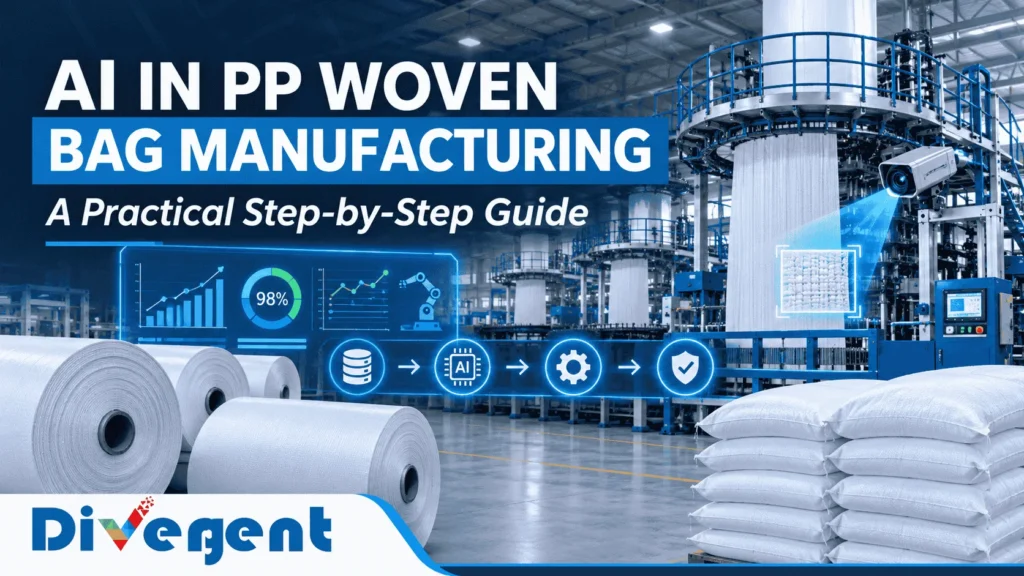
AI-powered computer vision cameras mounted at each production stage can inspect every bag — or every metre of fabric — for defects that human inspectors miss or catch too late. At extrusion, cameras detect tape width variation and surface defects in real time. At weaving, cameras detect missing tapes, broken threads and GSM deviation from the fabric surface pattern. At printing, cameras verify colour registration and print density on every bag at full line speed. The defect is flagged, the line can be stopped or the batch quarantined, and the problem is contained before significant waste has accumulated. See our guide on AI quality control in manufacturing for how computer vision transforms defect detection.
How to Implement AI in a PP Woven Bag Plant: Step-by-Step
What are the steps to implement AI in PP woven bag manufacturing?
Implementing AI in a PP woven bag plant does not require a separate AI system or a data science team. Modern manufacturing ERP systems include AI modules that activate automatically as transaction data accumulates. The implementation follows a practical sequence that any plant can follow.
| AI Application | What You Need First | What AI Delivers | Timeline |
|---|---|---|---|
| AI demand forecasting | 3-6 months of clean sales and production history in ERP | Accurate PP granule purchase recommendations 3-4 weeks ahead | Month 4-6 of ERP |
| AI extrusion yield optimisation | Shift-wise yield data recorded per extrusion line | Optimal temperature and speed recommendations per granule batch | Month 6-9 of ERP |
| AI loom efficiency analysis | Machine-wise output data per shift per specification | Identifies underperforming looms and operators automatically | Month 3-6 of ERP |
| AI predictive maintenance | Vibration and temperature sensors on critical machines | Failure predictions 2-4 weeks before breakdown | Month 6-12 |
| AI quality inspection | Cameras at each production stage | 100% inspection at full line speed — zero defect escape | Month 3-6 |
Step 1 — Get ERP transaction data clean and complete. AI is only as accurate as the data it learns from. Before activating any AI module, ensure that every shift’s production, every material issue and every quality check is recorded in the ERP at the point it happens — not at end of shift or end of day. This discipline is the foundation everything else builds on.
Step 2 — Start with AI demand forecasting for PP granules. This is the highest-ROI starting point because raw materials are 65-75% of cost. After 3 to 6 months of clean consumption data, the AI can predict granule requirements from confirmed production orders with high accuracy — eliminating both emergency procurement and excess stock simultaneously.
Step 3 — Activate loom efficiency AI. With machine-wise output data recorded per shift, the AI identifies efficiency patterns within weeks. Which looms consistently underperform on high-mesh specifications. Which shifts achieve better output on which machine types. Which efficiency drops precede mechanical problems. This information is available from the data — the AI makes it visible without manual analysis.
Step 4 — Add predictive maintenance sensors on critical machines. Vibration sensors on extrusion line bearings and loom drive motors, temperature sensors on motors and gearboxes. The ERP connects the sensor alerts to maintenance work orders automatically — spare parts are checked in inventory, the maintenance window is scheduled in the production plan, and the breakdown never happens.
Step 5 — Deploy computer vision quality inspection at high-risk stages. Start with the stage where defects cause the most downstream waste — typically weaving, where a GSM shortfall in a fabric roll affects every bag made from that roll. Camera inspection at the loom output catches the problem at the source rather than at final inspection.
The plants that implement AI most successfully in PP woven bag manufacturing are those that treat ERP and AI as one connected system rather than two separate projects. The ERP provides the transaction data the AI learns from. The AI provides the predictions and recommendations the ERP surfaces to the team. Together, they give a PP woven bag plant the operational visibility and forward planning capability that manual systems cannot match.
Divergent PackPro: ERP and AI Built for PP Woven Bag Manufacturers
Divergent PackPro is a manufacturing ERP built specifically for PP woven bag, FIBC and packaging plants. It is not a generic ERP configured for manufacturing — it is a system designed around the specific stages, measurements and requirements of woven bag production.
- GSM-based costing and quotation: Enter bag specification — GSM, mesh, dimensions, print colours, liner — and PackPro calculates material consumption, production time and total cost automatically. When PP prices change, open order costs update automatically and margin-at-risk orders are flagged.
- Extrusion yield tracking: Actual granule consumption and tape output recorded per shift per line. Yield variance against BOM standard flagged in real time. Cumulative data feeds AI optimisation recommendations for temperature profiles and line speeds.
- Loom efficiency monitoring: Actual metres or bags produced per loom per shift tracked against target. Efficiency dashboard visible to production head in real time. AI identifies which looms and operators consistently outperform — and which need attention.
- Stage-wise WIP tracking: Material quantity tracked at every stage handover — tape to loom, fabric to printing, printed fabric to cutting, cut panels to stitching. Production planning built on actual WIP data, not estimates or yesterday’s numbers.
- AI-driven inventory management: PP granule and masterbatch requirements calculated from confirmed production orders and actual consumption rates. Stockout predictions generated weeks in advance. Slow-moving and excess stock flagged automatically.
- Quality module: Quality checks at each stage recorded against the production batch. Rejected batches held in the system — cannot be issued to the next stage or dispatched until cleared. Quality trend data feeds AI defect pattern analysis.
- Live management dashboard: Production output by stage, loom efficiency, yield variance, quality pass rate, stock position and dispatch status — all on one screen, updated as transactions happen. No weekly MIS. No manual compilation.
See how Divergent PackPro works for PP woven bag manufacturers or speak to our team for a demonstration using your own specifications, loom count and production volumes.
Frequently Asked Questions — PP Woven Bag Manufacturing
What is PP woven bag manufacturing?
PP woven bag manufacturing is the process of converting polypropylene granules into finished woven sacks through extrusion, weaving, printing, cutting and stitching. Each stage must be precisely controlled to produce a bag that meets the customer’s weight, strength and print specification.
What raw materials are used in PP woven bag manufacturing?
The primary raw material is polypropylene homopolymer or copolymer granules. Secondary materials include UV stabiliser masterbatch, colour masterbatch, LDPE for lamination, printing inks and stitching thread. Raw material cost represents 60 to 75 percent of total manufacturing cost.
What are the stages of PP woven bag manufacturing?
PP woven bag manufacturing has five main stages: extrusion converts PP granules into flat tape, weaving converts tape into fabric on circular or flat looms, printing adds branding and product information, cutting converts fabric to bag panels at the specified bag length, and stitching assembles the panels into finished bags.
How is PP tape made?
PP tape is made by melting polypropylene granules in an extruder, forcing the melt through a flat die to form a film, stretching the film to orient the polymer chains and increase strength, then slitting the film into tapes of the specified width and winding onto bobbins. The stretching step increases tensile strength by 300 to 500 percent.
What is GSM in PP woven bags?
GSM stands for grams per square metre and is the primary weight specification for PP woven fabric. It is determined by the tape denier and the mesh count — the number of tapes per inch in both warp and weft directions. A higher GSM fabric is heavier and stronger. Customers specify the GSM they require and quality control verifies it at regular intervals during weaving.
What are the main quality checks in PP woven bag manufacturing?
Quality checks in PP woven bag manufacturing cover every stage: tape denier, tenacity and width at extrusion; fabric GSM, mesh count and defect inspection at weaving; colour registration, print density and ink adhesion at printing; bag dimensions and cut quality at cutting; and stitch count, seam strength and thread tension at stitching. Final inspection before dispatch covers all parameters.
What are the main challenges in PP woven bag manufacturing?
The main challenges are PP price volatility, extrusion yield variation, loom efficiency inconsistency, quality defects that propagate across stages before they are caught, and production planning complexity across five interdependent stages. Each challenge has a direct cost in material waste, rework or late deliveries.
How does ERP software help PP woven bag manufacturers?
ERP software connects all five production stages in one live system — giving production managers real-time visibility of WIP at every stage, actual yield and efficiency data, automatic material requirement calculations from the production plan, and quality records linked to each production batch. It replaces the spreadsheets and verbal updates that most PP woven bag plants currently use to manage production.
How is AI used in PP woven bag manufacturing?
AI is used in PP woven bag manufacturing for raw material demand forecasting, extrusion yield optimisation, loom efficiency pattern analysis, predictive maintenance to prevent unplanned stoppages, and computer vision quality inspection at each production stage. AI gives production teams information they could not access from manual systems.
What is the difference between PP woven bags and FIBC bags?
PP woven bags are smaller packaging bags — typically 5kg to 50kg — used for agriculture, cement, chemicals and food. FIBC bags (Flexible Intermediate Bulk Containers or jumbo bags) are large industrial bags — typically 500kg to 2000kg — used for bulk material transport and storage. Both are made from PP woven fabric using similar production processes, but FIBC manufacturing has additional requirements for safety factor testing and loop construction.
Related Reading
- PP Woven Bag ERP Software: How to Choose the Right System
- AI Quality Control in Manufacturing
- Predictive Maintenance in Manufacturing
- AI Demand Forecasting in Manufacturing
- Inventory Management Challenges in Manufacturing
Follow Divergent Softlab on Google
Enjoying our insights on manufacturing ERP, artificial intelligence and business technology? Add Divergent Softlab as a preferred source on Google to discover more of our latest articles.