What is Agentic AI?
Imagine a manufacturing plant where a material shortage is identified before it stops production. The purchase team receives a prepared purchase order, production planning gets an updated schedule, and management receives a report explaining which customer orders could be affected.
Today, these activities often involve several people checking different reports, exchanging messages and updating ERP records manually. Agentic AI offers a way to connect these activities and automate parts of the decision-making process.
Agentic AI is an approach to artificial intelligence in which AI agents can work towards defined goals, plan multiple steps, use connected tools, and take actions within specified permissions. Unlike a basic chatbot that primarily responds to questions, an AI agent can interact with business systems, check information, execute approved tasks, and respond to changing conditions.
In manufacturing ERP operations, this could mean more than predicting a material shortage. An AI agent could check inventory, calculate material requirements, compare approved suppliers, prepare a purchase order, and send it for approval. Once approved, it could update relevant ERP records and notify the production planning team.
The important distinction is that agentic AI does not mean giving AI unlimited control over a factory. Its actions need to follow business rules, permission levels, approval limits and human oversight. According to Gartner, agentic AI represents the most significant enterprise AI shift of 2025 to 2027 — moving from AI that assists humans to AI that executes workflows within defined boundaries. And according to Wikipedia’s definition of intelligent agents, an AI agent perceives its environment, processes information and takes actions to achieve specific goals.
For manufacturing plants managing procurement, inventory, production, quality, and dispatch, this creates an opportunity to move from disconnected manual activities towards more coordinated operations. In this guide, we explain what agentic AI is, how it differs from traditional AI, five practical manufacturing ERP use cases, the challenges to consider, and how businesses can approach implementation.
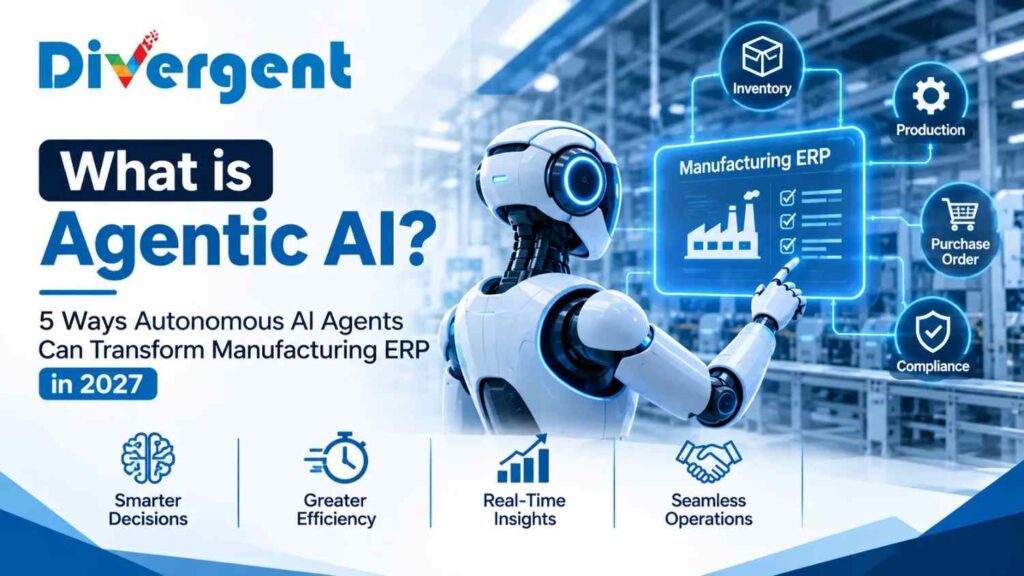
Table of Contents
- What Is Agentic AI?
- Traditional AI vs Agentic AI
- How Agentic AI Works Inside ERP Systems
- How Agentic AI Handles a Real Manufacturing Scenario
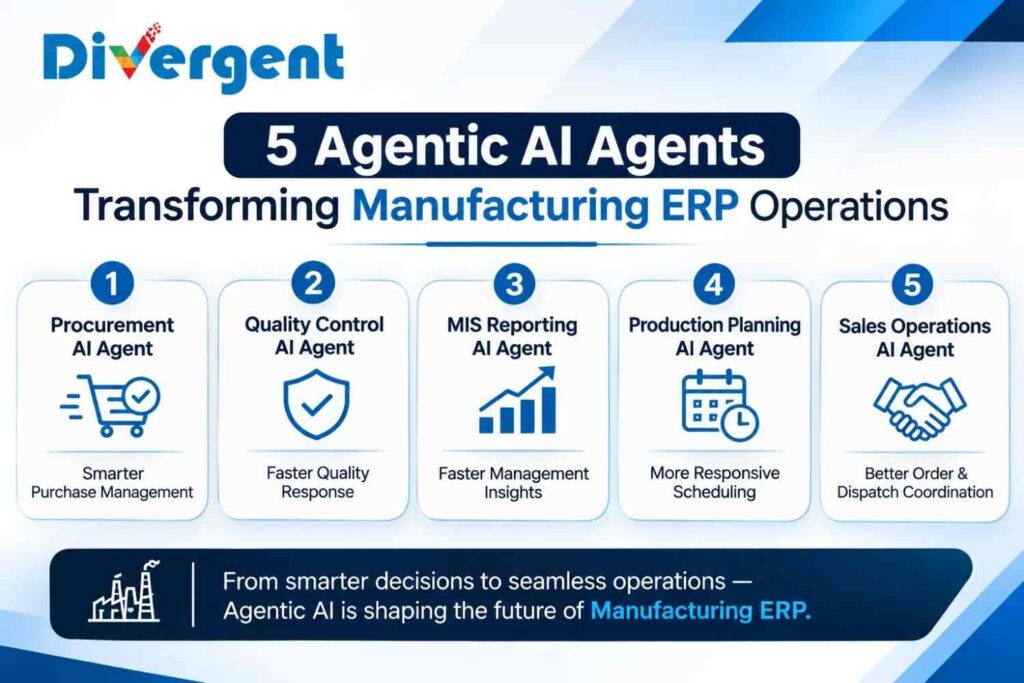
- 5 Agentic AI Agents Transforming Manufacturing ERP
- What Results Can Manufacturing Plants Measure?
- Risks and Limitations of Agentic AI
- How to Implement Agentic AI in Manufacturing ERP
- How Divergent Software Labs Approaches Agentic AI
- Frequently Asked Questions
What Is the Difference Between Agentic AI and Traditional AI?
How does agentic AI differ from traditional AI in manufacturing?
Traditional AI and agentic AI can both support manufacturing decisions, but they do not necessarily work in the same way. Traditional AI is commonly used for tasks such as prediction, classification, forecasting and recommendations. An agentic AI system can use AI models, business rules and connected tools to plan and execute multiple steps towards a defined goal.
| Capability | Traditional AI | Agentic AI |
|---|---|---|
| Main purpose | Predicts, analyses or recommends | Works towards a defined goal |
| Decision process | Produces an output for another system or person | Can plan and coordinate multiple actions |
| Procurement | Predicts a material shortage | Checks requirements and prepares a purchase order |
| Quality | Identifies a possible defect | Can initiate a quality hold workflow within approved rules |
| Production | Identifies a scheduling problem | Can evaluate alternatives and recommend schedule changes |
| Reporting | Analyses production data | Compiles reports and sends relevant alerts |
| Human involvement | Depends on the application | Depends on the agent’s permissions and risk level |
The value of agentic AI is its ability to coordinate multiple steps, use tools and respond to changing information rather than simply producing an isolated prediction. See our guide on AI in manufacturing for how traditional AI is already being used in packaging plants today.
How Agentic AI Works Inside Manufacturing ERP Systems
How does an agentic AI agent connect to and work within an ERP system?
An agentic AI system needs more than an AI model. It needs access to relevant business information, tools to interact with ERP workflows and clear rules defining what it is allowed to do. A typical agentic AI workflow inside a manufacturing ERP involves six stages.
- Data collection and monitoring: The agent accesses relevant ERP information — raw material inventory, confirmed production orders, material consumption, machine capacity, quality inspection results and supplier delivery history. The quality of this information directly affects the quality of the agent’s decisions.
- Understanding the situation: The agent checks the available information to identify a condition that needs attention — for example, that available PP granules are insufficient for the next week’s confirmed production requirements.
- Planning the next steps: The agent evaluates possible actions based on the information available — calculating the required quantity, checking approved suppliers, comparing delivery dates and identifying whether the purchase requires management approval.
- Checking business rules and permissions: Before an action is taken, the system checks whether it is permitted — is the supplier approved, is the purchase within the permitted value, does the order require approval, is the material specification correct?
- Executing approved actions: Depending on its permissions, the agent prepares ERP records, creates notifications, updates workflow statuses or executes an approved transaction. Actions with higher financial, operational or quality risks are routed to authorised employees.
- Monitoring outcomes and improving performance: The system records what the agent did, which information it used and what happened afterwards. Manufacturing teams can review these records and improve the agent’s instructions, business rules or underlying models through controlled testing.
How Agentic AI Handles a Real Manufacturing Scenario
What does agentic AI look like in a real FIBC manufacturing plant?
Consider an FIBC manufacturing plant producing different types of bulk bags for multiple customers. The plant has confirmed production orders for the coming week. However, its PP granule inventory is not sufficient to meet the planned material requirements.
- Procurement agent identifies the shortage: Checks available stock, confirmed production orders, material consumption and expected deliveries. Calculates the shortage and prepares a purchase recommendation using approved supplier information.
- Purchase approval is requested: The system checks the purchase value against the company’s approval policy. If within permitted limit, it follows the authorised workflow. If management approval is required, the agent sends the purchase request to the responsible person.
- Production planning agent reviews the schedule: Checks which orders can be produced using the available material. Evaluates machine capacity, order priority and delivery commitments before recommending a revised production sequence.
- MIS agent informs management: Prepares a summary showing material shortage, expected supplier delivery date, production orders potentially affected, proposed scheduling changes and actions awaiting approval.
- Sales operations agent identifies affected orders: Checks which customer orders may be affected by the revised schedule and prepares customer updates for authorised review — without automatically changing delivery commitments.
The business benefit: purchasing, planning, production, management and sales work with connected information. Teams can identify problems earlier, reduce repetitive follow-ups and respond to operational changes more efficiently. See our guide on inventory management challenges in manufacturing for how disconnected data creates the stockout problems agentic AI prevents.
5 Agentic AI Agents Transforming Manufacturing ERP Operations
What are the most valuable agentic AI use cases in manufacturing ERP?
1. Procurement AI Agent — Smarter Purchase Management
A procurement AI agent helps purchase teams monitor material requirements and manage routine purchasing activities. In a manufacturing ERP, it analyses inventory levels, confirmed production orders, material consumption and supplier delivery history. It can identify materials approaching reorder levels, calculate requirements from confirmed production demand, check approved suppliers, compare prices and lead times, prepare purchase orders for review and track expected deliveries.
For example, if PP granule inventory is insufficient for upcoming production, the agent calculates the shortage and prepares a purchase request. The purchase manager reviews the quantity, supplier and price before approving. See our guide on AI inventory management in manufacturing for how AI-driven procurement reduces emergency purchasing costs.
2. Quality Control AI Agent — Faster Quality Response
Quality problems in manufacturing do not always appear at the final inspection stage. A quality control AI agent monitors inspection records and compares results with defined product specifications and quality rules. It can identify unusual in-process inspection readings, flag batches requiring additional inspection, notify quality managers about specification deviations, initiate quality hold workflows within approved rules and prepare investigation records.
An authorised quality professional should review the evidence and approve the final disposition or release when required. See our guide on AI quality control in manufacturing for how AI transforms defect detection across production stages.
3. MIS Reporting AI Agent — Faster Management Insights
An MIS reporting agent gathers information from connected ERP modules and prepares reports based on defined schedules or business conditions. It covers production versus planned output, machine utilisation and downtime, raw material consumption, rejection and wastage, inventory movement, order completion and dispatch status. When loom efficiency drops, the agent highlights the affected machines, shifts and production orders — helping managers focus on exceptions rather than compiling data.
4. Production Planning AI Agent — More Responsive Scheduling
A production planning agent analyses constraints and helps planners evaluate alternative schedules. It checks material availability against production requirements, reviews machine capacity, considers labour and shift availability, identifies conflicts between production orders, evaluates order priority and delivery commitments, recommends alternative production sequences and flags schedules that may affect customer delivery dates.
If one loom becomes unavailable, the agent evaluates whether another machine has the required capacity and specification capability — the planner reviews the change before it is confirmed. See our guide on production planning challenges in manufacturing for how connected planning eliminates scheduling conflicts.
5. Sales Operations AI Agent — Better Order and Dispatch Coordination
A sales operations agent helps manage information across the order-to-dispatch workflow. It checks customer order information, reviews material availability and production capacity, identifies potential delivery risks, tracks production and order completion status, prepares customer order updates and flags orders that need sales or management attention. Any change to an agreed delivery commitment should follow the company’s approval rules.
What Results Can Manufacturing Plants Measure With Agentic AI?
How do you measure the ROI of agentic AI in manufacturing ERP?
The value of agentic AI should be measured through actual operational improvements, not simply by counting how many tasks have been automated. Manufacturers can compare performance before and after implementation using relevant KPIs. The best starting point is to establish a baseline, introduce one workflow and measure its actual performance before expanding.
| AI Agent | Potential Improvement | KPI to Measure |
|---|---|---|
| Procurement agent | Earlier response to material shortages | Emergency purchase rate |
| Quality agent | Faster identification and containment of deviations | Defect rate and quality response time |
| MIS agent | Reduced manual report preparation | MIS preparation time |
| Production planning agent | Faster identification of scheduling conflicts | Schedule adherence |
| Sales operations agent | More timely order-status communication | On-time delivery and response time |
Risks and Limitations of Agentic AI in Manufacturing
What are the risks of implementing agentic AI in manufacturing ERP?
- Incorrect or incomplete ERP data: If inventory records are inaccurate, an agent may calculate the wrong purchase quantity. Fix: improve inventory accuracy and regularly validate production records.
- Unauthorised transactions: An agent with excessive permissions could create or modify records outside its intended responsibilities. Fix: apply role-based access, transaction limits and approval workflows.
- Incorrect AI recommendations: An agent may misunderstand incomplete information or produce an unsuitable recommendation. Fix: validate recommendations and require human review for high-impact decisions.
- ERP integration failures: An API error or interrupted connection can prevent the agent from completing its workflow. Fix: use transaction validation, error logging, retry controls and recovery procedures.
- Data security: ERP systems contain commercially sensitive data. Fix: define data access policies, secure integrations and monitor system activity.
- Employee adoption: Employees may hesitate to rely on AI if they do not understand how it makes decisions. Fix: start with a limited workflow, explain the approval process and train employees.
How to Implement Agentic AI in Manufacturing ERP
What are the steps to implement agentic AI in a manufacturing plant?
- Prepare and validate ERP data: Check the quality of inventory, production, purchase, quality and sales records. Correct incomplete information, duplicate entries, and inconsistent master data before allowing agents to make operational recommendations.
- Identify the right workflow: Choose a process where repetitive manual work or delayed responses create a clear operational problem. Start with MIS report preparation or routine inventory monitoring rather than immediately giving an agent authority over major purchase approvals.
- Define the agent’s responsibilities: Clearly specify what information the agent can access, which tasks it can perform, which transactions it can prepare, which actions require approval, when it must escalate, and what it must record in the audit trail.
- Integrate with the existing ERP: Connect the agent to the required ERP data and workflows through supported APIs. The integration should respect existing permissions, transaction rules, and data security requirements.
- Test in observation mode: Before enabling autonomous actions, run the agent in a testing environment. Compare its recommendations with decisions made by experienced employees. Check for incorrect recommendations, missing information and exceptions.
- Activate gradually and monitor performance: Start with low-risk, clearly defined tasks. Monitor recommendation accuracy, failed transactions, approval exceptions, employee overrides, and business KPIs. Expand the agent’s authority only when its performance has been validated.
See our guide on ERP implementation in manufacturing for the step-by-step approach that packaging plants use when going live with new systems without disrupting production.
How Divergent Software Labs Approaches Agentic AI for ERP Operations
Divergent Software Labs builds agentic AI for manufacturing ERP operations — autonomous AI agents that connect to existing ERP data, execute operational workflows, and deliver measurable improvements without replacing the ERP systems plants already use.
Our approach to agentic AI for manufacturing is built around five areas:
- ERP integration: Agents need controlled access to relevant ERP information and workflows. Integration requirements depend on the existing ERP system, available APIs, and the processes involved.
- Manufacturing-specific workflows: Manufacturing operations involve GSM-based costing, PP granule consumption, loom efficiency, production specifications, quality parameters and FIBC safety factors. These business rules need to be configured correctly before an AI agent can make useful operational decisions.
- Controlled autonomy: Not every action should be automated. Agents operate within defined permissions, transaction limits, and approval requirements.
- Action tracking and audit trails: Every important agent action is traceable — including the information used, the action attempted, its approval status, and the resulting ERP update.
- Human escalation: When information is incomplete, a decision exceeds the agent’s authority or an unusual situation occurs, the workflow is routed to the responsible employee.
Contact Divergent Software Labs to discuss manufacturing ERP workflows, AI integration requirements and potential automation opportunities for your plant.
Frequently Asked Questions About Agentic AI
What is agentic AI in simple terms?
Agentic AI is an approach where AI agents can work towards a defined goal by analysing information, planning steps and using connected tools to complete tasks. Unlike a basic chatbot, an agent can interact with business systems and perform permitted actions.
What is the difference between agentic AI and traditional AI?
Traditional AI commonly predicts, analyses, classifies or recommends. Agentic AI can use those capabilities to plan and coordinate multiple actions towards a goal. Both can be connected to automated workflows, but agentic systems are designed for more flexible, multi-step execution.
How does agentic AI work in manufacturing ERP?
Agentic AI connects to relevant ERP information and workflows through controlled integrations. It analyses operational data, identifies a condition requiring attention, plans possible actions and executes permitted tasks. Actions outside its authority are sent for human approval.
What is an MIS reporting AI agent?
An MIS reporting AI agent gathers information from connected ERP modules and prepares management reports. It highlights changes in production, inventory, downtime, wastage and order performance, helping managers focus on important exceptions.
How is agentic AI different from RPA?
RPA generally automates repetitive tasks using predefined rules and workflows. Agentic AI can use AI models to interpret context, plan multiple steps and select tools to achieve a goal. Both technologies can work together in a manufacturing automation system.
Can agentic AI work with an existing ERP system?
It may be possible when the ERP provides suitable APIs, integration options, and access permissions. Compatibility depends on the ERP architecture, data quality, security requirements and the workflows that need to be automated.
Is agentic AI safe for manufacturing operations?
It can be used more safely when implemented with restricted permissions, approval limits, audit trails, monitoring and human escalation. High-impact actions such as major purchase approvals and critical quality releases should follow the plant’s authorised procedures.
What are the limitations of agentic AI?
Agentic AI depends on reliable data, suitable system integrations and clearly defined business rules. It can make incorrect recommendations, encounter API failures or struggle with unusual situations. Continuous monitoring and human oversight are therefore important.
Conclusion: Moving Towards More Connected Manufacturing Operations
Manufacturing operations depend on hundreds of connected decisions across purchasing, inventory, production, quality, sales and dispatch. When these activities rely heavily on manual follow-ups and disconnected information, even a small problem can affect multiple departments.
Agentic AI offers a way to coordinate some of these activities by connecting AI agents with ERP data, business rules and operational workflows. From preparing purchase orders to identifying quality deviations and reviewing production schedules, agents can help teams reduce repetitive work and respond to changing conditions more effectively.
However, successful implementation depends on reliable ERP data, suitable integrations, controlled permissions and human oversight. The opportunity is not simply to automate more tasks — it is to build better-connected operations where people and AI agents work together, with clear responsibilities and measurable results.
Related Reading
- AI in Manufacturing: Complete Guide
- AI Inventory Management in Manufacturing
- AI Quality Control in Manufacturing
- AI Demand Forecasting in Manufacturing
- Predictive Maintenance in Manufacturing
- ERP Implementation in Manufacturing
Follow Divergent Softlab on Google
Enjoying our insights on manufacturing ERP, artificial intelligence and business technology? Add Divergent Softlab as a preferred source on Google to discover more of our latest articles.