How to reduce production cost in manufacturing?
How to reduce production cost in manufacturing is one of the most searched questions by packaging plant owners and operations heads in India. The answer to how to reduce production cost in manufacturing is almost always the same: the biggest production cost reductions come not from renegotiating supplier prices or pushing operators harder, but from eliminating the hidden operational waste that most plants cannot even measure because they do not have the systems to see it.
A mid-size packaging plant — 30 to 100 looms, Rs 3 to Rs 15 crore monthly revenue — typically loses Rs 40 to Rs 120 lakhs per year to production costs that are entirely avoidable. Not because of bad management. Because the plant is running on spreadsheets and verbal updates that make these losses invisible until they show up as a bad month-end P&L that nobody can fully explain.
According to McKinsey’s Industry 4.0 research, manufacturers that implement connected digital systems and AI report operational cost reductions of 15 to 20 percent. For a packaging plant spending Rs 5 crore per month on operations, a 15 percent reduction translates to Rs 75 lakhs saved annually — not from cutting corners but from eliminating the hidden waste that most plants cannot currently measure.
This guide covers 9 proven ways ERP software and AI reduce production costs in packaging and FIBC manufacturing plants — with real numbers, root causes, and exactly how each solution works.
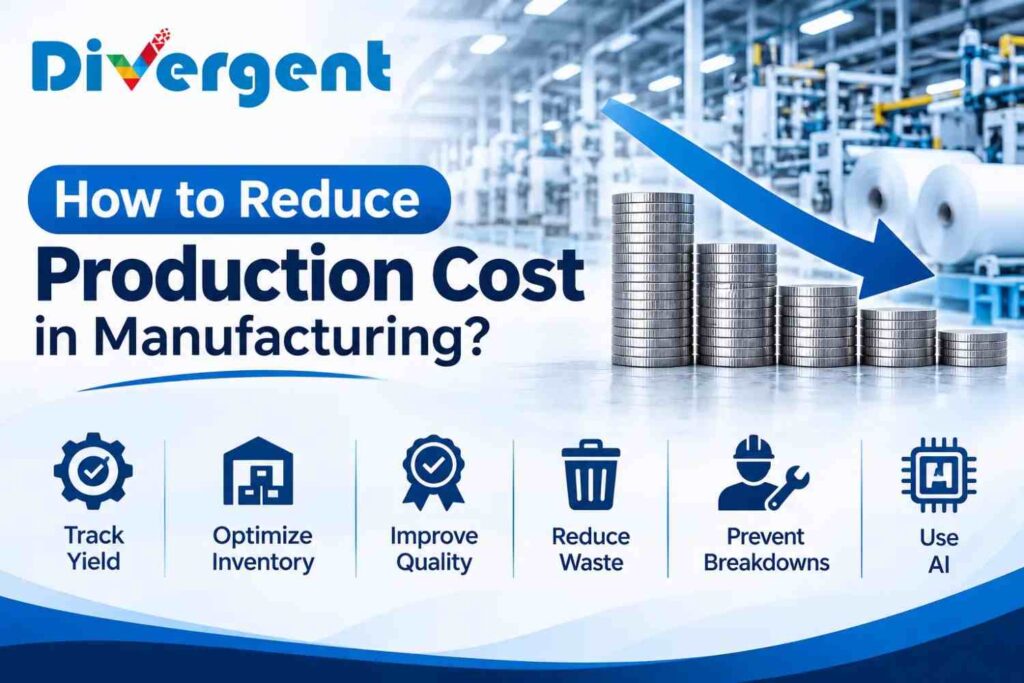
Table of Contents
- Where Production Costs Hide in Packaging Plants
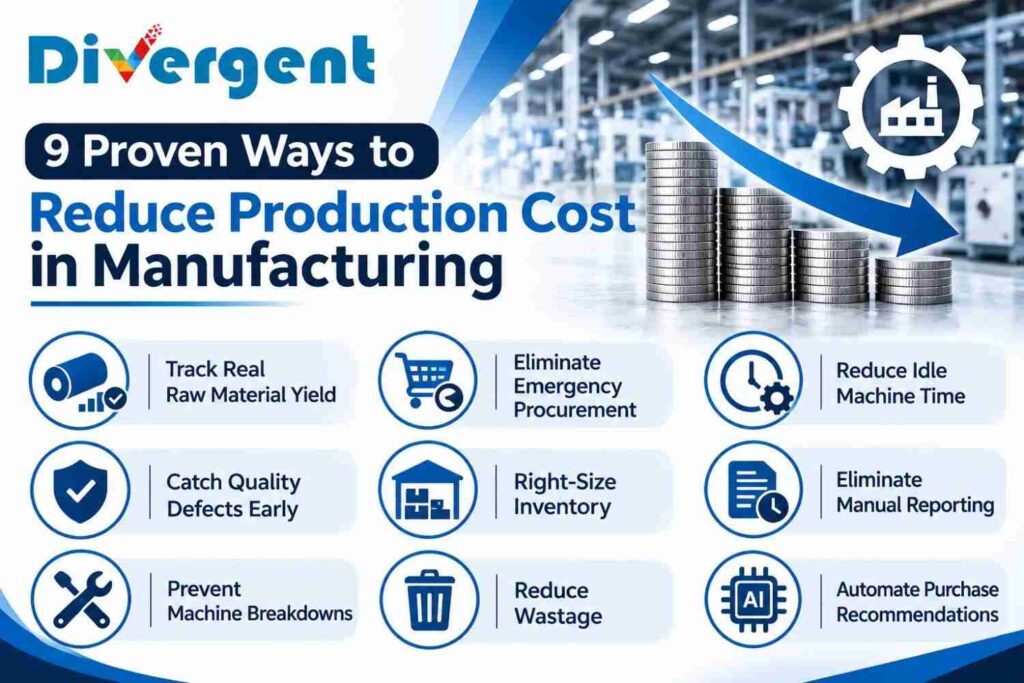
- 9 Proven Ways to Reduce Production Cost in Manufacturing
- How ERP Software Reduces Production Costs
- How AI Reduces Production Costs Further
- What ROI Do Packaging Plants Get?
- Divergent PackPro: ERP and AI for Cost Reduction
- Frequently Asked Questions
Where Production Costs Hide — The Root Cause of High Manufacturing Costs
What are the hidden production costs in packaging manufacturing?
The hidden production costs in packaging manufacturing are raw material waste from untracked yield losses, emergency procurement premiums from unexpected stockouts, idle machine time from poor production planning, quality rework and customer returns from defects caught too late, and management time wasted on manual reporting that could be generated automatically. None of these appear as a single line in the P&L — they are distributed across material cost, labour cost and overhead in ways that make them invisible without the right systems.
| Hidden Cost | Typical Annual Loss | Root Cause |
|---|---|---|
| Raw material yield gap | Rs 5-15 lakhs | Actual yield not measured per shift |
| Emergency procurement premium | Rs 3-10 lakhs | Stockouts not predicted in advance |
| Idle machine time | Rs 4-10 lakhs | Production plan not connected to material availability |
| Quality rework and returns | Rs 2-8 lakhs | Defects caught at dispatch not at production |
| Excess inventory holding cost | Rs 4-12 lakhs | Purchasing not driven by actual demand |
| Manual reporting cost | Rs 1-4 lakhs | MIS compiled manually from multiple sources |
| Total | Rs 19-59 lakhs | Disconnected data across departments |
The root cause of every item in this table is the same: departments operating on disconnected data. When stores does not know what production needs, when purchasing does not know what stores holds, when quality results stay on paper — every department makes decisions based on incomplete information, and the gap between what they think is happening and what is actually happening costs money every shift.
9 Powerful Ways to Reduce Production Cost in Manufacturing With ERP and AI
What are the most effective ways to reduce production costs in a packaging plant?
The 9 most effective ways to reduce production costs in manufacturing packaging plants are listed below. Each way to reduce production costs in manufacturing is supported by real data from packaging plant operations and delivers measurable results within months. How to reduce production cost in manufacturing starts with tracking real raw material yield, eliminating emergency procurement, reducing idle machine time through connected production planning, catching quality defects at the production stage, right-sizing inventory to actual demand, eliminating manual reporting, reducing machine breakdowns through predictive maintenance, optimising energy consumption, and automating purchase recommendations with AI. Each of these delivers measurable cost reduction within months of implementation.
1. Track Real Raw Material Yield — Not BOM Standards
How does yield tracking reduce production cost?
Raw material is 60 to 75 percent of production cost in a packaging plant. A 2 to 3 percent gap between the BOM yield assumption and actual yield — completely normal and almost universal in plants without real-time tracking — translates directly into material cost overrun that the plant has been absorbing without knowing it.
A plant consuming 400 tonnes of PP granules per month at Rs 90 per kg with a 2 percent yield gap is spending Rs 7.2 lakhs per month — Rs 86 lakhs per year — on granules that become waste rather than product. ERP records actual granule input and tape output per shift per extrusion line, calculates real yield and flags the variance against the BOM standard immediately — before the month-end reconciliation that currently reveals the gap too late to act on it.
2. Eliminate Emergency Procurement Premiums
How does ERP reduce emergency procurement costs?
Emergency procurement — buying material urgently at a 10 to 15 percent premium because a stockout was not predicted in advance — is one of the most common and most avoidable production costs in packaging manufacturing. It happens not because purchase managers are careless but because Tally and spreadsheets update inventory from invoice dates rather than from actual consumption at the production stage. By the time Tally shows a low balance, the shortage has already arrived.
ERP is connected to actual production consumption and updates stock balance in real time — every material issue is recorded at the point it happens, not at the end of the shift or the end of the day. AI inventory management then calculates when each material will reach its reorder point from actual consumption rates and actual supplier lead times, generating a purchase recommendation 3 to 4 weeks before the shortage would occur. See our guide on AI inventory management in manufacturing for how AI eliminates emergency procurement.
3. Reduce Idle Machine Time With Connected Production Planning
How does production planning reduce idle machine costs?
Idle machine time — looms stopped because fabric has not arrived from weaving, stitching machines stopped because cut panels are not ready, extrusion lines stopped because granules have run out — is one of the least visible and most expensive production costs in a packaging plant. The machine is paid for. The operators are paid for. The overhead is running. No output is being produced.
ERP production planning connects the production schedule to material availability at every stage — when extrusion output falls behind, the system flags the downstream impact on weaving immediately. The production head can reallocate capacity before the stoppage occurs. See our guide on production planning challenges for how connected planning eliminates idle machine time.
4. Catch Quality Defects at the Production Stage — Not at Dispatch
How does quality management reduce production costs?
A quality defect caught at the production stage costs only the material and time consumed up to that point. The same defect caught at dispatch — or worse, at the customer — costs the entire production value plus the cost of the return, the replacement production and the relationship damage. The difference between catching a defect at weaving versus at final inspection is typically 4 to 6 stages of additional processing cost added to already-defective material.
ERP quality management records inspection results at each production stage and enforces holds that prevent non-conforming material from moving to the next stage automatically — without anyone needing to remember to check or communicate the hold. AI computer vision inspection at each stage catches defects that human inspection misses at scale. See our guide on AI quality control in manufacturing for how computer vision reduces quality costs.
5. Right-Size Inventory to Actual Demand
How does inventory optimisation reduce production costs?
Excess inventory is a production cost that most packaging plants underestimate. Holding excess stock costs 20 to 30 percent of its value per year — storage, insurance, handling, damage and the cost of working capital tied up in material that is not being consumed. A plant carrying Rs 50 lakhs of excess raw material inventory is paying Rs 10 to Rs 15 lakhs per year to hold material it should not have bought.
AI inventory management calculates purchase quantities from confirmed production orders and actual consumption rates — not from estimates, habits or last order quantities. When demand is lower than expected, the AI reduces the purchase recommendation. When a material slows down, it flags it as excess before it becomes dead stock. See our guide on inventory management challenges for how right-sizing inventory frees working capital.
6. Eliminate Manual Reporting Time
How does ERP reduce management reporting costs?
In most packaging plants, the weekly MIS report takes 2 to 3 days to compile. Someone manually pulls production data from the supervisor’s register, inventory data from Tally, quality data from the QC file and dispatch data from the logistics record — then assembles it in Excel. By the time the report reaches management, it is already 3 days old and the decisions it should inform have already been made on guesswork.
ERP generates this report in real time from live transaction data — updated every time any department records a transaction. The management team opens a dashboard and sees the current state of production, inventory, quality and dispatch without anyone compiling a file. The 2 to 3 days per week that was spent on reporting is redirected to the work that actually improves the plant.
7. Prevent Machine Breakdowns With Predictive Maintenance
How does predictive maintenance reduce production costs?
An unplanned machine breakdown in a packaging plant costs significantly more than a planned maintenance window. The unplanned stoppage disrupts production schedules, delays customer deliveries, creates idle time for all dependent stages and often requires urgent spare part procurement at a premium cost. A planned maintenance window — scheduled during a low-production period with parts already in stock — costs a fraction of the same repair done as an emergency.
AI predictive maintenance analyses machine efficiency data — loom output per shift, motor temperature, vibration signatures — and identifies the patterns that precede mechanical failure 2 to 4 weeks before breakdown. The maintenance team replaces the bearing during a planned window. The unplanned stoppage never happens. See our guide on predictive maintenance in manufacturing for how AI prevents breakdowns before they occur.
8. Reduce Wastage With Real-Time Consumption Tracking
How does real-time consumption tracking reduce wastage costs?
Manufacturing waste — extrusion trim, weaving edge waste, printing setup waste, cutting offcuts, stitching thread waste — is a production cost that most packaging plants track only at month-end, when it is too late to act on the information. By the time the month-end reconciliation reveals a wastage rate 1.5 percent above standard, 30 days of excess waste have already left the plant.
ERP tracks actual material consumption against BOM standard per shift per production stage — flagging wastage variances in real time so the production team can investigate and correct the cause the same shift rather than the same month. See our guide on manufacturing waste and ERP for how real-time wastage tracking reduces material cost.
9. Automate Purchase Recommendations With AI
How does AI reduce purchasing costs in manufacturing?
Manual purchasing decisions — based on experience, habit, or a weekly stock check — consistently result in both over-buying and under-buying simultaneously. Some materials accumulate excess stock that ties up working capital. Others run short unexpectedly and require emergency procurement at a premium price. The same purchase team, in the same week, may be sitting on 90 days of one material while scrambling to find another.
AI purchase recommendations calculate the right quantity and timing for every material from confirmed production orders and actual consumption rates — updated every day from live transaction data. The purchasing team reviews and approves recommendations rather than calculating them. See our guide on AI demand forecasting in manufacturing for how AI optimises purchasing decisions.
How ERP Software Helps Reduce Production Cost in Manufacturing Plants
What does ERP software do to reduce production costs?
ERP software reduces production costs by making every cost driver visible in real time — yield per extrusion line per shift, idle time per machine, quality rejection rate per stage, inventory days of cover per material and emergency procurement frequency. When these numbers are visible, they can be managed. When they are invisible — buried in registers, spreadsheets and verbal reports — they cannot be managed, only absorbed.
| Cost Driver | Without ERP | With ERP | Saving |
|---|---|---|---|
| Raw material yield | Monthly variance — too late | Per shift per line — correctable | Rs 5-15 lakhs/yr |
| Emergency procurement | Reactive — after stoppage | Predicted 3-4 weeks ahead | Rs 5-15 lakhs/yr |
| Idle machine time | Visible only after the fact | Flagged before it occurs | Rs 4-10 lakhs/yr |
| Quality rework | Caught at dispatch | Caught at stage of occurrence | Rs 3-8 lakhs/yr |
| Excess inventory | Discovered at stock count | Flagged continuously | Rs 5-15 lakhs/yr |
| Reporting time | 2-3 days per week | Real-time dashboard | Rs 2-5 lakhs/yr |
How AI Reduces Production Costs Further
How does AI reduce production costs beyond ERP?
AI reduces production costs beyond ERP by adding predictive capability to real-time visibility. ERP shows what is happening now. AI shows what will happen next — which materials will run short before the production line notices, which machines are showing efficiency patterns that precede breakdowns, and which production runs are likely to generate quality failures based on current process parameters.
- AI yield optimisation: Analyses the relationship between extrusion temperature profiles, line speed, granule batch properties and actual yield to identify parameter combinations that consistently deliver the highest yield. Over time, the AI recommends the optimal settings for each granule grade — reducing yield loss without any manual analysis.
- AI loom efficiency analysis: Identifies which looms consistently underperform on which specifications, which operators achieve better efficiency on which machine types and which efficiency drops precede mechanical problems — from shift-level data the ERP has been collecting.
- AI demand forecasting: Predicts seasonal demand patterns for each product type — rice packaging peaks before harvest, sugar peaks before festivals — and adjusts purchase recommendations to build stock before the peak rather than scrambling during it.
- AI quality inspection: Computer vision cameras at each production stage inspect every bag at full line speed — catching defects that human inspection misses, containing the problem at the stage of occurrence rather than at dispatch or the customer.
What ROI Do Plants Get When They Reduce Production Cost in Manufacturing?
What is the ROI of ERP and AI for reducing production costs?
The ROI of ERP and AI for reducing production costs in packaging plants is typically 15 to 20 percent reduction in total operational costs within two years of implementation — consistent with McKinsey’s findings on connected manufacturing systems. For a plant spending Rs 5 crore per month on operations, a conservative 15 percent reduction delivers Rs 75 lakhs in annual savings — from eliminating the hidden waste that the plant has been absorbing without measuring.
| Cost Reduction Area | Typical Annual Saving | For Rs 5Cr/Month Plant |
|---|---|---|
| Raw material yield improvement | 1-2% of material cost | Rs 5-10 lakhs |
| Emergency procurement reduction | 50-70% reduction | Rs 3-8 lakhs |
| Idle machine time reduction | 20-40% reduction | Rs 3-6 lakhs |
| Quality rework and returns | 30-50% reduction | Rs 2-5 lakhs |
| Inventory carrying cost | 15-25% reduction | Rs 3-8 lakhs |
| Reporting and admin time | 50-70% reduction | Rs 1-3 lakhs |
| Breakdown prevention | 30-50% reduction | Rs 2-4 lakhs |
| Total annual saving | Rs 19-44 lakhs |
A purpose-built ERP for a mid-size packaging plant costs Rs 8 to Rs 25 lakhs in Year 1 including implementation and training. The savings delivered typically exceed this cost within 8 to 14 months — after which the plant continues to benefit from lower operational costs every year.
The question packaging plant owners ask most often is not whether to reduce production cost in manufacturing — every owner wants to reduce production cost in manufacturing. The question is where to start. The answer is always the same: start with visibility. You cannot reduce production cost in manufacturing that you cannot measure. ERP gives you the measurement. AI gives you the prediction. Together they give you the control over production costs that spreadsheets and Tally alone can never provide.
Divergent PackPro: Built to Reduce Production Cost in Manufacturing Plants
Divergent PackPro is a manufacturing ERP built specifically for FIBC, BOPP, PP woven bag and packaging plants — designed to make every production cost driver visible and actionable in real time, and to use AI to predict and prevent the costs that ERP visibility alone cannot eliminate. PackPro is how to reduce production cost in manufacturing without hiring more people or cutting corners — by giving every department the live data they need to make better decisions every shift.
- Real-time yield tracking: Actual granule consumption and tape output recorded per shift per extrusion line. Yield variance against BOM flagged immediately — not at month end.
- AI inventory management: Purchase recommendations from confirmed production orders and actual consumption rates. Stockouts predicted 3 to 4 weeks ahead. Emergency procurement eliminated.
- Connected production planning: Production schedule connected to material availability at every stage. Idle machine time flagged before it occurs.
- Stage-wise quality enforcement: Quality holds enforced automatically at each production stage. Non-conforming material cannot move forward without clearance.
- AI loom efficiency analysis: Underperforming looms and operators identified automatically from shift data. Efficiency gaps visible without manual analysis.
- AI predictive maintenance: Machine failure predicted 2 to 4 weeks before breakdown from efficiency trend data. Unplanned stoppages converted to planned maintenance windows.
- Live cost dashboard: Yield variance, idle time, rejection rate, inventory days of cover — all on one screen, updated in real time. No weekly MIS compilation required.
See how Divergent PackPro reduces production costs or speak to our team for a cost analysis using your own plant data — loom count, monthly PP consumption and current yield rates.
Frequently Asked Questions — How to Reduce Production Cost in Manufacturing
How to reduce production cost in manufacturing?
The most effective ways to reduce production cost in manufacturing are tracking real raw material yield per shift, eliminating emergency procurement with AI inventory management, reducing idle machine time through connected production planning, catching quality defects at the production stage and right-sizing inventory to actual demand. Together these typically save Rs 30-60 lakhs per year for a mid-size packaging plant.
What are the biggest hidden production costs in packaging plants?
The biggest hidden production costs in packaging plants are raw material yield gaps (Rs 10-30 lakhs/year), emergency procurement premiums (Rs 5-15 lakhs), idle machine time from poor planning (Rs 8-20 lakhs), quality rework and customer returns (Rs 5-15 lakhs) and excess inventory holding costs (Rs 8-25 lakhs). Most plants cannot see these costs because they lack real-time production data.
How does ERP reduce production costs?
ERP reduces production costs by making every cost driver visible in real time — yield per shift, idle machine time, quality rejection rate, inventory days of cover and emergency procurement frequency. When these numbers are visible, they can be managed. When invisible in spreadsheets and registers, they can only be absorbed.
How does AI reduce manufacturing production costs?
AI reduces manufacturing production costs by predicting material shortages 3 to 4 weeks before they occur, identifying loom efficiency patterns that precede breakdowns, forecasting seasonal demand to prevent both stockouts and excess inventory, and catching quality defects at production speed using computer vision. AI adds predictive capability to the real-time visibility that ERP provides.
What is the ROI of ERP for cost reduction in packaging plants?
The ROI of ERP for cost reduction in packaging plants is typically 15 to 25 percent reduction in operational costs within two years. For a plant spending Rs 5 crore per month, that is Rs 75 lakhs to Rs 1.5 crore in annual savings. ERP for a mid-size plant costs Rs 8 to Rs 25 lakhs in Year 1 — the savings typically exceed this within 8 to 14 months.
How much does a yield gap cost a packaging plant?
A 2 percent yield gap on 400 tonnes of PP at Rs 90 per kg costs Rs 7.2 lakhs per month — Rs 86 lakhs per year. Most packaging plants without real-time yield tracking run yield gaps of 1.5 to 3 percent that remain invisible until month-end reconciliation reveals a material variance that nobody can explain.
How can I reduce raw material waste in manufacturing?
Raw material waste in manufacturing is reduced by recording actual consumption against BOM standard per shift per production stage, flagging variances immediately rather than at month end, using AI to identify optimal process parameters that minimise waste and tracking wastage by machine, operator and shift to identify the specific sources.
How does predictive maintenance reduce production costs?
Predictive maintenance reduces production costs by converting unplanned machine breakdowns into planned maintenance windows. An unplanned breakdown disrupts production schedules, delays deliveries and requires urgent spare parts at premium cost. AI detects failure signatures 2 to 4 weeks before breakdown — the maintenance team acts during a planned window at a fraction of the emergency repair cost.
How does quality management reduce production costs?
Quality management reduces production costs by catching defects at the production stage rather than at dispatch or the customer. A defect caught at weaving costs only the material consumed up to that point. The same defect caught at dispatch costs the entire production value plus return, replacement and relationship cost — typically 5 to 8 times more expensive.
How to reduce inventory cost in manufacturing?
Inventory cost in manufacturing is reduced by calculating purchase quantities from confirmed production orders and actual consumption rates rather than from estimates or habits, flagging slow-moving materials before they become dead stock and setting safety stock levels from actual demand variability rather than fixed estimates. AI inventory management does all of this automatically from live transaction data.
Related Reading
- AI Inventory Management in Manufacturing
- Predictive Maintenance in Manufacturing
- AI Quality Control in Manufacturing
- 12 Critical Manufacturing Challenges
- ERP vs Excel in Manufacturing
Follow Divergent Softlab on Google
Enjoying our insights on manufacturing ERP, artificial intelligence and business technology? Add Divergent Softlab as a preferred source on Google to discover more of our latest articles.